

A denied claim is rarely a final answer; in most small practices, it is simply an unworked one, and unworked denials quietly become write-offs. So what is denial management in medical billing? It is the structured process of logging, sorting, correcting, appealing, and analyzing denied claims so that revenue is recovered and repeat denials stop, and it is a core part of effective Revenue Cycle Management Services. This guide covers the five costly gaps behind preventable denials, a six-step workflow, how to sort, appeal, and prevent denials, and the metrics that show whether your process works. Each section is written for lean billing teams that share duties with the front desk.
Why Denial Management in Medical Billing Matters to Small Practices
Here is how claim denials affect cash flow: each denied claim delays or removes payment and adds rework, and one unworked backlog can strain the monthly cash flow of a lean practice.
Lean teams are exposed for three reasons. Billing is shared with front-desk duties, no one owns denials, and few teams can see denial patterns. Without visibility, the same denied claims return month after month.
The stakes are also time-bound. Filing and appeal deadlines can turn a fixable denial into a permanent write-off. CMS’s Medicare Claims Processing Manual guidance on timely filing states that Medicare fee-for-service claims must be filed within 12 months of the date of service, while other payers set their own limits.
Your revenue cycle management (RCM) process should track every deadline your payers set. If you use a billing vendor, review medical billing pricing models and confirm who reworks denied claims and how that work is priced.
The 5 Costly Gaps Behind Preventable Claim Denials
Why do medical claims get denied? Many denials trace back to a preventable workflow gap rather than a coverage exclusion, and each gap has a matching control.
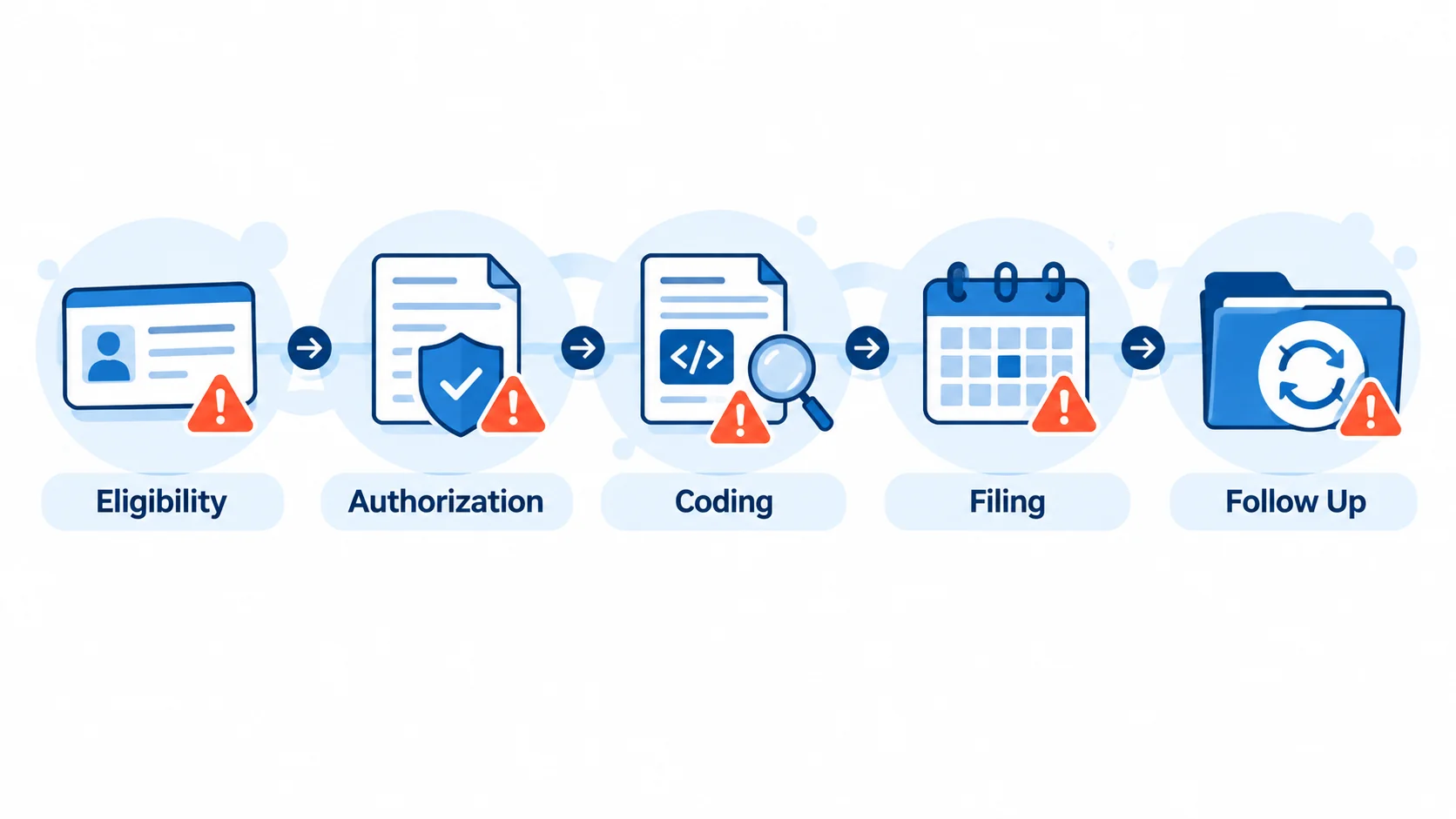
Eligibility and enrollment errors. Coverage is inactive, demographics do not match, or the provider is not enrolled. Incomplete provider credentialing or payer enrollment can deny otherwise clean claims, so review Credentialing Services. Control: eligibility verification at scheduling and again before the visit.
Missing or invalid prior authorization. Services are delivered before approval is confirmed, or the authorization does not match the billed service. Control: hold scheduling until the prior authorization (PA) number is on file.
Coding and documentation mismatches. Codes, modifiers, or diagnoses do not match the chart, or the chart does not support medical necessity. Control: coder review before submission against the American Medical Association’s overview of the CPT code set, which the AMA develops and maintains.
Late submission and missed deadlines. Claims and corrections miss payer filing limits, or claim rejections from the clearinghouse go unread. Control: a daily clearinghouse rejection report reviewed by a named person and a fixed internal submission standard.
Unworked denials and no follow-up. Denials sit in a shared inbox until they are written off. Control: one named denial owner and a weekly denial worklist that lists every open item by payer and deadline.
Denial Management in Medical Billing: A Step-by-Step Workflow
Denial management in medical billing is the structured process of capturing, sorting, correcting, appealing, and analyzing denied claims to recover revenue and prevent repeat denials. A small practice can run it in six steps: capture, classify, prioritize, correct or appeal, track, and prevent.
The following denial management process step by step keeps every denied claim moving toward payment or a documented decision.
- Capture. Post the electronic remittance advice (ERA) or explanation of benefits (EOB) the day it arrives and log each denial with claim, payer, codes, and date, per CMS’s official remittance advice resource.
- Classify. Label each denial as a soft denial or a hard denial, then sort it by cause and payer so that patterns become visible before rework begins.
- Prioritize. Rank open denials by dollar value and deadline, and work the denials closest to a filing or appeal limit first so that time-sensitive revenue is not lost.
- Correct or appeal. Send a corrected claim for data errors, and build a fully documented appeal for authorization and clinical disputes before the payer’s deadline expires.
- Track. Keep a dated log of every submission and follow up at the payer’s stated turnaround, recording each response, so that no denial stalls in a queue.
- Prevent. Feed each root cause back to the front desk, coders, and schedulers, and review denial patterns monthly so that the same error does not return.
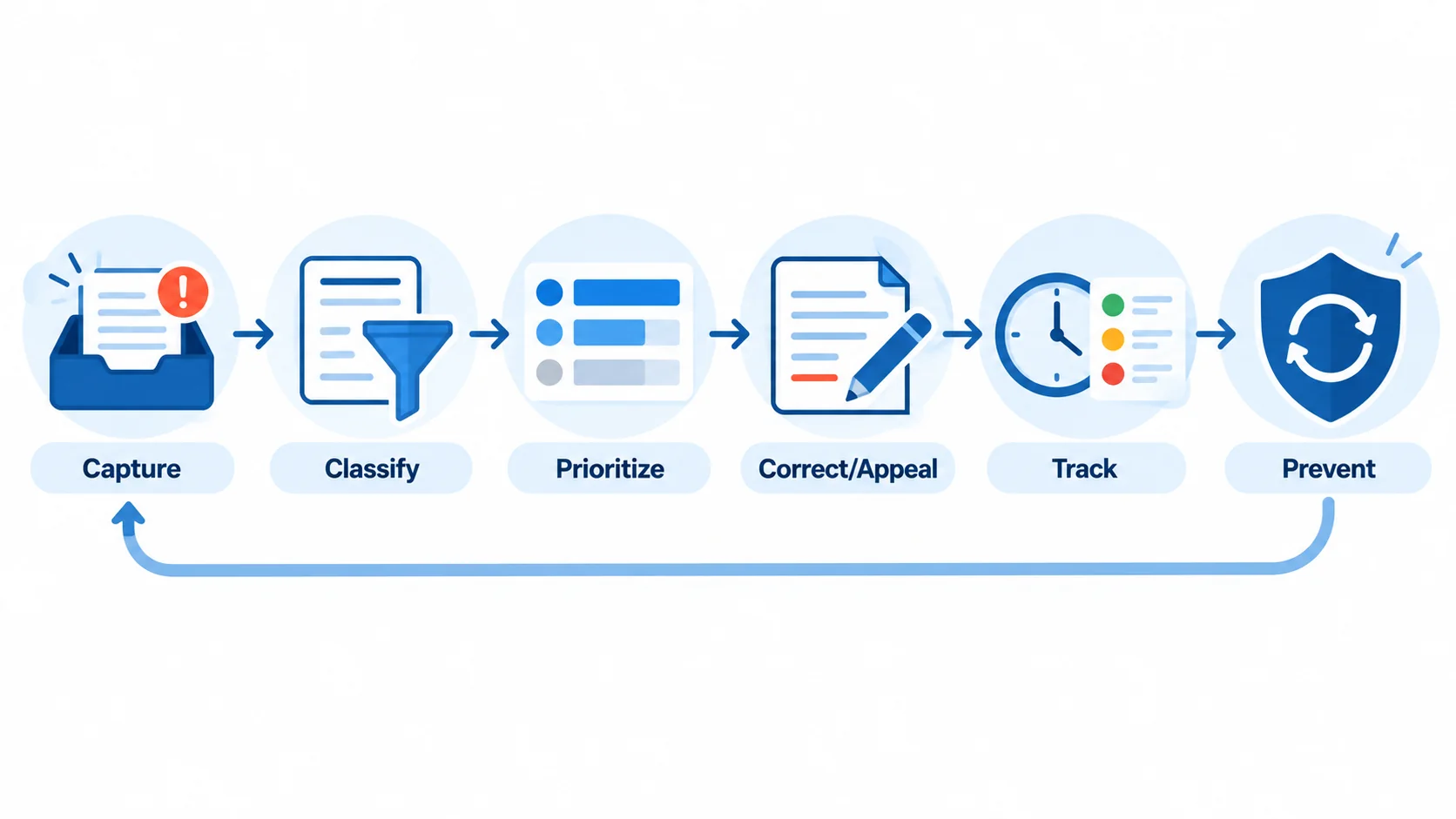
In a lean practice, one trained owner can run all six steps. Practices weighing in-house staffing against outside help can review the mental health billing cost comparison for specialty detail.
How to Sort Denials by Type, Cause, and Priority
Sort every denial first by the soft denial vs hard denial test, then by cause and payer. A soft denial is fixable through correction or added information, while a hard denial is a final decision that requires an appeal or a write-off. These are common industry terms, not formal standards.
A claim rejection stops a claim before adjudication, usually at the clearinghouse, and is typically corrected and resubmitted; a denial is an adjudicated decision reported on the remittance advice.
The claim adjustment group code (CO, PR, OA, or PI) shows who is financially responsible, the claim adjustment reason code (CARC) states why the payer adjusted the claim, and the remittance advice remark code (RARC) adds detail. X12 maintains these code sets, and X12’s official list of Claim Adjustment Reason Codes is the reference to use.
This table maps six common categories to example CARCs and a first action; the examples are illustrative, so always read the full CARC and RARC pair on the remittance advice.
| Denial Category | Example CARCs | First Action |
|---|---|---|
| Eligibility and enrollment | CARC 27 (coverage ended before service); CARC 31 (patient not identified as insured) | Re-verify coverage, correct demographics or payer, then resubmit. |
| Authorization and referral | CARC 197 (authorization absent); CARC 198 (authorization exceeded) | Confirm authorization status, request retroactive review if the payer allows it, and appeal with documentation. |
| Coding and edits | CARC 4 (code inconsistent with modifier); CARC 236 (procedures incompatible under National Correct Coding Initiative (NCCI) or state rules) | Coder review, then a corrected claim. |
| Medical necessity | CARC 50 (payer judges service not medically necessary) | Pull chart notes and payer policy, then appeal with a clinical rationale. |
| Missing information or duplicate | CARC 16 (claim lacks information or has a billing error); CARC 18 (exact duplicate claim) | Supply the missing data, or confirm the original claim’s status first. |
| Timely filing | CARC 29 (filing time limit expired) | Locate proof of timely submission, and appeal only with documented evidence. |
Route each denial by cause: data errors go to a corrected claim the same day, clinical and authorization disputes go to an appeal packet, and timely filing denials are treated as a prevention problem because recovery is uncommon.
Code descriptions verified: September 2026.
How to Appeal a Denied Claim Step by Step
Here is how to appeal a denied insurance claim: confirm the denial reason, decide whether a correction or an appeal is the right remedy, and file a documented request within the payer’s window, although no outcome is guaranteed.

Begin by reviewing the EOB and ERA to confirm the denial reason and codes. Next, decide whether the issue is a correctable data error or a disagreement over medical necessity or authorization, and verify that the claim was filed on time. Before you appeal a denied claim, confirm that an appeal is warranted, because not every denial merits one.
Then assemble the appeal packet. It should include a copy of the claim, the ERA or EOB, chart notes that document the clinical need for the service, proof of authorization where relevant, and the payer policy language that supports coverage. Add a concise appeal letter that cites the denial reason and codes.
Deadlines and levels vary by payer. For Original Medicare, CMS’s official page on the first level of appeal explains that a first-level redetermination is requested in writing from the Medicare Administrative Contractor (MAC) within 120 days of receiving the initial determination, and CMS describes five levels of appeal. Commercial plans set their own windows, forms, and internal and external review steps, so always confirm the current payer manual. Appeals never carry a guarantee, so reserve them for denials where your documentation supports payment.
How to Prevent Denials Before They Hit Cash Flow
Here is how to prevent claim denials: fix the cause where it enters the claim rather than at the appeal stage, and assign each gap a control and an owner.
Front-end controls. Complete eligibility verification at scheduling, recheck coverage before the visit, track each prior authorization against the scheduled service, and confirm provider enrollment before the first appointment. Review the credentialing cost early, so that enrollment is planned and never rushed after patients are already scheduled.
Claim-build controls. Require a coder review of high-risk services, and use a claim scrubber that applies NCCI edits, described on CMS’s National Correct Coding Initiative program page. Set clean claim standards, such as complete demographics, matched diagnoses, and valid modifiers, that every claim must meet before submission.
Back-end controls. Review a daily clearinghouse rejection report, post each ERA the day it arrives, hold a monthly root cause review of denial patterns, and train staff on each recurring cause and on payer policy updates. This routine turns denial management in medical billing into a habit rather than a reaction.
Denial Metrics Every Small Practice Should Track
Here is how to calculate denial rate: divide denied claims by claims submitted over the same period, choose one method (by count or by dollars), and apply it consistently.
Several key performance indicators (KPIs) are worth tracking: initial denial rate, denial rate by category and payer, days to work a denial, the overturn rate on appeals, denial write-offs as a share of net patient revenue, and days in accounts receivable (A/R days) for denied claims. HFMA’s guidance on standardized denial metrics, developed by its Claim Integrity Task Force, offers standard definitions for several of these measures.

Set a baseline before any corrective action, and review the figures monthly. Treat every figure as illustrative, because standardized definitions matter more than a target number, and this guide states no industry benchmark. The review should find the root cause behind each pattern rather than only count the denials. Practices that want outside help with reporting can compare current service pricing.
How TMS Billings Supports Denial Management for Small Practices
Should a small practice outsource denial management? Not necessarily, because the workflow can run entirely in-house when a trained owner, the right tools, and enough time are available.
For denial management in medical billing, TMS Billings applies the workflow above through denial categorization by code, appeals supported by a documented clinical rationale, credentialing coordination, and monthly denial reporting. Outsourced denial tracking can shorten the rework cycle compared with in-house handling, although no percentage is guaranteed.
Outside support makes sense when a practice wants added capacity, an independent review, or ongoing help. Common triggers include no dedicated denial owner, a growing backlog, staff turnover, or a new payer or service line. Well-staffed in-house teams can run this process successfully, and our RCM and billing support team works alongside them when extra help is useful.
Real practice example: A small multi-provider practice let denied claims pile up in a shared inbox with no assigned owner. After the team named a denial owner, built a weekly worklist sorted by denial category, and added a pre-submission eligibility and authorization check, the recurring denial cause stopped, and the outstanding claims were corrected, resubmitted, or appealed.
Key Takeaways
- Most claim denials trace back to five preventable gaps, and each gap has a matching control and a named owner.
- Sound denial management in medical billing follows six steps: capture, classify, prioritize, correct or appeal, track, and prevent.
- Sort each denial as soft or hard, read the CARC and RARC pair, and send data errors to a corrected claim.
- Appeals need a complete packet and a confirmed deadline, and payer rules outside Original Medicare must be checked in the current manual.
- Track a consistent denial rate, review patterns monthly, and choose outside support only when in-house capacity falls short.
Related Reading: medical billing services cost in California · medical billing services cost in Texas. These guides cover billing cost topics across TMS Billings’ coverage, and additional denial-specific guides are planned as this content library grows.
Final Thoughts
Your practice does not need a large team to run strong denial management in medical billing. It needs a named owner, a weekly worklist, and consistent controls where claims are built. Begin this week by logging every open denial and assigning one person to work the list, which helps expose the repeat claim denials worth fixing first. Payer rules and deadlines change periodically, so confirm current requirements with each payer. For an independent review of your denied claims, Book a Free Consultation.