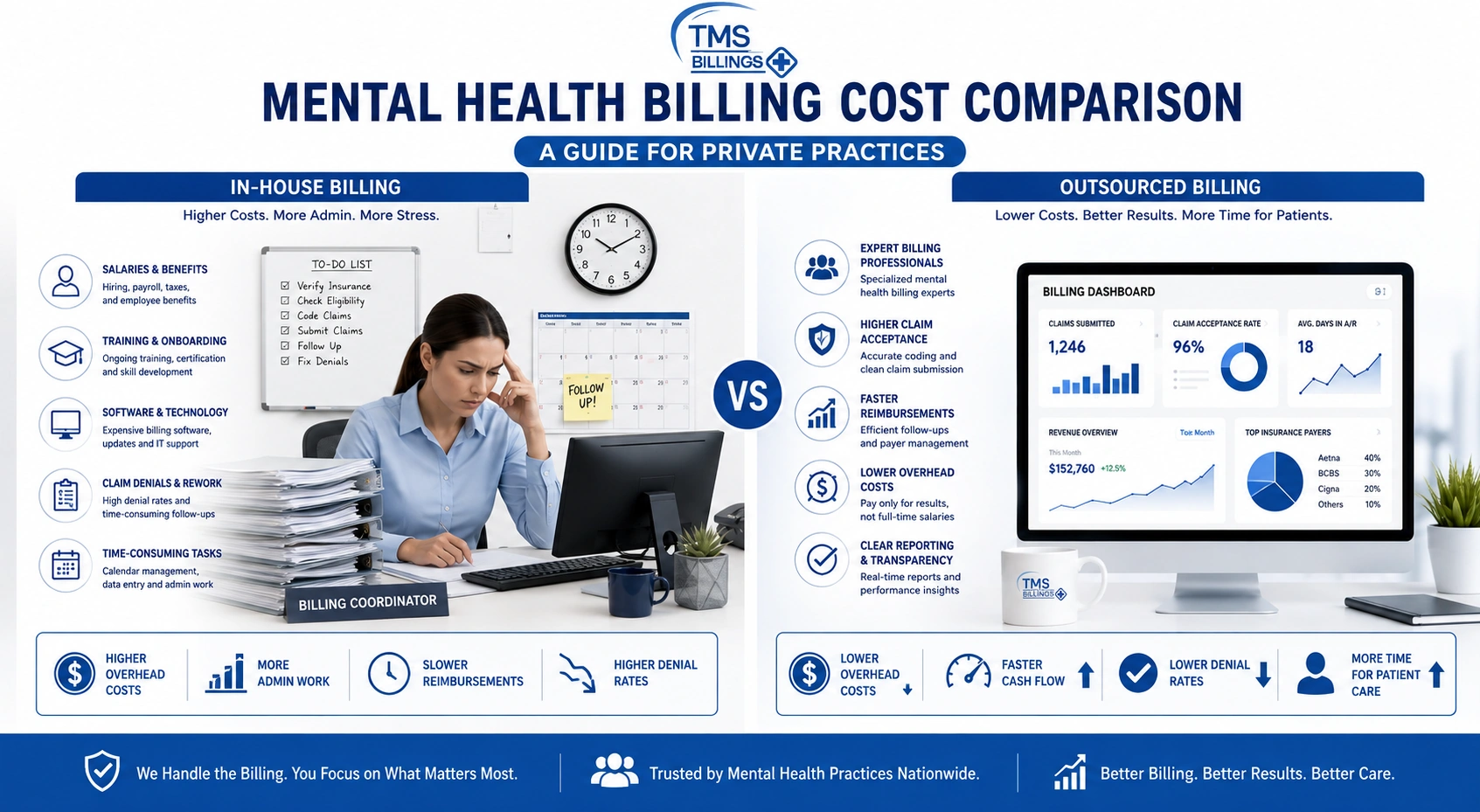
In-House vs. Outsourced Mental Health Billing: The True Cost Comparison for Private Practices
A solo therapist who managed her own billing thought she was saving money — until she added it up. Once she counted her biller’s salary, benefits, software subscriptions, and the hours lost each month to fixing denied claims, a real mental health billing cost comparison put the number at just over $62,000 a year. An outsourced billing company quoted her under $15,000 for the same claim volume.
That $47,000 gap is why this comparison matters, and it’s one most private practices never actually run. If you’ve searched how much does mental health billing cost and gotten five different answers, you’re not alone — pricing varies by model, practice size, and what’s actually included in the fee. This guide breaks down every dollar on both sides, walks through a break-even calculation you can apply to your own numbers, and links to a mental health billing services page if you want a quote once you’ve run the math.
What Is a Mental Health Billing Cost Comparison — and Why Most Practices Skip It?
A mental health billing cost comparison is a side-by-side look at every dollar an in-house billing operation actually costs versus what an outsourced billing company charges for the same volume of claims. Most practices skip it because the in-house cost hides in places nobody adds up — payroll taxes, software renewals, denial rework, and the weeks a biller is out sick or training a replacement.
A mental health billing cost comparison weighs the fully-loaded cost of in-house billing — staff salary, benefits, software, and training — against an outsourced billing fee (typically 5–8% of collections) to determine which model costs less and performs better for a given practice size.
The comparison only works if you use fully-loaded numbers on both sides. A single biller’s base salary looks cheap next to a billing company’s fee until you add benefits, a laptop, an EHR license, and the six weeks it takes to hire and train a replacement when they quit.
The True Cost of In-House Mental Health Billing
The true cost of in-house mental health billing runs well past a biller’s paycheck — it includes payroll taxes, benefits, software, training, and the revenue lost to denials that never get worked. Private practice billing costs break down into two buckets: money you spend whether or not a single claim gets paid, and money you lose when claims get denied and nobody follows up.
Staff Salary, Benefits, and Hidden Overhead
A full-time in-house biller for a mental health practice typically earns $38,000–$55,000 a year, and benefits plus payroll taxes add another 25% on top — roughly $9,500–$13,750. That’s before counting billing staff overhead like paid time off, sick coverage, a workstation, and recruiting costs when that person eventually leaves.
Turnover is the part most owners underprice. Behavioral health billing has its own rules — time-based CPT codes, telehealth place-of-service modifiers, payer-specific carve-outs to Optum or Carelon — and a new hire needs weeks to get fluent in them. Every week of ramp-up is a week of slower claims and more denials.
Software, Training, and Compliance Costs
Billing software cost for a solo practice runs $2,400–$6,000 a year, and that’s before EHR billing integration fees, clearinghouse charges, and annual license renewals that tend to creep up. Add $500–$2,000 a year for training and staying current on payer policy changes, since insurance reimbursement for therapists is governed by rules that shift almost every year.
Staffing this role is also getting harder. Behavioral health workforce shortages are well documented — SAMHSA’s workforce resources point to shortages across the field, and billing and administrative roles compete for the same limited pool of qualified people. That scarcity shows up as higher salaries and longer vacancies when a biller leaves.
What Outsourced Mental Health Billing Actually Costs
Outsourced mental health billing typically costs 4% to 10% of monthly collections, with most specialized behavioral health billing companies landing between 5% and 8%. That fee usually bundles claims submission, eligibility checks, denial follow-up, and reporting — not just the act of sending a claim.
This is what revenue cycle management for therapists actually means in practice — not one task, but the full loop of verifying eligibility, coding correctly, submitting clean claims, and chasing every denial until it’s paid or formally closed. Outsourced medical billing for therapists is priced as a variable cost, which means a slow month costs you less and a strong month costs the billing company more effort for the same percentage.
Ask any prospective partner two questions before signing: what’s your average clean claim rate, and what’s your typical accounts receivable days? A clean claim rate above 90% and A/R days under 30–40 are reasonable benchmarks for a mental health specialist. A vendor that can’t answer either question quickly is a red flag.
In-House vs. Outsourced: Side-by-Side Cost Breakdown
The in-house vs outsourced billing decision comes down to three numbers: your fixed cost, your variable cost, and your denial rate — and this table puts all three side by side for a typical practice.
In-House vs. Outsourced Mental Health Billing: True Cost Breakdown
| Cost Factor | In-House Billing | Outsourced Billing |
|---|
| Biller salary (full-time) | $38,000–$55,000/year | Included in service fee |
| Benefits + payroll taxes | ~25% of salary ($9,500–$13,750) | $0 |
| Billing software / EHR | $2,400–$6,000/year | Often included |
| Training + compliance updates | $500–$2,000/year | Provider’s responsibility |
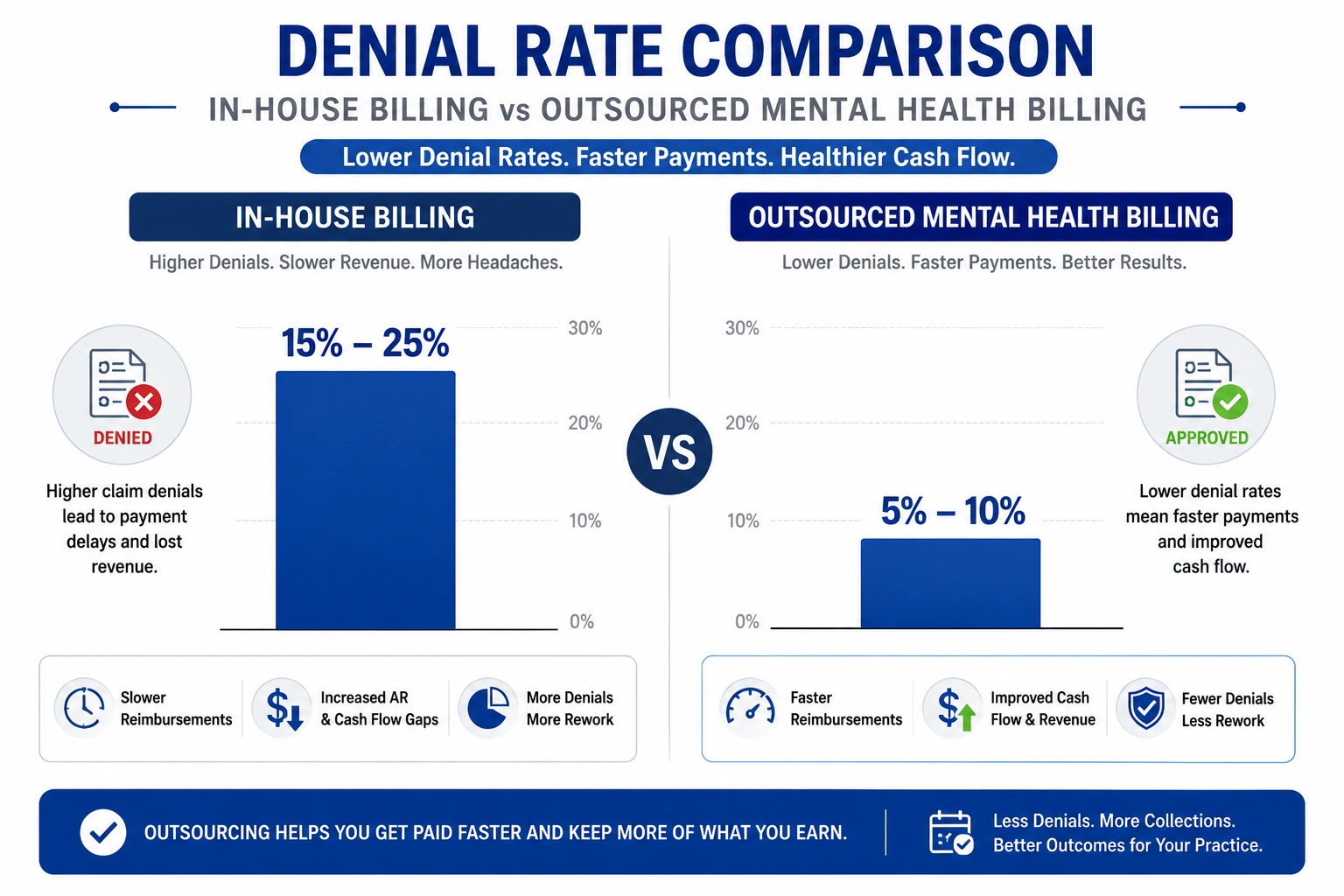
| Average denial rate | 15–25% (industry average) | 5–10% (optimized workflows) |
| Estimated annual total | $50,000–$77,000+ | 5–8% of collections |
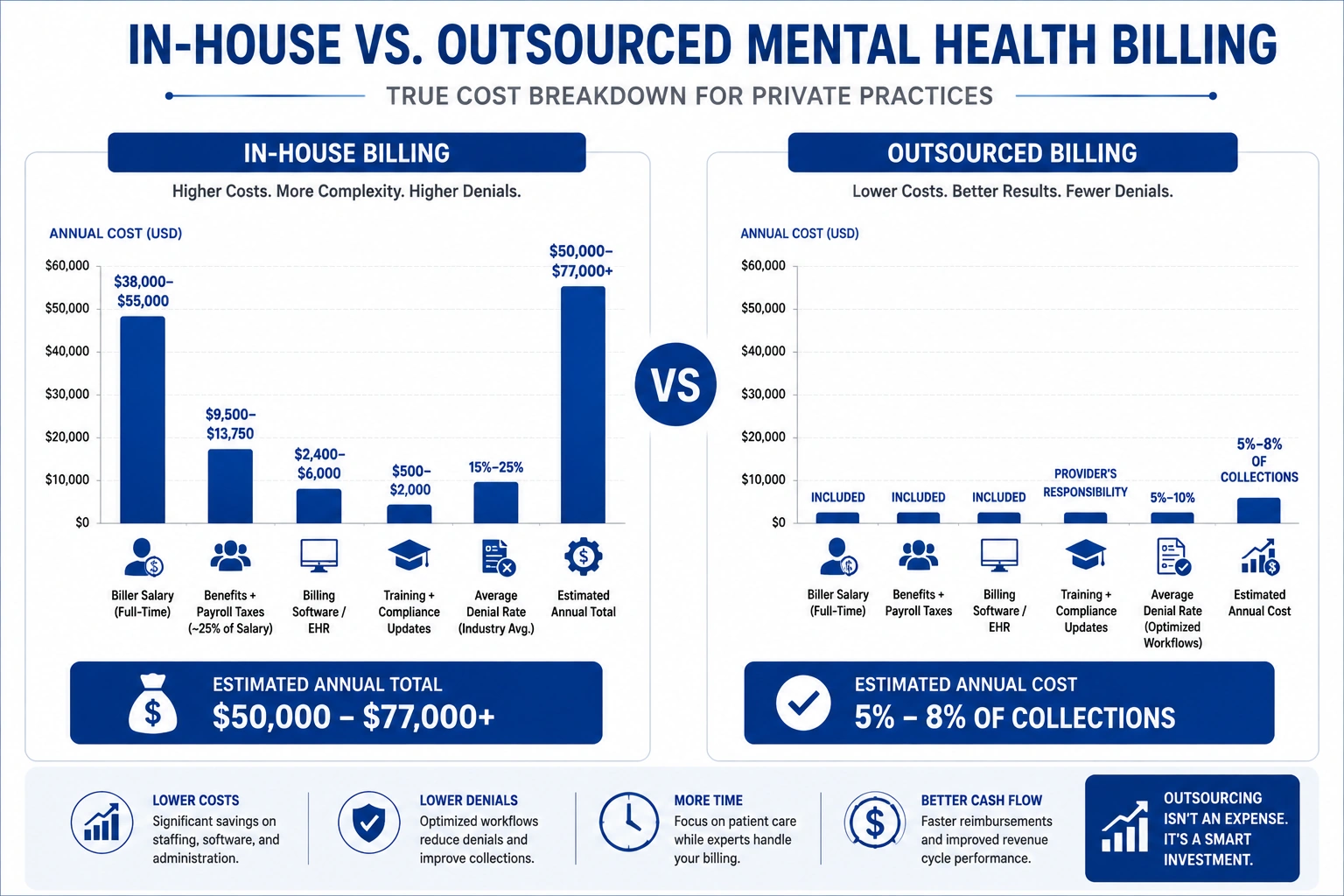
Reading this table as an in-house vs outsourced mental health billing costs comparison, the denial-rate row matters as much as the dollar rows. A practice stuck at a 20% denial rate isn’t just paying salary and software — it’s also losing a fifth of its billed revenue to claims that need rework or never get collected at all. Behavioral health claims are denied at meaningfully higher rates than general medical claims, largely due to authorization requirements and documentation standards tied to mental health parity rules under CMS’s MHPAEA guidance. For more on why specific claims get denied, see the denial code guide.
When Does Outsourcing Make Financial Sense for a Private Practice?
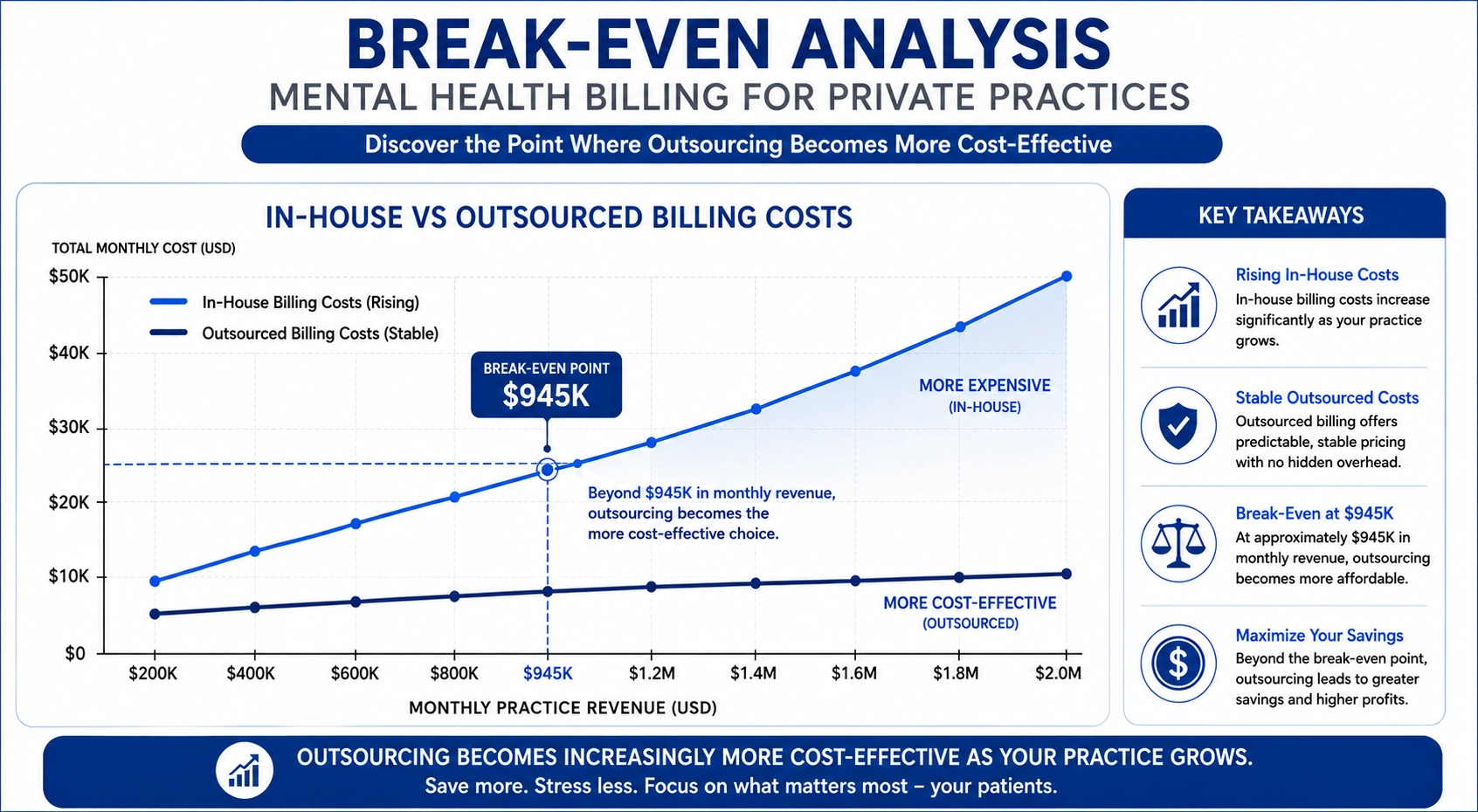
Outsourcing makes financial sense once your in-house billing cost, as a percentage of collections, exceeds what a billing company would charge for the same volume — and for most practices under roughly $900,000 in annual collections, that crossover has already happened. Is outsourced billing worth it for private practice owners specifically? Run the break-even analysis for mental health billing on your own numbers and the answer usually becomes obvious fast.
Here’s the math for a practice billing $400,000 a year in collections:
- In-house cost: $45,000 salary + $11,250 benefits/payroll taxes + $4,000 software + $1,200 training = $61,450/year, which works out to about 15.4% of collections — and that’s before counting anything lost to denials.
- Outsourced cost: at a mid-range 6.5% fee, $400,000 × 6.5% = $26,000/year.
- Difference: outsourcing saves roughly $35,450 a year at this volume — before even accounting for a lower denial rate improving actual collections.
The break-even point — where a full-time in-house biller costs about the same as an outsourced fee — sits around $900,000–$950,000 in annual collections, using the ranges in the table above ($61,450 ÷ 6.5% ≈ $945,000). Below that volume, outsourcing wins on raw dollars almost every time. Above it, in-house starts to look competitive on cost alone, but usually only if that single biller can still handle credentialing, denial management, and reporting at the same standard a specialized billing company delivers — which is a lot to ask of one employee once volume climbs that high.
How TMS Billings Reduces Mental Health Billing Costs for Private Practices
TMS Billings reduces mental health billing costs by replacing a fixed salary-and-software expense with a single performance-based fee that covers the full revenue cycle. That includes mental health eligibility verification, time-based CPT coding built for therapy sessions, claims submission, and denial follow-up — the work that otherwise falls on one in-house employee who’s also covering front-desk duties.
Because the fee is tied to collections, TMS Billings only grows its revenue when your practice collects more, which keeps incentives aligned in a way a flat salary never quite does. Practices working with a specialized billing partner typically see denial rates fall from the 15–25% range down toward 5–10%, which recovers revenue that a generalist biller — in-house or outsourced — tends to leave on the table.
Get a Clear Picture of Your Own Numbers
Most private practices underestimate their in-house billing costs by $15,000–$30,000 a year because they don’t factor in denial rework, compliance training, or staff turnover. TMS Billings handles mental health billing end to end — credentialing, claims, follow-up, and reporting — so your revenue cycle runs cleaner at a predictable, performance-based fee. That’s also the fastest way to reduce billing costs in a mental health practice without hiring or firing anyone.