
Year End Medical Billing Checklist: 9 Easy, Essential Steps

The final weeks of the year decide how much 2026 revenue your practice collects and how cleanly 2027 begins. Aged claims, unworked denials, and outdated payer rates all carry into January, which is why many practices turn to Revenue Cycle Management Services for added capacity. A year end medical billing checklist is an ordered set of closing tasks covering claims, accounts receivable (A/R), denials, payments, underpayments, enrollment, and fee schedules. This guide presents nine steps in order of urgency, a timeline from October through January, and a way to decide who should do the work.
What Is a Year End Medical Billing Checklist, and Why Does It Matter?
A year-end billing close is a structured review that settles open claims, aged balances, denials, payments, enrollment, and payer rates before the calendar changes.
Timing matters because timely filing and appeal windows run on the calendar, deductibles and eligibility reset when the new plan year begins, and new payment rates and code sets take effect on or around January 1.
A year end medical billing checklist for small practices, where one or two people share billing and front-desk duties, replaces memory with a defined order of work.
The Centers for Medicare & Medicaid Services (CMS) proposed Medicare physician payment changes for 2027, and the comment period closed on September 14, 2026. As of the last review of this article, CMS had not finalized the rule; the details appear on CMS’s CY 2027 Physician Fee Schedule proposed rule page (CMS-1848-P). Until then, treat every 2027 Medicare payment amount as pending.
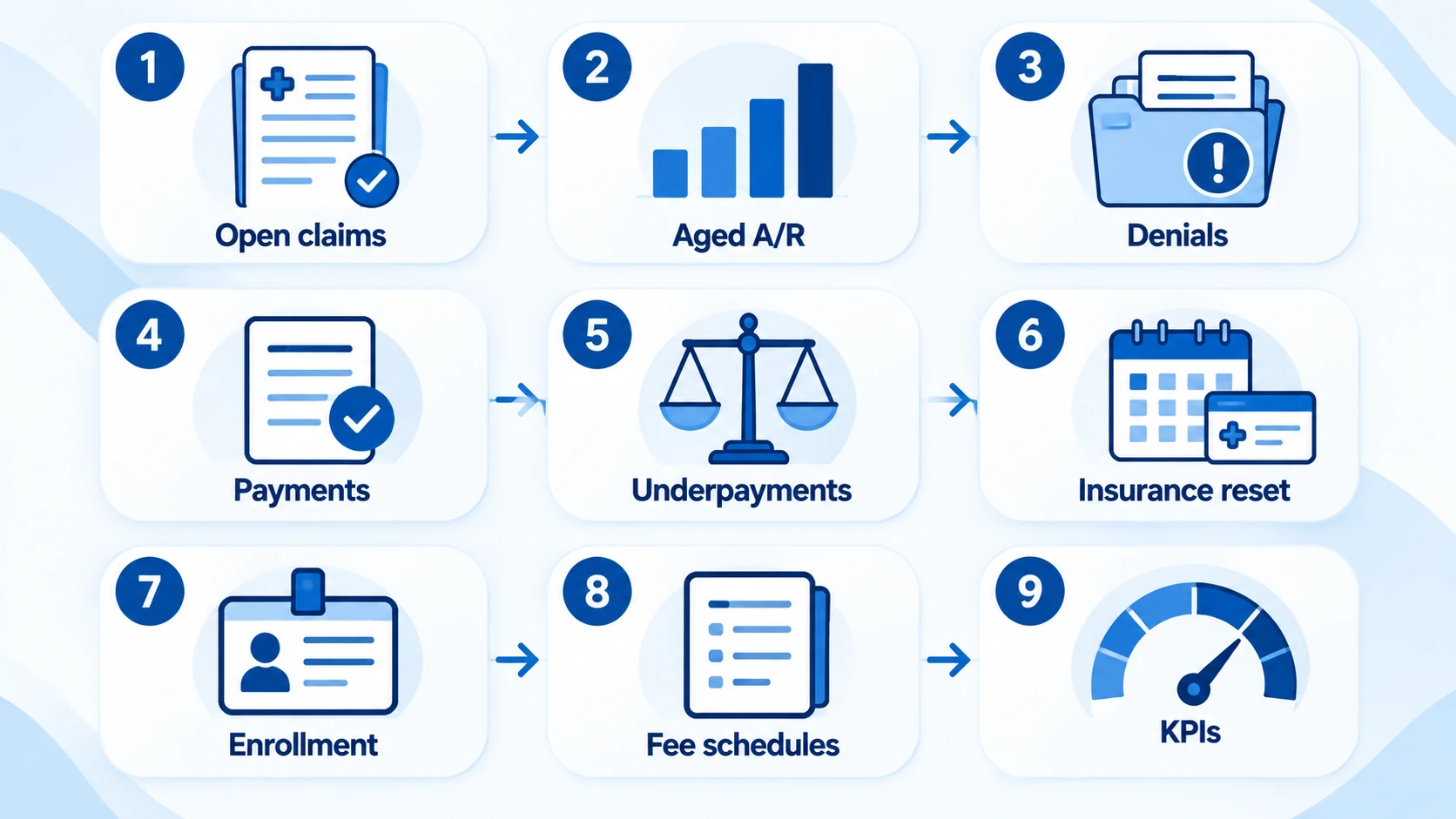
The Year End Medical Billing Checklist: 9 Steps in Order of Urgency
A year end medical billing checklist moves in nine steps: clear open claims, work aged A/R, resolve denials and appeals, reconcile payments and credits, check payer underpayments, prepare for the new plan year, update provider enrollment, load 2027 fee schedules and code sets, and report year-end KPIs.
Deadlines decide the order of these steps, so the tasks closest to a filing or appeal limit come first, and the rest follow in the sequence below.
1. Clear Open and Held Claims
Start by comparing scheduled encounters with billed claims to find unbilled charges, a gap known as charge capture, and chase any unsigned or incomplete notes. Then release claims held in the claim scrubber or rejected at the clearinghouse, running each through National Correct Coding Initiative (NCCI) edits, which update quarterly and are described on CMS’s National Correct Coding Initiative program page. This is how to clear open claims before year end, and cleaner submissions also protect your clean claim rate. You are finished when every 2026 encounter has a submitted claim or a documented reason it has not been billed.
2. Work Your Aged A/R
Run your A/R aging report by payer, then sequence the work by deadline instead of balance alone, so claims nearest a filing or appeal limit come first. Under Medicare’s timely filing rule, fee-for-service claims must be filed within one calendar year of the date of service, with limited exceptions, so claims from the same period last year reach that limit in the fourth quarter (CMS’s Medicare Claims Processing Manual page). Other payers set their own windows, so check each contract. For your year-end A/R cleanup, record days in A/R, your average collection time, before and after, and never write off aged claims to improve a metric. Every aged claim needs a next action, an owner, and a date.

3. Resolve Denials and Appeals
Group unresolved claim denials by reason using claim adjustment reason codes (CARCs), which explain why a payer adjusted a payment, along with the remark codes that accompany them. Correct and resubmit what can be fixed, and appeal what merits it. Each payer sets its own corrected-claim and appeal deadlines in the contract or provider manual, so confirm them rather than assume. Then trace every denial to its root cause, whether eligibility verification, coding, authorization, or enrollment, so your billing team fixes the cause before January. Tracking the denial rate by reason shows whether those fixes hold.
4. Reconcile Payments and Credit Balances
Post every electronic remittance advice (ERA) and explanation of benefits (EOB) payment, match bank deposits to remittances, and clear unapplied cash, which is money received but not yet assigned to a claim. Next, identify credit balances, meaning accounts where payments exceed what is owed, and resolve them according to payer rules, contract terms, and state law. Confirm refund and reporting requirements with your compliance advisor and accountant before acting. You are done when deposits equal posted payments and no unexplained balance sits in suspense.
5. Check Payer Underpayments
Compare ERA allowed amounts with contracted rates for your highest-volume CPT codes, using the payer contract rather than an outdated internal price list as the reference. CPT is the Current Procedural Terminology code set that the American Medical Association maintains. A contractual adjustment, commonly reported under CARC 45, is the expected difference between the billed charge and the allowed amount. A payer underpayment review looks for the other case: any payment below the contracted allowed amount, which you should dispute within the payer’s contract window. The code set appears in X12’s official list of Claim Adjustment Reason Codes, which X12 maintains.
6. Prepare for the January Insurance Reset
Many patients begin the year with a January deductible reset, a new plan, or a changed member ID, and the Medicare Part B deductible also applies per calendar year. Run eligibility verification for every January appointment before patients arrive, re-check authorizations for services scheduled in the new year because some expire at year end, and send final statements for open patient balances. CMS applies prior authorization to certain hospital outpatient department services only, a program that may not cover the services your practice bills; see CMS’s Prior Authorization for Certain Hospital Outpatient Department Services page.
7. Update Provider Enrollment
Review each provider enrollment revalidation date, along with CAQH attestations, since CAQH maintains the shared provider data profile that many payers consult. Check the National Provider Identifier (NPI), taxonomy, and practice location data on file for every provider. Confirm that any provider starting in January is enrolled with each payer before the schedule opens, because enrollment gaps and mismatched data produce claim denials that take time to rework. Practices that need support tracking these dates can review Credentialing Services.
8. Load 2027 Fee Schedules and Code Sets
As each payer publishes its rates, load 2027 fee schedules into your practice management system and update the charge master, your internal list of billable services and prices. Confirm that the October 1 ICD-10-CM update is installed, and prepare for the January 1 CPT and HCPCS changes (the Healthcare Common Procedure Coding System covers supplies and services CPT omits) and the new NCCI edit version. Medicare is different: CMS has only proposed its 2027 amounts, so load them after the final rule and payment files appear, and keep proposed figures in a scenario file, never your live schedule, as CMS’s CY 2027 Medicare Physician Fee Schedule proposed rule fact sheet explains.
9. Report Year-End KPIs and Set 2027 Targets
Run and save your year-end key performance indicators (KPIs): clean claim rate, denial rate, days in A/R, and net collection rate, which compares payments collected with the amount your contracts allow. Treat this year-end KPI report as the baseline for monthly comparison in 2027, and set targets from your own history rather than outside benchmarks. A billing fee set as a percentage of collections moves with revenue, while fixed staffing costs do not; medical billing pricing models explain how those structures differ.
When to Start: A Year End Medical Billing Checklist Timeline
Start in October, because denials, appeals, and disputed payment shortfalls all need weeks of payer response time. Spread across four months, your year end medical billing checklist becomes a year-end billing timeline that a lean team can follow. Because the annual CPT update takes effect January 1, review the American Medical Association’s overview of the CPT code set it develops and maintains before the new year.
| Month | Priority Tasks | Steps |
|---|---|---|
| October | Pull A/R aging, clear open claims, start enrollment review | 1, 2, 7 |
| November | Work denials, reconcile payments, review underpayments | 3, 4, 5 |
| December | Verify January eligibility, send final statements, load payer fee schedules | 6, 8 |
| January | Confirm new code sets and edits, run KPI report, set targets | 8, 9 |

Which Practices Need a Year-End Checklist Most?
Practices with a lean billing team, a growing backlog of aged claims, a high Medicare share, or recent staffing changes have the most to gain from a structured close. Exposure still varies by specialty and code mix, because procedure billing, authorization requirements, and specialty-specific coding updates add risk for some specialties and not for others.
Specialty societies track these changes. The American Society of Interventional Pain Physicians’ overview of coding and reimbursement recognition for the specialty is one example, and you should check your own specialty society for updates. Practices adding providers or locations in the new year should also budget for enrollment, and an overview of credentialing cost can help set expectations.
Keep Year-End Billing In-House or Outsource It?
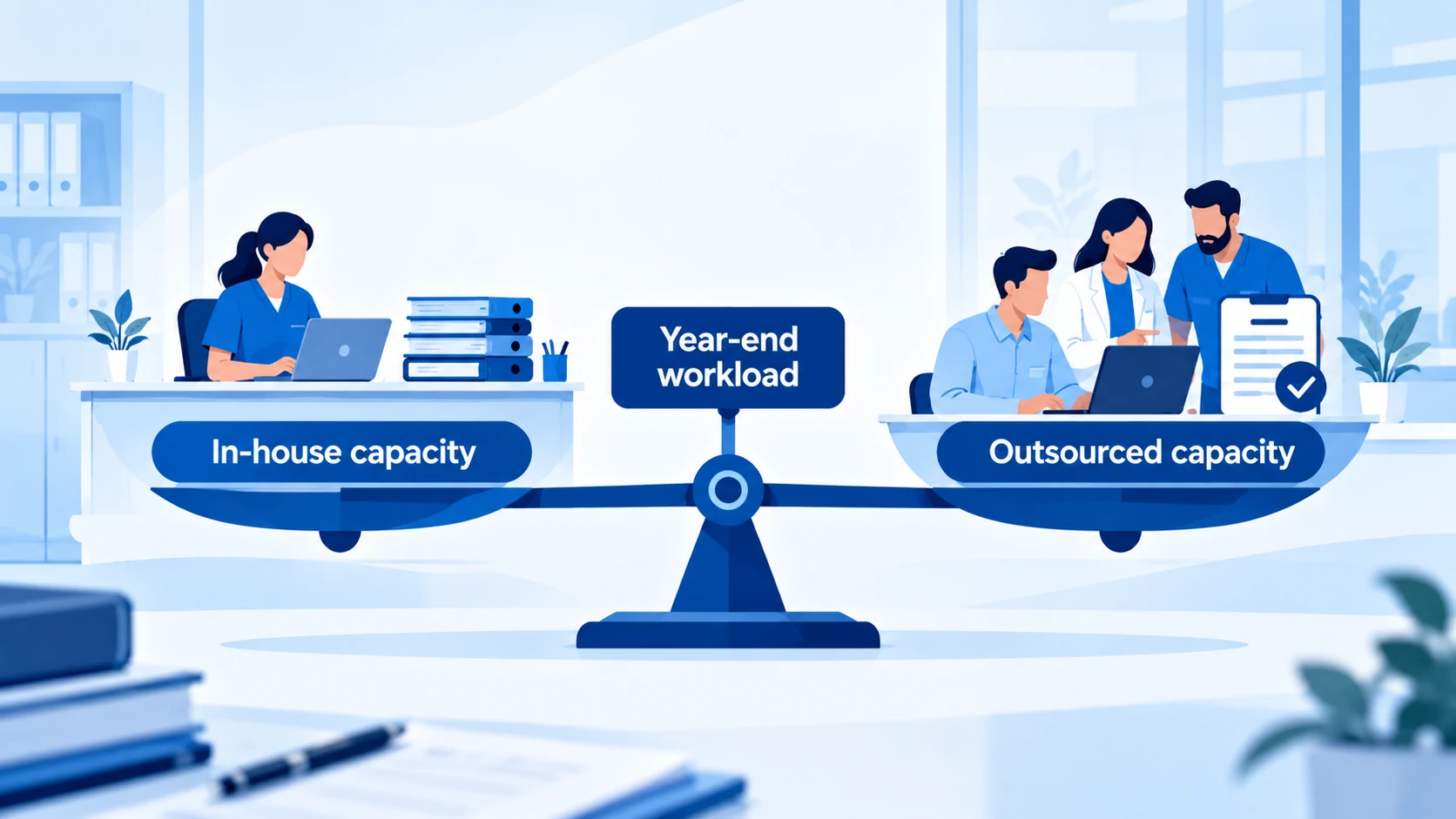
There is no universal answer. The right choice depends on claim volume, the rate of denials, staffing stability, holiday coverage, and how much capacity your billing team has for a deadline-driven close.
In-house billing still makes sense when you have a trained, stable, dedicated team, low turnover, strong denial-tracking tools, and enough volume to justify the fixed cost. Staffing expense belongs in that comparison, and MGMA’s 2026 Management and Staff Compensation Data Report on medical practice staffing costs offers useful context.
Outsourced billing tends to make more sense when turnover is frequent, the rework queue keeps growing, a new provider or service line is starting, or your team lacks the capacity to work aged claims, reconcile remittances, and follow up on patient balances before December 31. For a worked example of how the cost categories compare, see this mental health billing cost comparison. Whichever route you choose, the year end medical billing checklist stays the same; only the owner of each step changes.
How TMS Billings Supports Your Year-End Billing Close
TMS Billings provides medical billing, credentialing, and revenue cycle management (RCM) support to small and specialty practices. Its services include claim scrubbing and coding review, ERA and denied claims follow-up, A/R follow-up, credentialing coordination, and monthly reporting on key performance indicators.
During a deadline-heavy close, outsourced billing, including A/R and denial follow-up, can add capacity, although results depend on your payers, claims, and starting point, and no outcome is guaranteed. Our medical billing support team can supplement your staff or provide an independent review of your current process, and it does not replace in-house teams that are already working well. Many practices assign a few steps of the year end medical billing checklist, such as aged claims follow-up, to outside help and keep the remaining steps in-house.
Hypothetical scenario: A small multi-provider practice pulled its A/R aging report in October and found older claims approaching payer filing limits. The billing team worked those claims first, then cleared held claims and compared ERA allowed amounts with contracted rates. The review surfaced documentation gaps to correct before January.
Key Takeaways
- Sequence the work by deadline, since filing and appeal limits decide which tasks cannot wait.
- Start with open claims and aged A/R, because those balances carry the nearest filing deadlines.
- Reconcile every payment, then test payer payments against contracts to catch shortfalls and credit balances.
- Hold proposed Medicare amounts until CMS finalizes the rule, while loading payer 2027 fee schedules.
- Keep your year end medical billing checklist in view through January, and save a KPI baseline.
Related Reading: for further reading on billing cost topics across our coverage, see medical billing services cost in California and medical billing services cost in Texas.
Final Thoughts
Closing the billing year well takes sequence, ownership, and lead time, all of which sit within your control. Keep your year end medical billing checklist open on your desk, assign each step an owner, and begin with the claims closest to a deadline. Payer rules vary, and 2027 Medicare payment amounts may change before CMS finalizes them, so confirm current requirements before acting. To discuss your close with our team, you can Book a Free Consultation.