
Outsource Medical Billing Michigan: Complete 2026 Guide
Michigan’s insurance landscape does not look like most other states. Blue Cross Blue Shield of Michigan controls a dominant share of the commercial market, the Healthy Michigan Plan adds Medicaid expansion rules that shift from year to year, and the state’s No-Fault auto insurance system layers a third billing framework on top of standard claims.
If your team already works with a Medical Billing Services in Michigan partner, or you are weighing the decision for the first time, that complexity is usually what pushes a practice to outsource medical billing Michigan regulators and payers make genuinely harder to manage alone. This guide walks through what outsourcing actually involves, what it tends to cost, the benefits most relevant to Michigan practices, what to look for in a billing partner, and how outsourcing compares with keeping billing in-house.
What Does It Mean to Outsource Medical Billing?
When a practice chooses to outsource medical billing Michigan regulations make unusually complex, it hands claims submission, coding, accounts receivable follow-up, denial management, and patient statements to a specialized third-party partner. This shift lets internal staff focus on patients instead of paperwork, while a dedicated team manages the revenue cycle from claim submission through final payment.
Outsourcing shifts the entire billing workflow, not just claims entry, to a partner with dedicated staff, software, and payer relationships. A full-service arrangement typically covers insurance verification, prior authorization support, coding, claims processing, denial management, and accounts receivable recovery, alongside patient billing and reporting. Choosing to outsource medical billing services also means transferring day-to-day payer communication, so your team is no longer the first call when a claim is denied or delayed.
For Michigan practices, this matters because Blue Cross Blue Shield of Michigan, the Healthy Michigan Plan, and No-Fault auto insurance each carry their own submission rules and timelines. Practices researching how to outsource medical billing in Michigan usually start by identifying which of these workflows their in-house team struggles with most, then scope a partner around those gaps specifically.
Why Michigan Practices Are Outsourcing Medical Billing
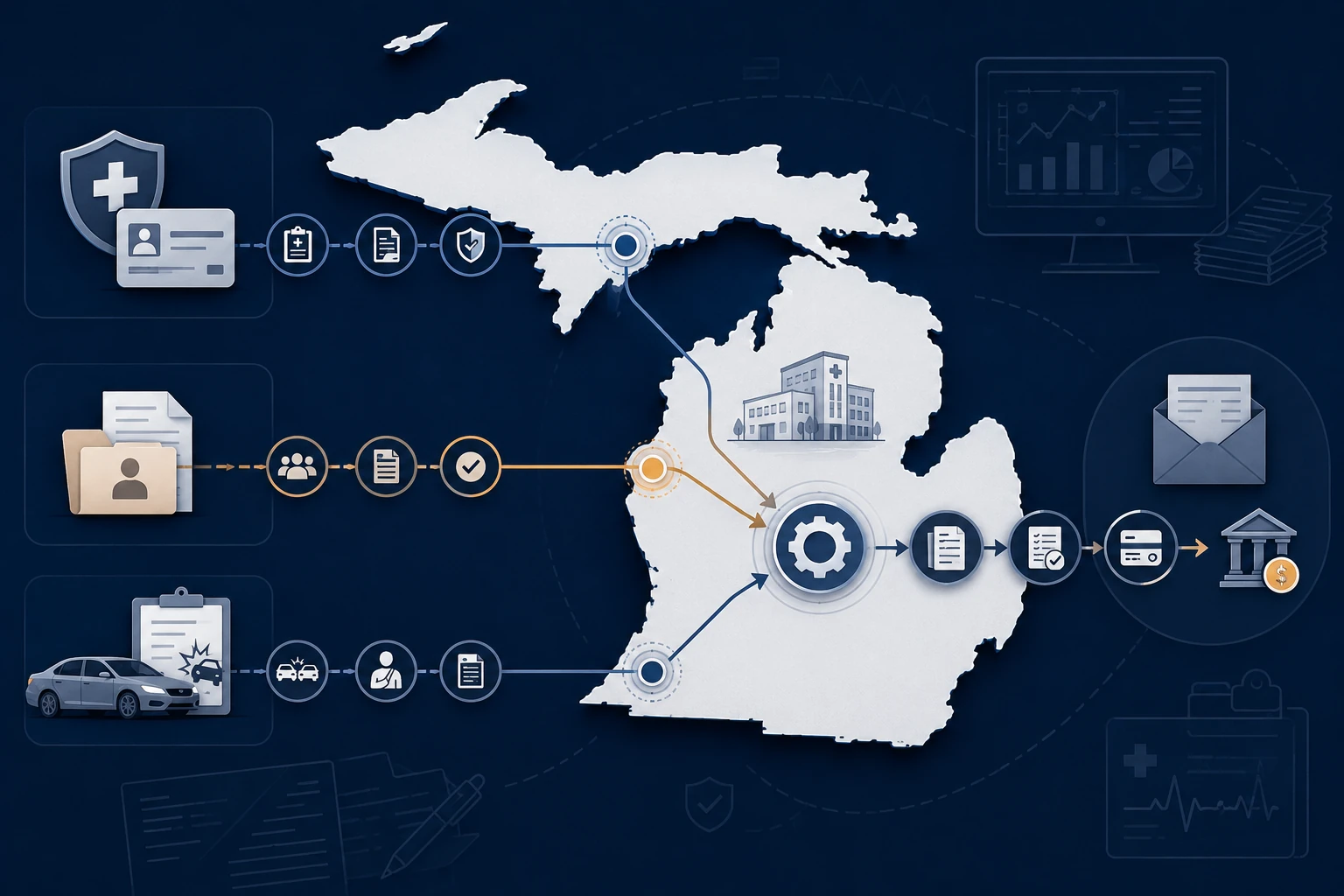
Michigan’s payer mix creates billing challenges that most other states do not share. Blue Cross Blue Shield of Michigan processes a large share of commercial claims statewide, and its documentation and timely-filing requirements differ enough from national payers that in-house teams often fall behind on denial follow-up.
The Healthy Michigan Plan, the state’s Medicaid expansion program, adds another layer: eligibility can change month to month, and billing rules are updated periodically through the Michigan Department of Health and Human Services. Practices unfamiliar with these updates risk claim rejections that have nothing to do with the care they provided.
Michigan’s No-Fault auto insurance system adds a third, entirely separate framework. Following the state’s 2019 reform, PIP(Personal Injury Protection) fee schedules and billing requirements are set and periodically revised by the Michigan Department of Insurance and Financial Services. Practices treating auto-injury claims, a common scenario for orthopedic, physical therapy, chiropractic, and pain management providers, need staff who understand No-Fault billing as its own workflow, not a variation on standard commercial claims.
Faced with three distinct payer systems layered on top of routine commercial billing, many practices find that the outsourced medical billing services Michigan vendors offer bring specialized knowledge an in-house team would need years to build.
What Does It Cost to Outsource Medical Billing in Michigan?
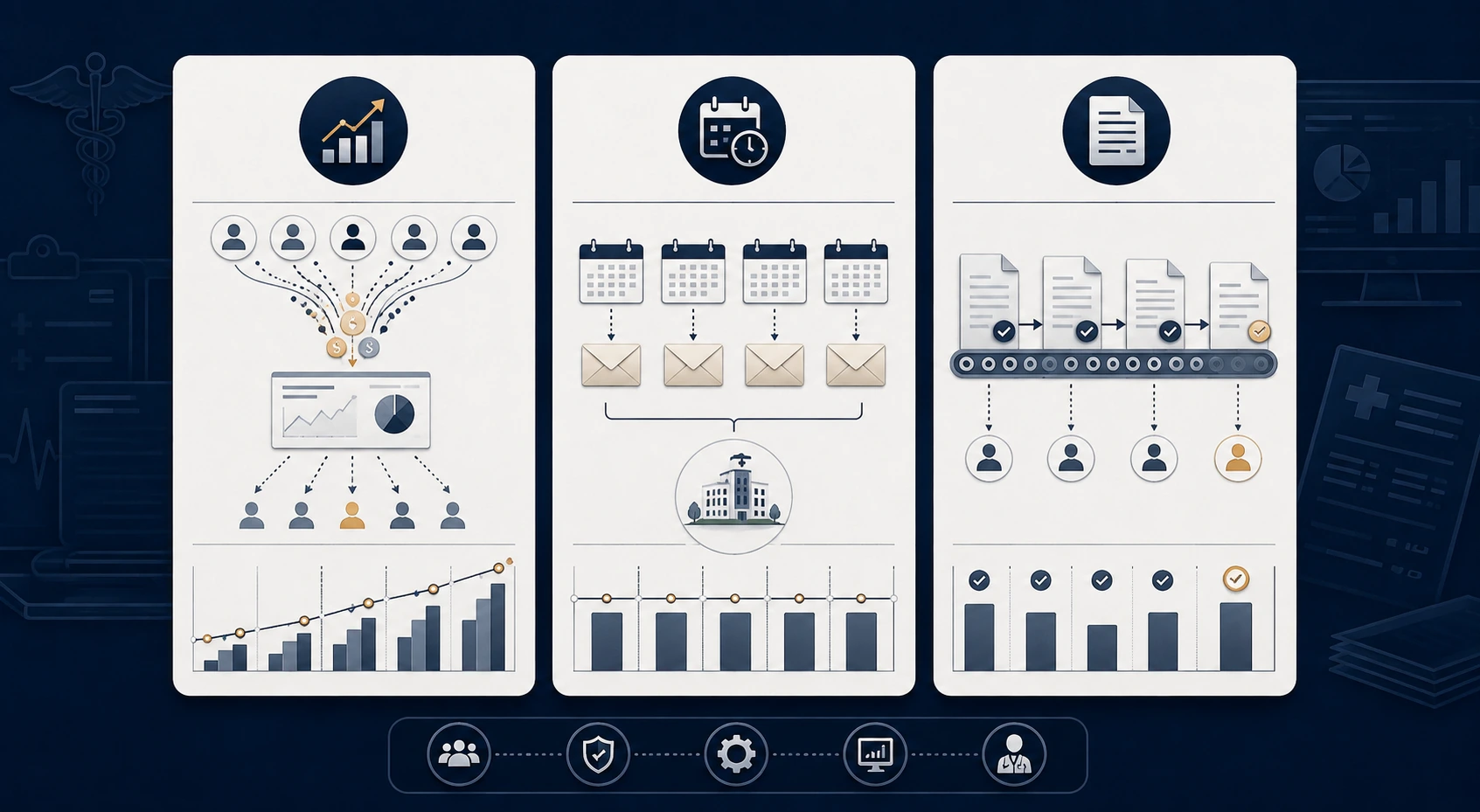
Pricing for outsourced billing follows a few common structures across the industry, and Michigan practices typically choose based on claim volume, specialty, and how much administrative work they want to hand off. What does it cost to outsource medical billing in Michigan depends heavily on which model a practice selects, so it helps to understand each one before comparing vendors.
| Pricing Model | How It Works | Best Fit For |
|---|---|---|
| Percentage of Collections | Fee scales with what the partner actually collects, typically a percentage of monthly revenue | Practices wanting costs tied directly to results |
| Flat Monthly Fee | A set fee regardless of claim volume or collections | Practices with predictable, steady claim volume |
| Per-Claim Fee | A fixed charge for each claim submitted | Lower-volume practices or specific service lines |
These figures represent a typical industry range rather than a fixed or universal number, and actual rates vary by specialty, claim complexity, and the volume of Blue Cross Blue Shield of Michigan, Healthy Michigan Plan, and No-Fault claims a practice handles. Michigan medical billing outsourcing cost also depends on whether a vendor includes credentialing, reporting, and patient statement services in its base fee or charges separately, and many outsourced medical billing services Michigan vendors offer bundle some of these while others price them individually.
Before signing with any vendor, confirm current medical billing pricing directly, and verify how No-Fault and Healthy Michigan Plan claims are priced, since these often fall outside standard commercial fee structures. Michigan medical billing outsourcing cost comparisons are most useful when practices request an itemized quote rather than a single blended rate.
Key Benefits of Outsourcing Medical Billing for Michigan Practices

The benefits of outsourcing medical billing for Michigan practices go beyond generic efficiency gains. Because BCBSM(Blue Cross Blue Shield of Michigan), the Healthy Michigan Plan, and No-Fault auto insurance each carry distinct rules, the right billing partner directly reduces the denial risk and administrative burden that are unique to operating in this state.
Fewer Denials and Faster Reimbursement
An experienced Michigan billing team tracks payer-specific rules closely enough to catch errors before a claim goes out, which directly improves your clean claim rate, the percentage of claims accepted and paid on first submission without correction. This matters most with Blue Cross Blue Shield of Michigan and Healthy Michigan Plan claims, where documentation requirements shift periodically and small errors trigger denials that delay payment for weeks. A partner focused on AR Recovery and Denial Management also works denied and aging claims proactively, rather than waiting for your staff to notice a payment gap in your accounts receivable.
Certified Coding and Compliance Expertise
Coding accuracy directly affects how quickly a claim moves through a payer’s system, and certified coders reduce the rework that comes from mismatched codes or incomplete documentation. Outsourced teams also maintain HIPAA compliance as a core part of their workflow, following claims-processing and data-handling standards referenced by the Centers for Medicare & Medicaid Services. For a Michigan practice juggling three distinct payer systems, this combination of coding precision and compliance discipline reduces the risk of errors that would otherwise fall on internal staff already stretched across patient care and administrative work.
Credentialing and Provider Enrollment Support
Credentialing and provider enrollment determine whether a physician can bill a given payer at all, and delay revenue for new hires or practices adding a payer relationship. A billing partner offering Credentialing Services manages applications, renewals, and payer follow-up as an ongoing function rather than a one-time task. For Michigan practices working with BCBSM, Medicaid managed care plans under the Healthy Michigan Plan, and auto insurers, staying current on enrollment status across every payer relationship is easier for a dedicated team than for office staff managing it alongside daily billing work.
One Michigan orthopedic and physical therapy practice shortened its reimbursement delays significantly after outsourcing its No-Fault auto insurance claims as a distinct workflow, rather than processing auto-injury billing the same way as standard commercial claims. Separating that workflow gave the practice’s billing partner room to apply No-Fault-specific documentation and fee-schedule rules from the start, instead of correcting errors after a denial.
What to Look for in a Michigan Medical Billing Company

Not every billing vendor understands Michigan’s payer landscape equally well. The best medical billing company Michigan practices choose is not always the cheapest option, but the one whose reporting, credentialing support, and specialty experience match what your practice actually needs. Use the following as a practical checklist when evaluating medical billing companies in Michigan, rather than comparing vendors on price alone.
Certifications, Experience, and Reporting
Ask any prospective partner about the coding certifications held by their staff, and how they stay current with CPT coding standards published by the American Medical Association. Coding standards change periodically, and a vendor without a clear process for tracking updates puts your clean claim rate at risk. Equally important is transparent reporting: request a sample of the Billing Reporting & Analytics a vendor provides before signing, not just a description of what they offer. The best medical billing company Michigan practices can rely on should be able to show real collections summaries, denial trends, and accounts receivable aging in a format your practice manager can use for monthly decisions.
Credentialing Support and Specialty Experience
Ask how long credentialing and provider enrollment typically take with the payers your practice depends on most, since timelines vary by payer and specialty. Standards published by the National Committee for Quality Assurance offer a useful benchmark for what a well-run credentialing process should include. Specialty experience matters just as much: a vendor experienced across medical billing specialties, particularly orthopedics, physical therapy, chiropractic, pain management, primary care, and behavioral health, will already understand documentation patterns specific to your field. Practices comparing medical billing companies in Michigan should ask directly whether a vendor has handled their specialty and payer mix before, rather than assuming general billing experience transfers evenly.
In-House vs Outsourced Medical Billing: Which Is Right for Your Michigan Practice?
The in-house vs outsourced medical billing Michigan decision usually comes down to staffing capacity and how much billing complexity your team can absorb without slowing down. Keeping billing in-house means hiring, training, and retaining staff who understand BCBSM(Blue Cross Blue Shield of Michigan), the Healthy Michigan Plan, and No-Fault billing simultaneously, a narrow skill set that takes time to develop and is expensive to replace when a trained employee leaves. Turnover in a billing role often creates a gap in follow-up on aging claims, which directly affects cash flow while a replacement is hired and trained.
Outsourcing removes that staffing risk but introduces its own considerations. Practices that outsource medical billing services still remain responsible for verifying their partner’s HIPAA compliance and security practices, since patient and claims data are shared with an outside team.
You also give up some day-to-day visibility into billing unless your vendor integrates cleanly with your practice management software and provides regular reporting, which is why reporting quality matters as much as pricing. For cost specifics, refer back to the pricing models covered earlier in this guide rather than treating any single figure here as fixed. Many practices settle this by piloting outsourcing for one payer category, such as No-Fault claims, before shifting their entire revenue cycle.
How TMS Billings Supports Michigan Practices
TMS Billings pairs certified coding staff with HIPAA-compliant workflows built around Michigan’s specific payer requirements, rather than applying a generic national process to every claim. Our team maintains direct, current experience with BCBSM, the Healthy Michigan Plan, and No-Fault auto insurance billing, so claims for each payer type follow the documentation and timing rules that payer actually requires. Every Michigan practice we support has a dedicated account specialist rather than a rotating queue, which means the person answering your questions already knows your claim history. Our Revenue Cycle Management approach also includes transparent reporting as a standard feature, not an add-on request.
One Michigan behavioral health practice required every prospective vendor to produce a sample reporting dashboard before signing, which eliminated several vendors offering only generic monthly summaries. That standard reflects what practices should expect from any outsourced medical billing services Michigan providers offer: visibility into your numbers, not just a promise that billing is being handled.
Key Takeaways
- Michigan’s BCBSM dominance, Healthy Michigan Plan rules, and No-Fault auto insurance create billing complexity most other states do not share.
- Pricing models vary by vendor; treat any figure as a typical range and confirm current medical billing pricing directly before signing.
- Outsourcing tends to improve clean claim rates and frees staff from denial follow-up on BCBSM(Blue Cross Blue Shield of Michigan) and Medicaid claims.
- A strong billing partner offers credentialing support, transparent reporting, and documented specialty experience, not just claims processing.
- The in-house vs outsourced decision depends on staffing capacity, data-sharing comfort, and how much complexity your team can absorb.
- Practices outsourcing medical billing in Michigan should confirm a vendor’s No-Fault and Healthy Michigan Plan experience before signing.
Final Thoughts
Michigan’s payer landscape is not simple, and it is not getting simpler. Between BCBSM’s market weight, the Healthy Michigan Plan’s shifting eligibility rules, and a No-Fault auto insurance system that operates on its own fee schedule, practices that try to manage all three in-house often find their staff stretched thin and their aging claims growing. Choosing to outsource medical billing Michigan payers and state agencies make this complex is not a shortcut; it is a way to put specialized attention on the part of your practice that directly determines cash flow.
If your team is ready to explore what that could look like for your practice, Book a Free Consultation with our Michigan billing team.