
Why Are My Medical Claims Getting Denied in New Jersey?
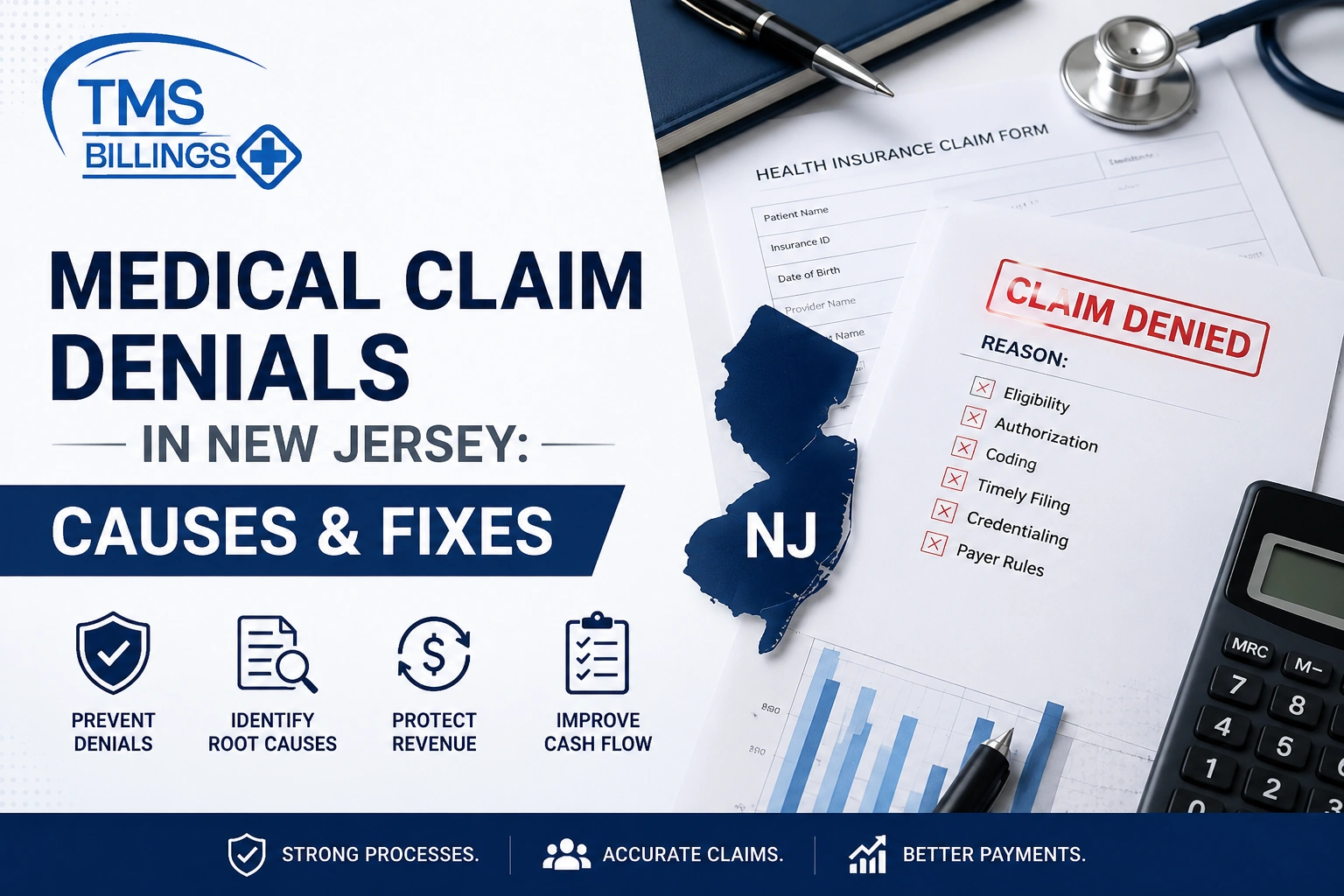
New Jersey practices operate under some of the strictest payer and prompt-payment rules in the country, and most medical claim denials in New Jersey trace back to a handful of avoidable, repeatable issues rather than one-time mistakes. If your team already manages medical billing and coding in New Jersey, you know how quickly a missed authorization or an eligibility mismatch can stall a claim and delay payment. This guide walks through the causes behind rising claim denials in NJ, the state-specific factors shaping how payers review your claims, and the practical steps your billing team can take to reduce denials going forward.
What’s Behind Rising Claim Denials in New Jersey?
Quick answer: Medical claim denials in New Jersey typically result from eligibility errors, missing prior authorization, coding mismatches, missed filing deadlines, credentialing gaps, and payer-specific submission rules. New Jersey’s prompt-payment framework and a payer mix dominated by Horizon BCBS and NJ FamilyCare make these errors more costly here than in many other states.
New Jersey imposes some of the more rigorous prompt-payment obligations for insurers, requiring payers to act on clean claims within defined timeframes once all required information has been submitted, as outlined by the New Jersey Department of Banking and Insurance. Because these requirements are updated periodically through DOBI bulletins, your billing team should confirm current figures directly with NJ DOBI rather than relying on a fixed deadline.
This regulatory backdrop, paired with a payer mix concentrated among Horizon BCBS and NJ FamilyCare, means denial patterns here often diverge from what practices see in other states. A clean claim rate that would be acceptable elsewhere can still produce a disproportionate share of NJ insurance claim denials if your workflow doesn’t account for New Jersey’s specific submission and documentation rules.
Top Reasons Medical Claims Are Denied in New Jersey
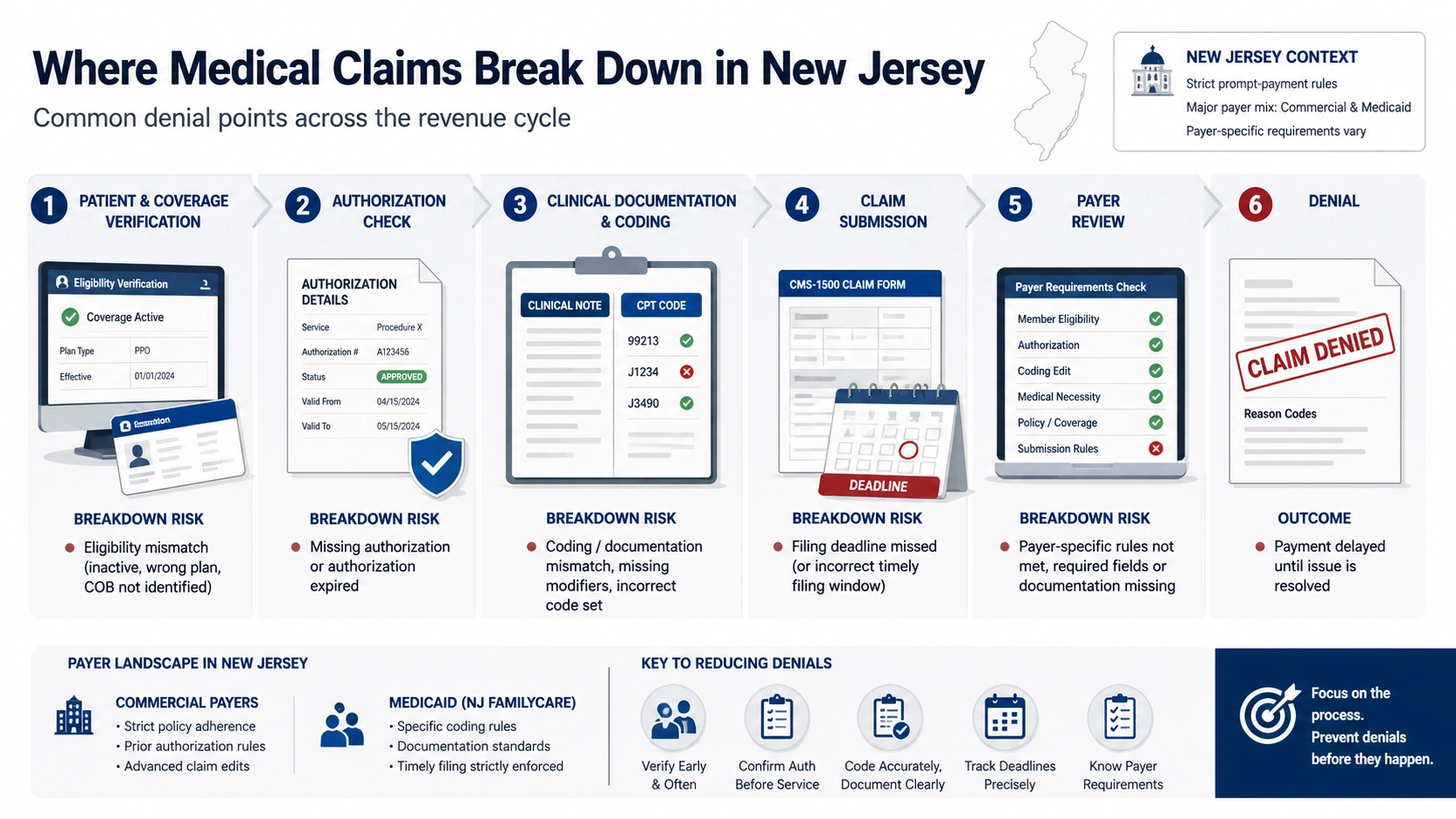
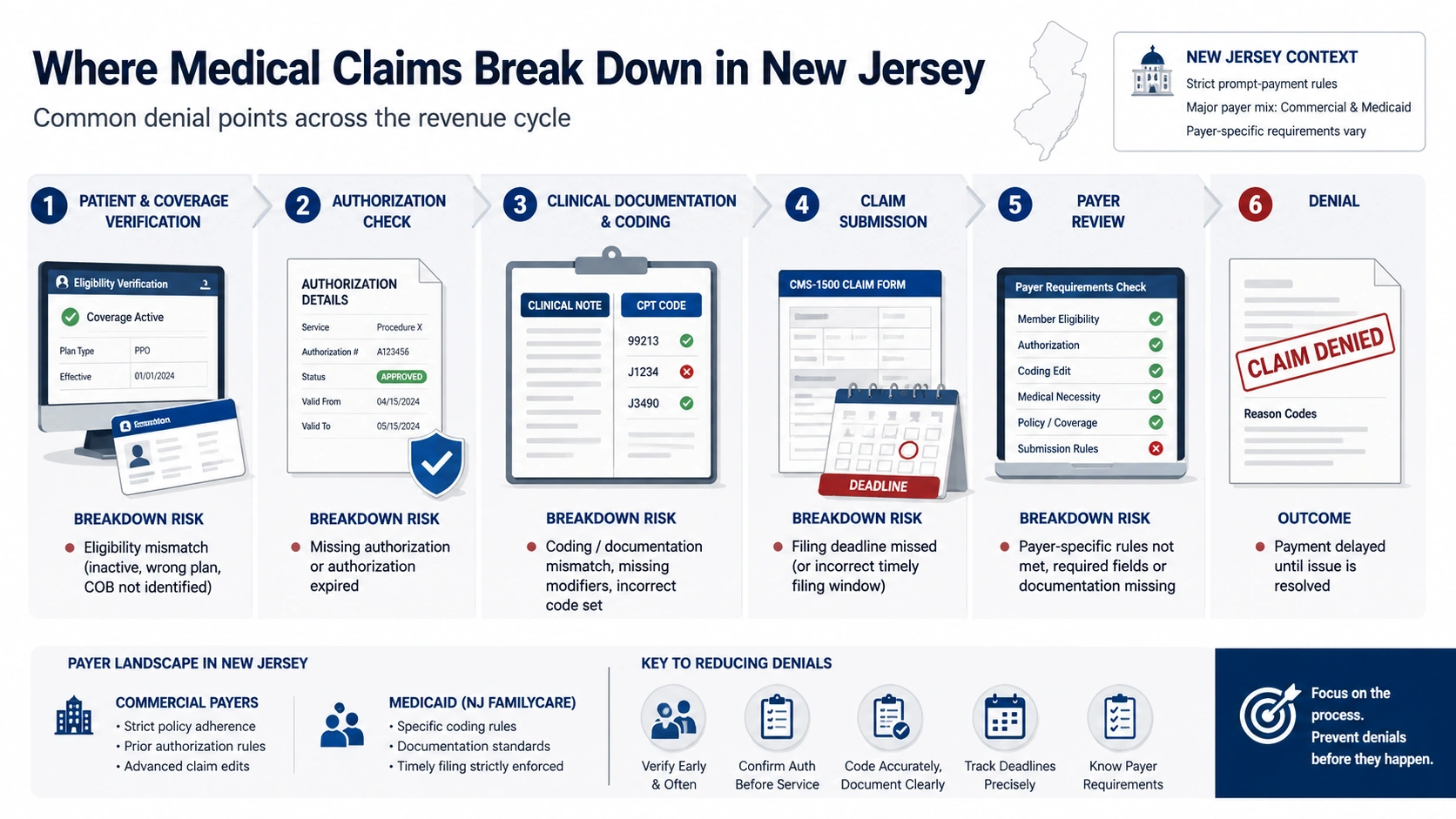
Medical claim denials in New Jersey rarely trace back to a single bad decision — they follow patterns. Most of the reasons for claim denials reported by New Jersey practices fall into one of six recurring points of failure, each tied to a specific stage of the claims process.
Eligibility and Coordination-of-Benefits Errors
Coverage that isn’t verified at the time of service is one of the most common sources of New Jersey medical billing denials. A patient’s plan may have lapsed, changed, or shifted to a different payer since the last visit, and if that change isn’t caught before the claim is submitted, the payer will reject it outright.
Coordination of benefits adds another layer of risk: when a patient has both a primary and secondary payer, an incorrect payer order or a missed secondary filing can trigger a denial even when the clinical documentation is flawless.
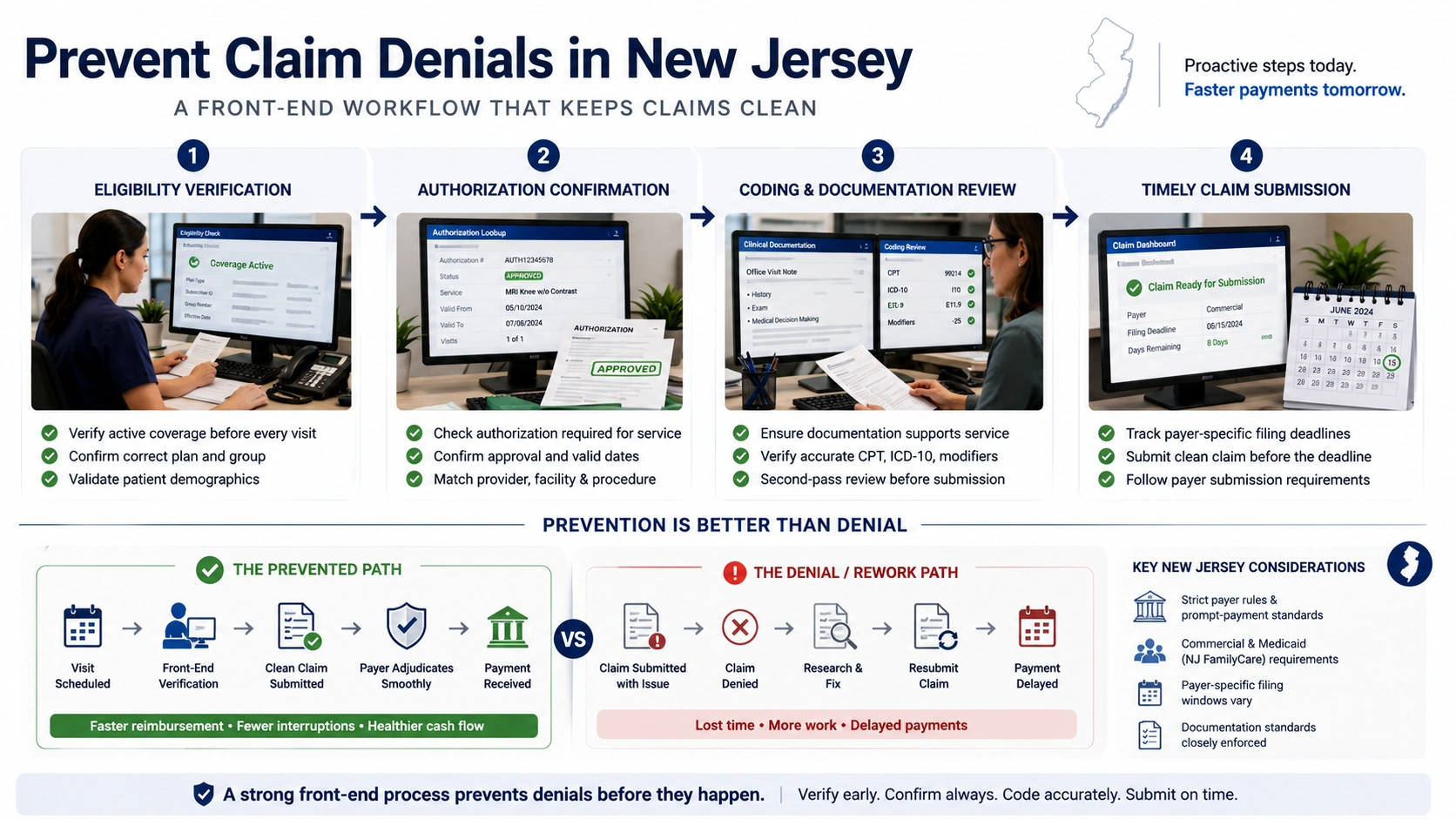
Front-end verification, performed consistently rather than occasionally, is the most reliable defense against this category of claim denials.
Missing or Incorrect Prior Authorization
Many services require prior authorization before they’re rendered, and New Jersey payers are consistent about enforcing this requirement. Denials in this category typically happen one of two ways: a service is billed before authorization is confirmed, or it’s billed after an authorization has expired mid-course of treatment.
Both scenarios are avoidable with a simple habit — checking authorization status before, not after, a visit is billed. This single change addresses a meaningful share of medical billing denials for NJ practices, particularly those delivering ongoing or multi-visit care.
Coding and Documentation Mismatches
Coding errors remain a leading contributor to common reasons for claim denials in New Jersey practices. Mismatches between the CPT code billed and the supporting clinical documentation, outdated code sets, or missing modifiers all give payers grounds to deny a claim rather than question it.
Coding accuracy depends on documentation that clearly supports the level and type of service billed, reviewed against current coding standards published by the American Medical Association. A second-pass review before submission catches most of these mismatches before they ever reach a payer.
Missed Timely Filing Deadlines
Every payer sets a window for timely filing, and New Jersey’s major payers are not lenient about it. A claim submitted even one day past a payer’s filing deadline is typically denied outright, regardless of how clean the claim otherwise is.
Because filing windows vary by payer and are subject to change, practices should track them individually rather than assuming a single statewide standard applies. This is one of the more preventable categories among New Jersey medical billing denials, since it’s driven by workflow timing rather than clinical or coding complexity.
Credentialing and Enrollment Gaps
Credentialing gaps are a quieter but persistent cause of denials. A provider who isn’t yet enrolled with a payer, whose enrollment has lapsed, or whose credentialing file contains outdated information will see claims rejected regardless of how accurately they’re coded. This is especially disruptive for growing practices bringing on new providers, where a credentialing delay can stall reimbursement for months.
TMS Billings’ Credentialing Services are built specifically to keep enrollment status current so claims aren’t denied over a gap that has nothing to do with patient care.
Payer-Specific Submission Errors
Horizon BCBS and NJ FamilyCare each maintain distinct submission and formatting rules, and a claim built for one payer’s requirements will often be rejected by the other. NJ FamilyCare, in particular, has provider and claims requirements outlined by the New Jersey Division of Medical Assistance and Health Services that differ meaningfully from commercial payer expectations. Treating every claim as though one payer’s rules apply universally is a fast route to avoidable NJ insurance claim denials.
A New Jersey physical therapy practice recently traced a run of denials to authorizations that expired mid-course of treatment — visits three and four of a treatment plan were billed under an authorization that had already lapsed. Once the practice began checking authorization status before each visit was billed rather than after a denial arrived, the pattern resolved.
How to Reduce Claim Denials in Your NJ Practice
Knowing why your medical claims are being denied in New Jersey is only useful if it changes what happens next. Practices that consistently reduce claim denials in New Jersey tend to share the same front-end habits: verifying eligibility before every visit, confirming authorization status rather than assuming it still applies, and building a second-pass coding review into the workflow before a claim ever leaves the office.
Tracking payer-specific filing windows — rather than relying on a single internal deadline for every payer — closes another common gap, since Horizon BCBS, NJ FamilyCare, and commercial plans don’t all operate on the same clock.
The final piece is speed after a denial happens. Practices that batch denials for later review routinely lose more revenue than practices that work them immediately, simply because timely filing windows for appeals are often shorter than the windows for original claims.
This is where dedicated denial management earns its place in the workflow: TMS Billings’ AR Recovery and Denial Management service exists specifically to catch denials early and rework them before they age into lost revenue. Practices looking to reduce claim denials in New Jersey over the long term generally need both prevention on the front end and consistent follow-up on the back end — one without the other tends to leave revenue on the table.
NJ Compliance Considerations: Prompt Payment and HIPAA
New Jersey’s prompt-payment framework doesn’t stop applying once a claim is disputed or denied — it also shapes how quickly a payer must respond once your practice appeals. Because DOBI updates these requirements periodically, practices should confirm current timeframes directly with NJ DOBI or the payer rather than treating any single figure as permanent.
Separately, HIPAA compliance plays a quiet but real role in denial prevention: documentation practices that fall short of HIPAA’s standards for accurate, secure patient records can create the same downstream coding and eligibility errors that drive New Jersey medical billing denials in the first place. The Centers for Medicare & Medicaid Services maintains federal guidance on HIPAA and claims-processing compliance that applies alongside New Jersey’s state-specific rules. Practices should verify their specific obligations with compliance counsel rather than treating general guidance as a substitute for legal advice.
How TMS Billings Helps New Jersey Practices Cut Denials
TMS Billings works with New Jersey practices to reduce denials through dedicated denial tracking, payer-specific claim review before submission, and ongoing credentialing monitoring so enrollment gaps don’t turn into lost reimbursement. Rather than routing questions through a general call center, practices get a single point of contact who already knows their claim history and payer mix.
That continuity matters most within revenue cycle management, where catching a small eligibility or authorization issue before submission is far less costly than resolving a denial afterward. TMS Billings’ Revenue Cycle Management services are built around this front-end approach rather than treating denial follow-up as the only line of defense.
A New Jersey primary care practice saw a measurable drop in recurring denials after moving claim tracking and follow-up to a dedicated billing team. Authorization and eligibility issues that had previously surfaced as denial notices were instead caught before submission, once a consistent review process was in place.
Key Takeaways
- Medical claim denials in New Jersey usually follow one of six recurring patterns rather than random one-off errors.
- Eligibility, authorization, coding, filing deadlines, credentialing, and payer-specific rules account for most denials.
- New Jersey’s prompt-payment framework and its Horizon BCBS and NJ FamilyCare payer mix shape denial trends differently than in other states.
- Front-end verification prevents more denials than back-end appeals ever recover.
- Working denials immediately, rather than batching them, protects revenue that timely appeal deadlines would otherwise put at risk.
- Consistent credentialing monitoring closes a denial category that has nothing to do with clinical accuracy.
Final Thoughts
Medical claim denials in New Jersey are rarely random, and they’re rarely permanent once your practice identifies where they’re coming from. The practices that see the fewest denials treat prevention as a daily habit rather than a periodic cleanup project — verifying eligibility, confirming authorization, and reviewing coding before a claim ever reaches a payer. If recurring denials are already cutting into your reimbursement, Book a Free Consultation with TMS Billings to see where your practice’s claims process can tighten up.