Why Medical Billing Reimbursement Rates Are Lower for Solo Practices Than Group Practices
The TMS Billings Coding & Compliance Team brings over 15 years of combined experience in medical billing and revenue cycle management for independent physician practices. Our certified professional billers (CPB) and coders (CPC) specialize in payer contract negotiation, underpayment recovery, and compliance for solo and small group providers across the United States.
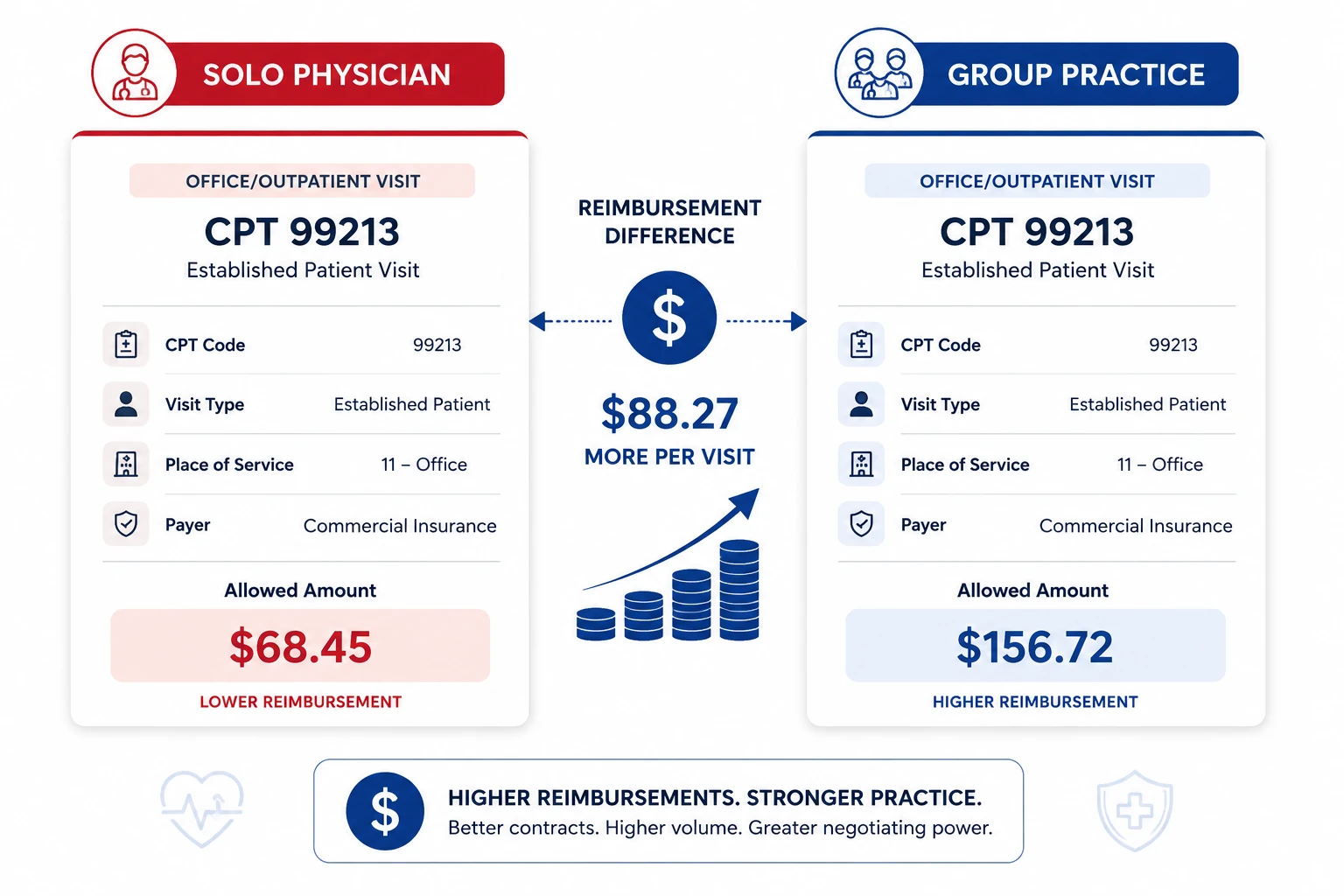
Two identical 99214 claims. Same payer. Same CPT code. One physician collects $148. The other collects $112. The first provider is part of a 15-doctor group practice. The second runs a solo office across the street. Same service. Same diagnosis. $36 less — every single visit. Multiply that across 20 patients a day, five days a week, and you’re looking at a $187,200 annual revenue gap for doing identical work. This is happening to independent physicians everywhere, and most have no idea their payer contracts are the reason.
Medical billing reimbursement rates are not uniform. They are negotiated, tiered, and systematically weighted to reward the largest providers — which means every independent physician operating outside a group structure is starting at a built-in disadvantage. This guide breaks down exactly why that gap exists, what it costs you in real dollars, and how to close it. If you’re serious about protecting your practice revenue, this is the most important thing you’ll read this year. You can start by reviewing your options with medical billing services for independent practices.
Quick Answer: Why Are Medical Billing Reimbursement Rates Lower for Solo Practices?
Medical billing reimbursement rates are consistently lower for solo practices because independent physicians lack the volume, leverage, and dedicated contract infrastructure that group practices use to negotiate higher allowed amounts. A solo physician billing the same CPT codes as a group practice may collect 15–30% less per claim — simply because of contract terms, not clinical performance.
The Real Dollar Gap: What Solo Practices Lose Per CPT Code
The reimbursement gap isn’t theoretical. It shows up on every ERA, every remittance advice, and every line item where your allowed amount is quietly set lower than your clinical peers across town.
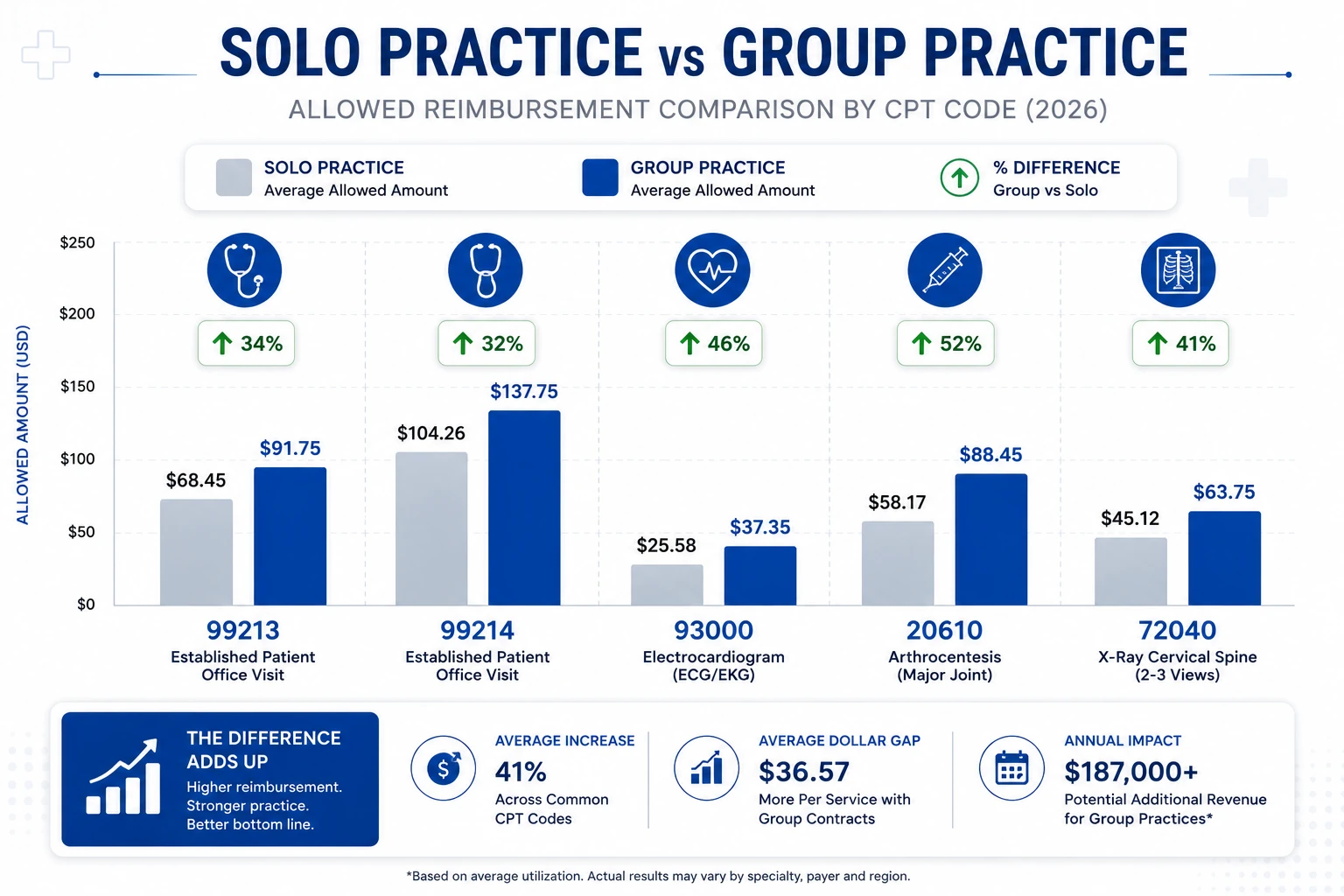
Here’s what the difference looks like in practice. For CPT code 99214 — one of the most commonly billed evaluation and management codes for established patients — solo physicians routinely receive between $108 and $122 from commercial payers. Physicians in a group practice contract often receive $140 to $158 for that exact same code, with the same payer, under the same network agreement. That’s a $36 gap per encounter. Per visit. Every day you see patients.
For CPT 99213, the gap narrows slightly but still averages $18–$24 per encounter. For higher-complexity codes like 99215, the spread widens further — solo practices are frequently collecting $15–$40 less per claim than their group-contracted counterparts.
What makes this so costly isn’t any single claim. It’s the compounding effect. A solo internal medicine physician seeing 18 patients per day at a $28 average rate disadvantage loses more than $126,000 annually — before factoring in underpaid procedures, modifiers, and Medicare Advantage claim behaviors. The revenue isn’t being denied. It’s just silently withheld, and if nobody audits your fee schedules, it stays that way.
Why Medical Billing Reimbursement Rates Differ for Solo vs Group Practices — The Core 5 Reasons
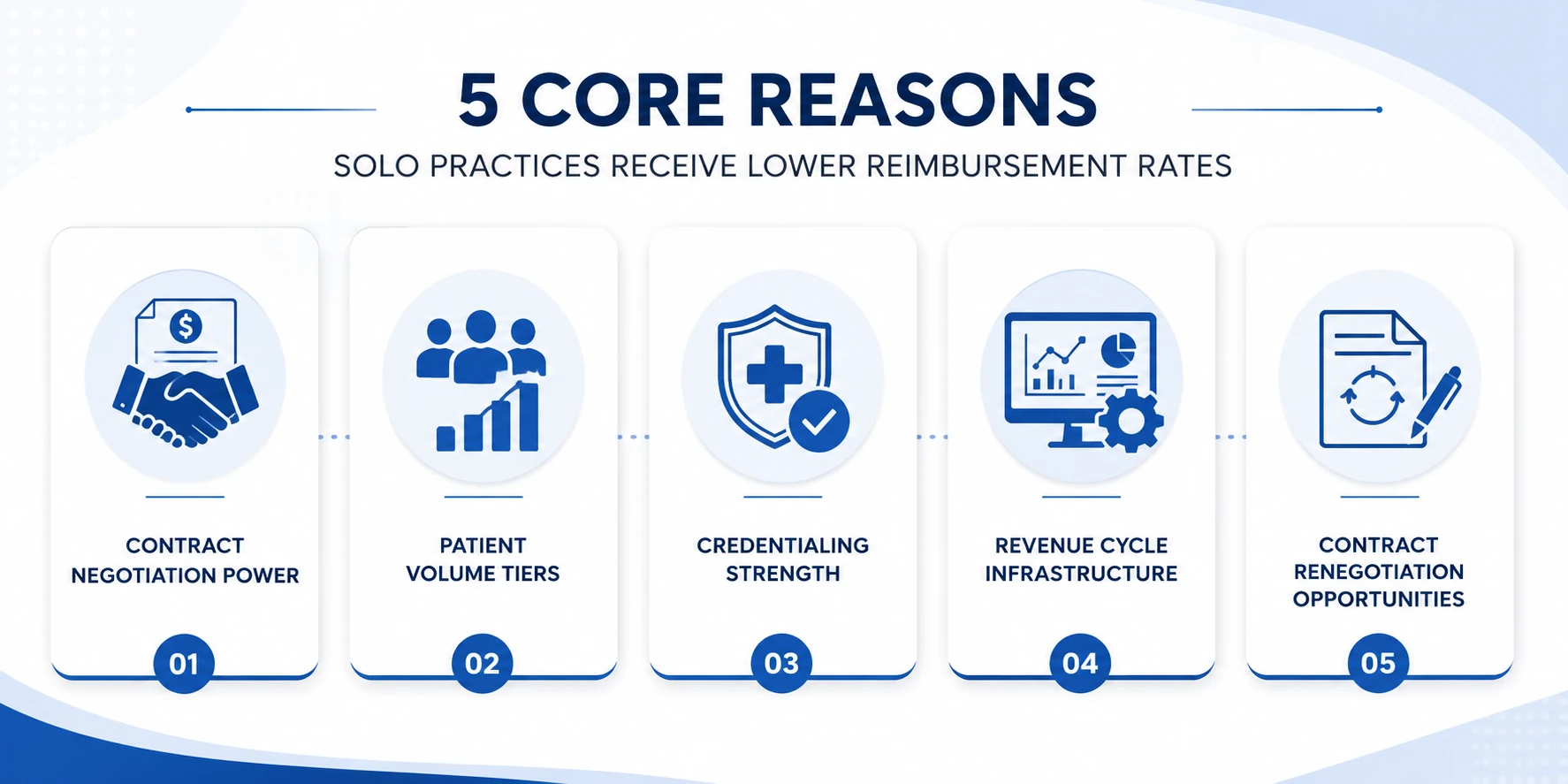
Understanding why solo practice reimbursement rates are lower requires understanding how insurance companies set their fee schedules. It is not random. It is a structured, repeatable system that consistently benefits high-volume providers — and leaves independent physicians behind.
Payer Contract Negotiation Leverage
The single biggest driver of the reimbursement gap is negotiating leverage. When a large group practice or hospital system sits across the table from a payer, they bring volume. They represent hundreds of thousands of covered lives, a significant share of the payer’s in-network provider directory, and the implicit threat that walking away disrupts patient access for thousands of members. Payers don’t want that friction. They negotiate.
Solo physicians bring none of that leverage. From a payer’s perspective, removing a solo physician from their network affects a small number of covered lives and produces minimal disruption. That reality gives payers little incentive to offer competitive medical billing reimbursement rates — and every incentive to start negotiations at the lowest defensible allowed amount.
Insurance contract negotiation for a solo practice is still possible and still worth pursuing. But it requires a different approach: data, documentation, and often a third-party billing partner with existing payer relationships.
Volume-Based Rate Tiers and Patient Panel Size
Most commercial payers structure their fee schedules in tiers. The more claims you submit, the more patients you serve, and the more your panel size grows — the higher your tier and the better your rates. Group practices with 10, 20, or 50 physicians naturally hit these volume thresholds without effort. Solo physicians almost never qualify for the upper tiers under their individual NPI.
What makes this particularly damaging is that most payer contracts don’t disclose the existence of these tiers. You’re placed into a tier at credentialing, and unless you ask specifically about volume-based rate tier eligibility and negotiate for an exemption or a reclassification, you stay there. Independent physician billing rates are often set in the lowest tier by default — not because the payer evaluated your quality, but because your volume doesn’t trigger an automatic upgrade.
Credentialing and Network Enrollment Disadvantages
Credentialing delays cost money. When a solo physician joins a new payer network — or when their re-credentialing lapses — they can face weeks or months without in-network rates while claims process at out-of-network or rejected status. Group practices have dedicated credentialing coordinators who monitor expiration dates, track provider enrollment status, and prevent gaps. Most solo physicians don’t.
Beyond delays, credentialing mismatches — a billing NPI that doesn’t align with the credentialing record, a taxonomy code error, or an outdated group enrollment — silently trigger payment reductions or denials. These aren’t flagged as errors by payers. They just pay less. Or don’t pay at all. Make sure your clinical documentation and coding accuracy is audit-ready before you push for a contract renegotiation — payers will use documentation gaps to push back.
Lack of Dedicated Billing Infrastructure
Group practices have billing departments. They have denial management workflows, underpayment tracking systems, and staff whose entire job is to compare contractual adjustments against contracted rates and escalate discrepancies. A solo practice billing through a front office coordinator or a part-time biller does not have that infrastructure.
The result: underpayments go undetected. Contractual adjustments that exceed the contracted write-off amount get accepted as-is. Accounts receivable (AR) ages without follow-up. And payers — who are perfectly aware of which practices have the bandwidth to audit them — pay accordingly. Your clean claim rate suffers, your accounts receivable metrics deteriorate, and the cycle reinforces itself.
Failure to Renegotiate Contracts Annually
Physician reimbursement rates are not static. Costs go up. The Medicare fee schedule gets updated annually. RVU values shift. But payer contracts? They often stay exactly where they were signed — sometimes five or even ten years ago — unless someone actively pushes to update them.
Group practices build contract renegotiation into their annual revenue cycle management calendar. Most solo practices don’t. And managed care contracts with no renegotiation activity quietly become the lowest-paying contracts in the market as inflation erodes the real value of every allowed amount. Explore what ongoing revenue cycle management services look like for independent practices — it’s worth the comparison.
Medical Billing Reimbursement Rates — How Allowed Amounts Are Set for Solo vs Group Providers
Payers do not set allowed amounts arbitrarily, but they do set them strategically. Understanding the mechanics helps you understand where your leverage points are.
Every commercial payer builds their fee schedule starting from a reference point — most commonly the Medicare Physician Fee Schedule (MPFS). The MPFS calculates payment based on relative value units (RVUs), which are made up of three components: work RVU (physician time and skill), practice expense RVU (overhead costs), and malpractice RVU (liability). These are then adjusted by the geographic practice cost index (GPCI), which accounts for regional cost variation.
Commercial payers then apply a multiplier to the MPFS rates. Large group practices negotiate that multiplier up. Solo physicians — if they negotiate at all — might get a slight improvement from the default. Most don’t get there. The result is that solo practice reimbursement rates for the same CPT code, in the same ZIP code, from the same payer, can sit at 85–90% of Medicare while the group across the street is collecting 115–120% of Medicare.
Medicare Fee Schedule vs Commercial Payer Allowables — What the Gap Actually Looks Like
Traditional Medicare is a floor, not a ceiling — but for solo physicians, it often functions as a ceiling because commercial payers slot them into rates that hover right around it or, in the case of Medicare Advantage plans, below it.
According to CMS data from the 2025 Physician Fee Schedule Final Rule, the national average allowed amount for CPT 99214 under traditional Medicare is approximately $130. A solo physician whose top commercial payer pays $109 for the same code is being reimbursed at roughly 84% of the Medicare benchmark — which means they are losing money relative to government payer rates while technically contracted with a commercial plan. This should never happen. But without a systematic contract audit, it goes unnoticed and unchallenged. Learn more about how medical billing services can create structure around your fee schedule monitoring.
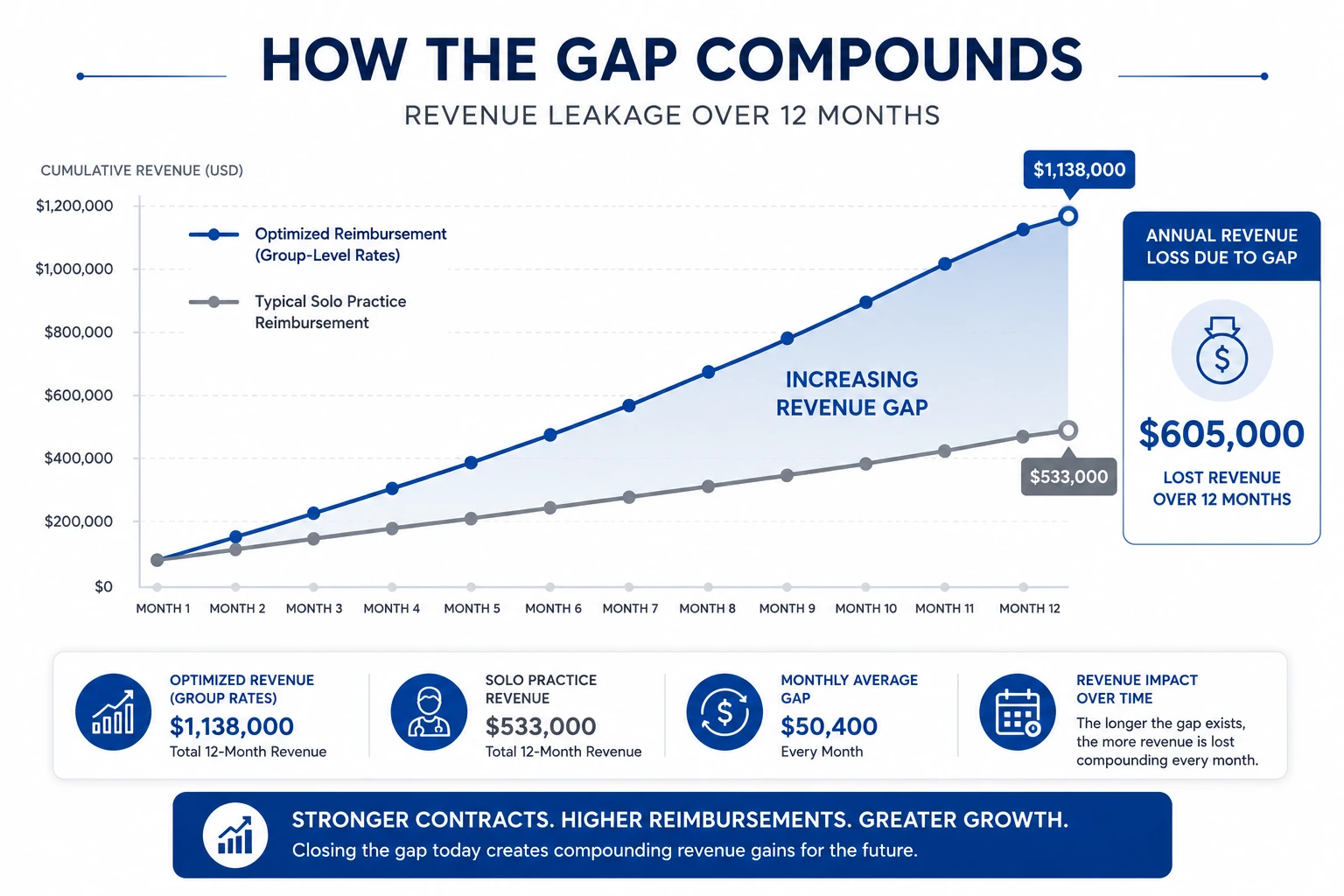
Medical Billing Reimbursement Rates — How the Revenue Gap Compounds Over Time
The reimbursement gap doesn’t just cost you money today. It costs you more money every year it goes uncorrected — and it costs you more money per year than it did the year before.
The Compounding Effect: Small Rate Gaps Become Six-Figure Annual Losses
Consider a solo family physician seeing 16 established patients per day, five days per week, 48 weeks per year. That’s 3,840 encounters annually. If the average allowed amount gap between their payer contracts and comparable group practice rates is $30 per visit, the annual revenue loss is $115,200. If that gap persists for three years without correction, the physician has left $345,600 on the table — not from denied claims, not from coding errors, but from underpriced contracts that nobody renegotiated.
This doesn’t include procedure codes, new patient encounters, or ancillary services, where rate gaps can be even larger. Physician reimbursement rates compound in exactly the same way that interest does — except in reverse, and it’s your revenue that’s shrinking.
Hidden Revenue Leakage: Underpayments Solo Practices Never Catch
The most insidious form of revenue loss isn’t denials. It’s underpayments — claims where the payer paid something, just not what the contract requires.
Payer systems are not perfect. Rates get loaded incorrectly. Fee schedule updates don’t apply retroactively. Modifier adjustments get processed wrong. In a group practice, someone catches it. In a solo practice, the ERA shows a payment, the biller posts it, and the underpayment becomes permanent revenue loss.
MGMA data indicates that the average medical practice fails to identify roughly 2–3% of claims that were paid below the contracted rate. For a solo physician billing $600,000 annually, that’s $12,000–$18,000 in missed recovery — recoverable money that simply isn’t being claimed because nobody is running payer-by-payer allowed amount reconciliation.
Medical Billing Reimbursement Rates — Solo vs Group Practice Trends in 2026
The data on this is clear, consistent, and frustrating for independent physicians. Here’s what the current research shows:
1. Average reimbursement rate gap by CPT code. According to MGMA’s 2025 Physician Compensation and Production Report, the allowed amount gap between solo and group practices for common E&M codes averages 18–24%. For CPT 99214, solo practice allowed amounts average $108–$122 while group contract rates average $140–$158 with major commercial payers.
2. Contract renegotiation inactivity. An AMA survey of independent physician practices found that approximately 62% of solo physicians had not formally renegotiated a commercial payer contract in the past three years. Of those, more than half had never submitted a formal written renegotiation request to any payer. Passive contracts are the direct cause of the lowest independent physician billing rates in the market.
3. Annual revenue gap by specialty. The financial impact of the reimbursement gap varies by specialty, but it is never negligible. Primary care solo physicians lose an estimated $65,000–$120,000 annually compared to equivalent group practice peers. In dermatology, where procedure codes drive significant revenue, the gap can exceed $180,000 annually. Orthopedic solo practitioners report the widest exposure — some exceeding $250,000 in annual reimbursement disadvantage when procedure reimbursement is included.
4. Commercial payers paying below Medicare. CMS analysis and third-party billing industry data suggest that approximately 1 in 4 solo physicians has at least one commercial payer contract that reimburses at rates below the Medicare Physician Fee Schedule for one or more high-volume CPT codes. This is the definition of a broken contract — and it is recoverable.
5. CPT code comparison: solo vs group allowed amounts. The impact of payer contracts on solo practice revenue is most visible at the CPT code level. For 99213: solo average $72–$84 vs. group average $93–$105. For 99214: solo $108–$122 vs. group $140–$158. For 99215: solo $142–$158 vs. group $178–$205. These figures reflect commercial payer averages and will vary by geography, specialty, and specific payer. Source: MGMA/CMS benchmarks, 2025–2026.
6. Medicare Advantage reimbursement behavior. Medicare Advantage plans are not bound to Medicare fee schedule rates. They negotiate independently — and solo physicians routinely accept MA plan rates 10–30% below traditional Medicare without realizing it. The AMA’s 2024 Prior Authorization and Medicare Advantage Physician Survey found that physicians in small or solo practices were significantly more likely to accept MA contract terms without modification than their group-affiliated peers. Medical billing reimbursement rates from MA plans deserve a separate audit from your commercial contracts.
7. TMS Billings internal benchmark. Across our client base, solo practices that renegotiated their payer contracts through TMS Billings saw an average reimbursement increase of $22–$38 per CPT code within 90 days of a completed contract audit and renegotiation submission. The fastest results came from practices with at least one commercial contract paying below Medicare benchmark — which gave us immediate, data-backed leverage in negotiations. The average recovery in recurring annual revenue was $74,000–$118,000 per solo physician client.
Payer-Specific Rules That Silently Shortchange Solo Physicians
This is the section most billing articles skip. Individual payer behavior — not just general market dynamics — is one of the biggest drivers of solo practice reimbursement rate gaps. Here’s what each major payer does that specifically disadvantages independent physicians.
Blue Cross Blue Shield tiered fee schedules. BCBS operates tiered network participation levels in most markets. Large practices and hospital-affiliated groups are placed into preferred network tiers, which carry higher allowed amounts, better patient incentives, and promotional placement in provider directories. Solo physicians who join a BCBS network are typically defaulted into the standard participation tier — a lower-paying tier — unless they actively request tier reclassification. Most never do, because they don’t know the tier system exists.
Medicare Advantage plan rate floors. MA plans are sold and administered by private insurers — United, Aetna, Humana, BCBS — and each sets its own rates. Unlike traditional Medicare, there is no uniform floor. A UnitedHealthcare MA plan can legally pay you 20% below traditional Medicare for a 99214, and they will, if your contract allows it. Solo physicians with mixed payer mixes that include several MA plans are particularly exposed. Auditing your MA contracts separately from your commercial contracts is essential.
UnitedHealthcare and Aetna volume thresholds. Both UnitedHealthcare and Aetna use claim volume and patient panel data to assign provider payment tiers. Practices that submit high claim volumes, maintain strong quality scores, and demonstrate consistent network engagement move into higher-paying value-based or preferred provider tiers. Solo physicians rarely hit the volume thresholds that trigger automatic tier upgrades. However, both payers do allow for manual tier reclassification requests backed by practice data — a step that most solo physicians and their billers never take.
Medicaid managed care organizations. MCOs that administer Medicaid managed care benefits negotiate bulk contracts with large group practices, hospital systems, and community health centers. Solo physicians accepting Medicaid managed care are typically assigned to default low-tier rate schedules. These schedules are set during the MCO’s annual contracting cycle, and unless you submit a formal objection or counter-proposal, you get whatever rate the MCO assigned. Joining an Independent Physician Association (IPA) can provide collective leverage in MCO negotiations — one of the most underutilized strategies in independent physician billing.
Silent PPO pass-through arrangements. This is the least understood and most financially damaging payer mechanism affecting solo practices. A silent PPO occurs when your contracted payer sells access to your in-network discount to a third-party rental network — without notifying you and, in some cases, without explicit authorization in your original contract. The third-party network then routes claims through your discount, applying rates you never negotiated with that payer. The result: you receive payment at your in-network discount rate for patients who are technically out-of-network or covered by a different plan entirely. If you’ve ever seen an ERA with a payer name you don’t recognize but a payment processed at your contracted rate, you may have been affected by a silent PPO arrangement.
Visit TMS Billings to learn how we identify and challenge silent PPO activity for independent physician clients.
Before and After: A Real Solo Practice Reimbursement Recovery Case Study
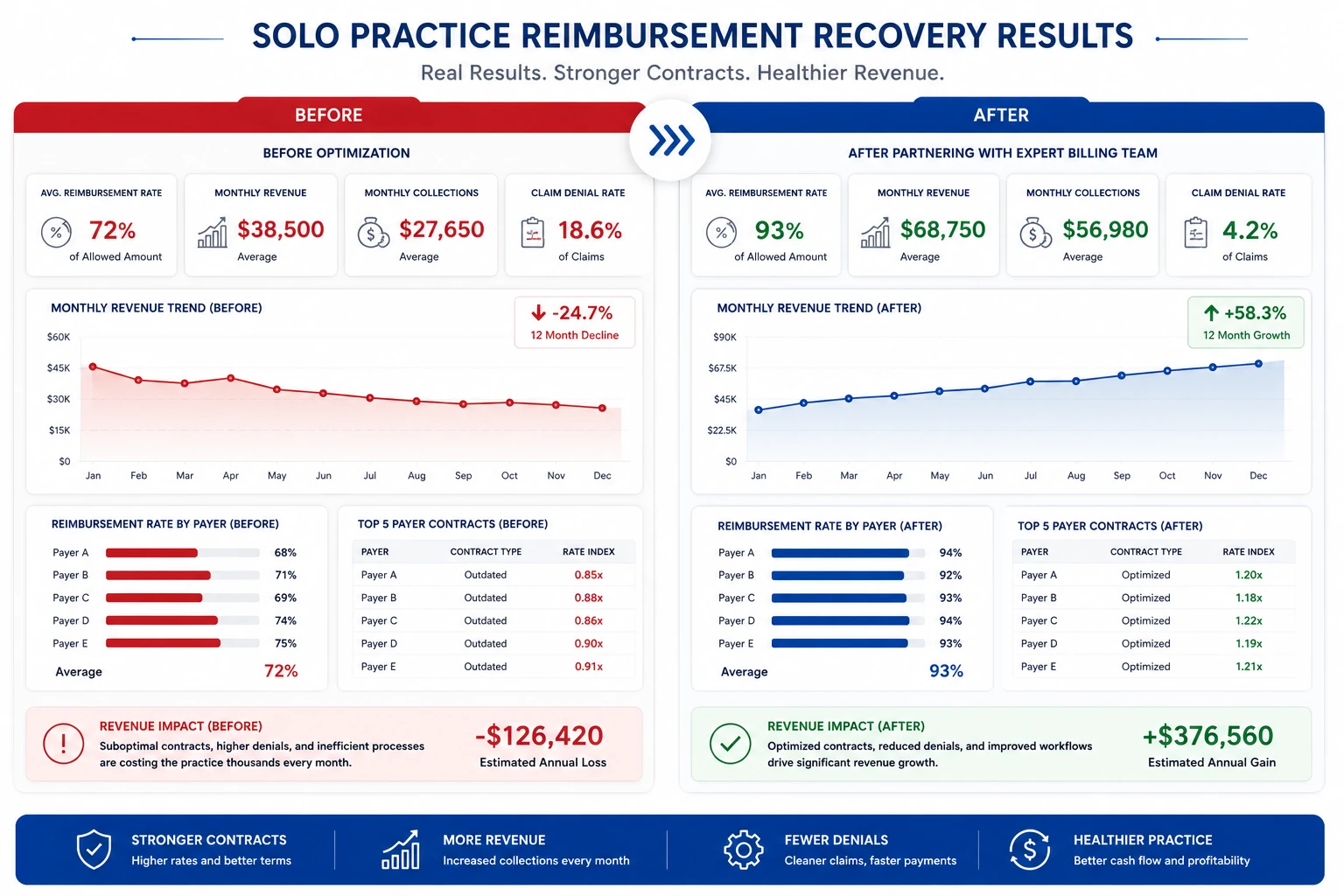
A solo internal medicine physician in the Southeast had been in practice for nine years when she first contacted TMS Billings. Her collections felt stable — until we ran a full contract audit.
Before TMS Billings:
Her average reimbursement for CPT 99214 from her largest commercial payer (a regional BCBS plan) was $109 per encounter. Her top three payers were collectively producing $28,400 per month in collections. One payer — a UnitedHealthcare Medicare Advantage plan — was paying her $97 per 99214, which was 25% below the traditional Medicare benchmark for her area. She had no documentation that this rate had ever been formally discussed or accepted. It was simply the rate that appeared in the initial contract paperwork, and it had never been questioned.
What we changed:
We conducted a full payer-by-payer contract audit, benchmarked her top 20 CPT codes against CMS geographic fee schedule data and MGMA specialty benchmarks, and identified three contracts producing below-market rates. We submitted a formal renegotiation request to BCBS backed by RVU benchmarking data, quality attestation, and a documented history of zero-balance claims. For the UnitedHealthcare MA plan, we submitted a Medicare rate floor request supported by CMS Physician Fee Schedule data.
After 90 days:
Her average BCBS allowed amount for CPT 99214 increased from $109 to $141 — a 29% improvement. The UnitedHealthcare MA plan increased her rate from $97 to $122, eliminating the sub-Medicare floor. Monthly collections increased from $28,400 to $36,800. The annualized revenue increase was $100,800. No new patients. No new services. The same practice, with the same clinical outcomes — just contracts that finally reflected fair market value.
Most Common Reasons Solo Practices Are Underpaid — Side-by-Side Impact Tables
Table 1: Solo Practice vs Group Practice Reimbursement — Side-by-Side
| Factor | Group Practice | Solo Practice |
|---|---|---|
| Average 99214 allowed amount | $140–$158 | $108–$122 |
| Payer contract leverage | High (volume + data) | Low (no volume tier) |
| Annual renegotiation rate | Routine (built into contract cycle) | Rarely pursued |
| Access to volume-based rate tiers | Yes | Rarely |
| Risk of silent underpayment | Low (dedicated billing team monitors) | High (often undetected) |
| Revenue cycle support | Dedicated billing department | 1–2 staff or outsourced |
| MA plan rate monitoring | Active, quarterly | Passive or never |
| Contract audit frequency | Annual | Rarely or never |
Source: MGMA 2025 Physician Compensation Report; CMS Physician Fee Schedule 2025–2026; TMS Billings internal client benchmarks.
Table 2: Reimbursement Rate Recovery ROI — In-House Billing vs TMS Billings
| Metric | In-House Billing | TMS Billings |
|---|---|---|
| Contract audit frequency | Rarely or never | Annually + at onboarding |
| Underpayments identified per month | Low detection rate | High detection rate |
| Payer renegotiation submissions | Infrequent | Systematic, data-backed |
| Average rate increase per CPT code (99214) | $0–$8 | $22–$38 |
| Monthly revenue recovered | Minimal | $6,000–$9,800 avg. |
| Time to first rate improvement | 6–18 months (if pursued) | 60–90 days |
| Silent PPO detection | Rarely identified | Standard audit item |
| Clean claim rate improvement | Marginal | 12–18% average gain |
TMS Billings internal client data, 2024–2026. Individual results vary based on practice size, specialty, and payer mix.
How to Negotiate Higher Reimbursement Rates as a Solo Practice — Step-by-Step
Insurance contract negotiation for a solo practice is not the same as it is for a hospital system. But it is absolutely doable — with the right preparation.
Step 1: Pull your current payer fee schedules. Request a written copy of your allowed amounts for your top 20 CPT codes from every contracted payer. Most solo physicians have never seen their own fee schedules in writing. Payers are required to provide them upon request. This is your starting data point.
Step 2: Benchmark against the Medicare fee schedule. Use the CMS Physician Fee Schedule lookup tool at cms.gov to compare your commercial allowed amounts against your geographic benchmark. Any commercial rate sitting below Medicare is your first, strongest renegotiation target.
Step 3: Identify your highest-volume CPT codes. The codes you bill most frequently are where rate improvements produce the largest compounding impact. If 99214 represents 60% of your encounters, a $25 rate improvement on that code alone generates significant annual revenue. Prioritize ruthlessly.
Step 4: Build your case with supporting data. Payers respond to data, not requests. Compile your patient volume, clean claim rate, quality metrics, no-show rate, denial rate, and specialty benchmarks from MGMA or AAPC. Show them you are a low-administrative-burden, high-quality provider. That is the argument that moves rates.
Step 5: Submit a formal renegotiation request in writing. Contact the payer’s provider relations or contracting department and submit your request in writing with a specific rate proposal. Verbal conversations are not binding and are rarely actioned. A written submission creates a paper trail, establishes a negotiation record, and gives you standing for escalation if the response is inadequate.
Step 6: Submit a counter-proposal with RVU-backed pricing. Reference current work RVU values and the geographic practice cost index (GPCI) for your area. Show the payer that your requested rate reflects fair market value relative to CMS benchmarks — not just what you want to collect. Payers take RVU-backed proposals more seriously than flat dollar requests because they reflect the same methodology payers use internally.
Step 7: Escalate to a billing partner if direct negotiation stalls. Payers respond differently to professional billing firms than to solo physicians. A third-party billing partner with existing payer relationships, negotiation volume, and documented outcomes can open doors that individual providers cannot. If your direct negotiation stalls at 60 days without meaningful progress, bring in support.
Best Practices to Maximize Medical Billing Reimbursement Rates for Solo Physicians
Use this 12-point audit checklist as your annual review framework. Every item on this list represents a recoverable revenue opportunity.
- Compare your allowed amounts to the Medicare fee schedule for your top 20 CPT codes. Any commercial rate below Medicare benchmark is a documented renegotiation case that payers cannot easily reject.
- Request a current, written fee schedule from every contracted payer. Rates can change mid-contract without notice. Verbal assurances are not binding. Always verify in writing, annually.
- Track reimbursement rates separately by payer. You may be collecting well from one payer while being severely underpaid by another. Aggregate collections data hides this reality.
- Identify CPT codes where contractual adjustments are highest. Large write-offs between your billed amount and allowed amount signal rate gaps — not just billing problems.
- Review your contracts for anniversary renegotiation windows. Missing the renegotiation window in your contract locks you into current rates for another full contract cycle. Track these dates proactively.
- Document your patient volume and quality metrics before any renegotiation submission. Payers use data to set rates. Your submission needs to speak the same language.
- Evaluate whether joining an IPA or ACO would improve your network rates. An Independent Physician Association pools the negotiating leverage of solo and small group physicians — and can qualify for volume-tier rates no individual physician could reach alone.
- Verify your credentialing is current and matches your billing NPI. Credentialing mismatches silently reduce payments or trigger denials that post as zero-pay or patient-responsibility errors on your ERA.
- Submit clean claims within 30 days of service. Your clean claim rate is a documented negotiating asset. Payers offer better rates to low-hassle providers. Protect that metric.
- Track your contractual adjustments monthly. A sudden increase in write-offs is the first sign of a rate change or a silent underpayment situation. Catch it early.
- Appeal underpayments within the payer-specified window. Underpayments have the same appeal deadlines as outright denials. Miss the window, and that recovery is gone permanently.
- Conduct an annual billing audit with a certified medical billing partner. An outside audit consistently identifies rate gaps, billing pattern errors, and underpayments that in-house teams don’t catch — not because they aren’t capable, but because they lack the payer-specific benchmarking data to know what to look for.
How TMS Billings Helps Independent Practices Close the Reimbursement Gap
Most billing companies process your claims. TMS Billings looks at what those claims are actually being paid — and whether it matches what your contract says you’re owed.
Our revenue cycle management for independent physician practices starts with a full contract and fee schedule audit. We pull your allowed amounts from every contracted payer, benchmark them against CMS data and MGMA specialty standards, and identify every contract producing below-market rates. From there, we build a payer-specific renegotiation strategy: which payers to target first, which CPT codes to prioritize, and what data to use in each submission.
We submit formal renegotiation requests on your behalf — in writing, with RVU benchmarking, geographic GPCI analysis, and quality documentation. We follow up. We escalate. And when rate improvements are secured, we monitor your incoming ERAs to verify the new rates are being applied correctly.
We also run silent PPO detection as a standard part of our onboarding audit — identifying any third-party network pass-through arrangements that may be quietly reducing your in-network rates without your knowledge.
The result, for our solo practice clients, is an average of $74,000–$118,000 in recovered annual revenue — from contracts that were already in place. Not new patients. Not new services. Just your existing work, paid at the rates your practice deserves.
Get started with our medical billing services for independent practices or explore a full overview of our medical billing services.

Key Takeaways
- Medical billing reimbursement rates for solo practices are typically 15–30% lower than for group practices billing the same CPT codes with the same payers.
- The gap is structural — built into how payers set fee schedules, volume-based rate tiers, and the negotiating dynamic between small independent physicians and large insurance organizations.
- The annual revenue cost of the reimbursement gap ranges from $65,000 to $250,000+ depending on specialty, payer mix, and contract history.
- Most solo physicians have never formally renegotiated a payer contract — which means most are locked into initial rates that no longer reflect market value.
- Payer-specific mechanisms — BCBS tiered networks, MA sub-Medicare floors, UHC volume thresholds, silent PPO arrangements — create additional rate compression that most practices never identify.
- Contract audits, RVU-backed renegotiation proposals, and ongoing ERA monitoring are the most effective tools for closing the gap.
- TMS Billings clients have achieved average reimbursement increases of $22–$38 per CPT code after contract audit and renegotiation support, with a 60–90 day average time to first rate improvement.
Final Thoughts + CTA
The reimbursement gap between solo and group practices is real, it is measurable, and it is not going to close itself. Every month your payer contracts go unreviewed is another month of revenue that leaves your practice and doesn’t come back.
The good news: this is one of the most recoverable problems in independent practice finance. You are not losing patients. Your clinical outcomes are not the problem. Your contracts are — and contracts can be renegotiated.
Most solo physicians who discover how much they’ve been leaving on the table through underpriced contracts are surprised by two things: how large the number is, and how few changes are actually required to recover it.
Find out exactly how much your solo practice is leaving on the table.
TMS Billings offers a free reimbursement rate audit for independent physicians — we’ll compare your top 10 CPT codes against current market rates, identify your biggest underpayment gaps by payer, and show you the exact dollar amount you could be collecting right now. No commitment. No fluff. Just numbers.