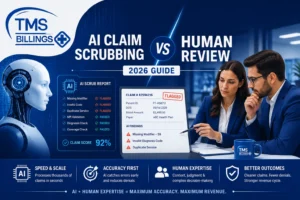
AI Claim Scrubbing vs. Human Review: What Practice Owners Actually Need in 2026
If a vendor or your billing company has pitched you on “AI-powered” claim review in the last year, you’re not alone. AI claim scrubbing is now standard language in nearly every revenue cycle sales deck, and for good reason — denial rates keep climbing and staff time keeps shrinking. But before you swap tools or sign a contract, it’s worth separating real medical billing automation from marketing language, and understanding what AI claim scrubbing actually does, what it still can’t do, and where it fits next to the team you already trust. Framed as an AI vs human medical billing debate, the question sounds binary — in practice, it isn’t. This guide walks through how Medical Billing Services blend both, so your practice gets the speed of automation without losing the judgment a denial-prone claim still needs.
What Is AI Claim Scrubbing?
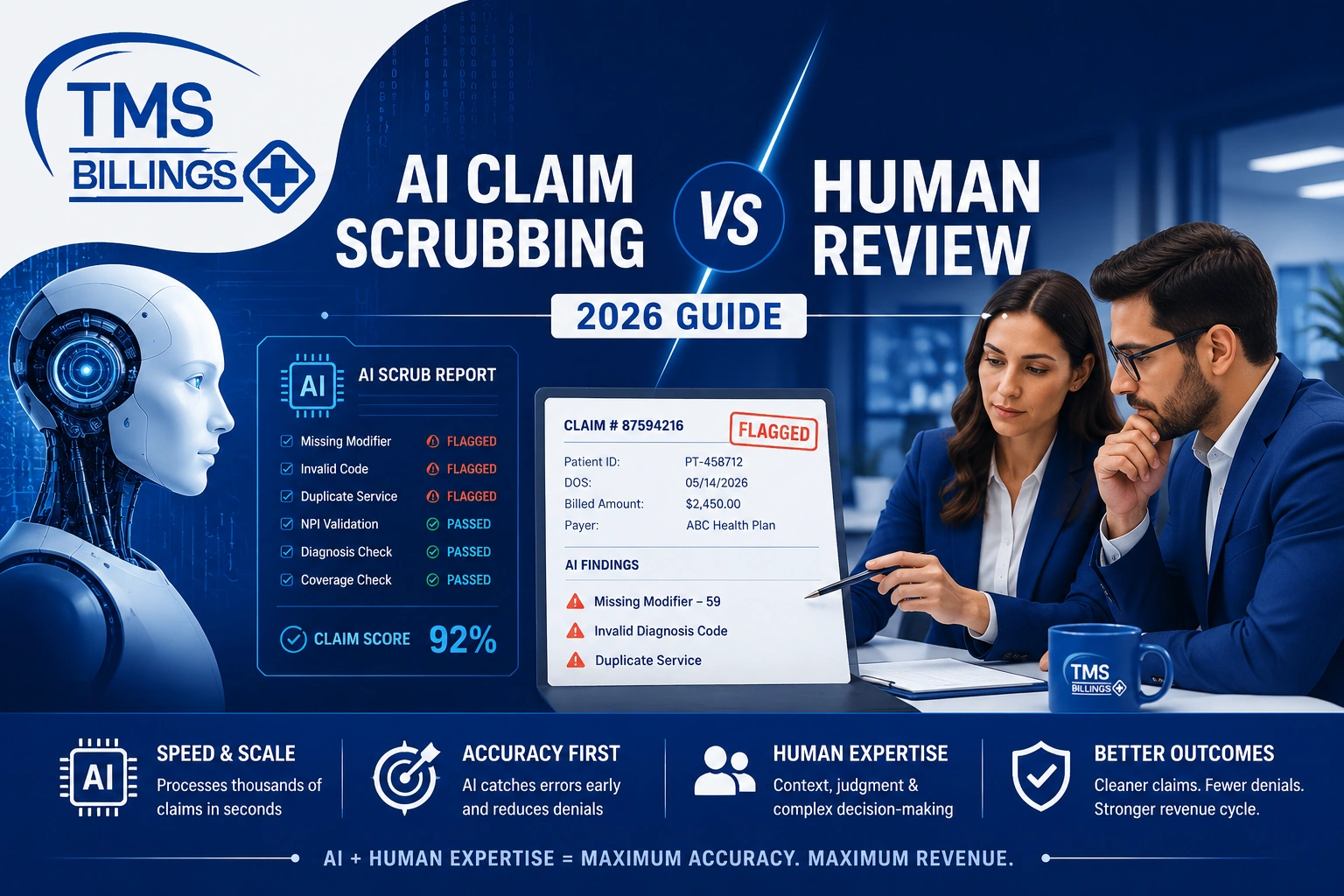
AI claim scrubbing uses machine learning to review claims before they’re submitted, flagging coding errors, missing documentation, and payer-specific red flags likely to trigger a denial. Unlike older rule-based scrubbers that only check claims against a fixed list, AI claim scrubbing tools learn from historical claims data to predict which submissions are actually at risk — before a payer ever sees them. So does AI claim scrubbing reduce denials? In most documented cases, yes — though by how much depends heavily on the tool, the specialty, and how it’s used.
Why “AI vs. Human” Is the Wrong Frame for Most Practices
Vendors love to frame this as a replacement story: software in, billers out. In practice, that’s not how successful denial prevention works. The practices posting the best clean claim rate numbers aren’t choosing AI or humans — they’re routing each claim type to whichever does that job better. Understanding that split starts with knowing what each side actually catches.
What AI Claim Scrubbing Actually Catches
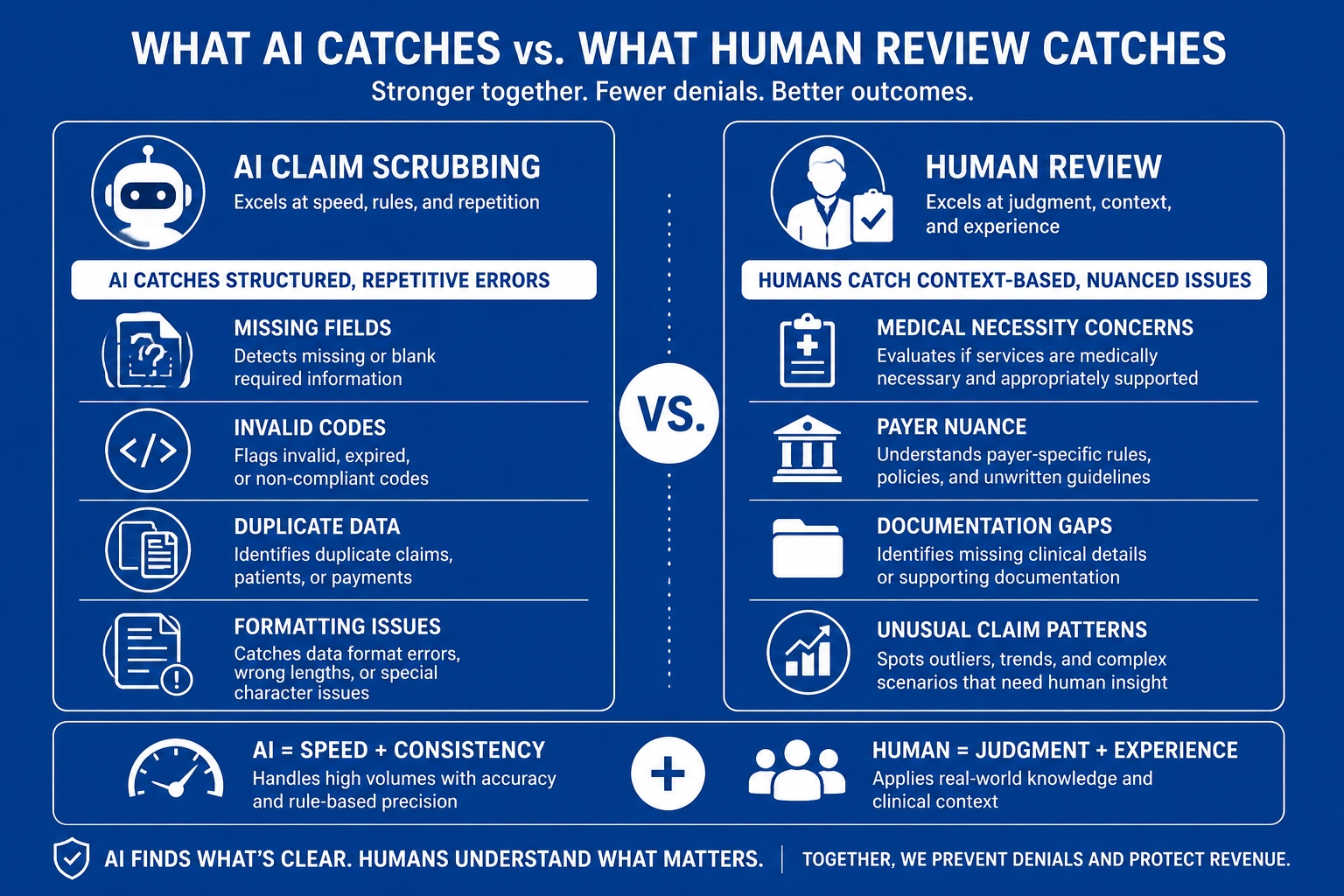
A well-trained model is fast and tireless at pattern-based checks, including:
- Eligibility mismatches — coverage lapses, terminated plans, or wrong payer IDs caught in real time
- Modifier errors — missing or mismatched modifiers against NCCI edit pairs
- Missing documentation flags — claims lacking a required attachment or prior auth reference number
- Deleted or outdated codes — ICD-10/CPT codes retired in the most recent annual update
- Payer-specific rule violations — claims that don’t match a specific plan’s submission requirements
These are exactly the coding errors caught by AI before a claim ever leaves the building. According to AAPC‘s 2024 Coding and Compliance Report, coding-related issues still drive 25–30% of all initial claim denials — squarely the territory automated checks are built for.
What Only a Human Reviewer Can Catch
Software is pattern-matching against historical data. It doesn’t read a chart the way a credentialed coder does. Experienced billers still catch things like:
- Documentation that’s technically present but doesn’t actually support medical necessity for the code billed
- Clinical nuance — a borderline case where two codes are both technically valid but one is far more defensible on appeal
- Payer behavior that hasn’t shown up in the training data yet, like a new local coverage determination
- Patient-specific context (a recent plan change, a coordination-of-benefits issue) that isn’t fully reflected in the EHR
This is the core of the AI vs human medical billing question: AI is excellent at “does this match the rule,” and far weaker at “would a reasonable reviewer agree this claim is medically justified.”
How AI Claim Scrubbing Works
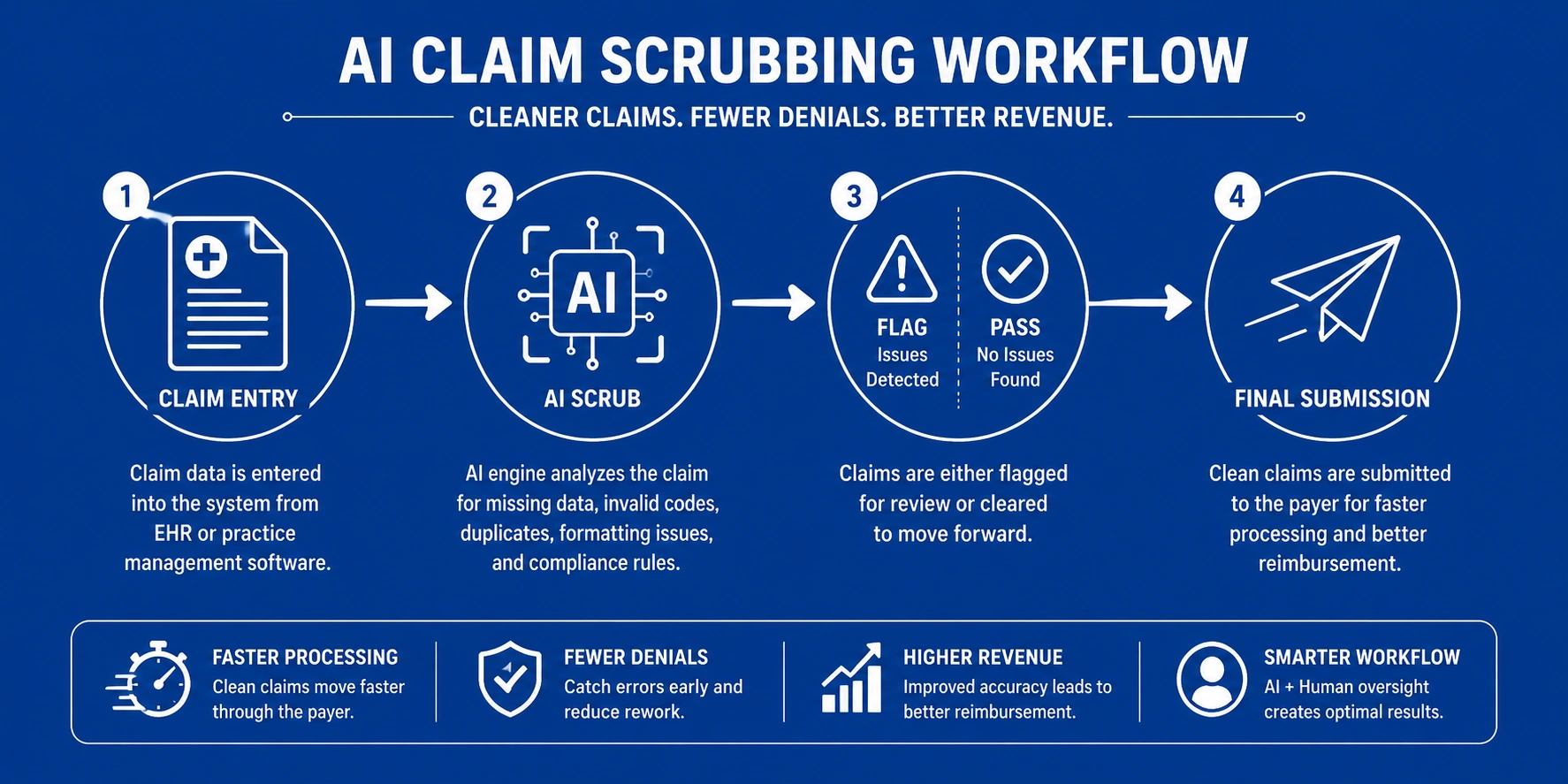
So how does AI claim scrubbing work in practice? Three components do most of the work.
Denial Prediction and Machine Learning Models
Denial prediction software is trained on a practice’s (or a billing company’s) historical claims and outcomes. It learns which combinations of code, payer, modifier, and documentation pattern correlate with a denial, then scores new claims accordingly before submission — this is machine learning claims processing in its most practical form.
Real-Time Eligibility and Documentation Checks
Modern tools run real-time claim adjudication simulations, checking eligibility, benefits, and documentation completeness at the point of entry rather than after the fact, so issues surface while a front-desk or billing staffer can still fix them same-day.
EHR and Practice Management System Integration
None of this works in isolation. EHR integration billing software is now a baseline expectation, not a premium add-on — the scrubber needs to pull clinical notes, demographics, and prior claims data directly from your EHR and practice management system to score claims accurately. For more on how documentation gaps specifically feed denials, see our breakdown of clinical documentation errors in medical coding.
How Human Claims Review Works
Human review still follows a structured process: a certified coder or biller checks code-to-documentation alignment, confirms medical necessity, verifies modifier logic against payer-specific nuance, and applies judgment to anything the scrubber flagged as ambiguous. It’s slower per claim, but it carries context no model has yet replicated.
What Experienced Billers Catch That Software Can’t
Tenured billers develop a memory for this specific payer’s recent behavior — which adjusters are denying which code pairs this quarter, which documentation phrasing gets claims through faster, which appeals are worth the staff time. That institutional memory doesn’t transfer to a model overnight.
Where Human Review Still Outperforms AI
Complex, multi-procedure claims, claims involving medical necessity disputes, and anything tied to an active appeal still benefit from a human set of eyes. AI vs human claims review accuracy isn’t a blowout in either direction — accuracy on routine claims tends to favor automation, while judgment-heavy claims still favor experienced staff.
AI Claim Scrubbing vs. Human Review — Side-by-Side Comparison
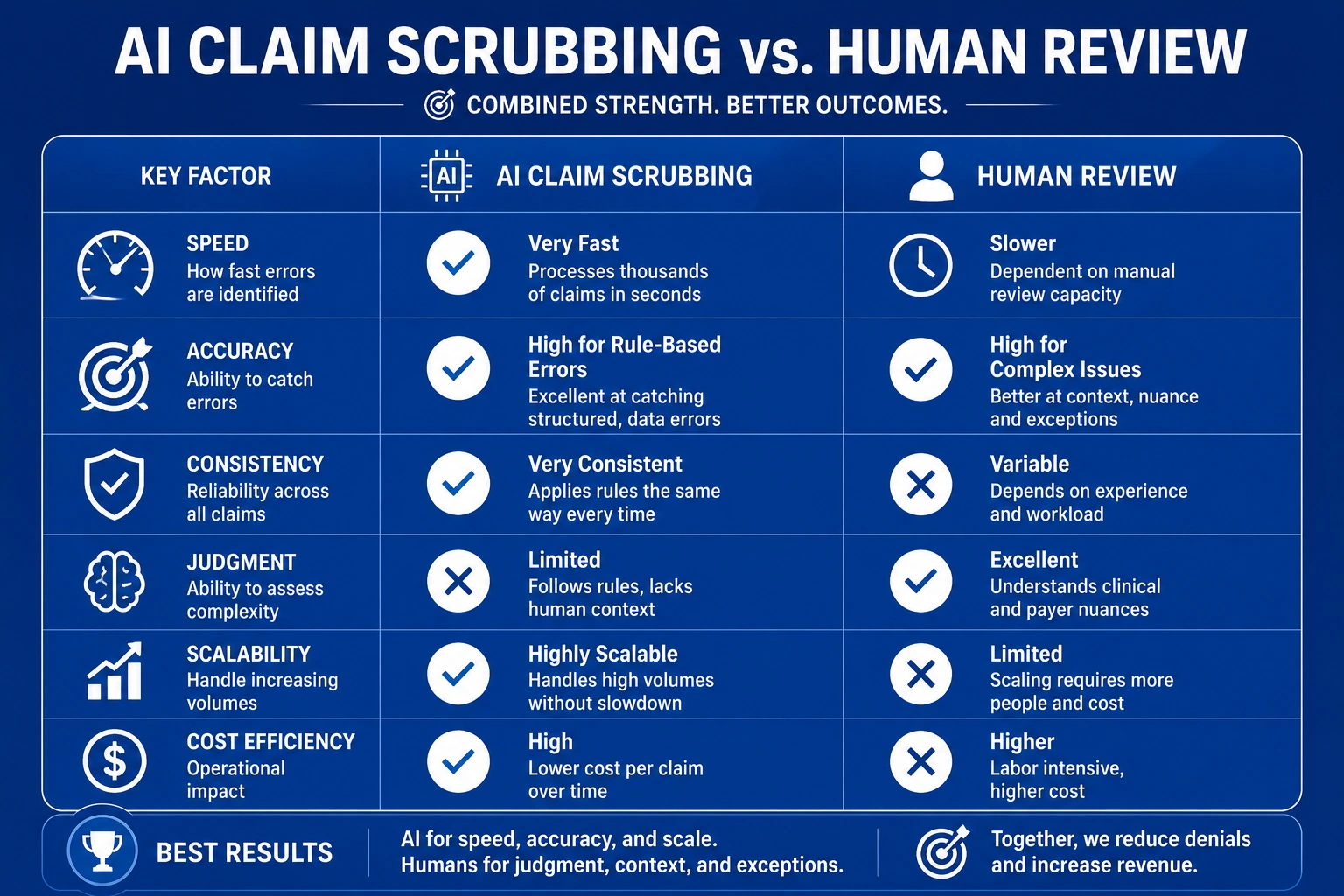
| Factor | AI Claim Scrubbing | Human Review |
|---|---|---|
| Speed | Seconds per claim, 24/7 | Minutes to hours per claim |
| Volume capacity | Unlimited, scales instantly | Limited by staff headcount |
| Eligibility/coding-rule errors | Very strong | Strong, but slower |
| Medical necessity judgment | Weak — pattern-based only | Strong |
| Learns payer-specific rule changes | Fast, once retrained on new data | Often faster in real time, via direct payer contact |
| Appeals strategy | Not capable | Strong |
| Cost structure | License/subscription, scales with volume | Labor cost, scales with headcount |
| Audit/compliance risk judgment | Limited | Strong |
| Consistency | Very high, no fatigue | Variable, subject to workload and turnover |
| Best use case | High-volume, rule-based claims | Complex, denial-prone, or appealed claims |
Does AI Claim Scrubbing Actually Reduce Denials? The Data
The honest answer: usually, but the size of the reduction varies enormously by vendor claim and practice complexity, so it’s worth separating marketing numbers from grounded estimates.
Clean Claim Rate Improvements
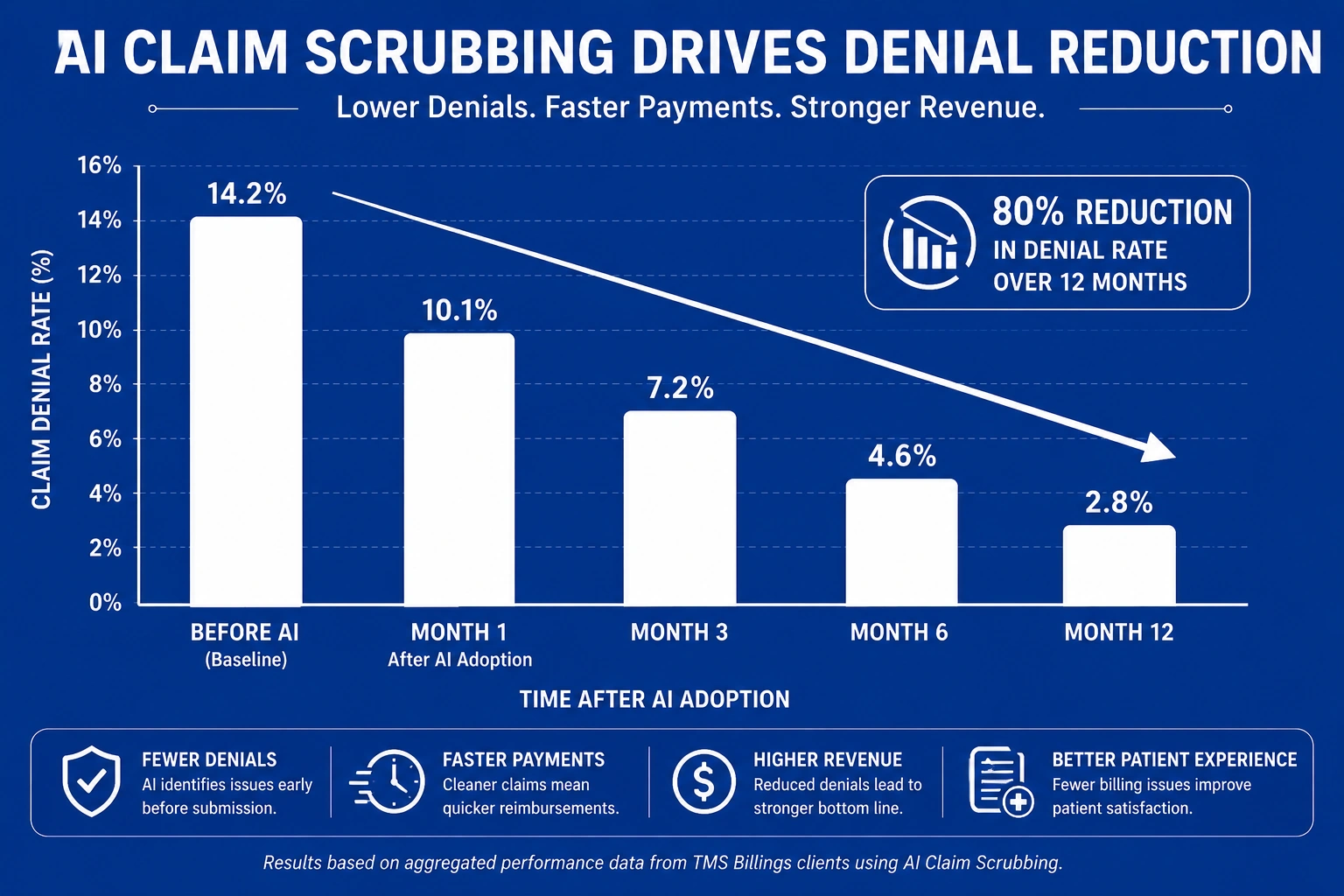
The average clean claim rate across U.S. medical practices sits around 72%, according to MGMA’s 2025 benchmarking data — well below the 95%+ first-pass rate many AI claim scrubbing vendors report in their own case studies. Independent and vendor-reported denial-rate reductions after adopting AI-assisted scrubbing commonly fall in the 15–30% range, with some case studies reporting higher results on narrower “avoidable denial” definitions.
Where AI Tools Still Fall Short
Even mature automated claim review software still routes a meaningful share of claims back to a human — first-pass acceptance rates above 95% imply roughly 1 in 20 claims (often more, in complex specialties) still needs a human decision before submission. AI also underperforms on claims tied to brand-new payer policies, since it’s scoring against patterns it hasn’t seen yet. See our piece on AI-driven prior authorization denials for more on this gap.
The Hybrid Model: Why Most Successful Practices Use Both
The practices seeing the strongest results aren’t running pure automation or pure manual review — they’re running a hybrid billing workflow, where AI claim scrubbing handles the high-volume, rule-based first pass, and trained staff handle anything flagged as ambiguous, high-dollar, or precedent-setting. This is also where AI denial prevention compounds over time: every human correction can be fed back into the model, sharpening its next prediction.
What to Automate vs. What to Keep Human-Reviewed
| Automate | Keep Human-Reviewed |
|---|---|
| Eligibility and benefits verification | Medical necessity disputes |
| NCCI/modifier edits | High-dollar or multi-procedure claims |
| Missing-field and missing-attachment checks | Appeals and reconsiderations |
| Routine, high-volume code pairs | New or unusual payer policies |
| Duplicate claim detection | Claims tied to active audits |
Choosing an AI Claim Scrubbing Tool: Red Flags and Must-Haves
What should I look for in an AI claim scrubbing tool? The strongest AI denial prevention platforms share a few must-haves: real EHR integration billing software (not a manual export/import process), payer-specific rule libraries that update automatically, transparent reporting on what the model flagged and why, and a clear human-override workflow. Red flags include vendors who can’t explain their training data, tools with no audit trail, and case-study denial numbers with no methodology behind them.
Questions to Ask Before You Buy or Switch
- What data trained this model, and is it specific to my specialty and payer mix?
- Can I see flagged-claim reasoning, or is it a black box?
- How deep is the integration with my specific EHR and practice management system?
- What’s your audited average denial-rate reduction — not your best case study?
- Who handles a claim the AI got wrong?
Is AI Claim Scrubbing Worth It for Your Practice Size?
Is AI claim scrubbing worth it for small practices, or is it overkill? It depends mostly on claim volume and denial-risk specialty.
Solo and Small Practices
For lower-volume practices, a standalone AI claim scrubbing license can be hard to justify against the subscription cost. Many small and solo practices get more value from outsourcing to a billing partner who already has enterprise-grade claims editing software built into their workflow — you get the automation without the separate software bill.
Multi-Provider Groups
For multi-provider groups, especially in high-denial-risk specialties like behavioral health, orthopedics, and cardiology, the math flips fast. Higher claim volume means even a modest percentage-point improvement in clean claim rate translates into real dollars, and medical billing automation typically pays for itself well within a year in documented cases.
How TMS Billings Uses AI and Human Review Together
Our team runs every claim through automated, AI-assisted medical coding checks first — eligibility, modifier logic, documentation completeness, and payer-specific rules — before it ever reaches a person. Anything flagged as ambiguous, high-dollar, or tied to a pattern we’ve seen denied before gets routed to a credentialed biller for a second look. That’s the hybrid billing workflow in practice: software handles repetition at scale, our team handles judgment. If you want to see how this fits into pricing, our guide to medical billing pricing models breaks down how automation affects cost structure.

The State of AI in Medical Billing in 2026
A few current benchmarks worth knowing before you evaluate a vendor:
- Denial rates are still climbing. More than half of healthcare organizations report denial rates above 10%, per MGMA’s 2024 Benchmarking Report on Denials and Appeals — consistent with the upward trend HFMA‘s revenue cycle benchmarking research has tracked in recent years — while average clean claim rate across U.S. practices sits at roughly 72% (MGMA, 2025).
- Adoption is real but not universal. Guidehouse‘s 2026 Healthcare RCM Trends report found 59% of provider organizations haven’t yet implemented AI or automation anywhere in the revenue cycle — meaning roughly four in ten already have, skewing toward larger organizations.
- Reported reductions vary widely. Case studies and vendor data most commonly cite 15–30% denial-rate reductions after adopting AI claim scrubbing, while Deloitte’s Center for Health Solutions reports automated scrubbing can prevent up to 85% of avoidable denials — a narrower, more favorable metric than overall denial rate.
- Human override remains the norm. Vendor-reported first-pass acceptance rates above 95% still imply a meaningful share of flagged claims — often 5% or more, higher for complex specialties — need a human decision before submission.
- The market is growing fast. The global AI-powered medical billing market is projected to grow from roughly $1.47 billion in 2026 to $11.80 billion by 2034, a CAGR near 30%, per Fortune Business Insights.
Key Takeaways
- AI claim scrubbing is genuinely effective at catching rule-based errors — eligibility, modifiers, missing documentation — fast and at scale.
- It is not a full replacement for trained billers, especially on medical necessity, appeals, and judgment calls.
- A hybrid billing workflow, not a binary AI-vs-human choice, produces the best clean claim rate outcomes.
- When evaluating automated claim review software, check audited denial-reduction numbers, not best-case marketing data.
- Practice size and specialty risk level should drive whether you buy software directly or get it bundled through a billing partner.
Conclusion
AI claim scrubbing has earned its place in modern revenue cycle management — but the practices getting the best results treat it as a tool that makes their team faster, not a replacement for the judgment that catches what software misses. If you’re evaluating a switch, start by asking any vendor or partner exactly how their AI and human review work together, not just how good their AI is on its own. Our Revenue Cycle Management Services are built around that hybrid model — reach out and we’ll walk through what it would look like for your claim volume and specialty.