
Outsource Pain Management Billing: 5 Proven Cost Savings

Pain management billing carries more coding, prior authorization (PA), and denial risk than general medical billing, and every unresolved claim consumes staff time while delaying cash flow. Should you outsource pain management billing to a specialized partner? In practice, that means handing claim submission, coding, denial follow-up, and collections to an outside team, often through revenue cycle management (RCM) support such as Revenue Cycle Management Services. This guide compares real in-house and outsourced costs, walks through five proven savings, examines the effect on claim denials, and gives your practice a fair framework for deciding.
What Does It Mean to Outsource Pain Management Billing?
A third-party billing company takes over eligibility verification, coding, claim submission, PA tracking, and denial follow-up for interventional and office-based pain management services. Your clinicians keep the clinical work, and the outside team manages the revenue cycle behind it.
Pain management billing carries specialty-specific complexity. Procedures such as epidural steroid injections (ESIs), facet joint interventions, radiofrequency ablation (RFA), and spinal cord stimulator (SCS) trials involve frequent bundling edits and payer-specific PA rules. Interventional pain management coders must also stay current with the American Medical Association’s overview of the CPT code set, which it develops and maintains.
Outsourcing also comes in different sizes. A practice can choose full-service RCM or hand off a single function, such as denial follow-up or credentialing.
In-House vs. Outsourced Pain Management Billing: A Real Cost Comparison
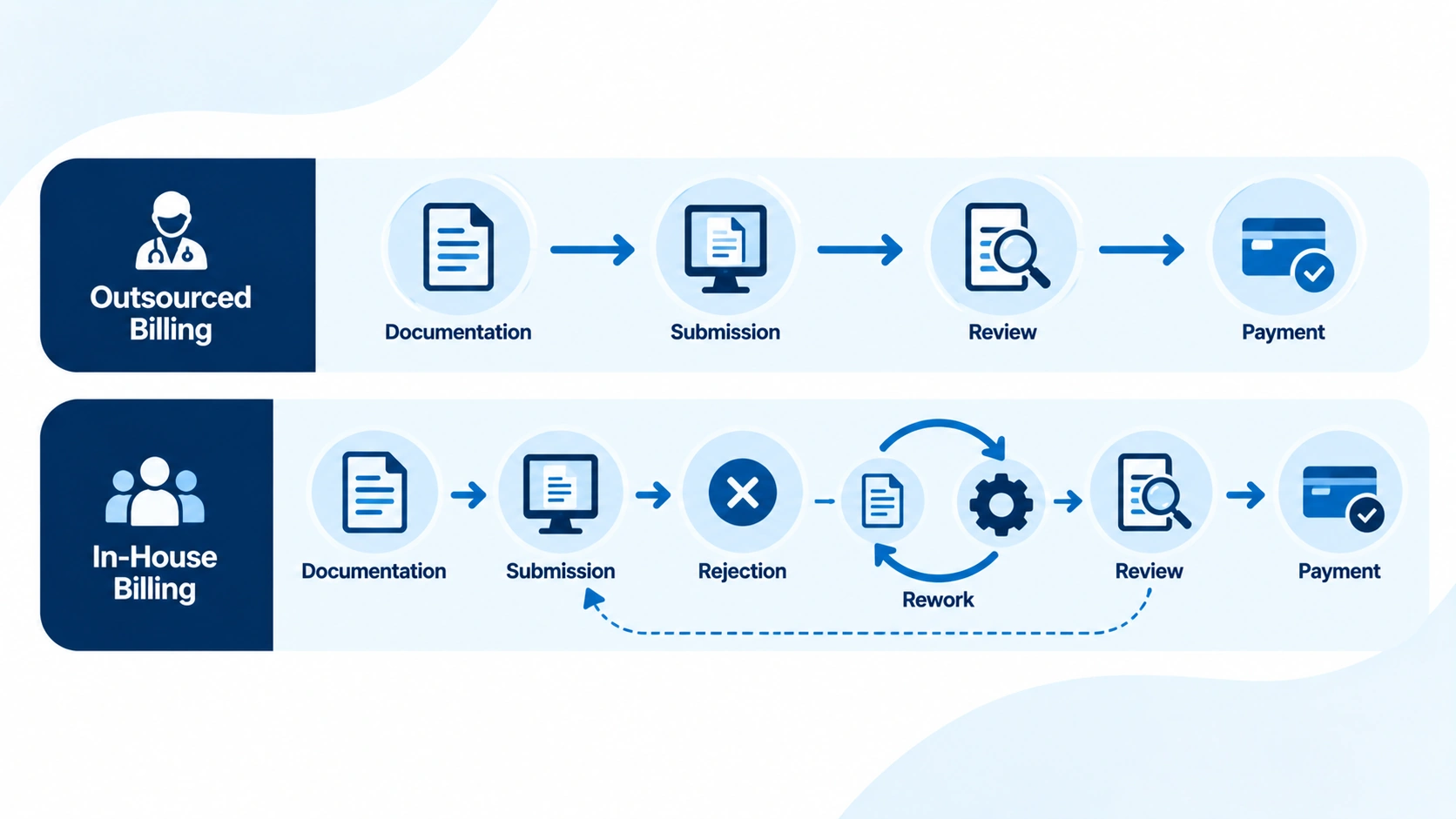
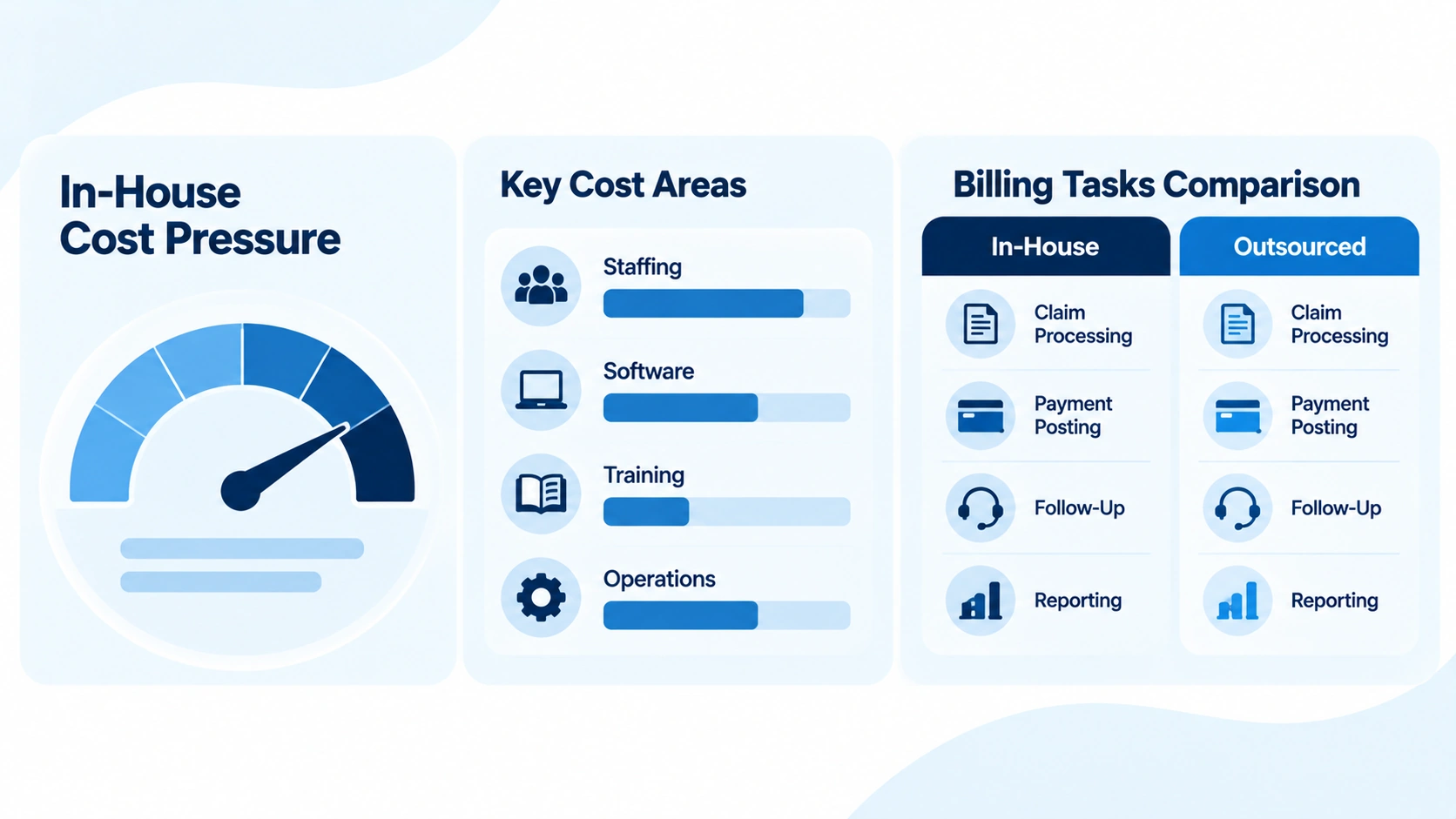
In-house vs outsourced medical billing costs differ mainly in structure. In-house billing carries fixed staffing and software costs regardless of claim volume, while outsourced billing is typically priced as a percentage of collections, so the expense moves with revenue.
Start with the in-house side. Your budget includes biller and coder salaries and benefits, billing software and clearinghouse fees, ongoing coding-certification training, and the cost of covering turnover or leave. MGMA’s 2026 Management and Staff Compensation Data Report on medical practice staffing costs offers a useful reference when you price these roles.
The outsourced side is simpler. Vendors usually charge a percentage of collections or a per-claim fee, typically with no separate software license or benefits cost to your practice. So how much does it cost to outsource pain management billing? The answer depends on the fee structure, so review common medical billing pricing models before you request quotes, and compare each fee against your in-house cost to collect.
Billing vendors across the industry often cite overhead savings of up to 30–40%. Treat that as a commonly cited claim, not a guarantee or a TMS Billings promise. Actual savings vary by practice size, claim volume, and current staffing efficiency.
5 Proven Cost Savings From Outsourcing Pain Management Billing
The benefits of outsourcing pain management billing come mainly from reduced staffing overhead, fewer coding and authorization errors, and a claim-submission process built for interventional pain procedures. Each of the five cost savings below traces to a specific part of the billing workflow.
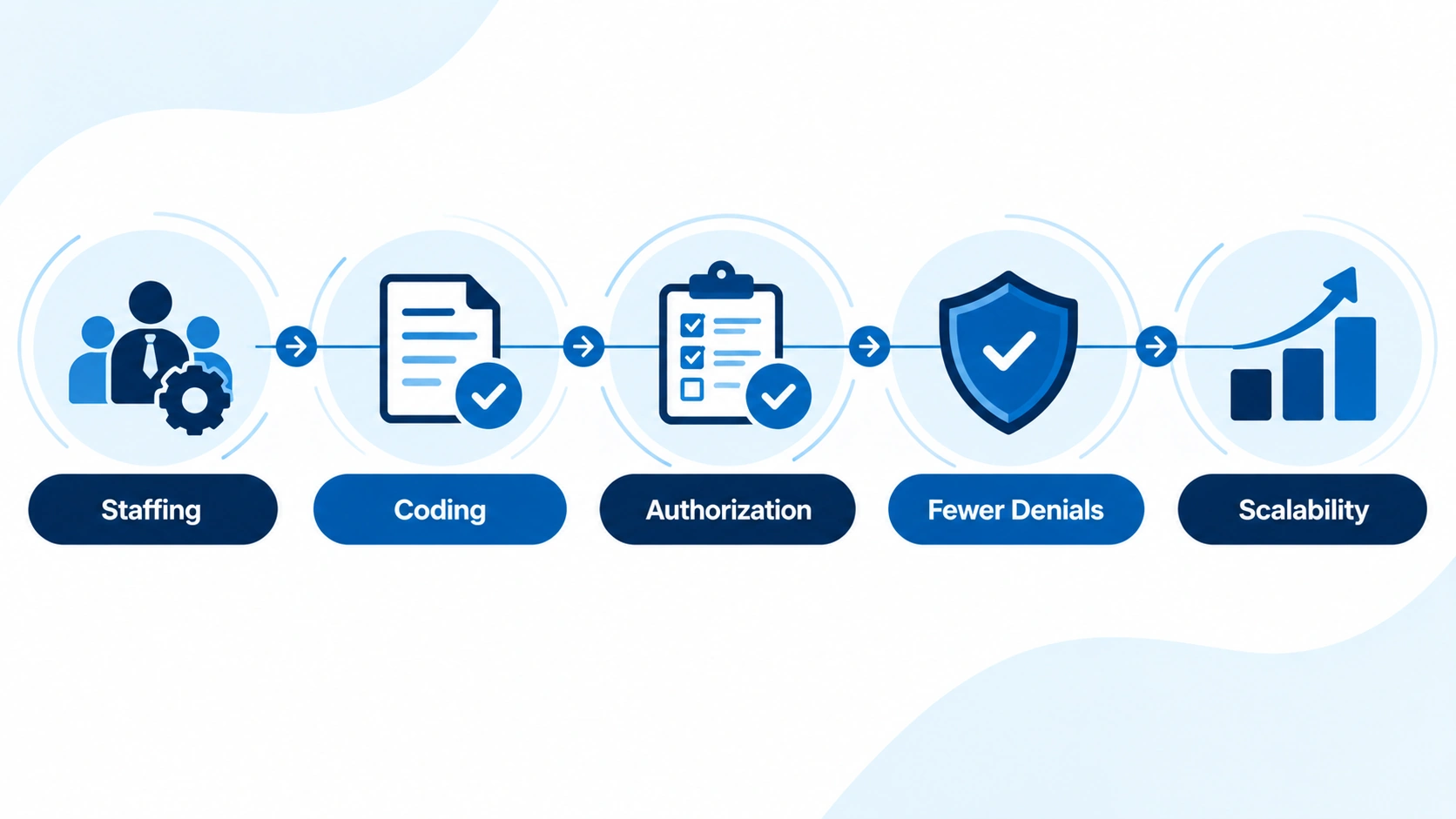
Lower staffing and overhead costs. Outsourcing removes the need to fund full-time biller salaries, benefits, software licenses, and ongoing coding-certification training. Costs follow collections instead of staying fixed during slow months. Vendors commonly cite overhead savings of up to 30–40%, though results vary by practice.
Fewer coding and bundling errors. Coders trained in interventional pain procedures apply current bundling edits before submission, reducing rework on nerve block, facet joint, and radiofrequency claims. A fully credentialed and enrolled provider also avoids denials tied to enrollment gaps, which is where Credentialing Services help.
Cleaner prior authorization handling. Certain interventional procedures, including facet joint interventions and implanted spinal neurostimulators, require Medicare prior authorization as a condition of payment. A dedicated team tracks approvals before the visit, and CMS’s Prior Authorization for Certain Hospital Outpatient Department Services page lists both.
Fewer unresolved rejections. A dedicated follow-up team works the clearinghouse queue daily instead of letting rejections wait behind other duties. A claim scrubber, which is software that checks claims for errors before submission, catches many problems early, and the team files each corrected claim promptly, shortening the rework cycle.
Scalable cost structure. A percentage-of-collections model flexes with patient volume. A growing or shrinking practice avoids the overstaffing or understaffing costs of a fixed in-house team, so billing capacity follows demand without new hiring or layoffs.
How Outsourcing Improves Claim Denial Rates in Pain Management Billing
Pain management claims tend to be denied more often than average because of coding bundling edits, missing authorizations, and eligibility gaps, so the pain management billing denial rate deserves close tracking. A practice that chooses to outsource pain management billing gains a dedicated team built to catch each problem before submission.
The National Correct Coding Initiative (NCCI), a CMS program that publishes procedure-to-procedure edits, frequently bundles pain management codes, such as nerve blocks performed with related procedures. These edits change regularly, so a code pair that paid last quarter can produce denied claims this quarter. Details appear on CMS’s National Correct Coding Initiative program page.
The table below maps four common pain-management denial causes to an example signal and a first action, using example claim adjustment reason codes (CARCs) from X12’s list of Claim Adjustment Reason Codes, which X12 maintains. The examples are illustrative.
| Denial Cause | Example Signal | How Outsourcing Helps |
|---|---|---|
| Missing or expired authorization (facet joint, spinal cord stimulator) | CARC 197 (authorization absent) | Dedicated authorization tracking flags the service before the visit |
| Coding and bundling edits on interventional codes | CARC 4 or 236 (code or edit conflict) | Specialty-trained coders review high-risk codes before submission |
| Eligibility and coverage gaps | CARC 27 or 31 (coverage or identification issue) | Eligibility re-verified at scheduling and again before the visit |
| Unworked rejections past the filing window | CARC 29 (filing limit expired) | Daily rejection report reviewed by a named owner |
Reviewing the explanation of benefits (EOB) and electronic remittance advice (ERA) behind each denial shows which cause is driving your own claim denial rate.
What It Costs to Keep Pain Management Billing In-House
Pain management billing staffing costs typically include at least one dedicated biller or coder, ongoing certification and continuing-education expenses, and software and clearinghouse fees that do not shrink in slow months. Even a fraction of a full-time equivalent (FTE) staff position carries salary, benefits, and training costs.
Turnover adds a real cost of its own. Recruiting, training, and temporary coverage gaps can stall claim submission and rejection follow-up for weeks at a time. A small practice, meaning one with lean billing staff and shared front-desk and billing duties, has little redundancy, so a single absence can create a rework backlog.
Some practices respond by deciding to outsource pain management billing, while others add staff or cross-train existing employees. Either path still requires provider credentialing and payer enrollment, so your credentialing cost stays in the budget whether billing remains in-house or moves outside.
How to Outsource Pain Management Billing: A Step-by-Step Process
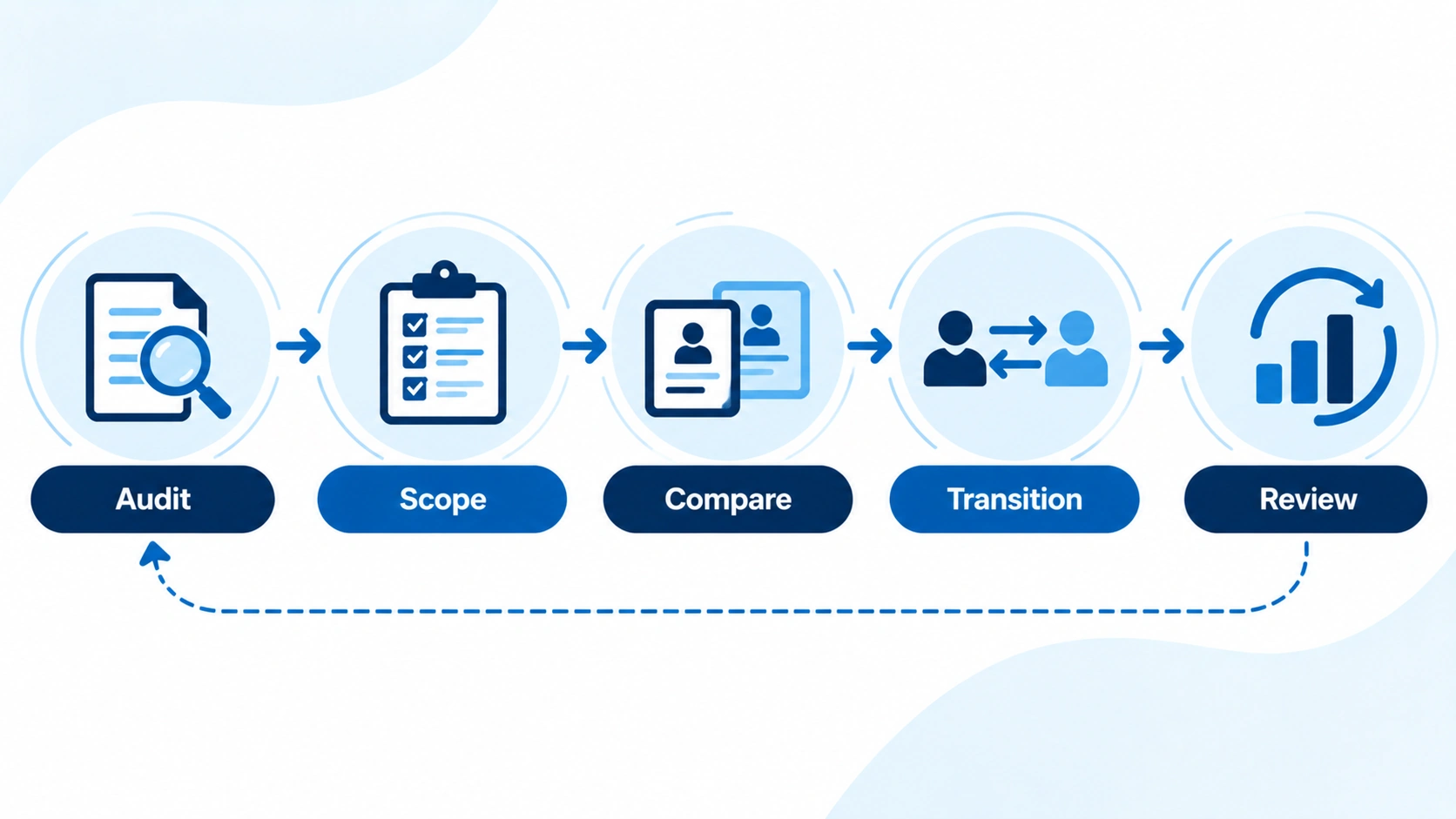
A practice can outsource pain management billing in five steps: audit current in-house billing costs and denial patterns, define the scope of work, compare vendor pricing models, run a transition period alongside current staff, and review performance each month against your own baseline.
The process below keeps your current operation running while the new team proves itself.
- Audit. Calculate your current in-house cost per claim, staffing cost, and denial rate for the last full quarter so you have a real baseline to compare against any vendor’s pricing.
- Define scope. Decide whether you need full service or one function, such as PA tracking, denial follow-up, or credentialing. For a parallel example of how scope affects price, see our mental health billing cost comparison.
- Compare vendors. Request pricing as a percentage of collections, ask how denials are categorized and reported, and confirm which X12 CARC sets and remittance advice remark codes (RARCs) the vendor tracks on each ERA.
- Transition. Run the new billing partner alongside your current staff for one to two billing cycles before fully handing off claim submission, PA tracking, and denial follow-up.
- Review monthly. Compare denial rate, days in accounts receivable (A/R days), and cost per claim against your original baseline, not against a universal target, and adjust the scope of work as results come in.
A practice weighing this decision against staying in-house can review the full cost comparison earlier in this guide.
Outsource Pain Management Billing or Keep It In-House? How to Decide
Is outsourcing pain management billing worth it? There is no universal answer, because the right choice depends on claim volume, current denial rate, staffing stability, and how much time your team can dedicate to billing.
In-house billing still makes sense when your practice has a trained, stable, dedicated billing team, low turnover, strong denial-tracking tools, and enough claim volume to justify the fixed cost. In that situation, outsourcing may add expense without adding capability.
Outsourcing tends to make more sense when turnover is frequent, the rework queue keeps growing, a new provider or service line is starting, or the practice is adding interventional pain management procedures without in-house coding expertise for them. In those cases, a decision to outsource pain management billing can steady cash flow while your team focuses on patients.
Specialty-specific expertise matters either way. The American Society of Interventional Pain Physicians (ASIPP) publishes an overview of coding and reimbursement recognition for the specialty, which supports the point that accurate coding depends on specialized knowledge whether your practice bills in-house or through a partner.
How TMS Billings Supports Pain Management Practices That Outsource Billing
For practices that want to outsource pain management billing services, TMS Billings applies eligibility verification, authorization tracking for interventional procedures, specialty-trained coding, daily rejection follow-up, credentialing coordination, and monthly key performance indicator (KPI) reporting.
Outsourced denial follow-up can shorten the rework cycle compared with handling it in-house, although results depend on payer mix and claim volume, and no specific outcome is guaranteed. TMS Billings supports practices that want added capacity or an independent review of their current process, and it respects the in-house teams that already work well. Practices can contact our pain management billing support team to discuss either option.
Consider a realistic example. A small interventional pain practice had two billing staff covering scheduling, coding, and follow-up. When one left, rejections went unworked and prior authorizations were missed. After outsourcing billing, a dedicated team tracked authorizations before each visit and cleared the rejection backlog within two billing cycles.
Key Takeaways
- Pain management billing carries coding, authorization, and denial risks that make staffing and process decisions more consequential.
- In-house billing carries fixed costs, outsourced billing usually moves with collections, and savings vary by practice.
- Specialty-trained coders and dedicated authorization tracking help reduce coding errors, missed approvals, and unworked rejections.
- Outsource pain management billing only after comparing baseline costs, denial patterns, and staffing stability with vendor pricing.
- In-house billing remains sound for practices with stable, trained teams, strong denial tracking, and sufficient claim volume.
Related Reading: for further reading on billing cost topics across TMS Billings’ coverage, see medical billing services cost in California and medical billing services cost in Texas.
Final Thoughts
The decision to outsource is ultimately financial and operational, and your practice is best positioned to make it with real numbers in hand. If your claim denial rate is rising, your billing team is stretched thin, or your practice is growing, it may be time to outsource pain management billing and measure the result against your own baseline. Payer rules and authorization requirements change periodically, so confirm current requirements with each payer. Book a Free Consultation to review your options.