

A claim that fails the first pass rarely means just one delay; it becomes rework, and rework quietly drains staff time and cash flow before anyone spots the pattern. Reliable Revenue Cycle Management Services exist because this happens often in small practices, where claim follow-up competes with patient care and front-desk duties. Many teams use 95% as a loose rule of thumb for first-pass performance, though no single figure fits every specialty. Your clean claim rate is the share of submitted claims a payer accepts on the first try, without a correction or resubmission. This article covers how the rate is calculated, five costly causes of first-pass failure, a six-step workflow, rejection-versus-denial tracing, and the metrics worth tracking monthly.
What Is Clean Claim Rate and How to Calculate It
A clean claim is submitted with accurate patient and coverage data, valid codes and modifiers, required authorizations, and supporting documentation, so the payer can process it without rework. To calculate clean claim rate, divide claims accepted on first submission by total claims submitted over the same period, then multiply by 100.
For illustration only: 170 accepted out of 200 submitted equals 85%; this is not a benchmark. Because organizations define clean claim differently, document your own definition: some count claims accepted at the clearinghouse and payer front end, closer to a first-pass acceptance rate, while others count only claims processed without rework after adjudication. Pick one definition and one method — by count or by dollar value — and apply it consistently by payer and provider. Clean claim rate and denial rate are not the same measure: one tracks submission quality, the other tracks payer decisions made after adjudication.
Why Clean Claim Rate Matters to Small Practices
Each unclean claim delays payment and adds rework, and small practices feel it most because a growing rework queue competes with front-desk and patient-care duties. Billing is often shared with front-desk staff, no one owns rejected claims, and there is little visibility into which payer or provider drives claim denials and rejections. The stakes go beyond one delayed payment: an unworked claim can drift past its filing deadline and become a permanent write-off.
Per CMS’s Medicare Claims Processing Manual guidance on timely filing, Original Medicare fee-for-service claims generally must be filed within 12 months of service, and commercial payers set their own, often shorter, windows. Revenue cycle management (RCM) exists to keep this from happening quietly. A practice using a vendor should confirm, in writing, who reworks rejected claims and how that work is priced; see TMS Billings’ medical billing pricing models. A low clean claim rate is rarely one bad month — it usually signals unclear ownership.
The 5 Costly Causes Behind Claims That Fail the First Pass
Most claims that fail the first pass do not fail from a coverage exclusion; they fail from a preventable workflow gap, and each gap has a matching control that keeps one more clean claim moving instead of stalling.

Eligibility, demographic, and enrollment errors. Coverage is inactive, demographics do not match the payer record, or the provider is not enrolled with that payer. Control: eligibility verification at scheduling and again before the visit, backed by current Credentialing Services so payer enrollment and provider credentialing stay current.
Missing or invalid prior authorization. Services are delivered before authorization is confirmed, or the prior authorization (PA) on file does not match the billed service. Control: hold scheduling until the authorization number is documented.
Coding, modifier, and edit errors. Codes, modifiers, or diagnoses do not match documentation, or they trigger a payer edit. The American Medical Association’s overview of the CPT code set, which it develops and maintains, is a useful reference. Control: coder review of high-risk services before submission.
Incomplete or inaccurate claim data. Required fields are blank, payer identifiers are wrong, or provider details differ from the enrollment record. Control: a claim scrubber with payer-specific edits and a charge review before release.
Late submission and unworked rejections. A claim rejection sits unread in the clearinghouse queue until the timely filing window closes. Control: a daily rejection report, a fixed submission standard, and one named owner.
How to Improve Clean Claim Rate: A Step-by-Step Workflow
Clean claim rate is the percentage of submitted claims accepted and processed on the first submission, without corrections or rework. A small practice can raise it in six steps: measure a baseline, capture every rejection and denial, categorize the causes, correct and resubmit, prevent repeats at the source, and review results monthly.
Here is that improvement process step by step, in six actions your team can own.

- Measure. Calculate a baseline for the last full month, by count or dollars, broken out by payer, provider, and service line so the weakest area is visible.
- Capture. Review the clearinghouse rejection report daily and post the electronic remittance advice (ERA) — see CMS’s official resource on the remittance advice payers use — or the explanation of benefits (EOB) the day it arrives, logging claim, payer, codes, and reason.
- Categorize. Group every failure by cause and payer — eligibility, authorization, coding, data entry, or a missed deadline — and separate denied claims from claim rejections.
- Correct. Fix data errors and send a corrected claim the same day; route authorization and medical-necessity disputes to a documented appeal instead.
- Prevent. Add a control at the point where each root cause enters the claim, such as a claim scrubber rule, a scheduling hold, or a checklist.
- Review. Recalculate monthly, compare against your own baseline, and tighten or retire controls based on results, not a universal target.
One trained owner can run this clean claim workflow without adding headcount. Practices weighing that time against outside help can review the mental health billing cost comparison.
Claim Rejection vs. Claim Denial: How to Trace Root Causes
A claim rejection stops a claim before adjudication, usually at the clearinghouse or payer front end, and is typically corrected and resubmitted without a formal appeal. A claim denial is an adjudicated decision reported on the remittance advice after the payer reviews the claim.
Read both reports closely — either can signal a claim that was not clean. On the remittance advice, the claim adjustment group code (CO, PR, OA, or PI) shows who is financially responsible, the claim adjustment reason code (CARC) states why the payer adjusted the claim, and the remittance advice remark code (RARC) adds detail; X12’s official list of Claim Adjustment Reason Codes is the source X12 maintains for these code sets, and every root cause below traces back to one of them.
The table maps six common causes to an example signal and a first action; these are illustrative — always read the full CARC and RARC pair on your own remittance advice.
| Unclean Claim Cause | Example Signal | First Action |
|---|---|---|
| Eligibility and enrollment | Coverage ended before service, or insured not identified | Re-verify coverage, correct demographics, resubmit |
| Authorization and referral | Authorization not on file | Confirm status, then correct or appeal with records |
| Coding and edits | Modifier mismatch or NCCI conflict | Coder review, then send a corrected claim |
| Missing or invalid data | Required field missing or incomplete | Supply the missing data and resubmit |
| Duplicate submission | Claim flagged as an exact duplicate | Confirm original claim status before resubmitting |
| Timely filing | Filing time limit expired | Locate proof of timely submission; appeal with evidence |
Data errors go to a corrected claim the same day; clinical and authorization disputes go to a documented appeal; timely filing denials are a prevention problem, since recovery afterward is uncommon.
Code descriptions verified September 2026.
How to Prevent Unclean Claims Before Submission
The best way to prevent claim rejections is catching the cause where it enters the claim, not after the payer responds; assign each cause a control and a named owner so nothing sits unassigned.
Front-end controls. Eligibility verification at scheduling, a pre-visit recheck close to the appointment, authorization tracking matched against the scheduled service, and confirmed provider enrollment before a new patient’s first visit; reviewing credentialing cost helps a practice budget for this step.
Claim-build controls. A coder review of high-risk services, a claim scrubber applying CMS’s National Correct Coding Initiative (NCCI) edits automatically, and a documented clean claim standard the team follows before release.
Back-end controls. A daily clearinghouse rejection report, ERA posting the day it arrives, a monthly root cause review of rejection and denial patterns, and staff training tied to each recurring cause and payer policy update.
What Happens When a Claim Is Not Clean: Rework, Denial, and Appeal
An unclean claim costs at least one extra touch: a rejection returns for correction and resubmission, while a denial may require a corrected claim or a formal appeal, each round adding delay. Not every one of these claim denials merits an appeal, and outcomes are never guaranteed, so weigh the administrative cost before appealing denied claims.
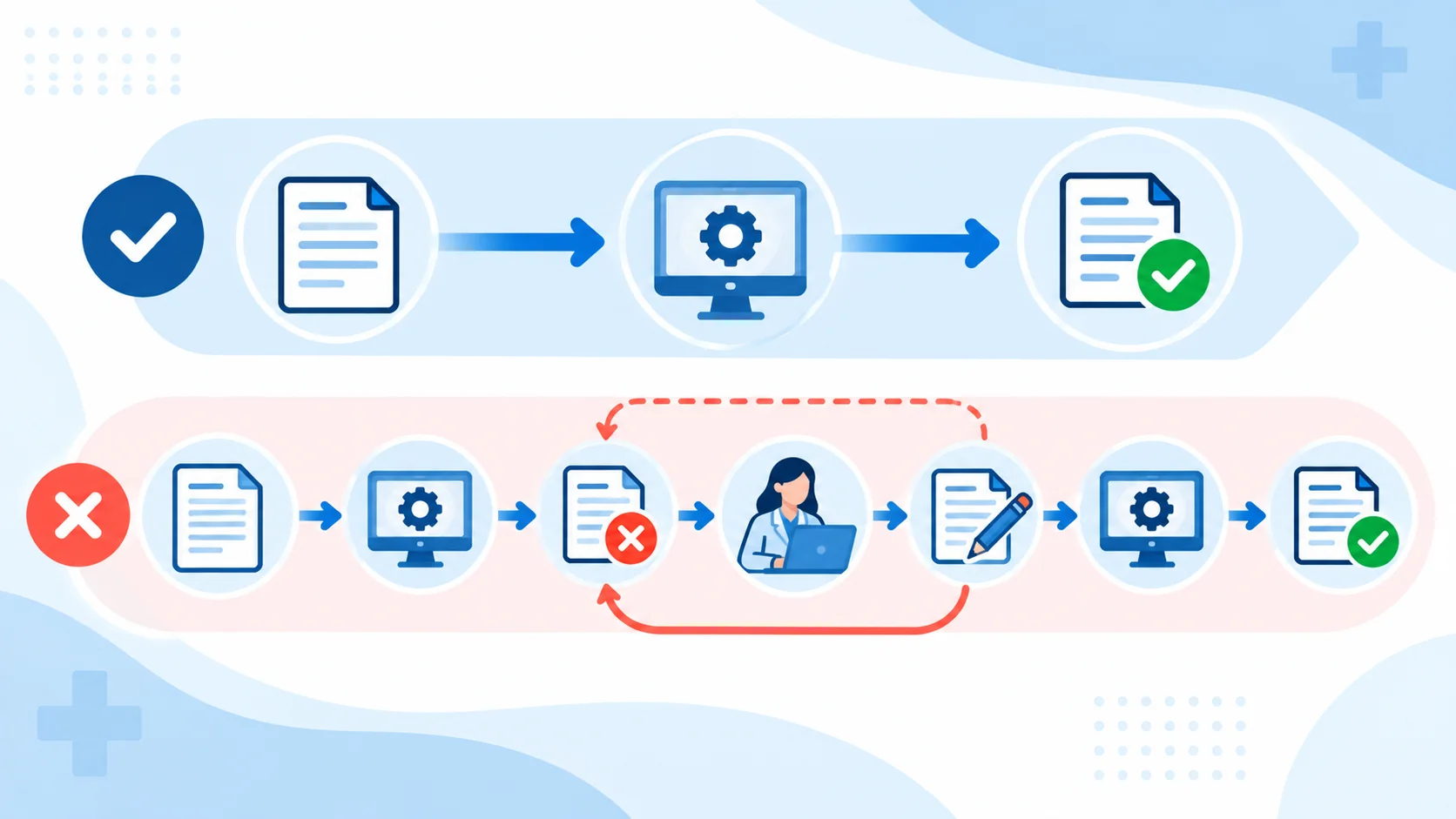
For Original Medicare, a first-level redetermination must be requested in writing from the Medicare Administrative Contractor (MAC) within 120 days of the initial determination, and CMS’s official page on the first level of appeal confirms Medicare has five levels of appeal. Commercial plans set their own windows and review steps, so confirm the current payer manual before filing.
What Is a Good Clean Claim Rate? Metrics Small Practices Should Track
No single number fits every practice, though 95% is a commonly cited target; real benchmarks vary by specialty, payer mix, and how “clean” is defined, so set your own baseline first. No industry-wide clean claim benchmark exists beyond that commonly cited figure. Worth tracking as key performance indicators (KPIs): clean claim rate by payer and provider, first-pass acceptance rate, initial denial rate, rejection rate by cause, days to correct a rejected claim, denial write-offs as a share of net patient service revenue, and days in accounts receivable (A/R days).

Set a baseline before any corrective action and review monthly, monitoring denied claims separately from rejections. HFMA’s guidance on standardized denial metrics, from its Claim Integrity Task Force, is a useful reference for consistent metric names. Standardized definitions matter more than any single target, and every review should trace results to a root cause. Practices weighing outside support can review current service pricing.
How TMS Billings Helps Small Practices Fix Unclean Claims
Should a small practice outsource billing to improve clean claim rate? Not necessarily — the workflow above can run in-house with a trained owner, the right tooling, and consistent time. TMS Billings runs that same workflow for client practices: eligibility verification and authorization checks, claim scrubbing, daily rejection follow-up, credentialing coordination, and monthly KPI reporting.
Outsourced rejection tracking can shorten the rework cycle compared with handling it entirely in-house, though no specific outcome is guaranteed. Outside support tends to fit best with no dedicated claims owner, a growing rework queue, recent turnover, or a new payer or service line — none of which means an in-house team is doing anything wrong. Our RCM and billing support team works alongside existing staff rather than replacing their judgment.
A small multi-provider practice once found rejections piling up because insurance details were keyed inconsistently at check-in and no one reviewed the daily report. After naming one owner, adding a pre-submission eligibility check, and reviewing rejection reasons weekly, the recurring cause stopped and the held claims were corrected and resubmitted.
Key Takeaways
- Clean claim rate is the share of claims accepted correctly on the first submission, with no rework.
- Most first-pass failures trace to eligibility, authorization, coding, data, or a missed filing deadline.
- A six-step cycle — measure, capture, categorize, correct, prevent, review — drives steady improvement.
- Rejections and denials need different responses, and both should route back to a root cause.
- Track KPIs monthly and set your own baseline instead of chasing one industry number.
Related reading: TMS Billings’ breakdowns of medical billing services cost in California and medical billing services cost in Texas; more claim-quality guides are planned as this library grows.
Final Thoughts
Your practice does not need a perfect month to make progress — it needs one owner, one consistent definition, and a monthly habit of tracing rejections to their root cause. Payer rules and filing deadlines change periodically, so confirm current requirements with each payer. Raising your clean claim rate is rarely one dramatic fix; it is steady, well-documented follow-up. If your team wants a second set of eyes, Book a Free Consultation with TMS Billings.