2026 Vaccine Billing Codes: The Full Guide to CPT, NDC, and Denial-Free Claims
Immunization billing is one of the highest-volume — and most denial-prone — workflows in any pediatric practice. If your team is submitting vaccine claims without a precise, up-to-date understanding of vaccine billing codes, you are almost certainly losing reimbursement on services you have already delivered. At TMS Billings, our Revenue Cycle Management Services team works with pediatric practices every day to close the gap between vaccine volume and clean claim rates. This guide covers every code set, documentation standard, and payer rule your billing team needs to stay ahead in 2026.
What Are Vaccine Billing Codes?
Vaccine billing codes are standardized alphanumeric identifiers — including CPT codes, ICD-10 diagnosis codes, and NDC numbers — used to report immunization services to payers. They tell insurers which vaccine was administered, what the clinical justification was, and the exact product used. Using the correct vaccine billing codes is essential for receiving timely, complete reimbursement.
What Are Vaccine Billing Codes in 2026?
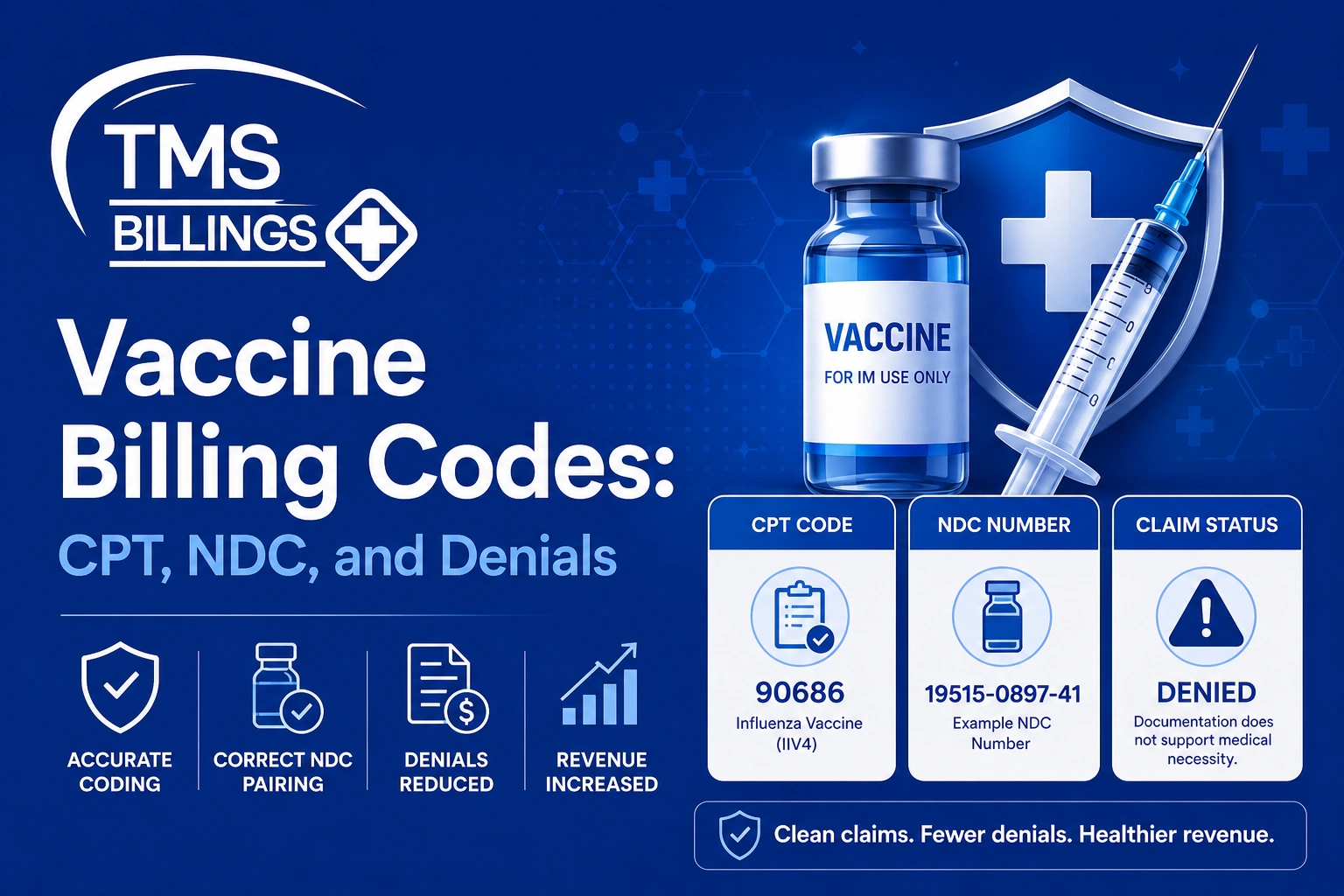
Vaccine billing codes are the foundation of any successful immunization claim. They combine three code sets: CPT codes that describe the administration service, ICD-10 codes that justify medical necessity, and NDC numbers that identify the precise vaccine product billed.
Getting all three right — and matching them to each payer’s specific requirements — is the difference between clean claims and costly denials. Immunization billing codes 2026 guidance from CMS and the AMA has reinforced existing reporting rules while tightening documentation expectations for VFC-enrolled practices.
For pediatric practices, the stakes are high. Vaccines represent a large share of visit volume, but also carry some of the most complex administrative requirements of any service line.
Why Vaccine Billing Code Accuracy Is a Revenue Priority for Every Pediatric Practice
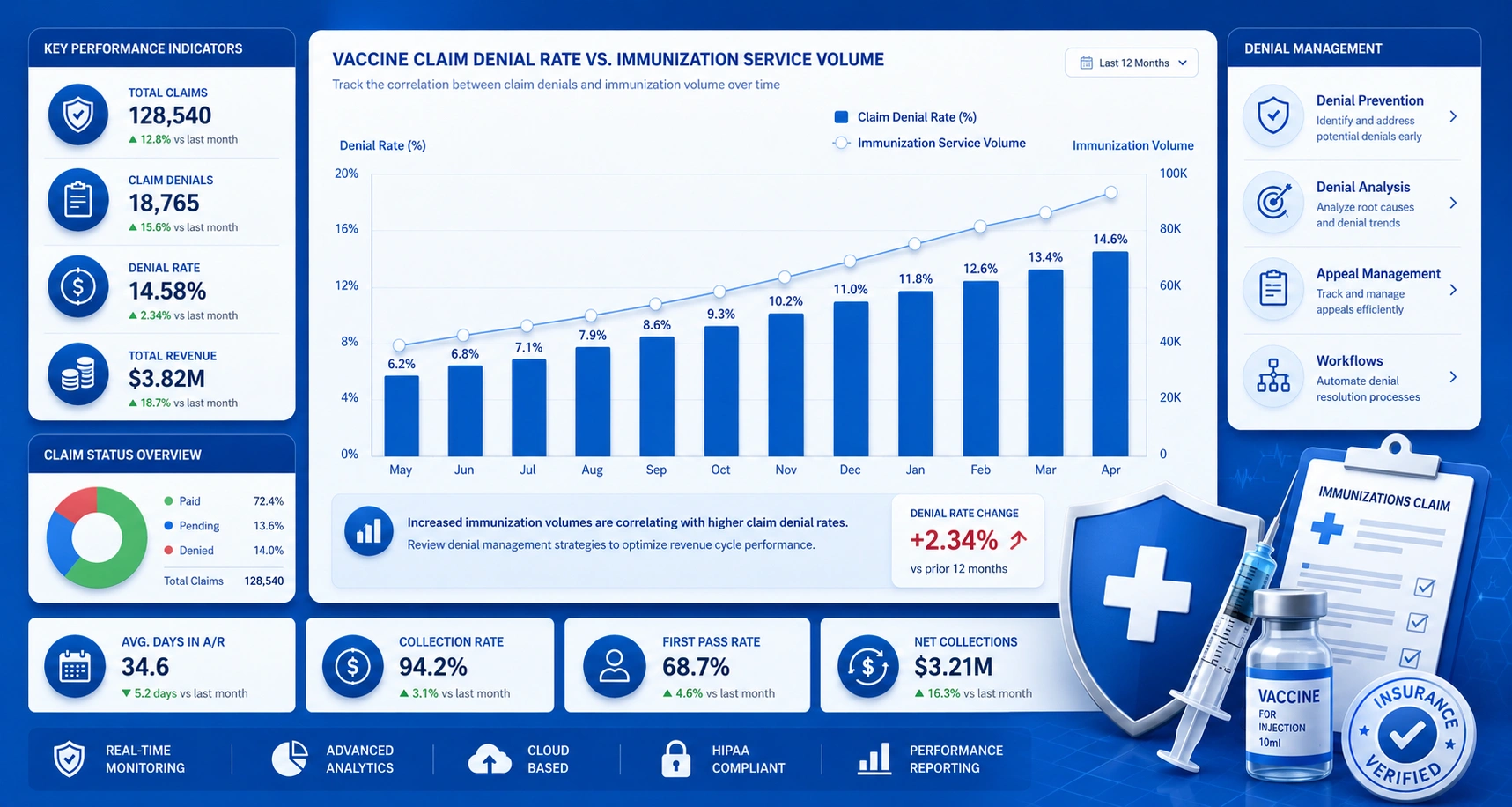
A single billing error on a vaccine claim does not just affect one encounter — it creates a pattern. Payers track denial trends, and a practice with recurring vaccine billing errors becomes a target for audits, clawbacks, and prepayment review. Pediatric vaccine billing 2026 is more scrutinized than ever, and your revenue depends on precision.
What Changed in Vaccine Billing After Recent CMS and VFC Program Policy Shifts
Recent changes from CMS and VFC program vaccine billing guidelines 2026 have focused heavily on documentation for VFC-enrolled patients. Practices must now verify and document VFC eligibility at every visit — not just at initial enrollment. Any gap in that documentation trail creates grounds for retroactive denial.
The CMS and VFC program has also tightened requirements around vaccine lot numbers and NDC reporting on claims. For high-volume pediatric practices, this means your billing workflow must capture that data from the clinical side before the claim ever leaves the office.
CMS and VFC Vaccine Billing Updates and What Is Permanent in 2026
Several administrative flexibilities introduced during the public health emergency have now expired. Practices should no longer rely on verbal consent documentation shortcuts or reduced-documentation approvals for immunization encounters. Per CMS.gov, 2026 vaccine administration CPT codes and fee schedule guidance have been finalized, and COVID-19 vaccine billing has transitioned fully to commercial payer and Medicaid frameworks.
The most important permanent change: vaccine procedure codes must consistently pair with the correct NDC number and must match the specific product administered — not just the category of vaccine.
Why Many Pediatric Practices Are Still Leaving Vaccine Reimbursement on the Table
Most practices do not discover vaccine billing losses until they run a denial report — and by then, months of revenue have already been written off. Common gaps include using outdated CPT codes, submitting an incorrect NDC for a manufacturer’s current lot, or missing the ICD-10 codes that support medical necessity for the encounter.
According to the American Medical Association, physicians consistently report immunization billing as one of the most administratively burdensome service lines — in part because it sits at the intersection of clinical documentation, payer-specific edits, and government program requirements.
The Hidden Revenue Risk of Incorrect Vaccine Administration Codes
Using the wrong vaccine billing codes — even by one digit — triggers automatic denial at the claim level. These are not disputes resolved with a quick phone call. They require documentation, formal appeals, and often a corrected resubmission. That costs staff time and delays cash flow your practice cannot afford.
The Biggest Causes of Vaccine Billing Denials in 2026
Understanding why claims are denied is the first step to stopping it. These are the most common denial triggers your billing team needs to monitor.
Missing or Mismatched NDC Numbers on Vaccine Claims
NDC numbers in vaccine billing must match the exact product administered — manufacturer, formulation, and package size included. A mismatch between the NDC on the claim and the vaccine lot documented in the patient chart is one of the top triggers for automatic denial across both commercial and Medicaid payers.
Wrong ICD-10 Diagnosis Codes — Immunization Encounter vs. Sick Visit Coding
ICD-10 codes for immunization billing depend entirely on the nature of the encounter. The diagnosis code Z23 for immunization encounters applies when the sole reason for the visit is prophylactic vaccination. Using a sick-visit diagnosis on a pure immunization claim — or vice versa — creates a payer mismatch that leads to immediate denial.
Medicaid and VFC Program Billing Confusion
Medicaid Vaccines for Children (VFC) program billing operates differently from commercial billing. VFC vaccines are supplied at no cost to the practice — so billing for the vaccine product cost in addition to the administration fee will result in rejection. Your team must understand this distinction by payer before submitting any immunization claim.
Documentation Gaps That Trigger Automatic Denials
Payers increasingly require clinical documentation to be available at the time of claim processing. Missing consent forms, incomplete VFC screening records, or absent Vaccine Information Statements can result in both prospective denials and retroactive audits.
Confusing Vaccine Administration Codes With E&M Codes for the Same Visit
E&M codes for well-child visits with vaccines are billable separately from vaccine administration codes — but only when the E&M service is clearly distinct from the counseling included in codes like 90460. Many billing teams inadvertently bundle these or apply the wrong modifier, resulting in partial payment or full denial.
Bundling Violations and Modifier 25 Errors by Payer
Vaccine modifier codes and add-on codes must be applied precisely by payer. Modifier 25 is required by most payers when both an E&M service and a vaccine administration occur on the same date — but applying it incorrectly or omitting it altogether is a top denial cause. Payer policies vary significantly, which is why payer-specific knowledge is non-negotiable.
The Complete Vaccine Billing Codes 2026 Guide
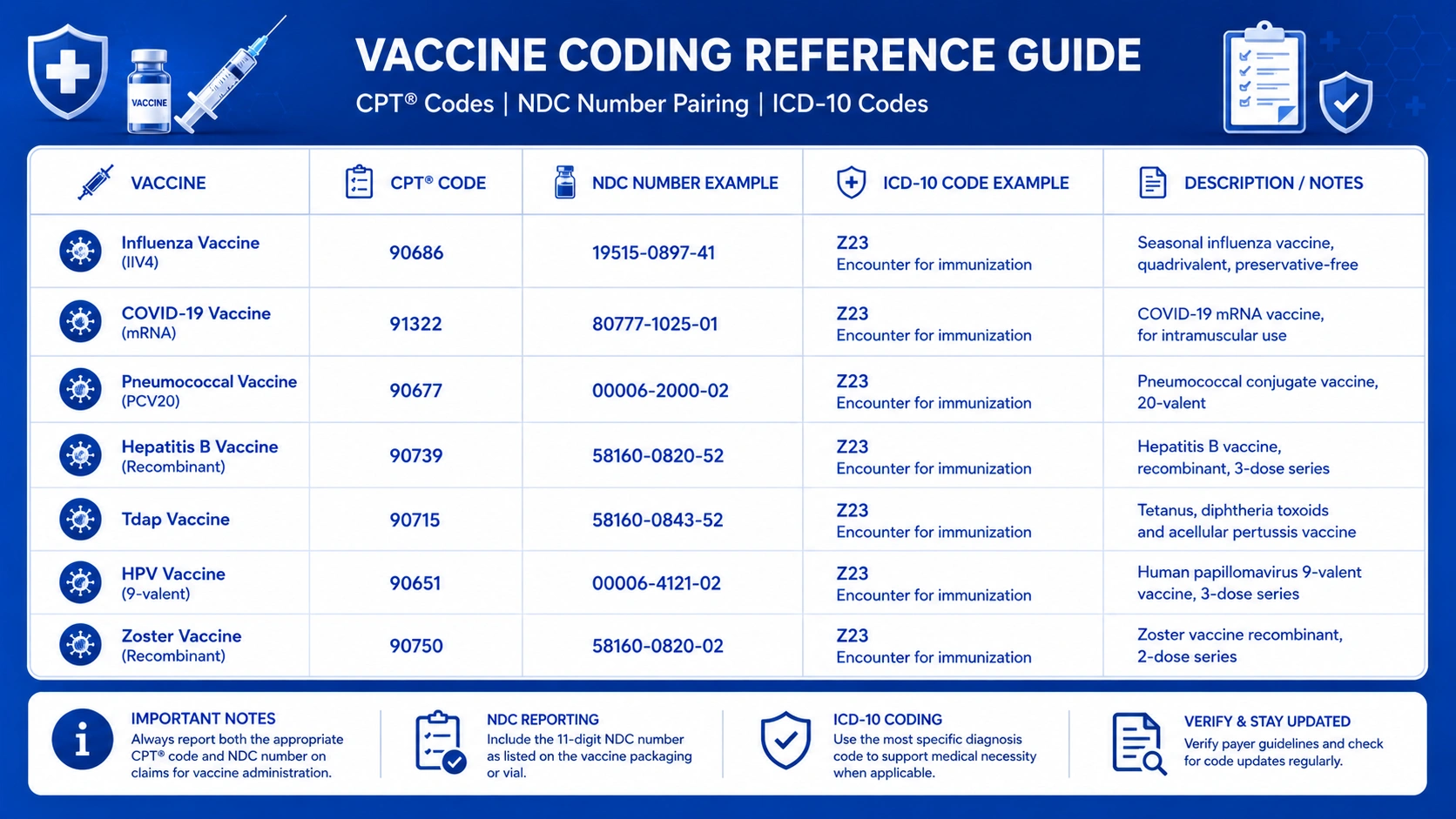
Vaccine Administration CPT Codes — 90460, 90461, and 90471–90474
Knowing what CPT codes are used for vaccine administration is the starting point for every clean claim. Here is the 2026 breakdown:
| CPT Code | Description | When to Use |
|---|---|---|
| 90460 | First vaccine/toxoid component, through age 18, with physician counseling | Physician or QHP provides face-to-face counseling |
| 90461 | Each additional vaccine component (add-on to 90460) | Combination vaccines — one unit per additional antigen |
| 90471 | First injection — no counseling by QHP | Non-physician staff administers; no QHP counseling |
| 90472 | Each additional injection, add-on to 90471 | Multiple injections same date, no counseling |
| 90473 | First intranasal or oral vaccine, no counseling | FluMist and other non-injection routes |
| 90474 | Additional intranasal/oral vaccine, add-on to 90473 | Multiple oral/intranasal vaccines same date |
The distinction between single antigen vs. combination vaccine CPT codes is critical here. When billing vaccine administration CPT codes 90460 90461 90471 for combination products like DTaP or MMRV, each antigen component is counted separately under the 90460/90461 series — but a single unit applies under 90471/90472. Misreading this is the source of widespread undercoding at multi-provider pediatric groups.
ICD-10 Codes That Support Medical Necessity for Immunization Services
Immunization CPT codes 2026 must be paired with the appropriate ICD-10 diagnosis. The most commonly used are:
- Z23 — Encounter for immunization (standalone vaccine visit)
- Z00.121 / Z00.129 — Routine child health exam with or without abnormal findings (well-child visit)
- Z28.xx — Used when documenting vaccine refusal or incomplete vaccination schedule
The diagnosis code Z23 for immunization encounters is the correct primary diagnosis when the sole purpose of the visit is vaccination. Using Z00-series codes when Z23 applies — or vice versa — creates a coding mismatch payers flag automatically.
NDC Numbers and How They Pair With CPT Codes on Claims
NDC numbers in vaccine billing serve as product identifiers. Every payer that covers vaccines requires the 11-digit NDC on the claim to confirm which product was administered. This must match the lot number documented in the patient chart. When your practice changes manufacturers or receives a new lot, your billing team needs immediate notification to update all pending claim submissions.
Telehealth and Counseling-Only Vaccine Billing Codes and Modifier Requirements
Telehealth visits that include vaccine counseling — but not administration — require a distinct coding approach. In these encounters, vaccine procedure codes do not apply. Billing should reflect the appropriate E&M or preventive service, with documentation of counseling content. Telehealth modifiers must still be applied per payer-specific guidelines for immunization CPT codes 2026.
How Much Revenue Is Your Practice Losing to Vaccine Billing Errors?
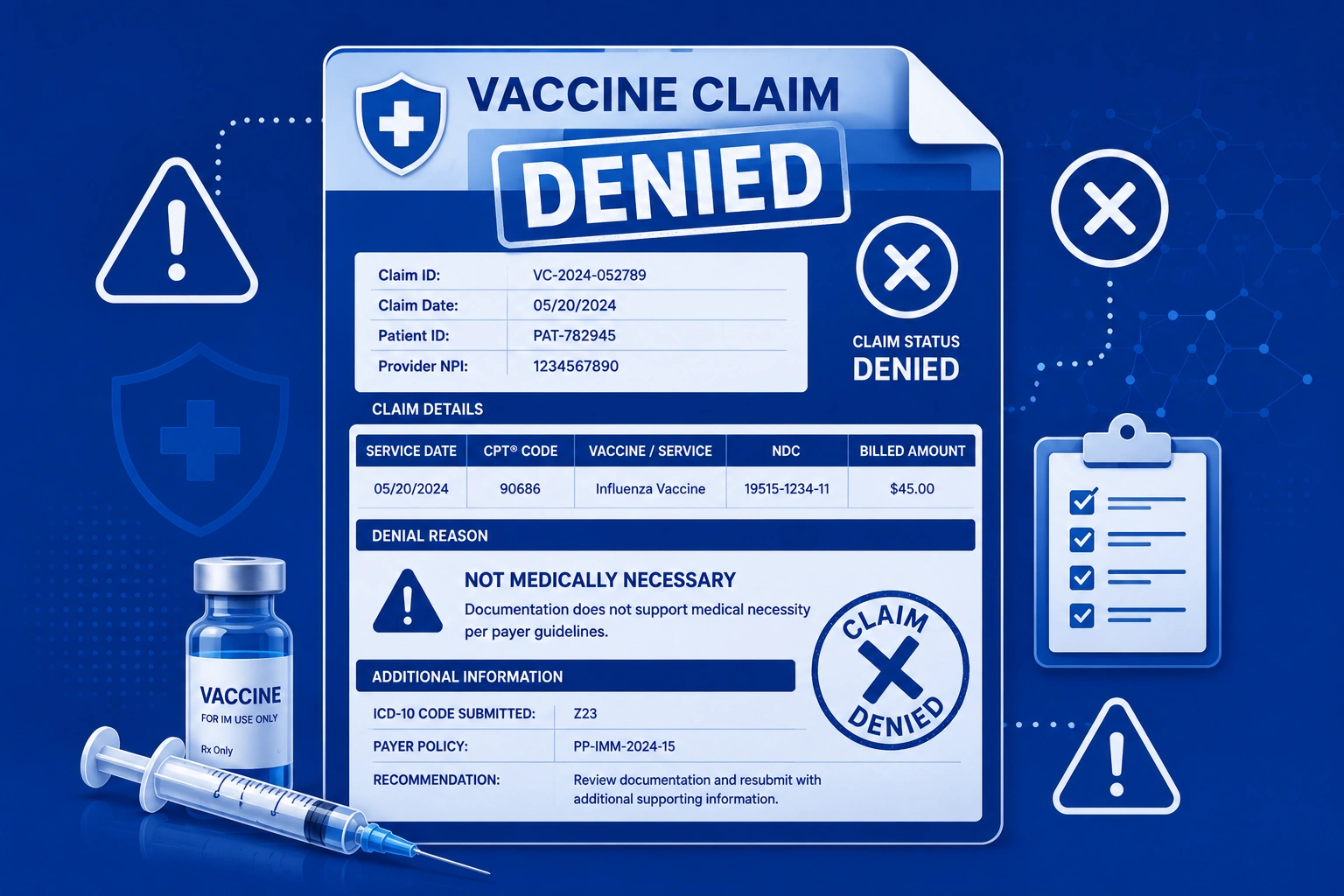
Example 1 — Wrong NDC Number Leads to a Blanket Claim Denial
A mid-size pediatric group submitted 200 vaccine claims following a product lot changeover. The billing team had not been updated on the new NDC, and all 200 claims were denied. The rework — correcting NDC data, resubmitting, and tracking remittance — consumed over 15 staff hours and delayed $18,000 in reimbursement by 45 days.
Example 2 — Vaccine Claims Denied for Incomplete VFC Documentation
A solo pediatric practice enrolled in VFC was audited after a payer identified inconsistent eligibility screening records. Retroactive denials were issued on 80 encounters spanning six months. The practice had to reconstruct documentation and resubmit, ultimately recovering only 60% of the denied revenue.
Example 3 — Specialty-Specific Reimbursement Gaps in Combination Vaccine Billing
A family medicine practice was not billing 90461 add-on codes for combination vaccine components. Every MMRV administration was submitted as a single unit under 90460, leaving multiple add-on units completely unbilled. The annualized revenue gap exceeded $12,000 — invisible to the practice until a billing review was conducted.
Our Medical Billing Services for Pediatric Practices team identifies this exact pattern across dozens of practice audits every year.
Medicaid/VFC vs. Commercial Payer Vaccine Billing: A 2026 Comparison
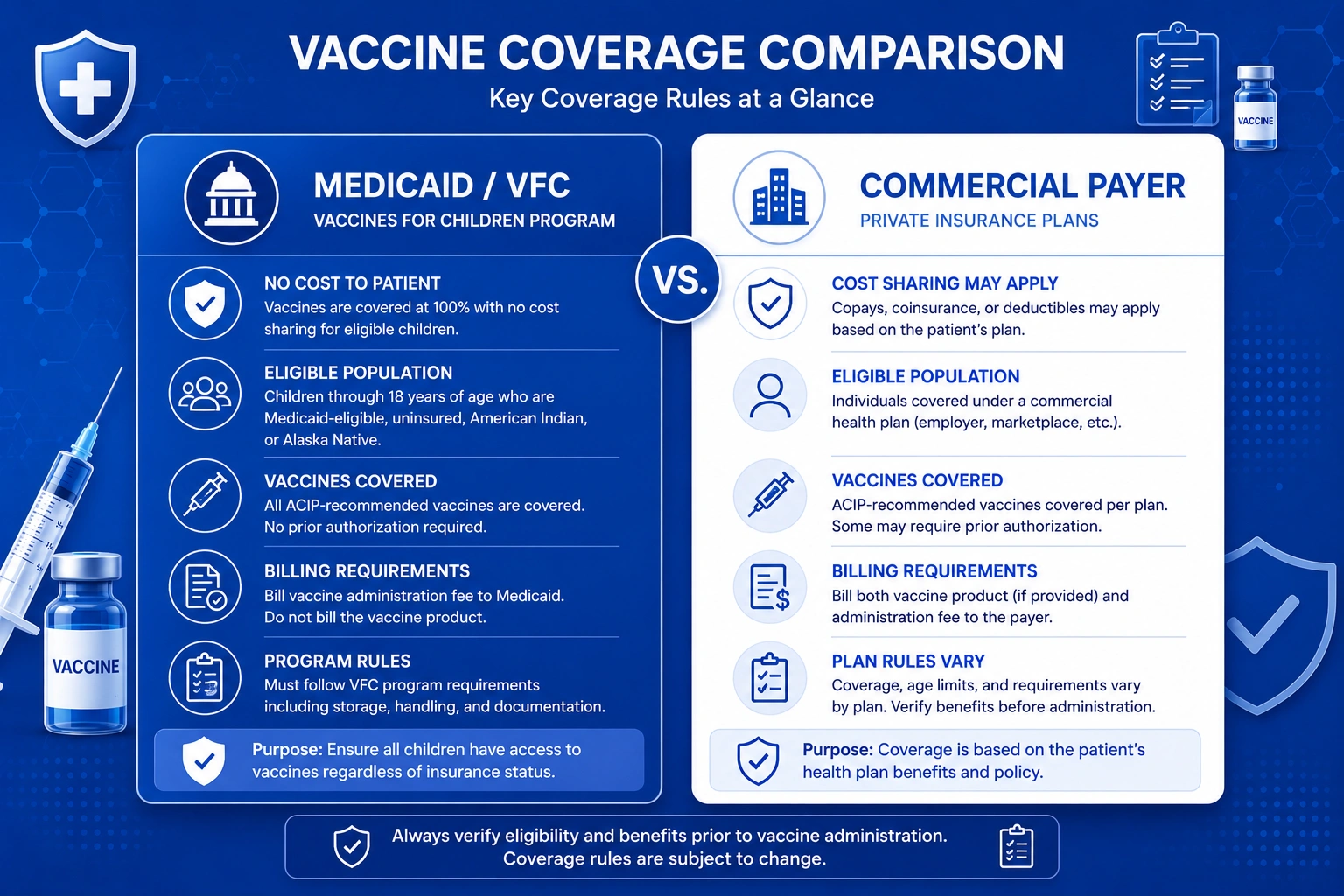
What Medicaid and the VFC Program Cover for Vaccines in 2026
Understanding how Medicaid and the VFC program cover pediatric vaccines in 2026 is essential for any practice serving low-income or uninsured children. The Vaccines for Children program provides vaccines at no cost to enrolled providers through the state VFC supply chain. Practices bill only for the administration fee — never the vaccine product. Medicaid administration fee rates vary by state and are generally lower than commercial benchmarks.
Medicaid Vaccines for Children (VFC) program billing requires VFC eligibility to be screened and documented at every encounter, with the screening form retained in the chart. Failing to document this correctly is the single most common trigger for VFC-related retroactive denials.
How Commercial Payers Differ From Medicaid on Vaccine Coverage
Commercial payer vaccine billing requirements differ significantly. Unlike VFC, commercial payers reimburse for both the vaccine product and the administration service, so billing must include the vaccine product CPT code, the administration CPT code, and the NDC number for product cost validation.
Commercial plans also impose prior authorization requirements for select vaccines — particularly newer, higher-cost products. Checking payer-specific PA requirements before ordering the vaccine is a critical front-end workflow step.
| Factor | Medicaid / VFC | Commercial Payers |
|---|---|---|
| Vaccine product billable? | No (VFC-supplied) | Yes |
| Administration fee billable? | Yes | Yes |
| NDC required on claim? | Yes | Yes |
| Prior authorization common? | Rarely | Often (newer vaccines) |
| Eligibility verification required | VFC screen at every visit | Insurance eligibility every visit |
| Counseling codes (90460) covered? | Varies by state Medicaid | Generally covered |
CHIP Vaccine Coverage Variation by State
Vaccine billing and VFC program requirements by payer 2026 also extend to CHIP. Some CHIP plans follow VFC rules; others function more like commercial plans. Your billing team must verify CHIP payer policies at the state level — assuming VFC rules apply universally to CHIP will produce denials.
Documentation Requirements for Vaccine Claims
What Must Be in the Clinical Note to Support Immunization Medical Necessity
Every vaccine claim must be supported by a clinical note that documents: the vaccine name, date, route, site, lot number, expiration date, the NDC number, the name of the administering provider, and the Vaccine Information Statement provided to the patient or guardian. Missing any of these creates audit exposure that a payer can act on immediately.
VFC Eligibility Screening and Documentation — What Payers Require in 2026
The VFC program requires practices to screen every patient at every vaccine visit using an approved VFC eligibility questionnaire. The completed form must be retained in the patient’s record. Payers conducting post-payment audits will request this documentation — and its absence is grounds for clawback regardless of whether the claim was otherwise coded correctly.
Avoiding Common Documentation Errors That Trigger Audits and Clawbacks
The three most common documentation failures are: missing VFC screening forms, absent vaccine lot and NDC data in the chart, and boilerplate counseling notes that do not reflect the specific conversation that occurred. Individualized, encounter-specific documentation is not optional — it is the foundation of a defensible claim.
Strategies Every Pediatric Practice Should Implement Right Now
Verify Vaccine Coverage and VFC Eligibility Before the Visit
Run eligibility checks the day before every scheduled well-child appointment. Confirm insurance coverage, VFC eligibility status, and any prior authorization requirements. This single process step prevents the majority of front-end vaccine billing denials before they happen.
Use the Correct CPT and NDC Code Combination for Each Payer
Build a payer-specific vaccine billing crosswalk that maps each vaccine administration CPT codes 2026 to the appropriate NDC and any required payer-specific modifiers. Update it immediately whenever a product lot changes or a new payer policy takes effect.
Build a Standardized Immunization Billing Workflow
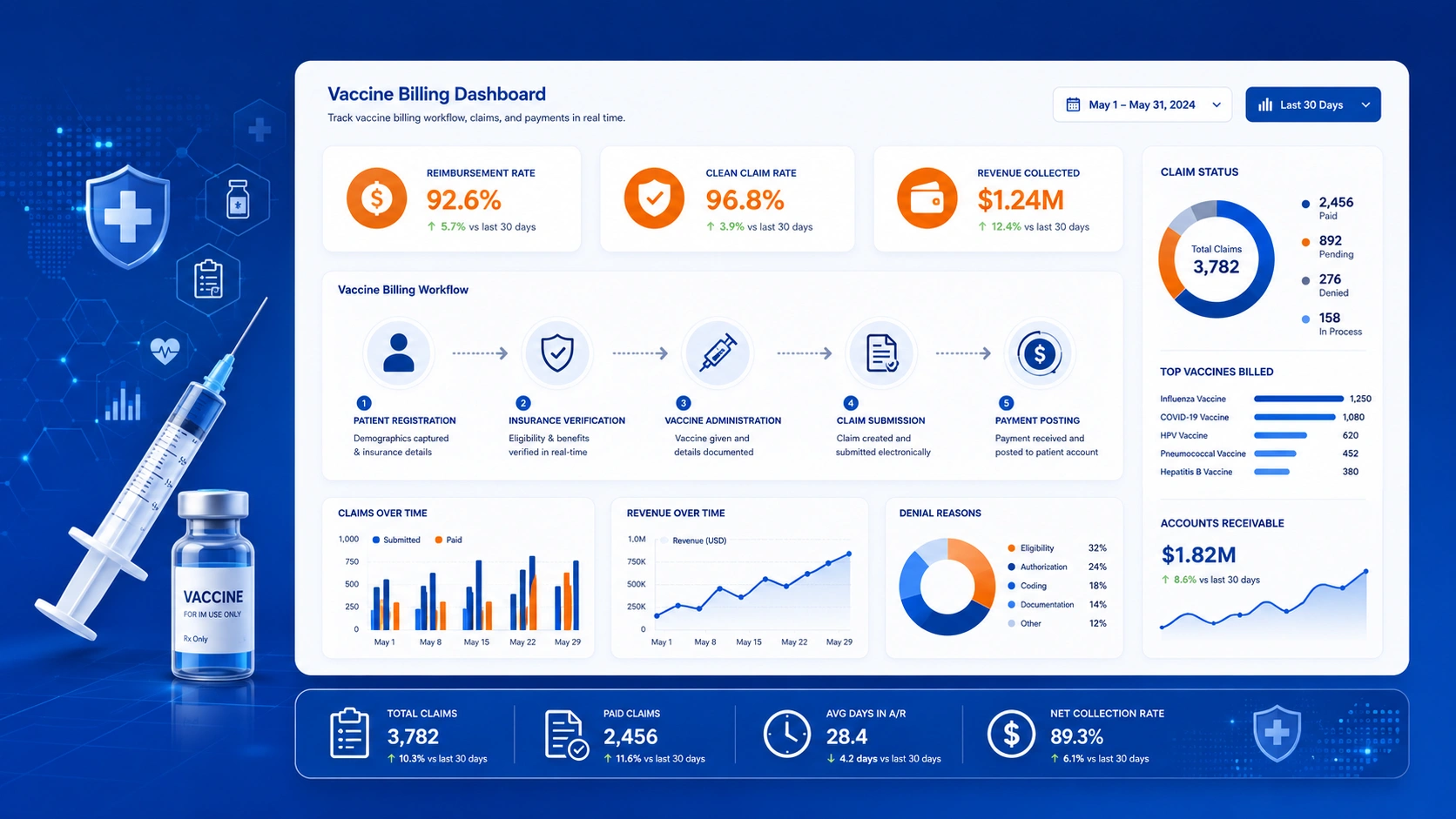
Knowing how to bill insurance for vaccine administration in 2026 comes down to process. Create a step-by-step checklist — eligibility verification → clinical documentation → code assignment → NDC capture → claim submission → remittance review — with clear accountability assigned at each stage.
Train Your Billing Staff on Payer-Specific Vaccine Codes and Bundling Rules
Billing staff must understand which payers require Modifier 25, which allow a bundled E&M and vaccine administration on the same claim, and which have unique payer edits for vaccine procedure codes. Annual training is the minimum given how frequently payer policies change.
Outsource Pediatric Vaccine Billing to Specialists
Can small pediatric practices get reimbursed for vaccine administration at competitive rates? Yes — but often only with specialized billing support. Small practices typically lack the staff bandwidth to manage payer-specific rules across dozens of immunization billing codes 2026. Our Medical Billing Services are purpose-built for exactly this challenge.
How Outsourced Vaccine Billing Protects Your Revenue
Proactive NDC and CPT Mismatch Prevention for Vaccine Claims
An outsourced billing team monitors for NDC updates and payer policy changes proactively — before claims are submitted. This eliminates the most common source of vaccine billing denials before they ever reach the payer’s system.
Faster, Fully Documented Appeals With Clinical Evidence
When denials do occur, an experienced vaccine billing team knows exactly what documentation is required for a successful appeal — and can typically resolve denials in a single submission cycle rather than multiple rounds of back-and-forth.
Payer-Specific Vaccine Denial Tracking and Trend Reporting
Tracking denial trends by payer and code gives your practice the intelligence to address systemic billing issues — not just individual claim errors. Our Billing Reporting and Analytics platform provides this visibility in real time so your leadership team can act on data, not guesswork.
How TMS Billings Helps Pediatric Practices Maximize Vaccine Reimbursement

At TMS Billings, we specialize in the full immunization billing cycle — from eligibility and VFC screening support to NDC validation, claim submission, denial management, and payer-specific appeal workflows. Our team understands the nuances of pediatric vaccine billing 2026 across Medicaid, VFC, CHIP, and every major commercial payer.
We work as an extension of your billing department, handling payer-specific complexity so your clinical team can stay focused on patients. Whether you are a solo pediatrician or a multi-provider group, our billing specialists will find the reimbursement that is currently slipping through the cracks in your existing process.
The Financial Cost of Vaccine Billing Errors in 2026
The volume of pediatric immunization services continues to grow — and so does the administrative complexity that comes with it. Here is what the data shows:
- Immunization service volume growth: Pediatric practices have reported year-over-year increases in vaccine encounter volume as catch-up scheduling continues through 2026. This growth amplifies every billing error — even a small percentage of miscoded claims at scale translates into tens of thousands of dollars in lost revenue annually.
- Revenue at risk per practice: Practices with incorrect NDC reporting or missing VFC documentation put an estimated $15,000–$40,000 in annual vaccine revenue at risk, depending on practice size and payer mix. According to MGMA benchmarking data, immunization billing errors rank among the top five drivers of pediatric practice revenue leakage.
- Cost to rework a denied claim: The average cost to rework a denied claim — including staff time, system overhead, and payment delay — ranges from $25 to $118 per claim. For a practice denying 10–15 vaccine claims per week, that represents over $15,000 per year in administrative waste alone.
- Reimbursement rate gap — Medicaid vs. commercial: Medicaid administration fees for vaccines are often 30–50% lower than commercial rates. Per CMS reimbursement data, practices with a heavy Medicaid and VFC payer mix must maintain nearly perfect clean claim rates to preserve margin — there is no room for avoidable errors.
- Clean claim rate gap: Industry data suggests that up to 20–25% of vaccine claims at practices without specialized billing support are denied on first submission. The gap between vaccine administration volume and successful first-pass reimbursement rates is a direct indicator of billing infrastructure quality — and a direct measure of recoverable revenue.
Key Takeaways
- Vaccine billing codes include CPT, NDC, and ICD-10 components — all three must align for a clean claim.
- NDC mismatches and missing VFC documentation are the top two causes of immunization claim denials.
- The diagnosis code Z23 is the correct primary ICD-10 for standalone immunization encounters.
- CPT codes 90460 and 90461 apply when a physician or QHP provides counseling; 90471 and 90472 apply without counseling.
- VFC billing requires eligibility documentation at every visit — not just at enrollment.
- Commercial payers require both the vaccine product CPT and administration CPT; Medicaid/VFC requires the administration code only.
- Modifier 25 must be applied correctly when an E&M service and vaccine administration occur on the same date — payer rules vary.
- Small practices can and should explore outsourced billing to recover reimbursement currently being missed.
Final Thoughts
Vaccine billing errors are not random. They follow predictable patterns — NDC mismatches, missing VFC documentation, bundling errors, and modifier misapplication. Every one of those patterns is preventable. If your practice is experiencing recurring vaccine billing denials, the answer is not just fixing individual claims. It is building a billing infrastructure that catches errors before they become revenue losses.
The right support makes that possible. Our Revenue Cycle Management Services are designed for the specific complexity of pediatric immunization billing — across every payer, every code set, and every documentation standard your practice faces in 2026. Contact TMS Billings today to schedule a vaccine billing audit and see exactly how much revenue your practice could be recovering.