
Common Dermatology Billing Denials and How to Prevent Them
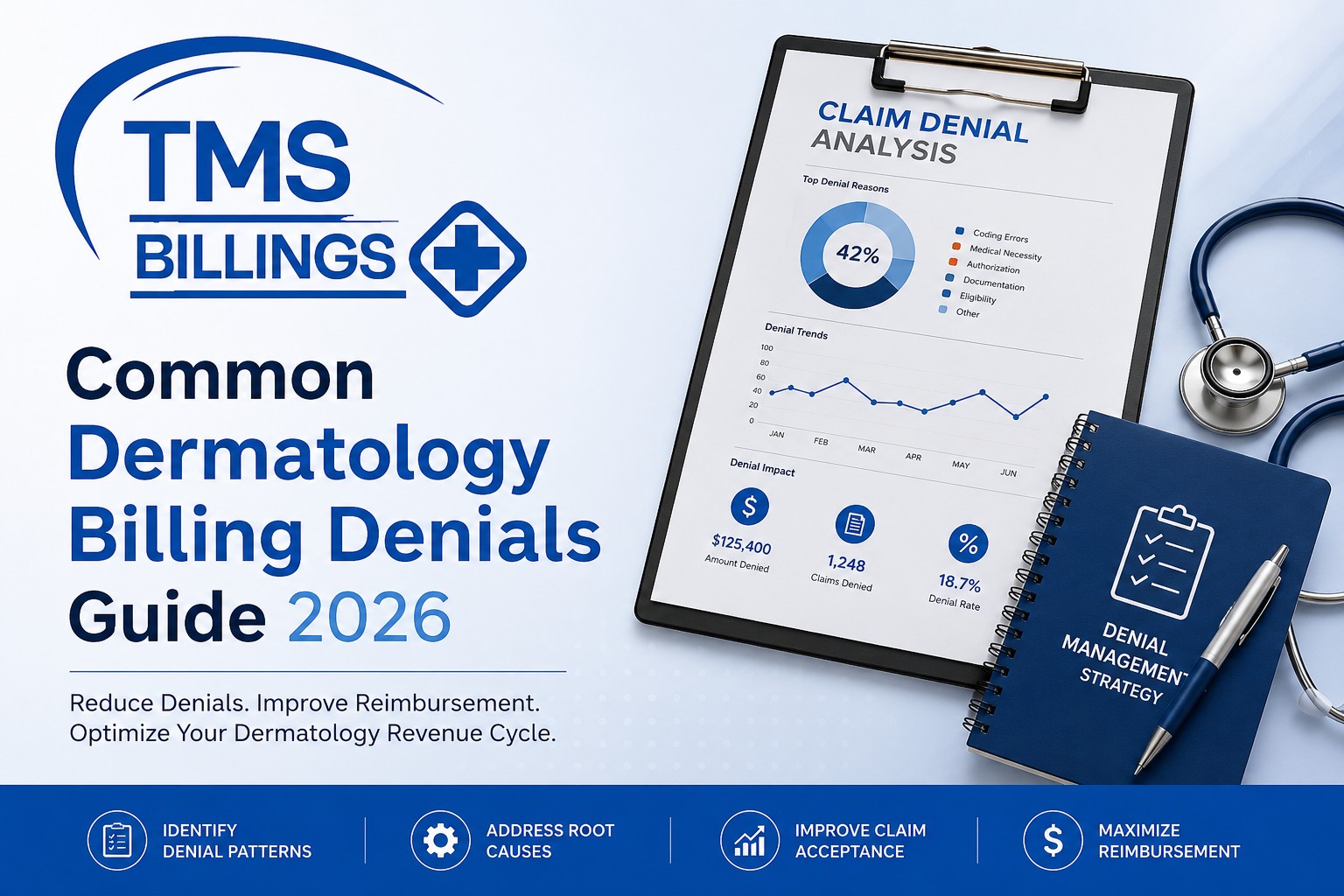
Running a dermatology practice means navigating one of the most complex billing environments in medicine. Between skin biopsies, excisions, Mohs surgery, cryotherapy, and the constant line between cosmetic and medically necessary procedures, the margin for billing error is razor thin. For many practices, dermatology billing denials are not an occasional frustration — they are a recurring source of revenue loss that compounds over time. If your claim denial rate is climbing or your accounts receivable is aging beyond 60 days, the root causes are almost always identifiable and fixable. This guide walks through why denials happen, how to stop them before they start, and how expert Dermatology Medical Billing Services can help your practice protect every dollar it earns.
Quick Reference: Top Dermatology Billing Denials and Fixes
| Denial Type | Common Cause | Fastest Fix |
|---|---|---|
| Eligibility denial | Coverage not verified before visit | Real-time eligibility check at scheduling |
| Prior authorization | Auth not obtained or expired | Pre-visit auth workflow for high-risk CPT codes |
| Medical necessity | Vague or missing documentation | Link diagnosis clearly to treatment in the chart |
| Coding errors | Wrong CPT, modifier, or ICD-10 | Use specialty-specific coding tools and audits |
| Incomplete claims | Missing NPI, modifiers, or dates | Automated claim scrubbing before submission |
| Duplicate claim | Same service billed twice | Claims tracking system with denial alerts |
Why Dermatology Billing Denials Hurt Practice Revenue
Every denied claim costs your practice money twice — once when the payer refuses payment, and again when your billing team spends time reworking and resubmitting it. The American Medical Association estimates that claim rework costs providers between $25 and $117 per claim depending on complexity. Multiply that by dozens of denied claims each month and the financial damage adds up fast.
Dermatology reimbursement issues are especially costly because of the high volume of procedures performed per patient visit. A single appointment might include a skin exam, a shave biopsy, cryotherapy of a benign lesion, and a prescription — each with its own billing code, modifier, and documentation requirement. One missing modifier or an unsupported diagnosis can trigger a denial cascade across multiple line items.
Beyond individual claims, dermatology claim denials affect your cash flow predictability, your team morale, and your ability to reinvest in the practice. Practices that don’t actively manage the denial management process often see a slow but steady increase in their denial rate year over year — a pattern that only reverses with deliberate intervention.
Understanding the Dermatology Claim Denial Process
1. What Happens When a Claim Gets Denied
Once a claim is submitted to a payer, it goes through an adjudication process — a series of automated and manual reviews that determine whether the claim is payable, partially payable, or denied. When a denial is issued, the payer sends an Explanation of Benefits (EOB) or Electronic Remittance Advice (ERA) with a denial reason code. Common codes include CO-4 (inconsistent modifier), CO-11 (diagnosis not covered), and CO-50 (not deemed medically necessary).
At this point, your billing team must review the denial, identify the root cause, correct the claim if possible, and resubmit within the payer’s appeal window — which is often 60 to 180 days from the date of service. Missing this window means losing the payment entirely. For busy practices without a structured denial management process, claims frequently fall through the cracks.
2. The Difference Between Rejections and Denials
These two terms are often used interchangeably, but they refer to different problems with different solutions.
A rejection happens before the claim is adjudicated. The clearinghouse or payer sends the claim back because it contains a technical error — a missing field, an invalid NPI, a formatting issue, or an incorrect date of service. Rejections are not processed, so they do not count against your claim submission process record. They simply need to be corrected and resubmitted promptly.
A denial happens after the claim has been adjudicated. The payer received the claim, reviewed it, and decided not to pay — or to pay less than billed — based on clinical, coverage, or coding criteria. Denials require formal appeals, additional documentation, and sometimes peer-to-peer review.
Understanding this distinction matters because the fix is different. A rejection is a technical correction. A denial is a substantive challenge that may require medical necessity documentation, coding justification, or an authorization appeal.
3. Why Dermatology Claims Are Especially Vulnerable
Dermatology practices face a higher-than-average denial rate compared to many other specialties. Several factors contribute to this:
- High procedure volume per visit. Multiple services billed on the same date increase the risk of bundling issues and modifier disputes.
- Cosmetic vs. medically necessary determinations. Payers scrutinize procedures like lesion removal, skin tag excision, and laser treatments to determine whether they are cosmetically elective or clinically necessary.
- Frequent prior authorization requirements. Biologics for psoriasis or atopic dermatitis, Mohs surgery, and certain excisions often require advance authorization that is easy to miss.
- Rapid CPT code changes. Dermatology-related CPT codes are updated annually, and practices using outdated code sets generate denied claims in dermatology without realizing it.
- Modifier complexity. Procedures like destruction of lesions, biopsies, and excisions frequently require modifiers (such as -59, -25, -51, or -XS) to distinguish services that might otherwise be bundled by the payer.
Step-by-Step Guide to Preventing Dermatology Billing Denials
Preventing denials is far more cost-effective than appealing them. These five steps create a front-end defense that reduces the volume of dermatology billing errors reaching the payer.
Step 1 — Verify Patient Eligibility Before the Visit
Eligibility verification is the single most impactful step in denial prevention, yet it remains inconsistently performed in many practices. Before a patient arrives, your team should confirm:
- Active coverage on the date of service
- Deductible status and any remaining balance
- In-network vs. out-of-network status for your providers
- Any procedure-specific exclusions or cost-share requirements
Real-time eligibility checks through your practice management system or clearinghouse can flag coverage issues before the patient is in the chair. This prevents a large category of denied claims in dermatology that arise from simple coverage lapses, plan changes, or secondary payer confusion.
Step 2 — Check Prior Authorization Requirements
Insurance claim rejections tied to missing or expired prior authorizations are among the most frustrating denials because they are entirely avoidable. Many payers require prior authorization for:
- Biologic medications (Dupixent, Skyrizi, Tremfya, etc.)
- Mohs micrographic surgery
- Excisions beyond a certain size or site
- Phototherapy (PUVA, narrowband UVB)
- Certain pathology lab services
Build a prior authorization workflow into your scheduling process. When a procedure is booked, your staff should immediately check the payer’s authorization requirements, initiate the request if needed, and document the authorization number in the patient’s chart before the date of service. Prior authorization errors remain one of the top reasons dermatology claims are rejected — and one of the most preventable.
Step 3 — Document Medical Necessity Clearly
Medical necessity documentation gaps account for a significant share of dermatology reimbursement issues, particularly for procedures that payers may view as borderline elective. Good documentation connects the diagnosis to the treatment in language that a payer’s medical reviewer can follow without guesswork.
For a shave biopsy, this means recording not just the location and size of the lesion, but the clinical rationale — irregular borders, patient history, symptomatic nature, or change in appearance over time. For cryotherapy of a seborrheic keratosis, note any symptoms like irritation or bleeding. For excisions, document the clinical diagnosis and the necessity of complete removal.
The Centers for Medicare & Medicaid Services provides guidance on medical necessity documentation standards that apply across payers. Following these standards and training providers on documentation expectations reduces coding and billing compliance risk significantly.
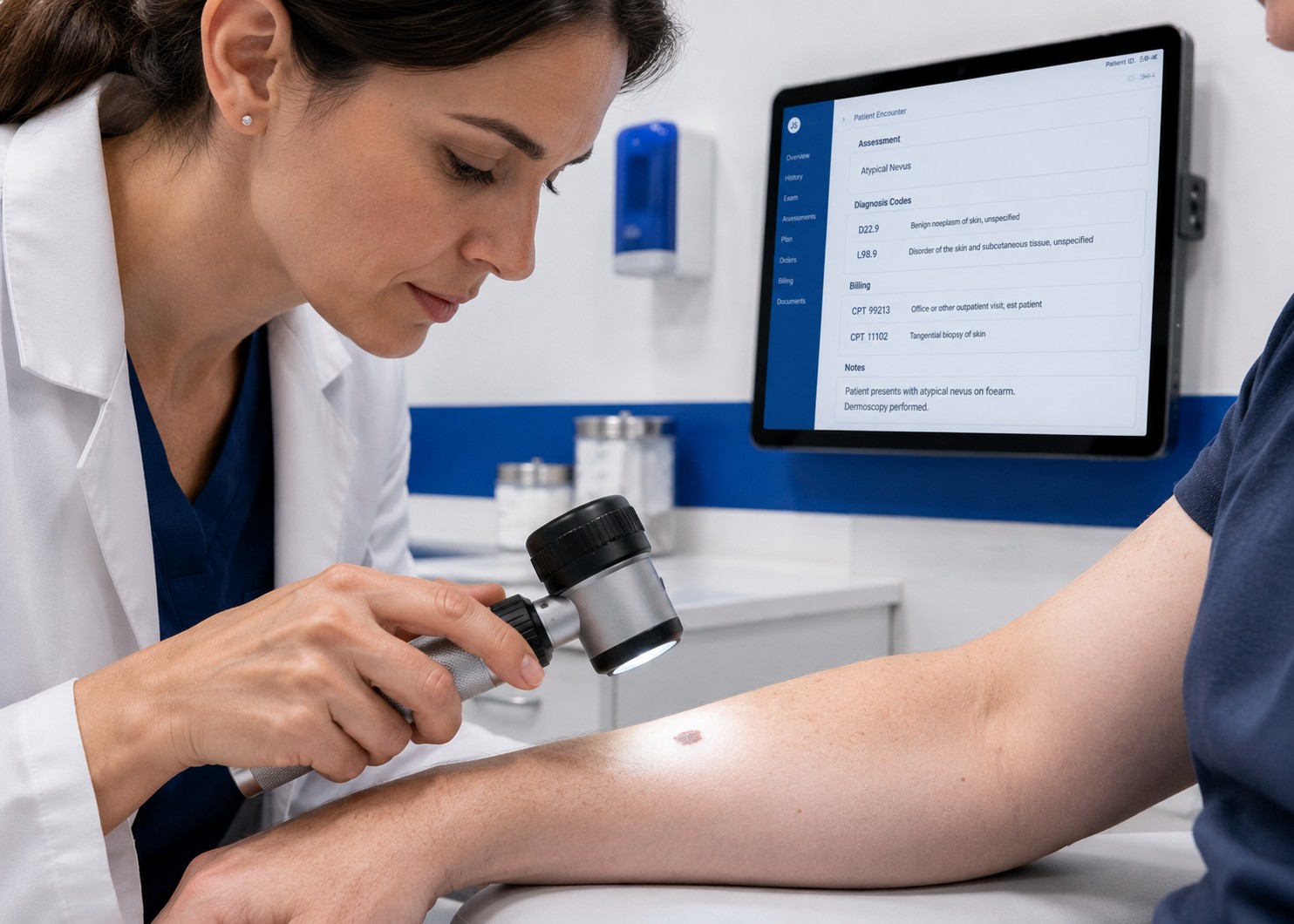
Step 4 — Use the Correct CPT and ICD-10 Codes
Coding mistakes in dermatology are a primary driver of denied claims. Unlike general medicine, dermatology coding requires granular specificity — the size of the lesion, the technique used, the anatomical site, and the pathological classification all affect which code is correct.
Common dermatology billing errors include:
- Using a biopsy code (11102–11107) when an excision code (11400–11646) is more appropriate
- Failing to report the correct destruction code based on method (cryosurgery, laser, electrosurgery) and lesion count
- Undercoding or overcoding E&M services that accompany a procedure on the same date
- Applying the wrong ICD-10 code — for example, using a benign lesion code when pathology returns a malignant result
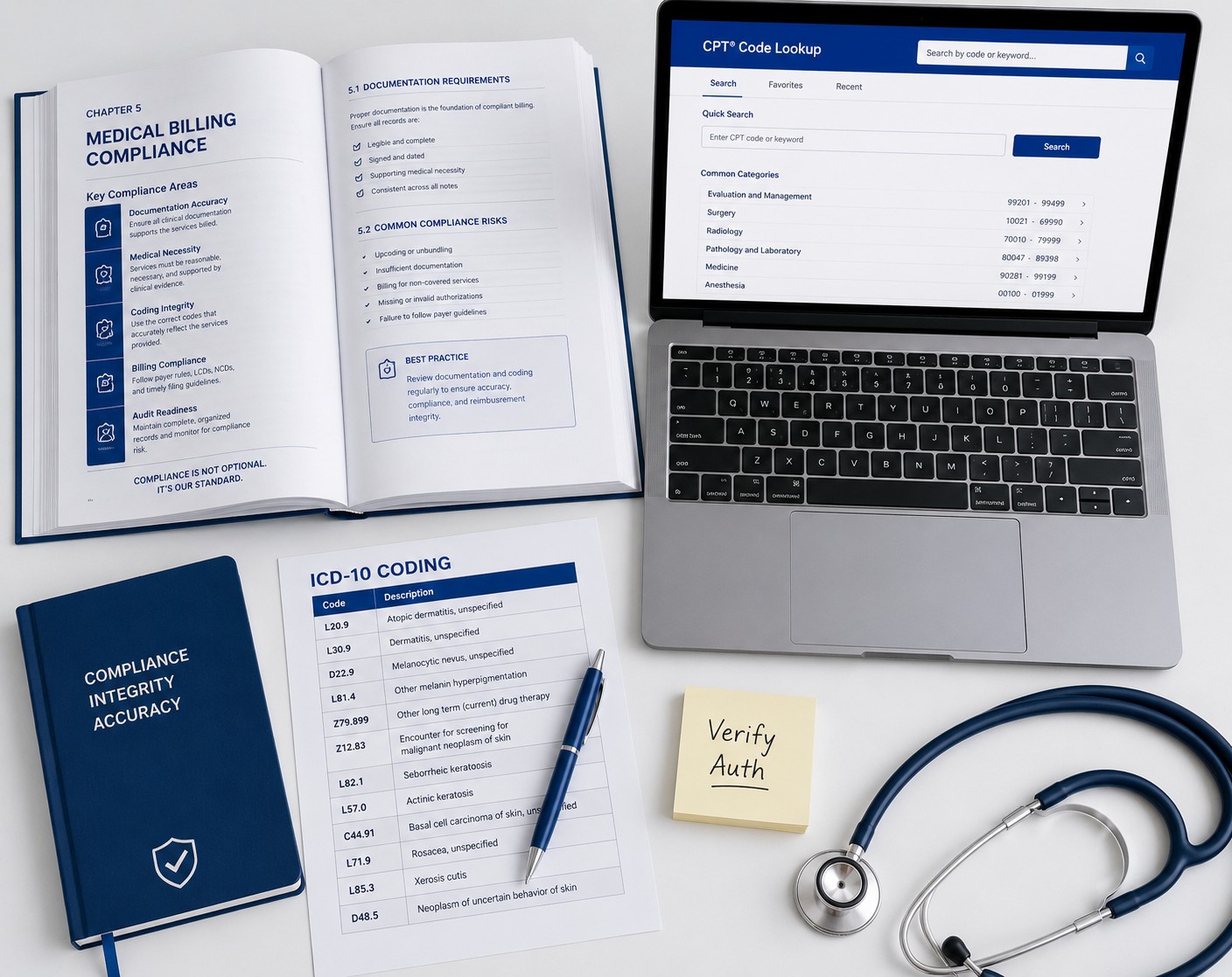
The American Medical Association’s CPT codebook and companion resources provide the most up-to-date guidance on procedure coding. Pairing this with regular coding audits ensures your team stays aligned with current standards.
Step 5 — Review Claims Before Submission
A clean claim is one that passes automated edits and includes all required data elements. Before submitting any dermatology claim, run it through a claim scrubbing process that checks for:
- Correct and complete patient demographics
- Valid NPI and taxonomy codes
- Required modifiers based on the procedure and payer
- Supporting diagnosis codes that match the service
- Prior authorization numbers where required
- Referring provider information when applicable
Catching errors before submission prevents rejections and keeps your claim submission process moving efficiently. Many practice management systems include built-in scrubbers, but payer-specific edits often require additional review.
Most Common Dermatology Billing Denials and How to Fix Them
Eligibility Verification Errors
When a claim is denied because a patient’s coverage was inactive, the service was rendered out of network, or the patient had a different primary payer than recorded, the fix is straightforward — but the prevention is even simpler. Verify eligibility at every touchpoint: at scheduling, at the reminder call, and at check-in.
For recurring patients, do not assume coverage is the same as the last visit. Employers change benefit plans annually, and patients switch insurers without always informing their providers. Eligibility errors are among the top reasons dermatology claims are rejected by payers who otherwise have no clinical objection to the service.
Prior Authorization Errors
Prior authorization denials fall into two categories: cases where authorization was never obtained, and cases where the authorization obtained does not match the service performed. The second type is subtler and often overlooked.
If a patient is authorized for a 1.5 cm excision but the surgeon removes a 2.1 cm lesion, the authorization may not cover the actual procedure performed. Similarly, if a biologic was authorized for one diagnosis code but a secondary diagnosis was also treated, the payer may deny the claim. Precise documentation of what was authorized and what was performed is essential.
Medical Necessity Documentation Gaps
This is the denial type that most often escalates to formal appeals. When a payer denies a claim as “not medically necessary,” they are usually looking for clinical documentation that supports why a particular treatment was the appropriate choice for that specific patient at that time.
For dermatology, this commonly affects phototherapy for psoriasis, excision of sebaceous cysts, or repeated visits for chronic skin conditions. Strengthen your templates to capture the clinical decision-making process, not just the procedure itself. A brief phrase like “lesion excised due to symptomatic irritation, failed conservative management, and concern for malignancy” carries far more weight than a bare CPT code and a generic diagnosis.
Coding Mistakes in Dermatology
Coding mistakes in dermatology span everything from simple typos to genuinely ambiguous coding decisions. Some of the most common include:
- Incorrect lesion size documentation leading to use of the wrong excision code tier
- Unbundling errors — billing separately for services that payers expect to be included in a comprehensive code
- Modifier -25 issues — failing to append modifier -25 to a significant E&M service rendered on the same day as a procedure, or appending it without documentation of a separately identifiable evaluation
- Wrong pathology linkage — not connecting the surgical CPT to the corresponding pathology report and diagnosis
Coding and billing compliance in dermatology requires ongoing training as payer policies and code sets evolve. The American Academy of Dermatology provides specialty-specific coding resources that help practices stay current.
Missing or Incomplete Claim Information
Claims submitted without a required field — an attending provider NPI, a place-of-service code, a referring physician, or a date of injury for wound care — will reject immediately at the clearinghouse level. While these are technically rejections rather than denials, they delay payment and consume staff time.
Create a mandatory pre-submission checklist and train every biller to complete it before releasing a claim. Automate what you can. The cost of a claim scrubbing tool is almost always less than the cost of manual denial rework.
How Denial Management Improves Dermatology Revenue Cycle Performance
Tracking Denial Patterns
The denial management process is not just about fixing individual claims — it is about recognizing patterns that point to systemic problems. If 30% of your Mohs surgery claims are being denied by a particular payer for lack of medical necessity, that is not a billing error. It is a documentation workflow issue that needs to be addressed at the provider level.
Track your denials by payer, by CPT code, by denial reason code, and by provider. Over time, this data reveals where your practice’s revenue leakage prevention efforts should focus. Dashboards built into your practice management or billing platform can automate this analysis.
Fixing Root Causes Instead of Resubmitting Blindly
Many billing teams fall into the habit of resubmitting denied claims without understanding why they were denied in the first place. This is expensive and ineffective. A claim resubmitted with the same error will be denied again, and your appeal window shrinks with each cycle.
Effective denial management means diagnosing the root cause — was it a coder, a documentation gap, a provider habit, or a payer policy change? — and addressing it before resubmission. This reduces your overall dermatology claim denials over time rather than simply recycling the same denials through the system.
Building a Better Claim Submission Process
Revenue leakage prevention starts with a structured claim submission process that leaves nothing to chance. This includes:
- Standardized intake workflows that capture accurate demographics and insurance data every time
- Consistent documentation templates that support medical necessity for common dermatology procedures
- Automated eligibility verification integrated into your scheduling system
- Pre-submission claim scrubbing with payer-specific edits
- Timely filing calendars that prevent claims from aging past payer deadlines
How Outsourcing Helps Reduce Dermatology Billing Denials

What Certified Billing Specialists Do Differently
A certified medical billing specialist who focuses on dermatology brings a depth of payer-specific knowledge that generalist billers often lack. They understand which payers require modifier -59 versus modifier -XS, which plans routinely deny cryotherapy as cosmetic, and which diagnosis codes trigger automatic prior authorization flags.
They also bring familiarity with denial trends across multiple practices — knowledge that allows them to anticipate problems rather than just react to them. For practices struggling with how to reduce dermatology billing denials, this expertise represents a significant competitive advantage.
Real-Time Claim Review and Denial Prevention
Outsourced billing teams typically operate with real-time claim review workflows, meaning a human reviewer checks every claim before it goes out the door. This layer of pre-submission review catches errors that automated scrubbers miss — especially subjective issues like documentation quality, modifier justification, or diagnosis-procedure linkage.
When a denial does occur, a dedicated team can respond within 24 to 48 hours rather than letting claims sit in a work queue for days or weeks. Faster denial resolution means faster reimbursement and better dermatology revenue cycle performance.
Staying Compliant With Payer Rules and Coding Updates
Payer policies change constantly. Medicare Local Coverage Determinations (LCDs) are updated, commercial payer medical policies shift, and CPT codes are added, deleted, or revised every January 1. A specialized billing partner monitors these changes on your behalf and updates your billing protocols accordingly.
This ongoing compliance management is one of the best ways to prevent dermatology claim denials before they occur — and it protects your practice against audit risk at the same time. According to the Healthcare Financial Management Association (HFMA), practices that proactively monitor payer policy changes see measurably lower denial rates than those that rely on reactive appeals.
Dermatology Billing Denials in Medical vs. Cosmetic Procedures

One of the most complex areas of dermatology billing is the boundary between medically necessary and cosmetic services. Payers draw this line carefully, and so should your billing team.
Services like Botox for hyperhidrosis, laser treatment for rosacea, or scar revision after Mohs surgery may have both cosmetic and clinical indications. How the claim is coded and documented determines whether it gets paid. If a procedure is cosmetic by payer definition, it should not be submitted to insurance — doing so invites audits and fraud allegations. If it is medically necessary, documentation must prove it.
Common coding and billing compliance pitfalls in this area include:
- Submitting cosmetic chemical peels under dermatitis treatment codes
- Billing laser hair removal for pilonidal cyst prevention without supporting documentation
- Coding scar revision as reconstruction without operative notes that justify the complexity
When in doubt, obtain a written Advance Beneficiary Notice (ABN) for Medicare patients and a general non-covered service waiver for commercial insurance patients. This protects the practice legally and allows patients to make informed financial decisions.
How TMS Billing Helps Dermatology Practices Prevent Denials
TMS Billing specializes in end-to-end revenue cycle management for dermatology practices across the United States. Their team understands the nuances of dermatology billing — from the intricacies of Mohs surgery coding to the prior authorization landscape for biologics — and builds workflows designed specifically to reduce your denial rate.
Services include real-time eligibility verification, pre-submission claim scrubbing, denial management and appeals, payer-specific coding audits, and monthly performance reporting that tracks your practice’s denial trends over time. Their approach targets the root causes of dermatology billing errors rather than just processing denials after the fact.
If your practice is losing revenue to preventable billing denials, connecting with a specialist team is one of the most direct ways to reverse that trend. Explore the full range of dermatology billing solutions available to practices like yours.
Dermatology Billing Tips for Physicians and Practice Managers
Preventing dermatology claim denials is a team effort. Here are practical steps every stakeholder in your practice can take:
For Physicians and Providers:
- Document the clinical rationale for every procedure, not just the procedure itself
- Use structured note templates that include all fields payers look for in medical necessity reviews
- Stay current with CPT code changes each January — attend at least one coding refresher annually
- Communicate clearly with your billing team when procedures deviate from the original plan
For Practice Managers:
- Monitor your denial rate monthly and set a target — most well-run practices aim for a denial rate below 5%
- Assign a dedicated denial management workflow with clear ownership and turnaround standards
- Review payer contracts annually to ensure reimbursement rates and billing policies are still current
- Invest in training for front-desk staff on eligibility verification and patient financial counseling
For Billing Teams:
- Use denial reason codes as a teaching tool, not just a data field
- Build payer-specific checklists for procedures that are frequently denied
- Appeal every preventable denial — many practices leave significant revenue on the table by not appealing
- Participate in coding education specific to dermatology at least twice per year
Key Takeaways
- Dermatology billing denials most commonly result from eligibility errors, prior authorization failures, medical necessity documentation gaps, and coding mistakes — all of which are preventable.
- There is an important difference between a claim rejection (a technical error caught before adjudication) and a denial (a payer decision after review). Each requires a different response.
- The best way to prevent denials is to build a front-end verification and documentation workflow that catches issues before the claim is submitted.
- Tracking denial patterns by payer, code, and provider is essential for identifying systemic problems and improving dermatology revenue cycle performance over time.
- Outsourcing to a specialized billing team provides access to deeper payer knowledge, real-time claim review, and proactive compliance monitoring.
- The cosmetic vs. medically necessary boundary is a significant source of coding and billing compliance risk — documentation and patient financial communication are your best defenses.
Final Thoughts
Dermatology billing denials are not inevitable — they are the result of gaps in processes that, once identified, can almost always be fixed. Whether the issue is an eligibility check that slipped through, a prior authorization that was never initiated, documentation that left a payer unconvinced, or a CPT code that was applied incorrectly, every denial has a cause. And every cause has a solution.
The practices that consistently achieve low denial rates and strong dermatology revenue cycle performance share one thing in common: they treat billing as a clinical support function that requires the same attention to detail as patient care. They invest in the right workflows, the right training, and — increasingly — the right partners.
If your practice is ready to reduce revenue leakage, improve reimbursement rates, and take the guesswork out of claim submission, our team is here to help. Book a free billing audit or speak directly with a specialist through our Dermatology Billing and Coding Support page. A single conversation can clarify where your denials are coming from and what it would take to stop them.