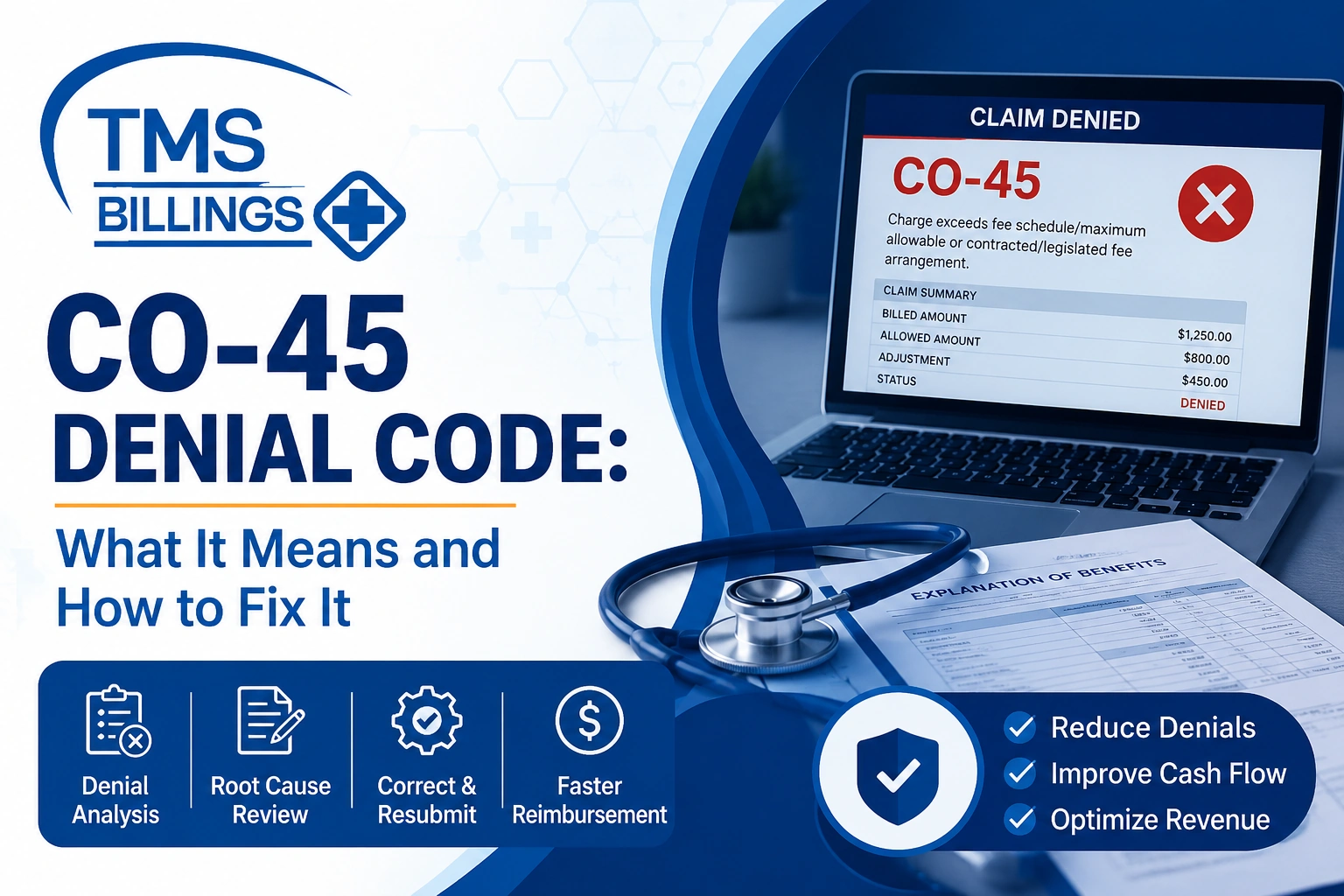
CO-45 Denial Code: What It Means and How to Fix It
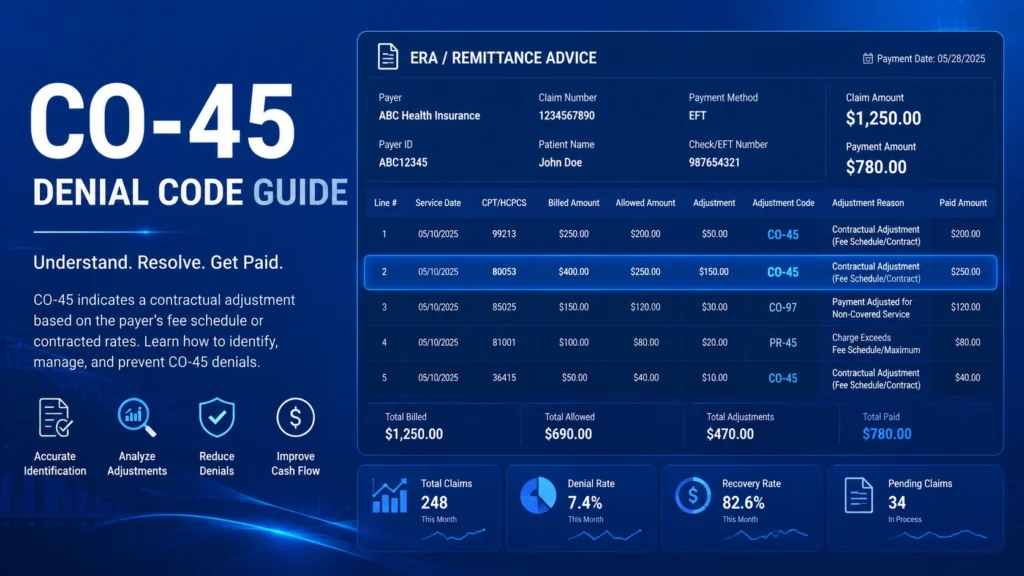
If you’ve ever reviewed an Explanation of Benefits (EOB) or Electronic Remittance Advice (ERA) and spotted a CO-45 denial code, you may have assumed your claim was rejected — and wondered whether the balance should go to the patient. The answer to both questions is no. Understanding how to fix a CO-45 denial starts with recognizing what it actually is: a contractual adjustment, not a coverage denial. This guide walks your billing team through what CO-45 means, why it appears, what you cannot do with the balance, and how to post and prevent it correctly.
Before your team dives into CO-45 reconciliation, it may also be worth reviewing your AR recovery services to identify whether unreconciled contractual adjustments are quietly eroding your revenue.
What Is the CO-45 Denial Code?
Featured Snippet: The CO-45 denial code means the amount billed exceeds the payer’s contracted fee schedule or maximum allowable amount. It is a contractual adjustment, not a true denial — the claim is paid at the allowed rate, and the difference is written off. This amount can never be billed to the patient.
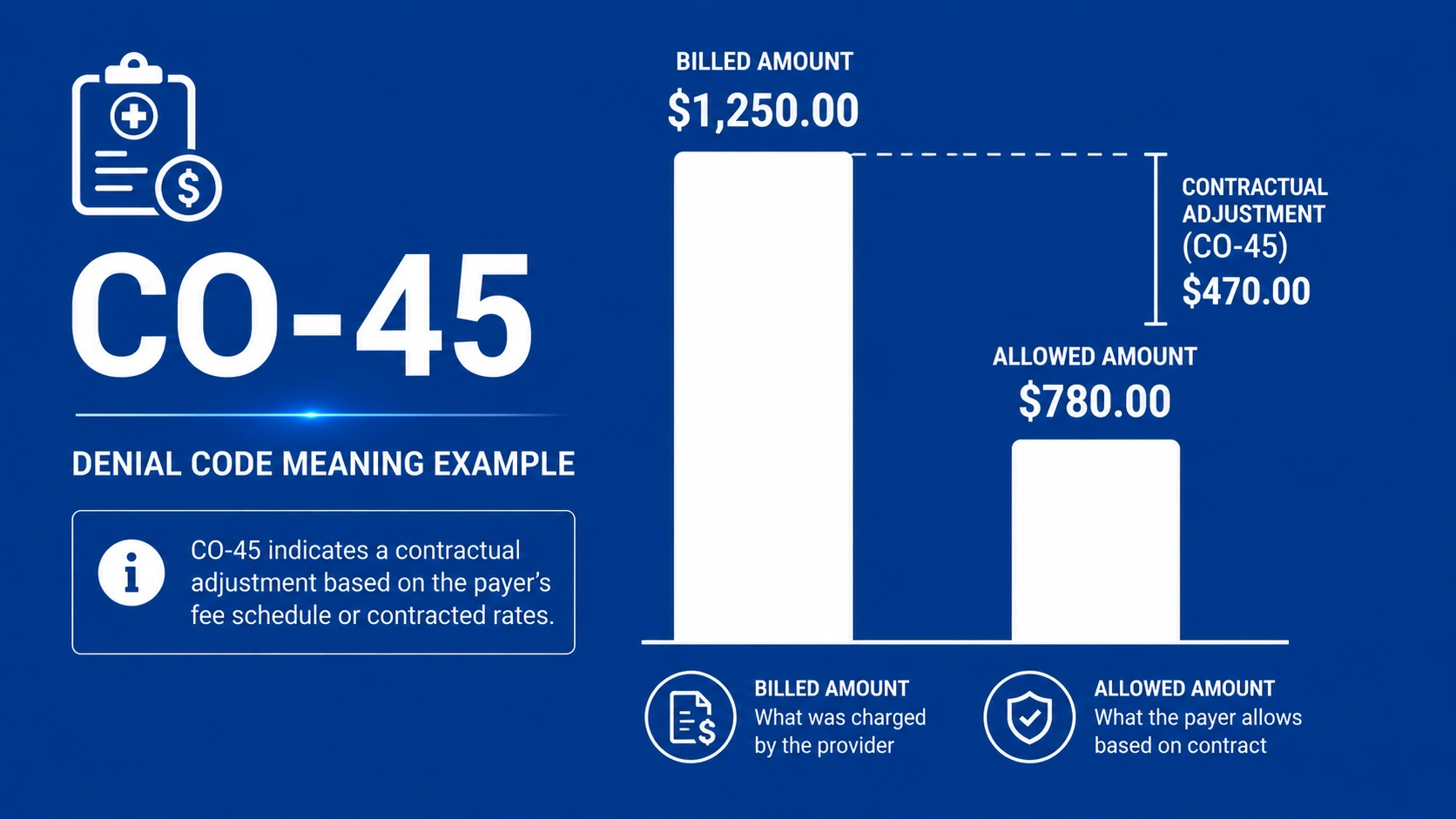
The CO-45 denial code — formally listed as CARC 45, or Claim Adjustment Reason Code 45 — appears on your ERA when the payer reduces your billed charge to match the contracted allowed amount. The X12/Washington Publishing Company, the official source for all CARC code definitions, describes CARC 45 as applicable when charges exceed the contracted or legislated fee arrangement.
In plain terms: you billed more than your payer contract permits. The claim was accepted, adjudicated, and paid — just not at your billed rate. The “CO” prefix stands for contractual obligation, indicating the reduction results from a signed provider agreement with the payer. CO-45 denial code meaning is therefore distinct from any coverage-based or medical-necessity denial: the service was covered; the charge simply exceeded the fee schedule.
Why Did You Receive a CO-45 Adjustment?
CO-45 is one of the most frequent reason codes in revenue cycle management. It appears every time your billed charge exceeds what the payer is contractually required to pay.
Concrete example: Your practice bills $200 for a level-3 office visit. Your contracted fee schedule caps that service at $150. The payer pays $150 and posts a CO-45 write-off of $50. That $50 is a contractual adjustment — it cannot be collected from the patient.
Common Causes of the CO-45 Denial Code
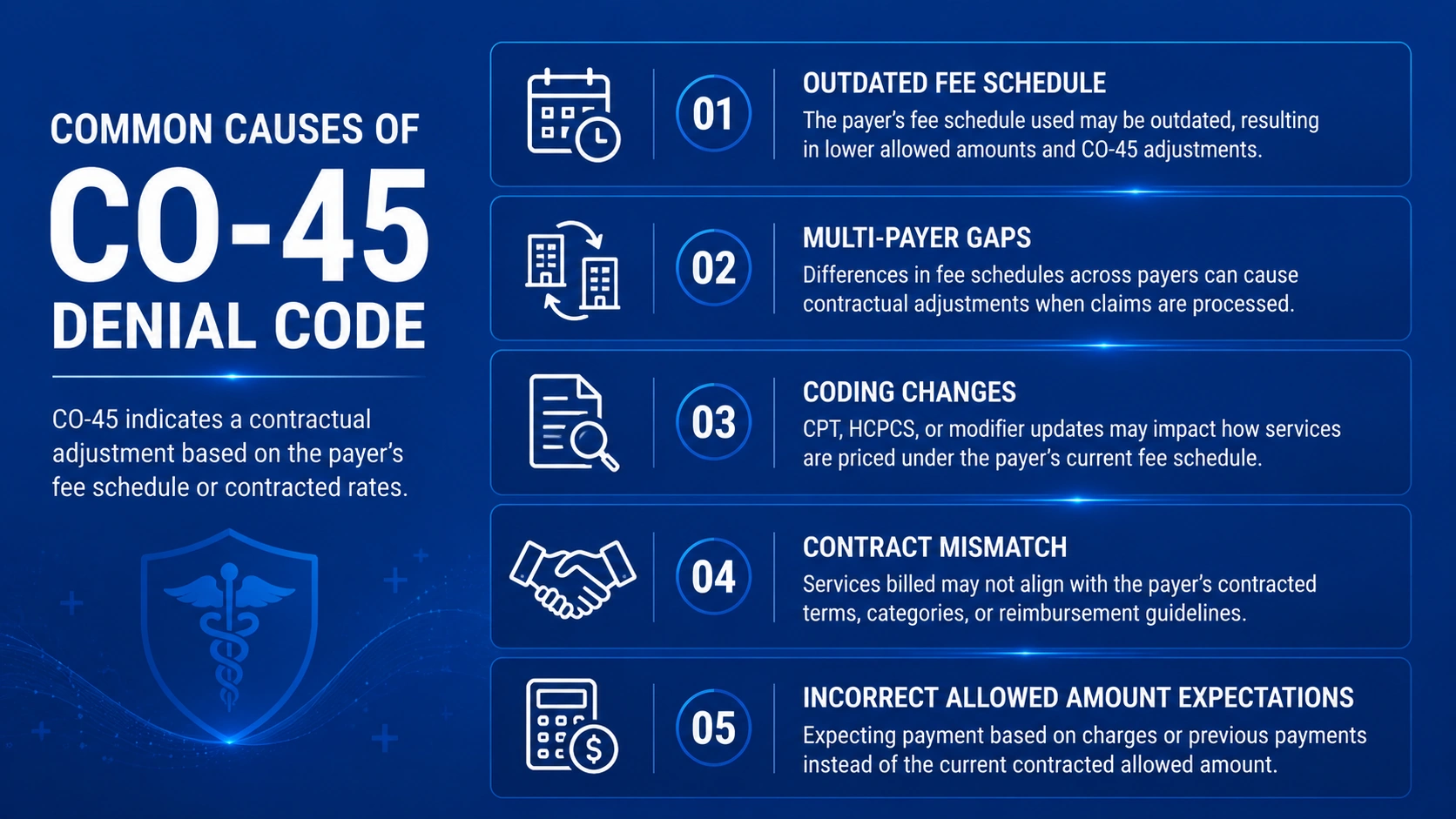
- Outdated fee schedule in your billing system: Your charge master hasn’t been updated to reflect current payer rates, so billed charges consistently exceed the allowed amount.
- Multi-payer environments: Your practice contracts with many payers, each carrying a different fee schedule. What one payer allows may be substantially less than your billed charge.
- Medicare or Medicaid rate gaps: The allowed amount is set by a government fee schedule that differs from your standard billed charge, which is common in high-volume service lines.
- Specialty service lines: Labs, imaging centers, urgent care clinics, and orthopedic practices see CO-45 frequently because their billed rates span a wide range of payer contracts.
- Coding changes without charge master updates: A modifier, bundling rule, or CPT code revision shifts the allowed amount, but your billed charge stays the same.
Is CO-45 a Real Denial or a Contractual Write-Off?
This is the most important distinction your billing team needs to internalize: CO-45 is not a denial.
A true denial means the payer has refused to pay the claim. With CO-45, that is not what happened. Your claim denials in medical billing workflows should not include CO-45, because the claim was processed and payment was issued. The adjustment reflects the difference between your billed charge and the payer’s contracted allowed amount — nothing more.
The “CO” prefix tells you this is a contractual obligation reduction. The payer is communicating: “We paid what our contract requires. The remaining balance is yours to write off per your provider agreement.” Treating CO-45 as a denial — routing it to an appeal queue, flagging it for follow-up, or posting it to a patient account — wastes staff time and creates compliance exposure. The correct action is to write off the balance and close the claim.
CO-45 vs Other Codes You’ll See on the Same ERA
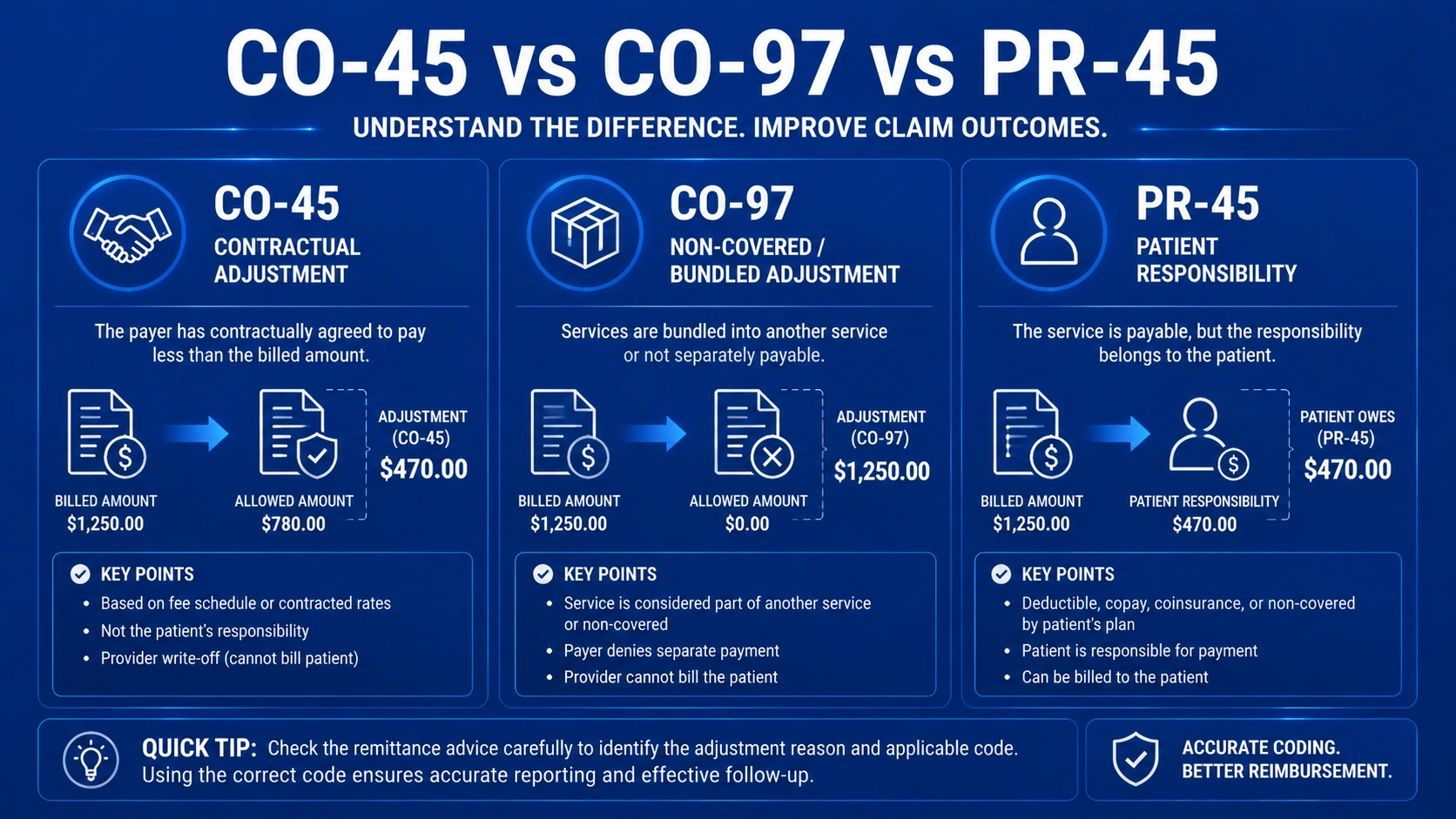
CO-45 vs CO-97
CO-97 signals that a service’s payment was already bundled into another service on the same claim. CO-45 is a pricing adjustment; CO-97 is a bundling or inclusive-service adjustment. CO-97 may point to a correctable coding issue worth resubmitting with a modifier or unbundled code. CO-45 almost never warrants an appeal because the payer is simply applying your contracted rate.
CO-45 vs PR-45
PR-45 uses the same numeric suffix (45) but an entirely different prefix. “PR” stands for patient responsibility. PR-45 means the patient owes the outstanding balance — for example, because a service exceeded a benefit maximum or was not covered under the patient’s plan. The distinction is critical for billing compliance: CO-45 = write it off; PR-45 = bill the patient. Confusing these two codes is one of the most common — and most costly — compliance errors in medical billing.
Can You Bill the Patient for a CO-45 Adjustment?
No — and this is non-negotiable.
When your practice signed a participation agreement with an insurance payer, you agreed to accept the payer’s allowed amount as payment in full for covered services. The CO-45 write-off amount is the difference between your billed charge and that allowed amount, and your provider contract expressly prohibits billing the patient for it.
Placing a CO-45 balance on a patient statement violates your payer contract. Depending on the payer and state, it may also violate balance-billing prohibitions under state consumer protection law or federal regulations. For practices subject to compliance audits, CO-45 amounts appearing on patient statements are a significant red flag — one that can trigger contract penalties, repayment demands, or exclusion proceedings.
If your Revenue Cycle Management Services include compliance auditing, CO-45 should be a standing line item in your patient statement review process.
How to Fix and Post a CO-45 Adjustment — Step-by-Step
Posting CO-45 correctly is straightforward once your team understands the code. Use this checklist on every ERA that includes CARC 45:
- Open the ERA/EOB. Locate the CO-45 line for each affected claim.
- Verify the allowed amount. Cross-reference the payer’s allowed amount against your contracted fee schedule for that CPT code and date of service.
- Confirm the payment total. Confirm the payer paid the full contracted allowed amount. If the payment falls short of the allowed amount without another reason code, you may have an underpayment — a separate issue requiring dispute with the payer.
- Post the payer payment. Apply the payment to the claim in your practice management system.
- Post the contractual adjustment. Write off the CO-45 balance using your system’s contractual adjustment reason code — not a denial code.
- Zero out the patient balance. The patient owes nothing on the CO-45 difference. Confirm no patient statement will be generated for that amount.
- Reconcile and close. Verify the claim balance is zero and the account is fully resolved.
- Escalate systemic patterns. If CO-45 is recurring on the same CPT codes across multiple payers, flag it for a charge master or fee schedule review.
Reviewing your medical billing pricing models can help identify where charge master rates are consistently misaligned with contracted fee schedules.
When (and How) to Appeal a CO-45 Denial
Can you appeal a CO-45 denial? Rarely — but narrow situations justify it.
Appeal is warranted if:
- The payer paid below the contracted allowed amount. If the CO-45 write-off exceeds what your contract permits, the payer has underpaid. Dispute this with the payer’s provider relations team, citing your fee schedule documentation.
- The payer used an outdated fee schedule. If you can document that a newer, higher-rate fee schedule applies to the date of service, an appeal with contract evidence may recover the difference.
- A credentialing gap placed a provider out-of-network incorrectly. Correcting that retroactively may change the allowed amount and reduce the write-off.
In the vast majority of cases, CO-45 is accurate. Appealing a standard CO-45 adjustment produces no recovery because the payer applied exactly what the contract requires. Your team’s time is better invested in identifying root causes and correcting fee schedule misalignment before claims are submitted.
CO-45 Denial Code — Side-by-Side Comparison
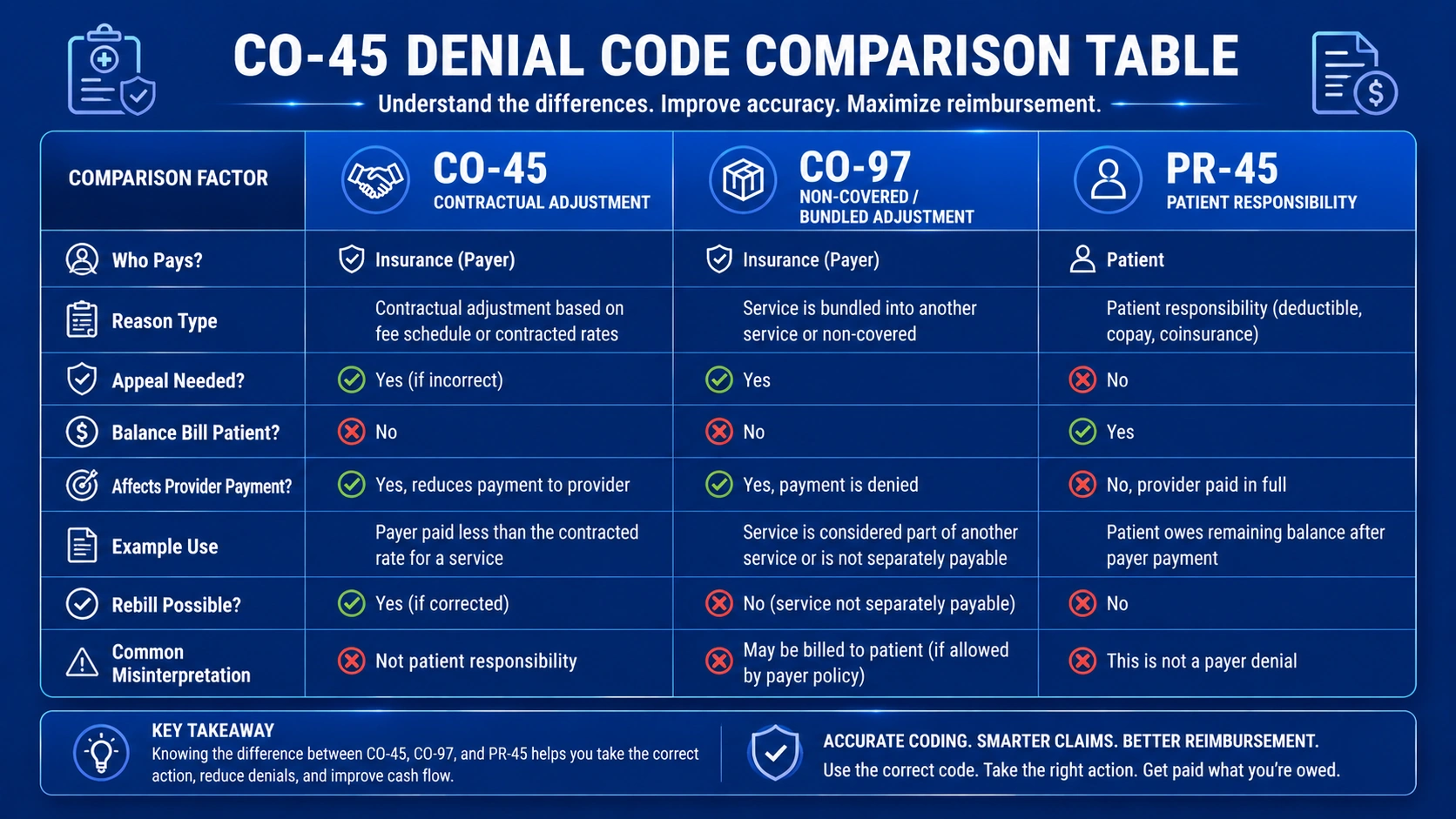
| Feature | CO-45 | CO-97 | PR-45 |
|---|---|---|---|
| Full Name | Contractual Obligation — Fee Schedule | Contractual Obligation — Bundled | Patient Responsibility — Fee Schedule |
| Meaning | Billed charge exceeds contracted allowed amount | Service included in another payment on same claim | Patient owes the outstanding balance |
| Patient Can Be Billed? | No | No | Yes |
| Write-Off Required? | Yes — contractual adjustment | Yes — write-off as bundled | No — transfer to patient |
| Appeal Recommended? | Rarely — only if underpaid | Sometimes — review coding | N/A |
| Commonly Seen In | All payer types, every specialty | Surgical and procedure claims | Non-covered or benefit-limit scenarios |
CO-45 and Contractual Adjustment Trends in 2026
The volume of CO-45 adjustments appearing on provider remittances is rising, driven by widening gaps between billed charges and contracted allowable rates. Here is where the data stands.
Claim denial landscape: The 2024 confirmed initial denial rate reached 11.8%, according to Kodiak Solutions and HFMA data published in March 2026. Experian Health’s 2025 State of Claims report found that 41% of providers now report denial rates above 10% — up from 30% in 2022. While CO-45 is a contractual adjustment rather than a true denial, when misclassified it inflates reported denial rates and distorts your revenue cycle metrics.
Revenue leakage: Net revenue leakage across U.S. hospitals grew 25% year-over-year, reaching $48.4 billion in 2025, per Kodiak Solutions. Contractual adjustments that are incorrectly posted — or CO-45 amounts improperly billed to patients — contribute directly to this figure through compliance exposure and payer contract penalties.
2026 Medicare fee schedule impact: For CY 2026, CMS finalized two separate Medicare Physician Fee Schedule conversion factors: $33.57 for qualifying APM participants (a 3.77% increase from 2025) and $33.40 for non-qualifying clinicians (a 3.26% increase), as detailed in the CMS October 2025 final rule. CMS also finalized a –2.5% efficiency adjustment to work RVUs for most non-time-based services. For practices with static charge master rates, the result is a wider billed-vs.-allowed gap — which means higher CO-45 write-off volume on Medicare remittances in 2026.
Rework cost: MGMA benchmarks the cost to rework a single denied or adjusted claim at $25 to $181, depending on claim complexity and staff level. For practices that misroute CO-45 adjustments into denial management workflows, this is a measurable administrative drain with zero recovery upside.
Compliance risk: MGMA’s Annual Regulatory Burden Report identifies audits and appeals as the single top regulatory burden for medical practices heading into 2026. Practices that place CO-45 balances on patient statements — through billing system misconfiguration or inadequate staff training — are among the most common sources of payer audit findings and contract disputes.
Best Practices to Prevent Unnecessary CO-45 Write-Offs
CO-45 is a normal byproduct of payer contracting, but systemic write-offs on the same procedure codes are a signal you can act on.
- Audit your charge master quarterly. Compare billed charges against contracted fee schedules for your top 20 CPT codes across your major payers. A large, recurring CO-45 gap on the same code is an actionable flag.
- Load contracted fee schedules into your PM system. Modern practice management platforms can store allowed amounts and alert your team when a billed charge will generate a CO-45 before the claim is submitted.
- Train billing staff on CO-45 vs. PR-45. The most damaging error is posting a CO-45 write-off incorrectly and generating a patient statement. Make this distinction a standard part of ERA posting training and onboarding.
- Separate CO-45 from your denial rate KPI. Contractual adjustments are not denials. Tracking them together distorts your clean claim rate and makes your denial management performance look worse than it is.
- Review new payer contracts before go-live. If your charge master doesn’t reflect a newly negotiated payer contract, every claim under that contract will generate a CO-45 until the fee schedule is loaded correctly.
How TMS Billings Helps Practices Manage CO-45 Adjustments
At TMS Billings, our revenue cycle and denial management team handles CO-45 reconciliation as part of every ERA posting workflow — not as an exception, but as a standard step built into every remittance review.
We reconcile each ERA against your contracted fee schedules, flag any instances where payer payment falls below the contracted allowed amount, and ensure that CO-45 write-offs are posted correctly with no patient statements generated for contractual adjustment balances. For practices with high CO-45 volume — particularly multi-specialty groups, imaging centers, urgent care networks, and orthopedic practices — we also perform periodic charge master reviews to identify where billed charges are consistently out of alignment with payer fee schedules, reducing write-off volume and administrative overhead.
Our denial management workflow draws a clear line between true denials (which require appeal or resubmission) and contractual adjustments (which require accurate write-off and reconciliation). That discipline protects your clean claim rate, keeps your denial rate KPIs accurate, and ensures your practice stays compliant with every payer contract you’ve signed.
If your current billing team is routing CO-45 adjustments into appeal queues, failing to zero out patient balances, or posting CARC 45 under a denial code, the cumulative cost in staff time, compliance risk, and patient experience is higher than it looks.

Key Takeaways
- The CO-45 denial code is a contractual adjustment, not a true denial. The claim was accepted and paid at the payer’s contracted allowed amount.
- The CO-45 write-off amount can never be billed to the patient. Doing so violates your provider agreement and creates significant compliance risk.
- CO-45 differs critically from CO-97 (bundling) and PR-45 (patient responsibility). Misclassifying these codes has direct financial and compliance consequences.
- Appeals on CO-45 are rarely productive unless the payer paid below the contracted rate or applied an incorrect fee schedule.
- Recurring CO-45 on the same procedure codes signals a charge master or fee schedule alignment problem — fix the root cause upstream, not just the write-off.
Final Thoughts
The CO-45 denial code is one of the most misunderstood codes in medical billing — not because it’s technically complex, but because the word “denial” in everyday billing conversation implies something that isn’t happening. Your claim wasn’t denied. It was paid correctly under the terms of your payer contract, and the adjustment simply reflects that contractual reality.
What matters is that your billing team posts it accurately, never bills the patient for the CO-45 balance, and treats recurring write-off patterns as diagnostic data for charge master hygiene. When CO-45 adjustments accumulate without scrutiny, they can mask a genuine underpayment problem, distort your denial rate reporting, and create compliance exposure — all at the same time.
The TMS Billings denial management team works with practices across specialties to ensure every ERA is posted correctly, every contractual write-off is compliant, and no recoverable revenue slips through misclassification or missed underpayment disputes. Ready to bring your CO-45 process under control? Contact TMS Billings today to review your current adjustment and denial management workflows.