

In House Biller Leaving? Your 30-Day Contingency Plan
Your in house biller leaving is the kind of news that turns a routine Monday into a scramble. Maybe you got two weeks’ notice over coffee. Maybe your medical biller resigned by email on a Friday and never came back. Either way, the claims queue keeps growing, denials sit unworked, and cash flow starts to slip before anyone realizes how much only one person actually knew.
If you’re wondering what to do when your medical biller quits, the honest answer is: move fast, but move in order. A biller leaving without notice creates real financial exposure, especially for practices where one person quietly held all the passwords, payer relationships, and institutional knowledge — but a practice that reacts in the first 24 hours can prevent most of the damage. This 30-day contingency plan walks through exactly what to secure, stabilize, and decide, day by day, and where our medical billing services can step in if you need backup sooner.
What to Do the Day You Learn Your Biller Is Leaving
An in house biller leaving can stall claims fast. Within 24 hours, secure system access and credentials, triage the claims queue, and decide by week two whether to hire, cross-train, or outsource before cash flow slows.
When you first learn your biller is leaving, the priority is control, not panic. Get the departure date in writing — resignation letter or verbal notice — and start a simple access-and-handoff checklist that same day.
While your outgoing biller is still available, have them walk you through:
- Every payer portal they log into, and who else has payer portal access
- Clearinghouse login credentials, and whether they’re tied to their personal account
- EHR/practice management access levels, including any custom reports they run
- Open items in the claims backlog and which claims are aging past 30 days
- Any denial management gap they’ve been personally covering without documentation
For credentialing access specifically, following the standards AAPC recommends for practice transitions can prevent a lapse that delays claims for weeks. Document everything in a shared file, not just in the departing biller’s head. If the departure is abrupt, loop in IT or your EHR vendor immediately so no access lapses once they’re gone. Even a rough version of this checklist, written in the first hour, is worth more than a polished one written a week too late.
Days 1–7: Stabilize Claims and Secure Access
Learning how to cover medical billing when a biller leaves starts with locking down access and triaging what’s already in motion. Treat the first week like a mini audit of the entire revenue cycle.
Start by changing or reassigning every login the departing biller used — payer portals, clearinghouse, EHR, and any bank or lockbox access. This isn’t about distrust; it’s a basic HIPAA-compliant handoff step that protects the practice if there’s ever a dispute over who touched what.
Next, pull a full claims backlog report: what’s submitted and pending, what’s been denied and not yet appealed, and what hasn’t been billed at all. Sort by dollar amount and age so your team, or a temporary hire, works the highest-value, most time-sensitive claims first.
Assign accounts receivable follow-up to whoever has the bandwidth, even if it’s imperfect. A biller resignation plan should name one single point of contact for billing questions during this stretch, even if that person isn’t the one doing the actual billing work.
By day seven, you should know exactly what’s stuck, what’s overdue, and who — even temporarily — owns each piece.
Days 8–14: Bridge the Gap — Temp Staff, Cross-Training, or Outsourcing
By week two, most practices need temporary medical billing coverage just to keep claims moving. The three most common temporary medical billing solutions — a contract biller, cross-trained staff, or an outsourced partner — each come with different speed, cost, and risk trade-offs.
A temp or contract biller gets someone in the seat fast, but agency placements vary widely in expertise and need ramp-up time on your specific payer mix. Cross-training current staff avoids new hiring costs, but pulls people from their primary roles and raises the odds of errors during the learning curve. Choosing to outsource medical billing sidesteps the hiring question entirely, usually with a team already trained on denial management and compliance.
Here’s how the three options compare:
| Factor | Temp/Contract Biller | Cross-Train Existing Staff | Outsourced Billing Company |
|---|---|---|---|
| Speed to implement | Fast (days) | Fast, but disruptive to other roles | Fast, no hiring needed |
| Cost structure | Hourly + agency fee | Opportunity cost of other work | Percentage of collections |
| Compliance/expertise risk | Varies by placement | Higher risk of errors | Dedicated, trained team |
| Long-term scalability | Limited, short-term fix | Limited | Scales with practice growth |
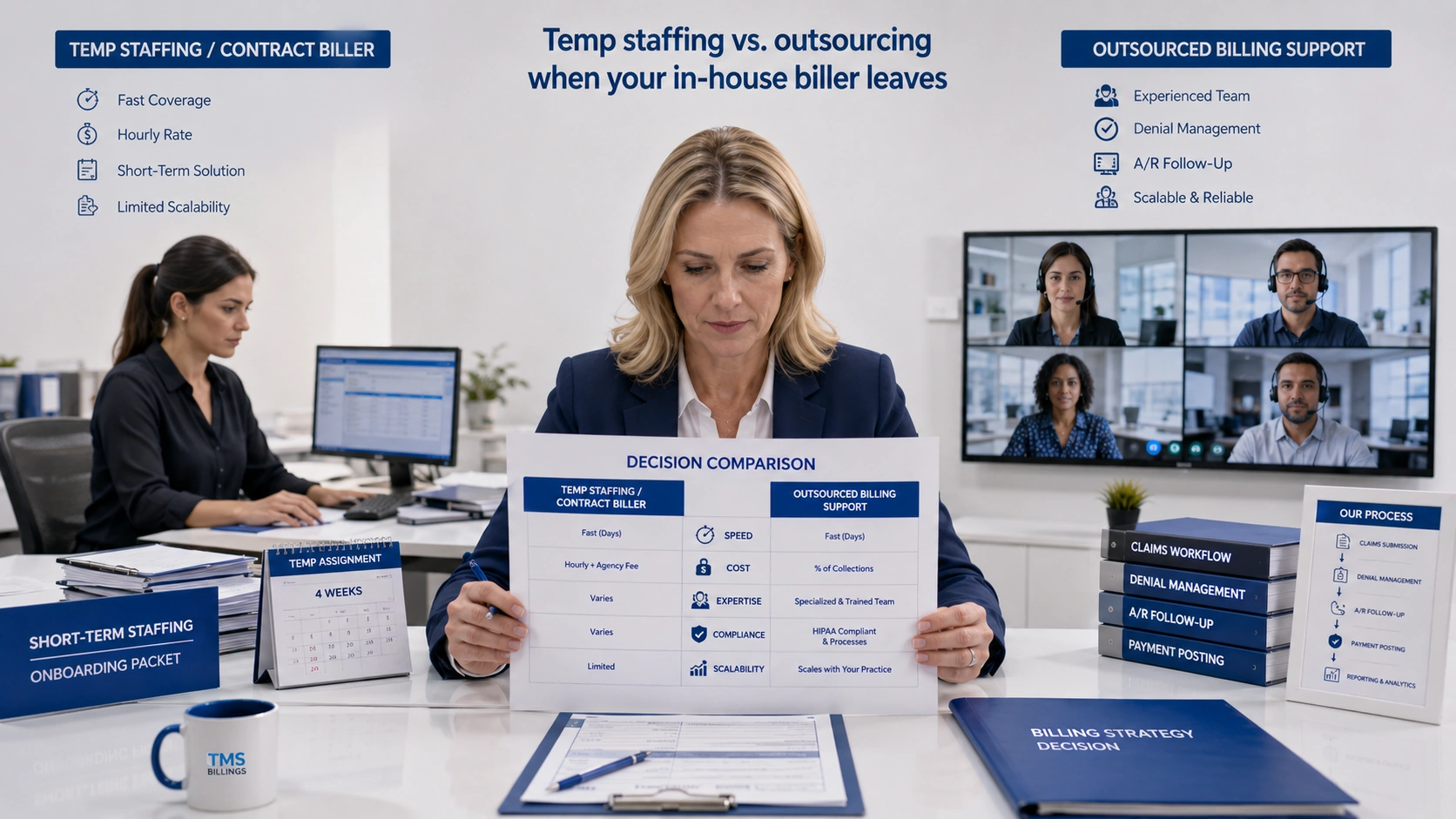
Most practices land on a mix: a short-term stopgap to get through weeks two and three, paired with a real decision about whether the in house biller leaving should be the last time this disruption happens.
Days 15–30: Choose a Long-Term Path Forward
Choosing a long-term path forward means deciding, before day 30, whether you’re rebuilding an in house team, formalizing cross-trained staff into a permanent role, or completing the move to an outside partner.
If you’re leaning toward hiring, start recruiting immediately rather than waiting past week two — qualified, certified billers take time to find, and a rushed hire often means repeating this whole process within a year. If cross-training worked well enough to stick, formalize it with written procedures, backup coverage, and a plan for what happens when that person is out sick or on vacation.
If you’re ready to learn how to transition to outsourced medical billing, this is the window to do it cleanly. A good billing partner can take over active claims mid-cycle without a coverage gap, using the access checklist and claims backlog data you already pulled together in week one. Ask any partner you’re considering how they’d handle the handoff — the answer should sound like a process, not an improvisation. The goal by day 30 is a decision made on data, not on how tired everyone is of covering the gap.

Red Flags You’re Already Losing Revenue During the Transition
You’re already losing revenue during the transition if any of these show up in week two or three: claims sitting unsubmitted for more than five business days, a growing pile of unworked denials, patient statements going out late or not at all, or nobody able to answer a payer’s request for additional information.
Medical billing staff turnover has real financial teeth, and staffing shortages remain one of the top challenges practice leaders report to MGMA year over year. Left alone, revenue cycle disruption compounds — one missed filing deadline becomes a permanently lost claim, not just a late one.
If you’re seeing two or more of these red flags at once, treat it as your signal to escalate: bring in temporary help or start outsourcing conversations now, rather than waiting until day 30.
How TMS Billings Covers the Gap When Your Biller Leaves
When your biller leaves, TMS Billings can step into the gap in days, not weeks. Our team works your claims backlog, follows up on denials, and keeps accounts receivable follow-up current while you decide on a permanent path — hire, cross-train, or continue outsourcing.

Because we handle payer portal access, clearinghouse login credentials, and HIPAA-compliant handoffs every day, there’s no learning curve on our end. You get a dedicated, credentialed team instead of a single point of failure.
An in house biller leaving doesn’t have to mean stalled claims and slipping cash flow. TMS Billings can step in within days — working your claims queue, following up on denials, and keeping collections moving while you decide on a permanent plan. Get a free billing transition audit.