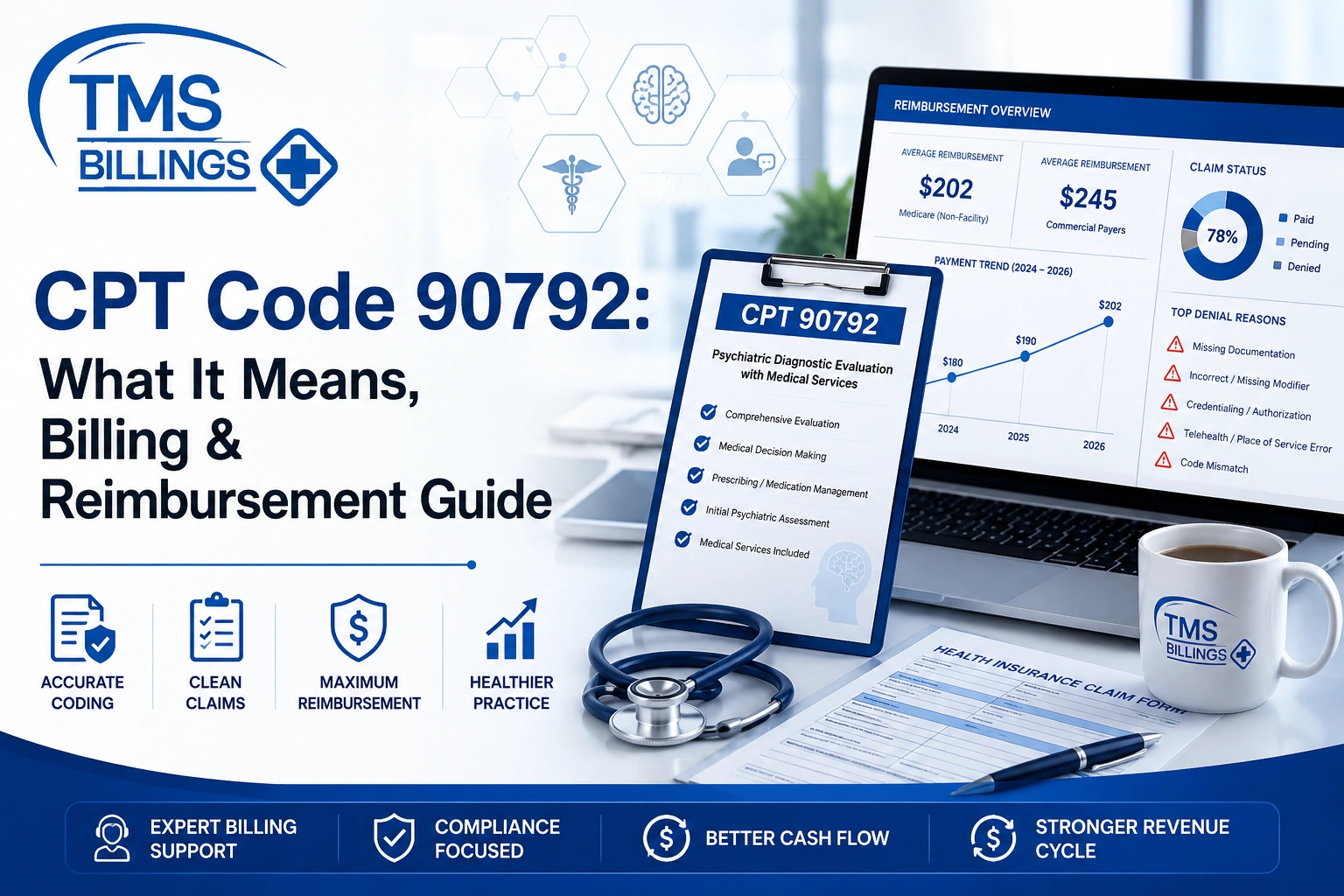
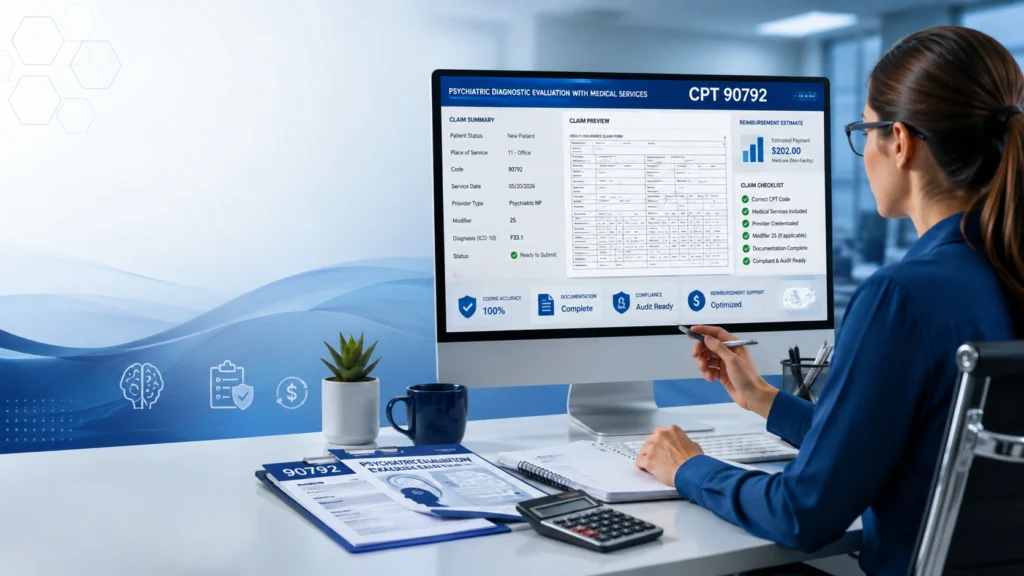
CPT Code 90792: What It Means, Billing & Reimbursement Guide
Written by TMS Billings Coding & Compliance Team — certified coders (CPC, CPB) with over 12 years of combined mental health billing experience. Reviewed by Jacob White, CPC, Compliance Director. Published August 6, 2026.
A psychiatric nurse practitioner assumed every new-patient evaluation qualified for the same code — until a payer audit flagged months of claims billed as 90791 instead of CPT code 90792, the code that actually covers evaluations with medical services like prescribing. The mix-up cost her practice thousands of dollars in delayed and reduced reimbursement.
Getting CPT code 90792 right isn’t just a coding technicality — it determines whether an evaluation gets paid in full, delayed, or denied outright. This guide breaks down what the code covers, who can bill it, how much it pays in 2026, and how to document it so claims clear on the first submission. For full-service support across all your mental health billing codes, see our mental health billing services overview.
CPT code 90792 is the billing code for a psychiatric diagnostic evaluation that includes medical services, such as prescribing. It’s used by psychiatrists, nurse practitioners, and physician assistants, and it typically reimburses at a higher rate than 90791, the therapy-only evaluation code.
What Is CPT Code 90792?
CPT code 90792 identifies a psychiatric diagnostic evaluation with medical services — an integrated biopsychosocial and medical assessment performed at intake or during an initial consultation. It covers the initial psychiatric evaluation when medication management is involved, not routine follow-up visits, and includes history-taking, a mental status exam, relevant physical exam findings, and medical decision-making such as prescribing or ordering labs.
The code sits in the CPT Medicine section under psychiatric diagnostic procedures, as defined by the American Medical Association’s CPT coding resources. Because it includes a medical component, only providers with prescribing authority can report it. A psychiatric diagnostic evaluation with medical services is not the same as ongoing psychotherapy — it’s a one-time or infrequent intake assessment, not a therapy session, and it carries no specific time requirement. It’s an untimed code, so payment depends on documented complexity, not minutes spent in the room.
CPT Code 90792 vs. 90791: What’s the Difference?
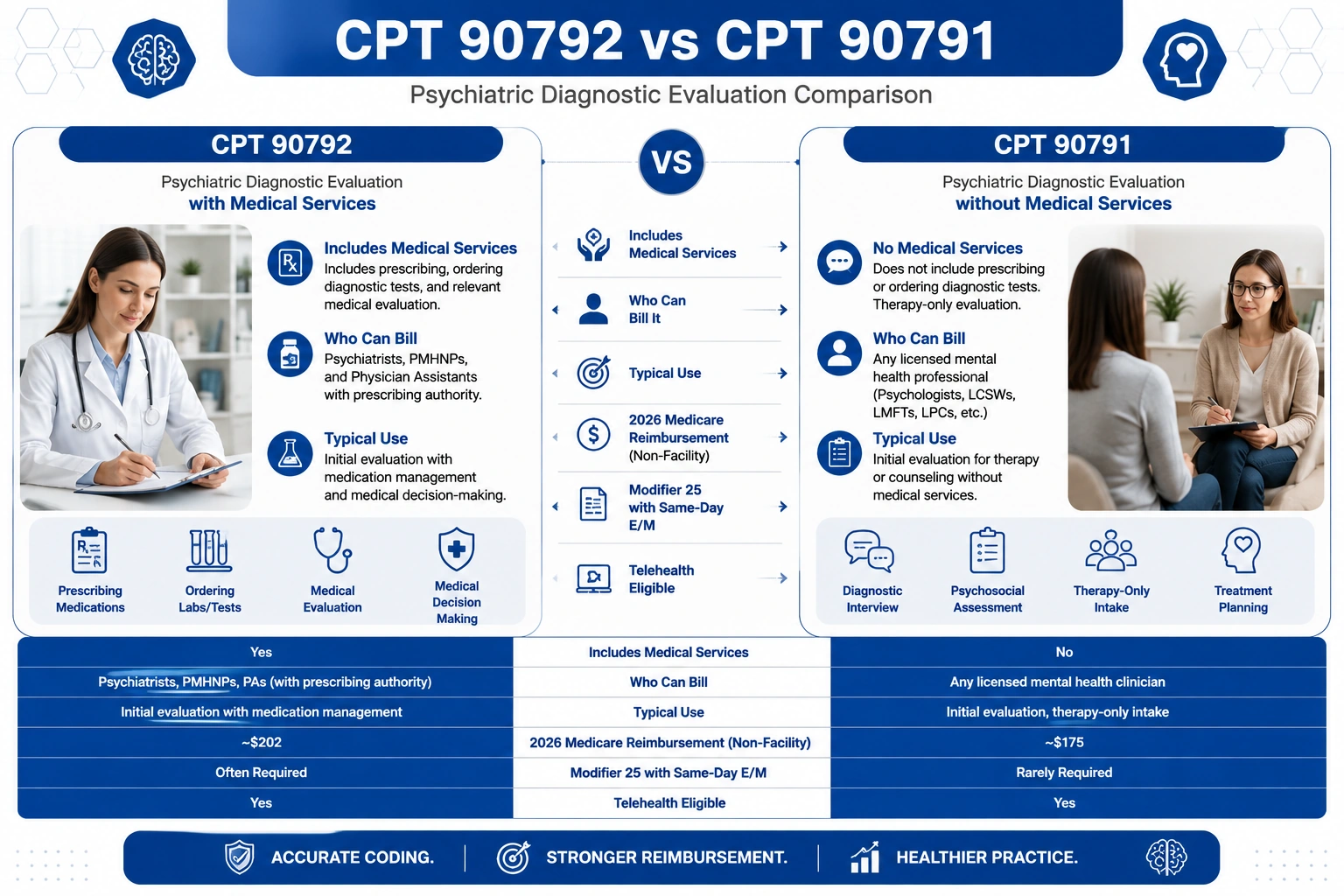
The core difference between CPT 90791 vs 90792 comes down to one thing: whether the evaluating clinician performs a medical service. CPT code 90792 includes a medical component — prescribing, ordering diagnostic tests, or physical exam findings — while 90791 covers the same diagnostic interview without any medical service and can be billed by any licensed mental health clinician, including psychologists and LCSWs. Understanding CPT 90791 vs 90792 before the first claim goes out prevents costly recoding later.
That distinction determines everything downstream — who can bill the code, how much it pays, and what documentation an auditor expects to see. The table below lays out the practical differences side by side.
CPT Code 90792 vs. 90791: Key Differences
| Factor | CPT 90792 | CPT 90791 |
|---|---|---|
| Includes medical services (e.g., prescribing) | Yes | No |
| Who can bill it | Psychiatrists, NPs, PAs with prescribing authority | Any licensed mental health clinician |
| Typical use | Initial evaluation with medication management | Initial evaluation, therapy-only intake |
| 2026 Medicare reimbursement (non-facility) | ~$202 | ~$175 |
| Modifier 25 required with same-day E/M | Often | Rarely |
| Telehealth eligible | Yes | Yes |
Choosing correctly matters for compliance, not just payment. Billing 90792 when the clinician can’t prescribe is a compliance violation — not a reimbursement upgrade — and payers increasingly cross-check license type against the code on the claim. When in doubt, the provider’s scope of practice determines the code, not the length or complexity of the visit. For a full breakdown of what causes claims to get kicked back after submission, see our denial code guide.
Who Can Bill CPT Code 90792?
Psychiatric diagnostic evaluation billing under this code hinges on one factor: whether the evaluating clinician has prescribing authority. That includes psychiatrists (MD/DO), psychiatric mental health nurse practitioners (PMHNPs), and physician assistants practicing within a psychiatric scope. Psychologists, licensed clinical social workers, and licensed professional counselors cannot bill CPT code 90792 under their own NPI, regardless of session length or complexity, because their license doesn’t authorize prescribing or ordering diagnostic tests.
Insurance credentialing plays a direct role too: a PMHNP must be credentialed with the payer and enrolled with an active NPI before 90792 claims will process under their own name. When a PMHNP evaluates a patient under incident-to supervision — meaning a supervising psychiatrist established the care plan and remains available — the claim can be billed at the full physician rate instead of the reduced non-physician rate. Getting the billing provider field wrong on the claim is one of the most common reasons these evaluations get flagged during payer audits.
CPT Code 90792 Reimbursement Rates (2026)
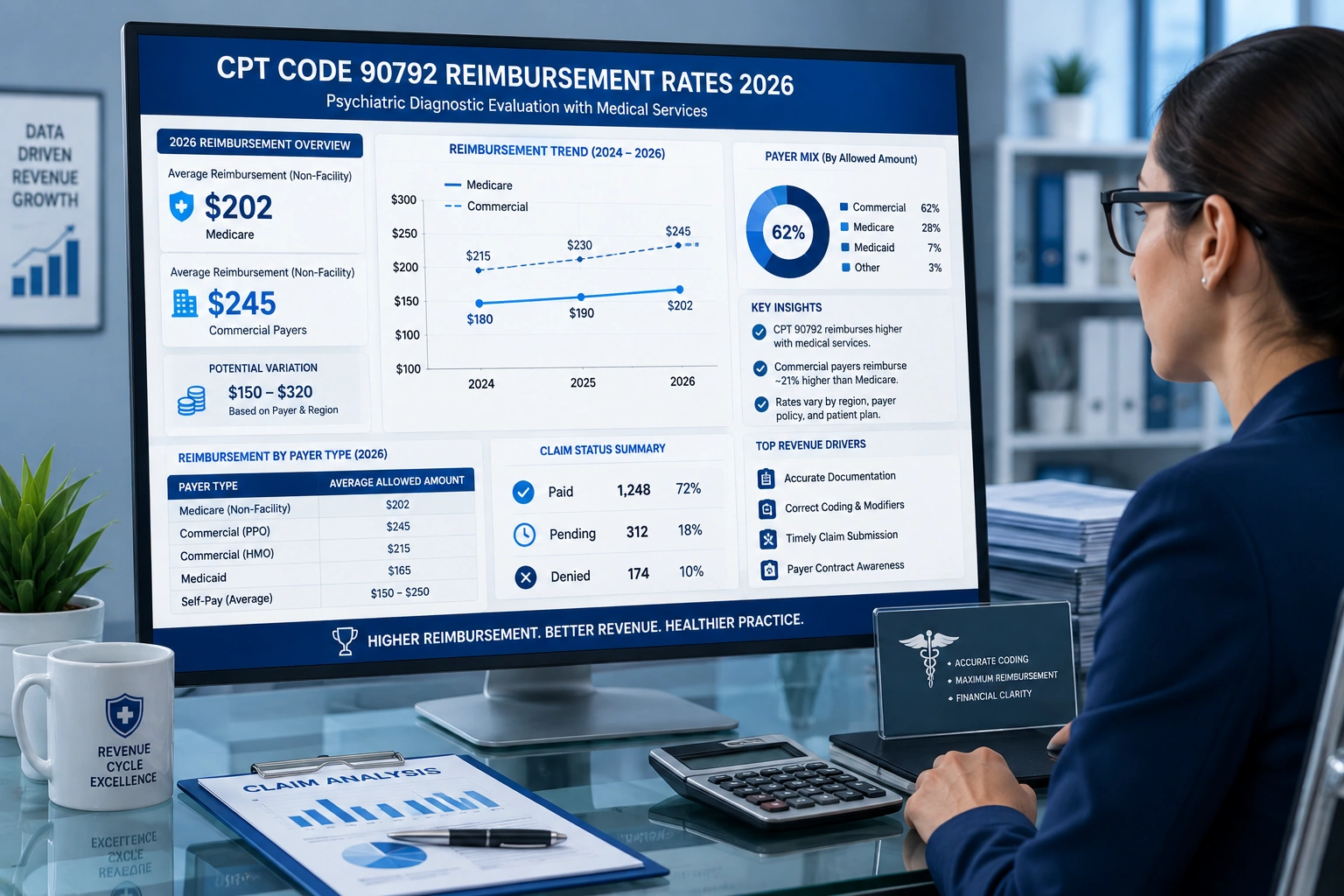
CPT code 90792 reimbursement in 2026 runs meaningfully higher than 90791, reflecting the added complexity of the medical evaluation component. Is CPT code 90792 covered by Medicare? Yes — Medicare Part B covers it nationwide for eligible beneficiaries when billed by a qualified prescribing provider, and most commercial and Medicaid managed-care plans follow suit.
Medicare Reimbursement for 90792
The 2026 Medicare non-facility reimbursement rate for CPT code 90792 is approximately $202 for psychiatrists (MD/DO) billing under their own NPI, based on the CMS Physician Fee Schedule. Psychiatric nurse practitioners billing independently under their own NPI are paid at 85% of the physician rate — roughly $172 — unless the visit qualifies for incident-to billing, in which case it pays the full physician rate. Actual payment varies by locality because CMS applies a geographic practice cost index on top of the national Medicare reimbursement rate, so confirm your exact number using the CMS Physician Fee Schedule lookup tool before estimating revenue.
Commercial Insurance Reimbursement for 90792
Commercial payers typically reimburse CPT code 90792 above the Medicare benchmark, and the spread between carriers is wide — national averages range from the mid-$170s at some carriers to well over $260 at others. Because commercial contracts are negotiated individually, a practice’s actual reimbursement depends heavily on its specific fee schedule, so two providers in the same city can be paid very differently for an identical evaluation. Practices that haven’t renegotiated psychiatric evaluation rates in the past two to three years are frequently leaving money on the table relative to current commercial averages.
Documentation Requirements for CPT Code 90792
Correct psychiatric diagnostic evaluation billing depends on documentation that clearly separates the medical service from the diagnostic interview. CPT code 90792 documentation requirements start with everything required for 90791 — history, mental status exam, and clinical impression — plus the medical elements that justify the higher-paying code: an integrated psychiatric and medical history, a documented medication review with dosages and side-effect assessment, a prescribing rationale tied to the diagnosis, and any relevant physical exam findings.
Vague or templated notes are the fastest way to turn a clean claim into a denial. “Medication reviewed,” with no dosage, efficacy, or documented clinical reasoning behind a change, doesn’t meet payer standards for medical decision-making. When an evaluation and management visit happens the same day as the psychiatric evaluation, modifier 25 is typically required on the E/M code to show it was a significant, separately identifiable service — without it, one of the two claims is likely to be bundled and denied. These documentation requirements aren’t red tape; they’re what keeps CPT code 90792 reimbursement moving instead of sitting in a payer review queue.
Billing CPT Code 90792 for Telehealth
CPT code 90792 telehealth billing is fully permitted — the code sits on Medicare’s permanent behavioral health telehealth list, and nearly every commercial payer covers a telehealth psychiatric evaluation the same as an in-person one. The two details that determine whether the claim pays are the place of service codes and the modifier.
For Medicare, use place of service 10 when the patient is at home (paid at the higher non-facility rate) or place of service 02 for a clinical telehealth site; Medicare identifies telehealth through the POS code rather than a modifier. Most commercial payers still require modifier 95 to flag a synchronous audio-video visit, while Medicare requires modifier 93 specifically for audio-only telehealth evaluations. Getting the place of service and modifier combination wrong — not the clinical care itself — is the single most common cause of telehealth claim rejections for psychiatric evaluations in 2026. Confirm each payer’s current telehealth policy before the visit, since coverage for audio-only initial evaluations still varies by plan.
Common Reasons CPT Code 90792 Claims Get Denied
CPT code 90792 claims get denied most often for coding and documentation errors, not clinical ones. The most frequent reasons include: incorrect code selection when the billing provider lacks prescribing authority, missing modifier 25 on a same-day E/M claim, documentation that doesn’t clearly separate the medical service from the diagnostic interview, exceeding a payer’s frequency limit for repeat evaluations, the wrong telehealth modifier or place of service code, and credentialing issues where the rendering provider isn’t enrolled with that specific payer.
Time-based billing errors also show up here, even though 90792 itself is untimed — mixing it up with a timed add-on code, or billing it alongside a same-day psychotherapy code without meeting bundling rules, both trigger automatic denials under current claim-edit logic. Most of these denial reasons are preventable with a second set of eyes on the claim before it’s submitted, which is exactly where a dedicated billing review process pays for itself.
How TMS Billings Helps Practices Bill CPT Code 90792 Correctly
Getting CPT code 90792 billed correctly takes more than knowing the definition — it takes ongoing attention to payer-specific rules, modifier updates, and documentation standards that shift year to year. TMS Billings reviews every psychiatric diagnostic evaluation claim before submission, verifying that the billing provider’s credentials match the code, that modifier 25 and telehealth modifiers are applied correctly, and that documentation supports the medical decision-making payers expect to see.
For practices juggling mental health billing codes across multiple payers, that review process is what separates a clean first-pass claim from a denial that eats weeks of staff time to appeal. TMS Billings also tracks credentialing status, flags frequency-limit risks before they become audits, and follows up on aging claims so reimbursement doesn’t stall in a payer queue.
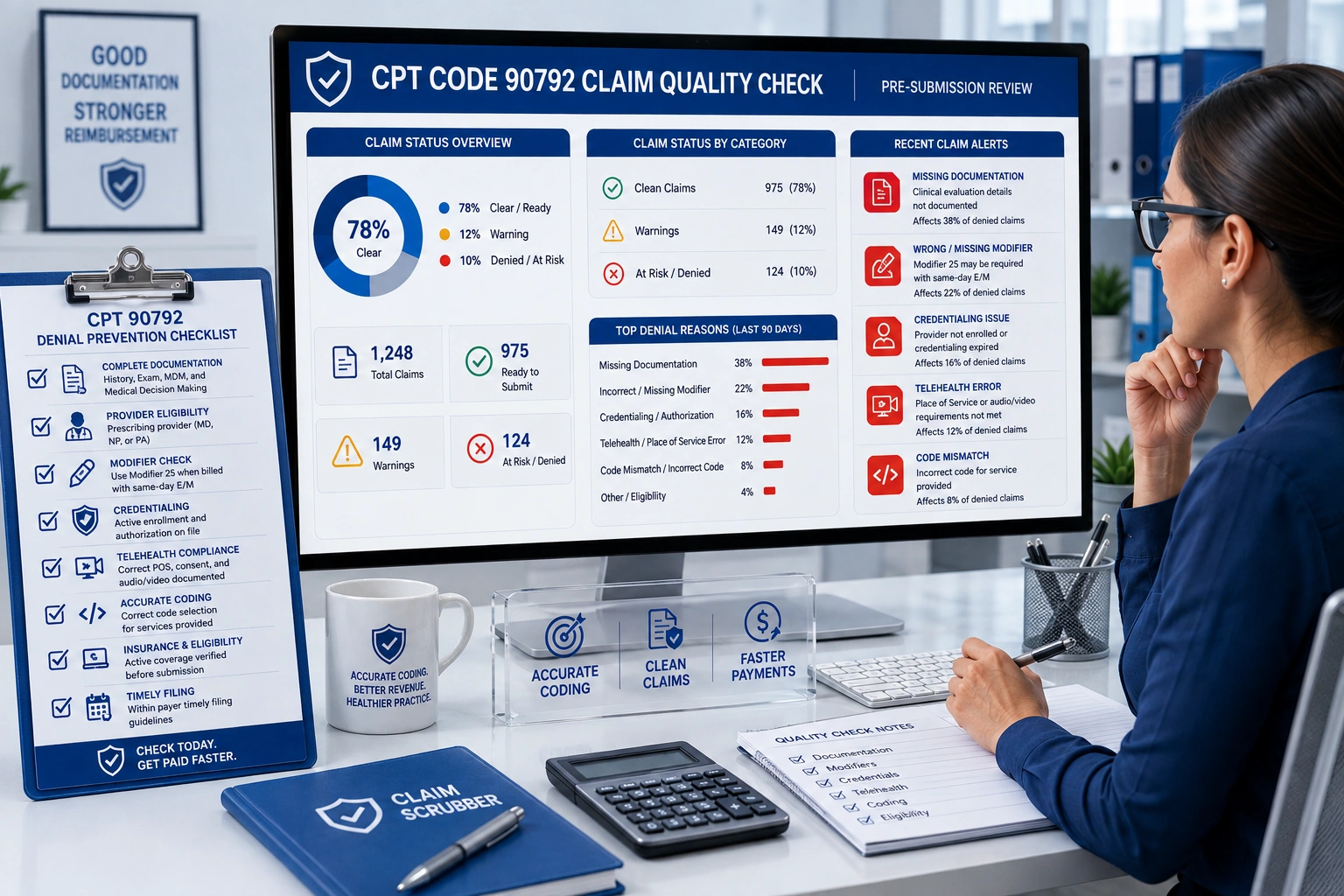
Miscoding an initial evaluation as 90791 instead of 90792 — or missing required documentation — can mean weeks of delayed payment or an outright denial. TMS Billings handles coding accuracy, documentation review, and claims follow-up for mental health practices, so every 90792 evaluation gets billed and reimbursed correctly the first time.