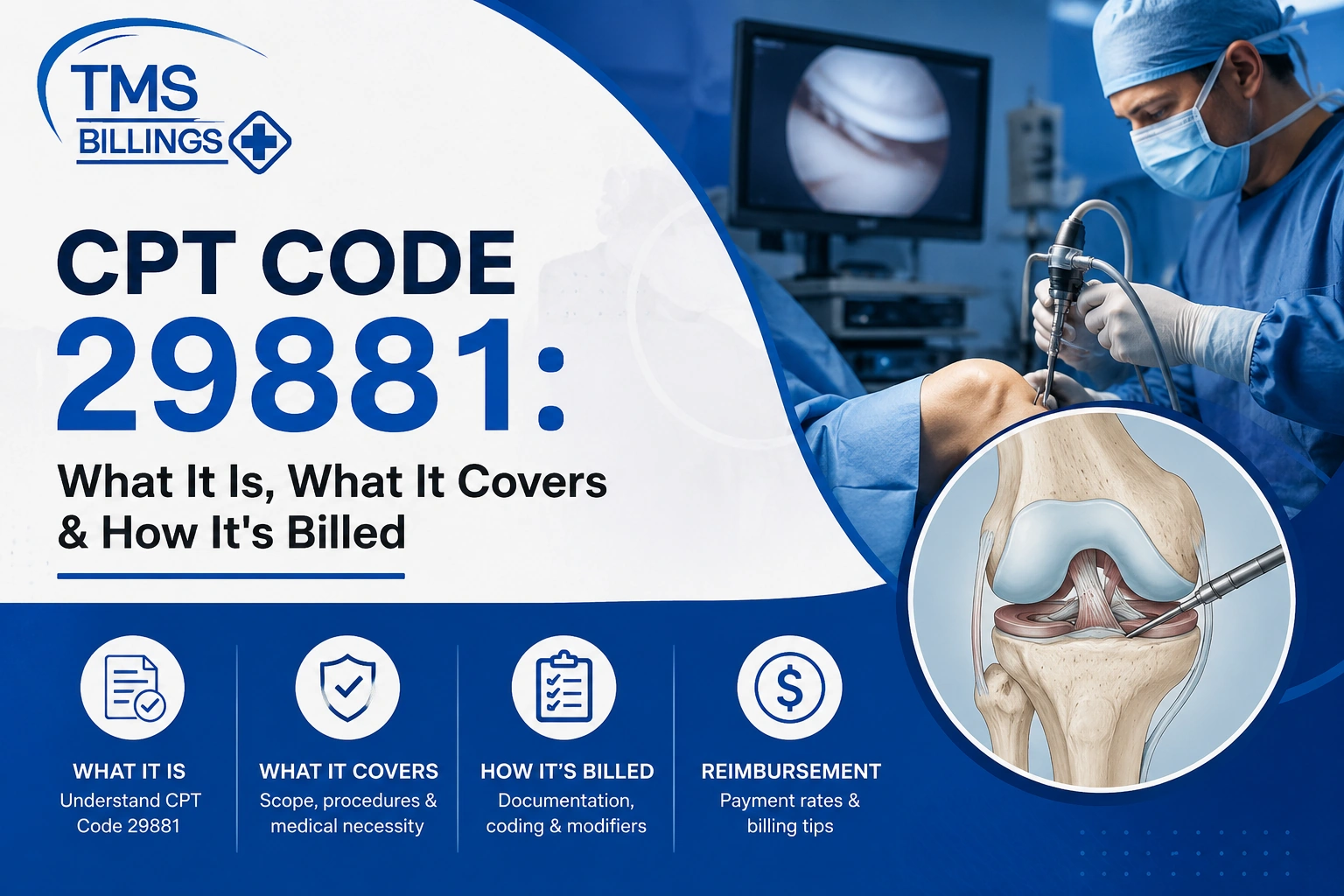
CPT Code 29881: What It Is, What It Covers, and How It’s Billed
Written by: TMS Billings SEO & Healthcare Content Team — with over 5 years of experience creating authoritative medical billing and revenue cycle management resources. Every article is thoroughly reviewed by our Certified Professional Coders (CPCs) and orthopedic billing compliance specialists to ensure accuracy, current CPT guidance, payer compliance, and alignment with the latest CMS and AMA coding standards.
Reviewed by: Lead Compliance Officer, TMS Billings — CPC-I, CPCO credentials; orthopedic billing compliance auditor with 15 years in surgical practice revenue cycle oversight.
Two orthopedic surgery centers. Same knee arthroscopy with meniscectomy. Same payer. One practice collects the full Medicare allowable for CPT code 29881. The practice across town gets denied entirely — then recoups 60 cents on the dollar after appeal. The difference isn’t surgical skill. It’s a missing laterality modifier, an operative report that doesn’t document the extent of the meniscal pathology, and a prior authorization that lapsed before the claim hit the clearinghouse.
CPT code 29881 is one of the highest-volume arthroscopic knee surgery codes billed in orthopedic practices — and one of the most frequently denied. This guide covers everything your billing team needs to know to get it right the first time. Our orthopedic medical billing services team sees these denial patterns daily, and the fixes aren’t complicated once you know what payers are actually looking for.
CPT code 29881 is the billing code for surgical knee arthroscopy with meniscectomy of the medial or lateral meniscus — performed on one meniscus per procedure. Practices that document laterality, meniscal extent, and conservative care failure in every operative report see significantly higher first-pass acceptance rates.
What Is CPT Code 29881?
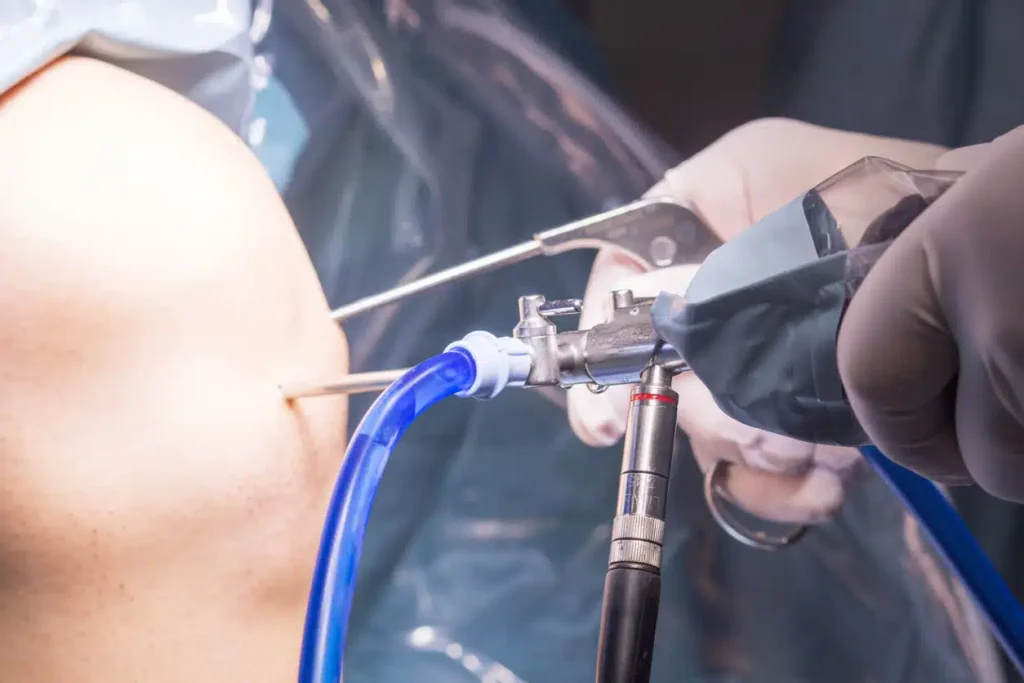
CPT code 29881 describes surgical knee arthroscopy with meniscectomy — specifically involving the medial or lateral meniscus (not both), including any meniscal shaving or debridement/shaving of articular cartilage performed during the same procedure. It falls under AMA CPT’s musculoskeletal arthroscopy section and is used by orthopedic surgeons and sports medicine physicians treating torn meniscal tissue that cannot be repaired.
The keyword in the descriptor is “or” — one meniscus, one compartment per claim. When both the medial and lateral menisci are addressed in the same operative session on the same knee, the correct code is CPT 29880, not two units of 29881. That single word causes more downcoding and audit flags in orthopedic billing than almost any other descriptor nuance in the knee arthroscopy code family.
CPT 29881 carries a 90-day global surgical period, meaning related post-operative services within that window are bundled into the procedure payment and cannot be billed separately without the appropriate modifier.
CPT Code 29881 vs CPT 29880 — When One Meniscus Becomes Two (And Why It Changes Your Reimbursement)
The difference between CPT 29881 and CPT 29880 comes down to exactly one thing: how many menisci the surgeon removed. CPT 29881 covers medial or lateral meniscectomy — one compartment. CPT 29880 covers medial and lateral meniscectomy in the same knee, same session.
This matters for two reasons. First, it’s a compliance issue — billing 29881 twice for a bilateral-compartment case when 29880 is what’s documented is an unbundling error that triggers NCCI edit denials and can flag an audit. Second, it’s a revenue issue — CPT 29880 reimburses at a higher rate because the work RVU is larger, and undercoding a bilateral case costs money.
The operative report decides the code. If the surgeon resected tissue from both compartments, 29880 is correct and should be billed. If only one compartment was addressed, 29881 is correct. Your coding team should never select a code before reading the operative note in full.

CPT Code 29881 Documentation Requirements — What Payers Actually Check
CPT 29881 documentation requirements follow a clear pattern: payers want to see that the surgery was necessary, that the right procedure was performed, and that the claim is tied to a specific patient on a specific knee. These requirements are not buried in payer policy fine print — they’re the same things that a payer auditor will look for in a post-payment review.
For clinical documentation errors that cause coding denials, meniscectomy claims rank consistently in the top-five problem areas in orthopedic billing.
The #1 Denial Trigger: Operative Reports That Don’t Specify Meniscal Extent
Vague language in the operative report is the most common reason CPT 29881 claims are denied on first submission. “Arthroscopy with meniscectomy performed” doesn’t cut it. Payers — especially Medicare Advantage plans and commercial carriers using InterQual or MCG criteria — require the report to describe the tear pattern, tissue quality, and extent of resection performed. A note that identifies the specific meniscus, describes the tear (bucket-handle, radial, degenerative, flap), and quantifies how much tissue was removed will survive an audit. One that doesn’t will generate a documentation deficiency denial.
Laterality, Meniscus Identified, Conservative Care History — What Must Be in Every Note
Every CPT 29881 claim should be supported by an operative report that explicitly states:
- Which knee (right or left — this drives modifier LT/RT)
- Which meniscus (medial or lateral — this determines 29881 vs. 29880)
- Extent of the tear and amount of tissue resected
- Conservative treatment history — most commercial payers require documented evidence of failed PT (typically 6+ weeks), NSAIDs, or cortisone injection before approving surgical arthroscopy
- Imaging correlation — MRI findings should align with intraoperative findings; a mismatch invites scrutiny

ICD-10 Codes That Pair With CPT 29881 — And Which Ones Trigger Denials
The most commonly paired ICD-10 codes for CPT 29881 billing are from the M23 range, which covers internal derangement of the knee. Common valid pairings include:
- M23.200 — Derangement of unspecified lateral meniscus by old tear or injury, unspecified knee
- M23.201 / M23.202 — Lateral meniscus derangement, right or left knee
- M23.301 / M23.302 — Other meniscus derangements, right or left knee
- M23.611 / M23.612 — Other internal derangement of right/left knee
ICD-10 codes that don’t support medical necessity for surgical intervention — such as unspecified knee pain codes (M25.561 / M25.562) without supporting imaging or exam findings — tend to trigger manual review and are associated with higher medical necessity denial rates. Match ICD-10 codes to MRI findings and operative report language for strongest first-pass results.
Modifier Rules for CPT Code 29881 — Laterality, Global Period, and Same-Day E/M
Modifier rules for CPT code 29881 are where billing errors compound quickly. There are four modifier situations you’ll encounter regularly:
Laterality (LT/RT): Use modifier LT for left knee, RT for right knee — every time. A claim submitted without a laterality modifier will be returned or denied by most payers. Modifier 50 (bilateral) should only be appended if both knees were operated on in the same session, which is clinically uncommon for meniscectomy.
NCCI edits and modifier 59/XS: CPT 29877 (chondroplasty/debridement) is bundled into 29881 under NCCI edits and cannot be separately billed for the same compartment on the same day. If a distinctly separate arthroscopic procedure was performed in a different area and the operative note supports it, append modifier 59 or XS to the secondary code. The documentation must support each separately billed procedure.
Same-day E/M: Yes, CPT 29881 can be billed with an E/M code on the same day, but only when the E/M represents a separately identifiable service (a new clinical decision, not routine pre-op review). Use modifier 25 on the E/M code. Without modifier 25, expect an automatic denial.
Global period modifiers: For complications or unrelated visits during the 90-day global window, modifier 24 (unrelated E/M during global) or modifier 79 (unrelated surgery during global) allows separate billing.
Our orthopedic medical coding services team reviews modifier logic at the claim level before submission — this single step catches a significant portion of preventable denials.
CPT Code 29881 Reimbursement Rates — Medicare and Commercial Payer Data 2026
As of the 2026 CMS Physician Fee Schedule (effective January 1, 2026, CMS-1832-F), CPT code 29881 carries a total RVU of 10.89 at the national level — composed of Work RVU 7.50, Practice Expense RVU 2.63, and Malpractice RVU 0.76. The 2026 non-QPP conversion factor is $33.4009.
Medicare physician payment (professional component): National average approximately $341 for procedures performed in an ASC or outpatient hospital facility. Geographic variation is meaningful — higher-cost metro areas like Manhattan, NY receive approximately 6% higher GPCI-adjusted payment than rural markets. A rural MAC locality (e.g., Rest of Iowa) may produce an estimated $484 in the non-facility setting. Verify your specific MAC locality rate using the CMS PFS Lookup Tool before submitting claims. (All figures sourced from the 2026 CMS MPFS relative value file, PPRRVU2026_Apr_nonQPP; verify against your MAC before billing.)
Facility vs. non-facility rates: CPT 29881 is a surgical procedure performed almost exclusively in a facility (ASC or outpatient hospital). The facility PE RVU applies when billing POS 22 or POS 24. Billing the wrong POS code silently reduces your reimbursement — and in 2026, CMS finalized a further reduction in indirect facility PE RVUs, making accurate POS coding more important than ever.
Commercial payer averages (national, 2026): BCBS approximately $747, UnitedHealthcare approximately $766, Aetna approximately $838, Cigna approximately $906. These represent contracted rates that vary by region and contract tier. (Source: PayerPrice, July 2026.)
Prior authorization: UnitedHealthcare, Aetna, BCBS, and most Medicare Advantage plans require prior authorization for CPT 29881. Conservative treatment documentation — typically 6+ weeks of physical therapy and/or NSAIDs — must be included in the PA request. Claims submitted without a current, valid auth number generate automatic CO-197 denials that are time-consuming and not always recoverable. See our orthopedic prior authorization guide for full submission requirements.
CPT 29881 vs 29880 reimbursement gap: CPT 29880 (bilateral meniscectomy) carries a higher work RVU than CPT 29881, which translates to a meaningfully higher Medicare allowed amount. If the operative report supports 29880 and your team is billing 29881, that gap is direct, avoidable revenue loss — not conservative coding.
NCCI bundling edits: CPT 29881 and CPT 29877 (chondroplasty) cannot be reported together for the same compartment of the same knee on the same date without supporting separate documentation and an appropriate modifier. Unbundling without clinical justification is a compliance risk. G0289 may be appended for loose or foreign body removal from a different compartment when that service took place and is documented.
Common CPT Code 29881 Billing Errors — and How to Fix Each One
The most common billing errors for CPT 29881 fall into four categories:
Missing laterality modifier: The single most frequent denial trigger. Every CPT 29881 claim must carry RT or LT. Fix: build a claim scrubber rule that holds any 29881 claim without a laterality modifier before submission.
Wrong code when both menisci were resected: Billing two units of 29881, or billing 29881 when the operative note supports 29880, generates immediate NCCI edit denials. Fix: make operative note review mandatory before code assignment — the note drives the code, not the surgery schedule.
Prior auth lapsed or mismatched: Procedures performed after an authorization expired, or billed under a CPT code that doesn’t match what was authorized, trigger CO-197 automatic denials. Fix: verify auth validity and CPT code match within 24 hours of the procedure date, before the claim is submitted.
Conservative treatment not documented in the PA request: Most commercial payers and Medicare Advantage plans require documented failure of conservative care before approving surgical arthroscopy. Fix: build a pre-auth documentation checklist that captures physical therapy dates, NSAID use, and injection history before submission.
How to Bill CPT Code 29881 Correctly — Step-by-Step
- Confirm the procedure involved meniscectomy of ONE meniscus. If both menisci were resected in the same session on the same knee, bill CPT 29880 — not two units of 29881.
- Verify prior authorization was obtained and remains valid. Most commercial payers and Medicare Advantage plans require a current, valid auth number. Confirm the auth covers the specific CPT code you’re billing.
- Confirm the operative report documents conservative care failure. Payers require evidence of failed PT (typically 6+ weeks), NSAIDs, or injections before approving surgical arthroscopy. Missing this history triggers medical necessity denials even with a valid auth.
- Document joint, laterality, meniscus, and resection extent in the operative report. The note must identify right vs. left, medial vs. lateral, and describe the tear and tissue removed. Vague notes are the #1 documentation cause of 29881 denials.
- Apply the correct laterality modifier. Modifier LT for left knee, modifier RT for right knee — on every claim. Never use modifier 50 (bilateral) unless both knees were operated on in the same session.
- Apply modifier 59 or XS when billing additional arthroscopic procedures same-day. The operative report must support each separately billed procedure as distinct and not bundled under the 29881 work.
- Use the correct place of service (POS) code. POS 22 (outpatient hospital) and POS 24 (ASC) produce different Medicare allowed amounts. Billing the wrong POS reduces reimbursement and can trigger a payer audit.
- Account for the 90-day global period on follow-up billing. Post-op visits within the global window are bundled. Flag complications or unrelated services with modifier 24 or 79 to bill them outside the global period appropriately.
How TMS Billings Helps Orthopedic Practices Get CPT 29881 Paid Right
TMS Billings works exclusively with orthopedic practices and ASCs on arthroscopic knee surgery billing — including CPT code 29881 — across multiple payers and MAC regions. Our team reviews operative reports against CPT descriptor requirements before code assignment, validates prior auth status before submission, and applies the correct modifier chain at the claim level.
The practices we work with see measurably higher first-pass acceptance rates on CPT 29881 claims than the industry average — because every preventable denial category above gets caught in pre-submission review, not after the denial hits your AR.
CPT code 29881 is one of the highest-volume surgical arthroscopy codes in your practice — and one of the most quietly denied. A missing laterality modifier, a lapsed prior authorization, or an operative report that doesn’t document conservative care failure compounds across dozens of claims before anyone catches it. TMS Billings offers a free CPT 29881 billing audit for your practice: we’ll review your last 30 knee arthroscopy claims, identify every documentation gap and coding error, and show you exactly how much reimbursement you’re leaving on the table — by payer, by modifier, by dollar amount. No commitment. No generic report. Just specifics.

Comparison: CPT 29877 vs CPT 29880 vs CPT 29881 vs CPT 29882 — Knee Arthroscopy Code Reference
| Factor | CPT 29877 | CPT 29880 | CPT 29881 | CPT 29882 |
|---|---|---|---|---|
| Procedure type | Debridement / chondroplasty | Meniscectomy — medial AND lateral | Meniscectomy — medial OR lateral | Meniscus repair — medial OR lateral |
| Meniscus removed? | ❌ No | ✅ Both | ✅ One | ❌ Repaired, not removed |
| 2026 Medicare RVU (total) | Lower than 29881 | Higher than 29881 | 10.89 | Verify at cms.gov |
| 90-day global period | ✅ Yes | ✅ Yes | ✅ Yes | ✅ Yes |
| Prior auth typically required | ✅ Yes | ✅ Yes | ✅ Yes | ✅ Yes |
| Most common billing error | Bundled with 29881 inappropriately | Billed when only one meniscus removed | Missing laterality / vague operative note | Repair vs. resection not clearly documented |
2026 Medicare allowed amounts vary by MAC locality and facility vs. non-facility setting. Verify specific allowed amounts at cms.gov PFS Lookup Tool before publishing or billing.

For complete CPT code definitions and arthroscopy coding guidelines, reference the AAPC CPT code database and the AMA CPT musculoskeletal guidelines.