
Denied claims, slow reimbursements, and billing staff turnover are quietly draining Ohio practices every month. If you have been asking whether to outsource medical billing Ohio, you are asking the right question at exactly the right time. This guide — written by the TMS Billings revenue cycle management team — gives you an honest breakdown of the costs, benefits, risks, and red flags involved in making the switch. Whether you are a solo physician, a multi-provider group, or a specialty clinic managing high-denial payers, the realities of medical billing services in Ohio demand a clear-eyed, data-backed evaluation before you decide.
What Does It Mean to Outsource Medical Billing?
To outsource medical billing Ohio providers hand claim submission, coding review, denial management, and accounts receivable follow-up to a third-party billing company. Rather than managing an in-house billing team, the practice pays a billing partner — typically a percentage of collections — to handle the full revenue cycle from charge entry to payment posting.
Why Ohio Practices Are Making the Switch
Ohio’s healthcare billing environment has grown significantly more demanding over the past three years. AI-driven payer audits, stricter prior authorization enforcement, and evolving Ohio Medicaid billing requirements are combining to push denial rates to record highs. At the same time, finding and retaining skilled billing staff has become one of the most persistent operational challenges Ohio practices face.
Two pressure points are pushing more providers than ever to outsource medical billing Ohio.
The Real Cost of Running an In-House Billing Team
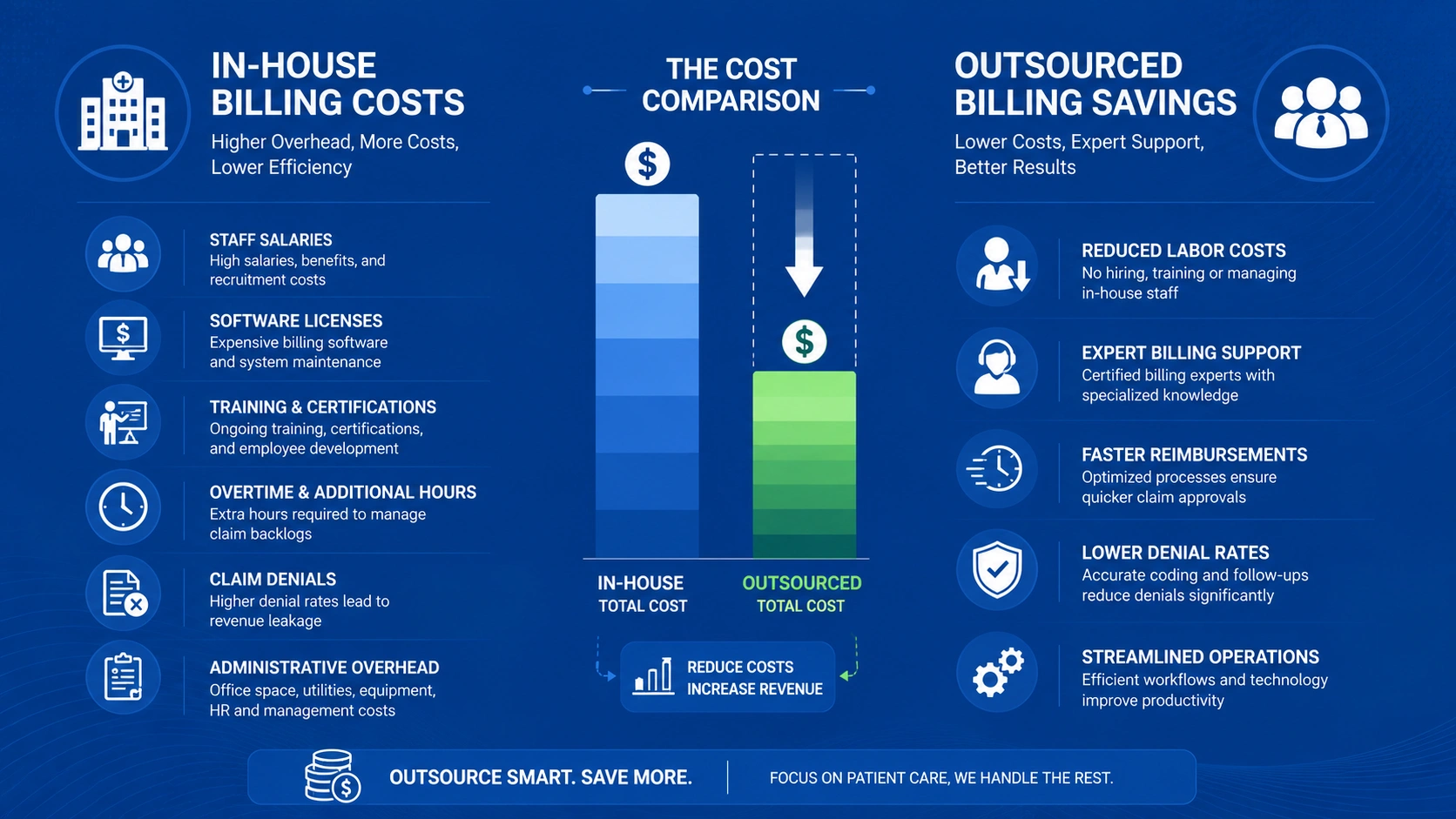
Running billing in-house costs more than most practice owners realize. In 2026, a medical biller earns $55,000–$75,000 annually before benefits — which add another 20–30% to compensation costs. Billing staff turnover is approaching 40% industry-wide, and training expenses to keep pace with CPT and ICD code changes run $2,000–$5,000 per employee every two years. Add practice management software licenses and IT overhead, and the true cost of one billing FTE routinely exceeds $90,000 per year.
When a biller leaves — and statistically, nearly half will within two years — coding gaps and stalled accounts receivable management follow immediately. The lost physician practice revenue from even a few weeks of billing disruption is difficult to recover.
Rising Denial Rates Across Ohio Specialties
The national initial claim denial rate hit 12.4% in 2025 — a ten-year high (Viaante, 2026). For Ohio specialties like behavioral health, orthopedics, and cardiology, where prior authorization requirements are most intensive, the numbers are often worse. Eligibility mismatches, payer-specific edits, and documentation gaps all contribute to a claim denial rate that compounds every month it goes unaddressed. MGMA’s 2026 benchmarking data confirms that practices using structured Revenue Cycle Management Services achieve 30–40% denial rate reductions within two billing quarters by catching errors before claims are submitted.
Key Benefits of Outsourcing Medical Billing in Ohio
The medical billing outsourcing benefits for Ohio providers go well beyond cutting a salary line. A high-performing partner delivers measurable improvements across every stage of your revenue cycle. The benefits of outsourcing medical billing in Ohio are clearest when you compare real performance numbers side by side.
Faster Claims and Improved Cash Flow
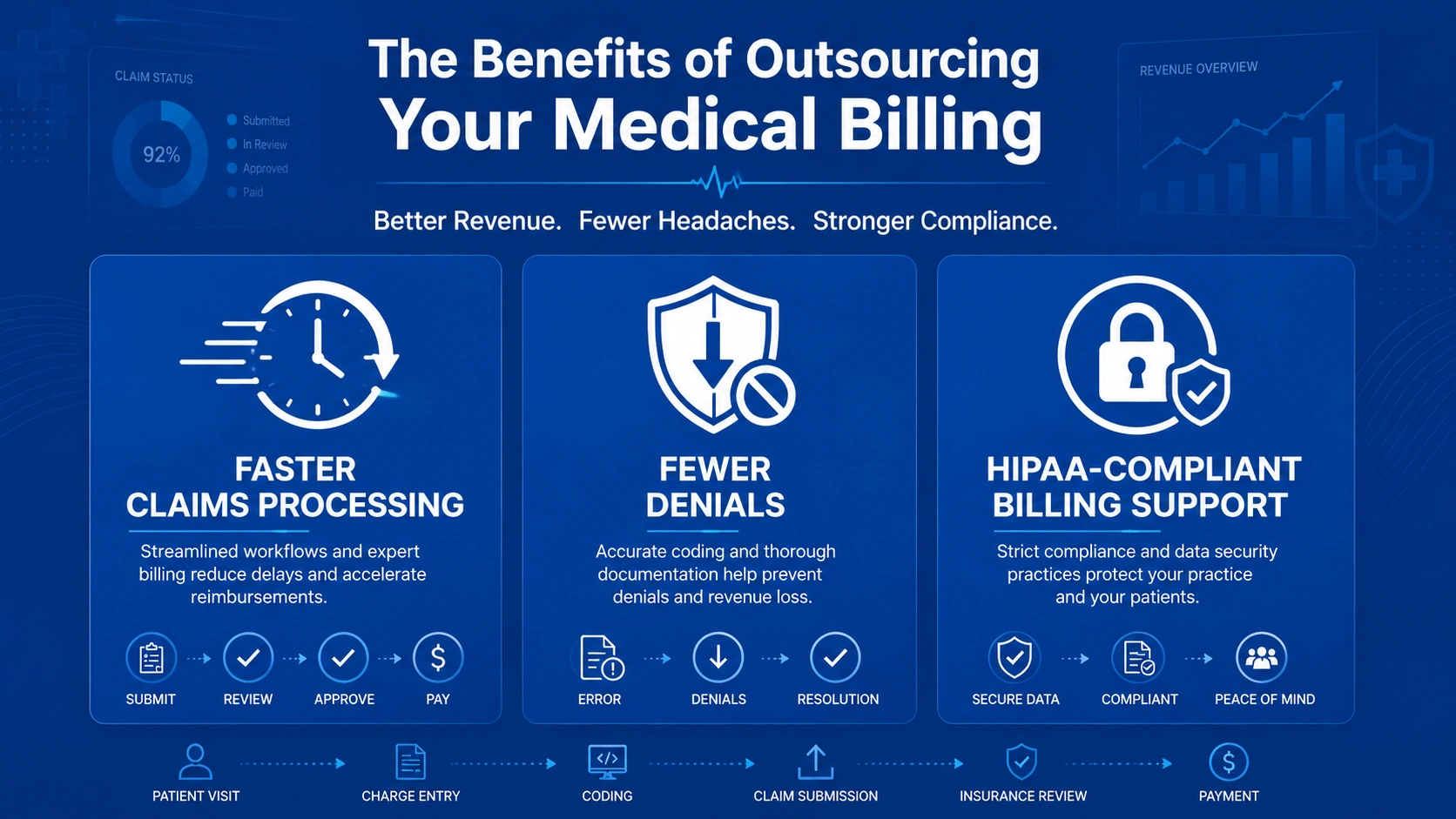
In-house billing teams typically run accounts receivable cycles of 50–60 days. Outsourced medical billing services reduce that window to 30–40 days through faster claim submission, real-time eligibility verification, and consistent AR follow-up. For a practice collecting $1.5M annually, cutting AR by even 15 days translates directly to improved working capital and fewer cash flow gaps between reimbursement cycles.
Fewer Denials and Stronger AR Recovery
Top-performing outsourced billing operations maintain a clean claim rate above 95% — well above the industry average of 85–90% for in-house teams. Dedicated denial management teams track every rejected claim, identify recurring patterns, file appeals before deadlines expire, and recover revenue that otherwise ages out. That level of accounts receivable management is nearly impossible to replicate with a small in-house team managing multiple responsibilities simultaneously.
HIPAA Compliance Without the Overhead
Maintaining HIPAA compliant billing workflows requires ongoing staff training, technology audits, documentation protocols, and continuous monitoring of payer rule updates. A reputable Ohio medical billing company manages Ohio healthcare billing compliance internally — their teams monitor CMS updates, HIPAA security requirements, and payer-specific edits so your practice does not absorb that risk. For a deeper look at how upstream issues cost practices money, review our resource on clinical documentation errors and their impact on claim outcomes.
The Risks of Outsourcing — And How to Avoid Them
Outsourced medical billing services carry real risks if you approach the vendor selection process carelessly. Knowing the common pitfalls before you sign a contract is how you protect your practice.
Loss of Visibility Into Your Billing Process
Some practice owners worry they will lose meaningful oversight of their revenue cycle once billing moves off-site. That concern is valid — but entirely avoidable. The right billing partner provides real-time dashboards, monthly performance reports on denial rates and AR aging, and a dedicated account manager accessible when issues arise. Before signing, confirm that weekly claim status updates and monthly denial breakdowns are written into your service contract, not offered as optional add-ons.
Choosing the Wrong Ohio Medical Billing Company
Low-cost billing services that offshore coding work, lack specialty expertise, or charge hidden fees frequently deliver lower net collections than a competent in-house team. The vendor evaluation section below gives you a practical checklist to separate high-performing Ohio medical billing companies from underperformers before you commit.
In-House vs. Outsourced Medical Billing — Side-by-Side Comparison
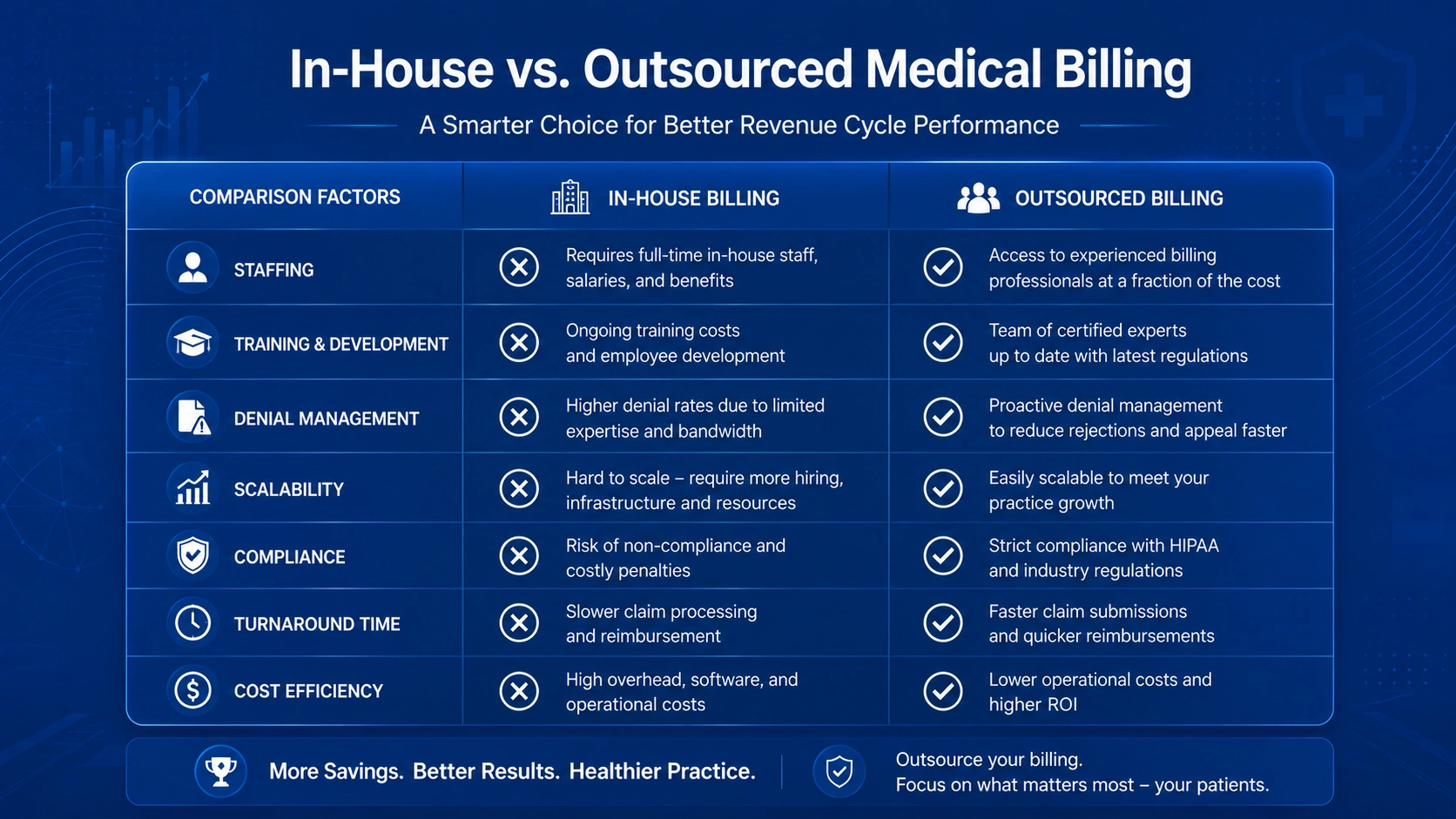
The in-house vs outsourced billing decision comes down to cost, risk tolerance, and payer complexity. For most Ohio practices, the numbers favor outsourcing decisively.
| Factor | In-House Billing | Outsourced Billing |
|---|---|---|
| Cost per FTE | $90,000+/year (salary, benefits, training) | 4–8% of net collections |
| Denial rate | 10–15%+ | 2–5% |
| Days in AR | 50–60 days | 30–40 days |
| Clean claim rate | 85–90% | 95%+ |
| Staff turnover risk | High (~40% annually) | Managed by billing company |
| HIPAA compliance | Practice responsibility | Vendor responsibility |
| Ohio Medicaid billing expertise | Depends on staff experience | Specialty-specific and current |
| Scalability | Limited by headcount | Scales with claim volume |
| Reporting and visibility | Manual, inconsistent | Real-time dashboards |
| Practice management software integration | Internal setup required | Included in onboarding |
How Much Does It Cost to Outsource Medical Billing in Ohio?
Most Ohio medical billing companies charge between 4% and 8% of net collections. Larger practices with higher claim volumes typically negotiate rates between 3% and 5%. Smaller or solo practices usually fall in the 6–10% range. Some vendors offer flat monthly fees ranging from $200 to $1,500 depending on claim volume, though percentage-based pricing better aligns the billing partner’s incentives with your collections. Explore our full breakdown of medical billing pricing models to determine which structure fits your practice’s volume and payer mix.
What you eliminate entirely: salaries, payroll taxes, benefits, turnover recruiting costs, biennial coding training, and software license fees. When those overhead costs are honestly totaled, outsourcing consistently costs less per dollar collected than in-house billing — and typically generates higher net collections on top of the savings.
Is Outsourcing Medical Billing Worth It for Your Practice?
Should I outsource medical billing Ohio? The honest answer depends on your current denial rate, billing overhead, and how much staff turnover is disrupting your revenue cycle.
How Solo Practices Outsource Medical Billing Ohio
Is outsourcing medical billing worth it for small practices? For most solo and small Ohio practices, yes — clearly. Carrying even one full-time billing FTE at $90,000+ per year frequently costs more than the outsourcing fee on equivalent revenue. Add the disruption when that employee leaves — with no backup and no training overlap — and the financial case becomes straightforward. How to outsource medical billing Ohio for a solo practice starts with a simple billing audit: calculate what your current team costs against what you are collecting, then compare that against a 6–8% outsourcing fee with a guaranteed clean claim rate above 95%.
Medical billing accuracy also improves immediately in most small practices because a dedicated billing company applies specialty-specific coding knowledge that a generalist in-house biller cannot replicate across all payer types.
Multi-Provider Groups and Specialty Clinics
For behavioral health, orthopedic, and cardiology groups managing complex prior authorization volumes and multiple payer contracts, the difference between a 91% and a 97% net collection rate on $3M in annual revenue is nearly $180,000. Multi-provider groups also gain scalability: as you add providers, your billing company scales with you — without the months-long lag of recruiting, hiring, and training new billing staff.
What to Look for in an Ohio Medical Billing Company
Knowing what to look for in an Ohio medical billing company is what separates a revenue-boosting partnership from a costly billing failure.
Questions to Ask Before You Sign
- What is your average clean claim rate across your Ohio client base?
- How do you handle Ohio Medicaid billing, Medicare Advantage, and commercial payer rules?
- What is your average denial rate, and how do you track and appeal rejected claims?
- Do you provide real-time reporting dashboards and a dedicated account manager?
- What practice management software platforms do you integrate with?
- How is HIPAA compliant billing maintained, and who is responsible in the event of a compliance issue?
- What are your contract termination terms and transition support provisions?
Red Flags to Watch For
- No demonstrable specialty experience in your billing area
- Vague or absent reporting on denial rates, AR aging, and collection performance
- Offshore coding teams with limited client visibility or accountability
- No clear escalation process for disputed or repeatedly denied claims
- Fee structures tied to submitted claims rather than collected revenue
- Unwillingness to provide references from current Ohio practices similar to yours
How TMS Billings Helps Ohio Practices Get Paid Faster
TMS Billings is a dedicated Ohio medical billing company built around the revenue cycle management Ohio providers face every day. Our Medical Billing Services cover every step from charge entry and coding review to denial management and payment posting — with Ohio-specific payer expertise built in from day one.
Here is what Ohio practices typically experience when they partner with us:
- Denial rates below 5% through pre-submission claim scrubbing and real-time eligibility verification
- AR cycles reduced to 30–35 days via consistent follow-up and proactive appeals management
- Real-time reporting dashboards so you maintain full visibility into your revenue cycle at every stage
- Ohio-specific payer expertise, including Ohio Medicaid billing, Medicare Advantage, and regional commercial payer rules
- End-to-end HIPAA compliant billing workflows managed by our internal compliance team

We work with practices across behavioral health, orthopedics, primary care, cardiology, and more — scaling services to fit solo practitioners and large multi-provider groups alike. We begin every engagement with a free billing audit, identify revenue gaps, and transition your billing without disrupting scheduling or clinical workflow.
The State of Medical Billing Outsourcing in Ohio
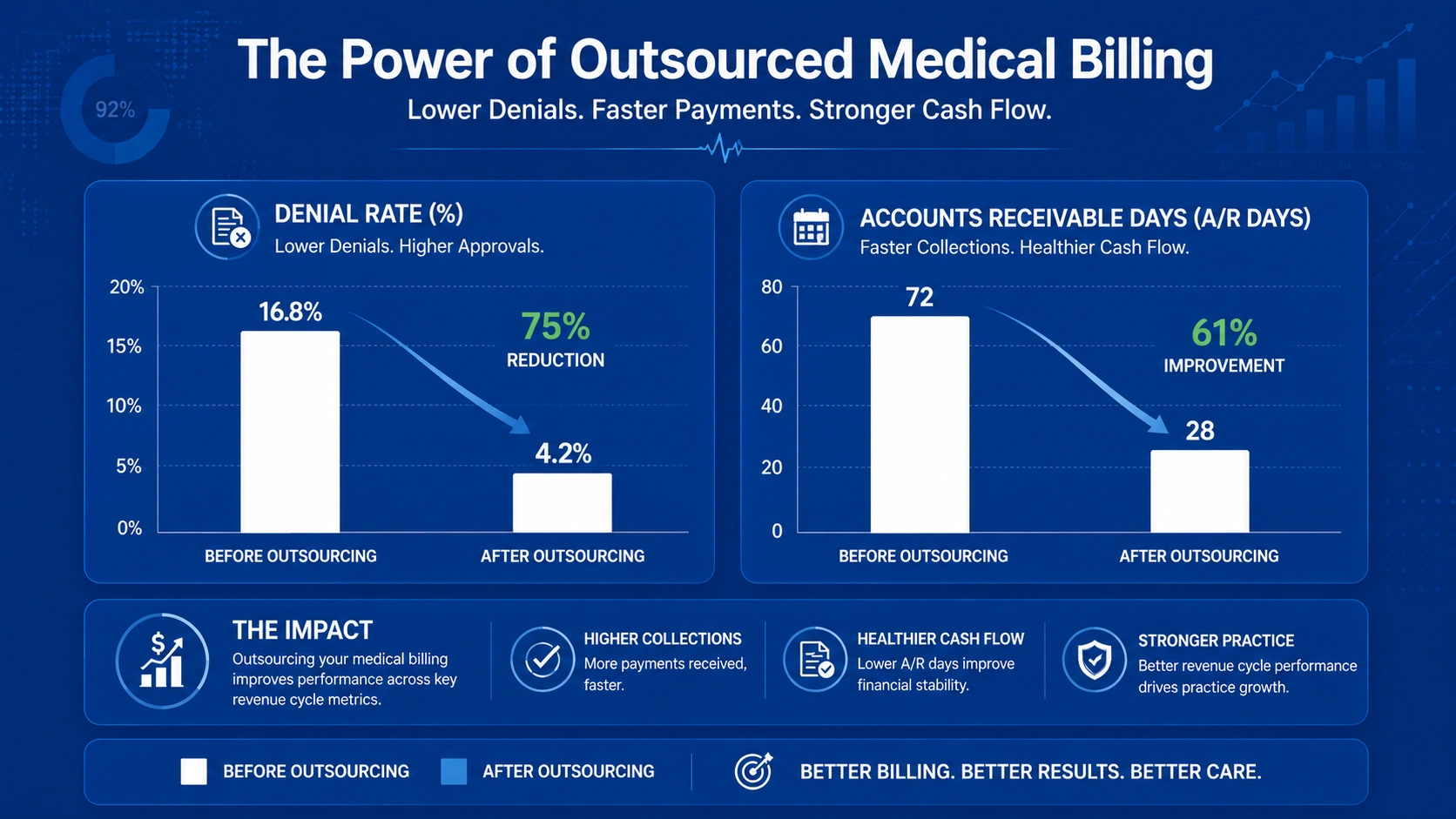
The data behind the decision to outsource medical billing Ohio is compelling. Here are five benchmarks every Ohio provider should review before making a final decision.
1. Claim Denial Rates: In-House vs. Outsourced The national initial claim denial rate reached 12.4% in 2025 — the highest in a decade (Viaante, 2026). HFMA benchmarking sets the target for financially healthy practices at below 5%, with less than 3% considered best-in-class. Outsourced billing operations consistently achieve denial rates of 2–5% through pre-submission claim scrubbing, real-time eligibility verification, and specialty-specific coding expertise. More than half of U.S. healthcare organizations now report denial rates above 10% (MGMA, 2024 Benchmarking Report on Denials and Appeals).
2. Share of Practices Using Outsourced Billing in 2026 According to a recent HFMA survey, 44% of healthcare organizations now outsource some or all of their revenue cycle management — and that number continues to rise as payer complexity increases. An MGMA Stat poll (November 2024) found that 36% of medical practice leaders planned to outsource or automate part of their RCM in 2025, with collections, billing, and coding topping the list of targeted functions.
3. Average Reduction in Days in Accounts Receivable In-house billing teams typically average 50–60 days in accounts receivable. Practices that transition to outsourced medical billing services routinely reduce that figure to 30–40 days — an improvement of 15–30 days that directly strengthens cash flow and reduces the risk of claims aging past recovery thresholds. The MGMA benchmark for healthy practices is under 40 days; top performers operate at 30–35 days.
4. Estimated Cost Savings When Replacing an In-House FTE Replacing one in-house billing FTE — who costs $90,000+ when salary, benefits, payroll taxes, and training are fully accounted for — with outsourced billing services typically cuts billing overhead by 20–40%, according to 2026 industry cost comparisons. For practices with two or more billing staff, the annual savings can reach six figures before accounting for improved net collections performance.
5. Projected Market Growth Through 2030 The U.S. medical billing outsourcing market was valued at $5.89 billion in 2024 and is projected to reach $18.74 billion by 2034, growing at a CAGR of 12.27% (Revenue Memo, 2026). The revenue cycle management Ohio market mirrors this national trajectory, with Ohio practices facing staffing shortages, AI-driven payer audits, and rising CMS compliance requirements turning to specialized billing partners for sustainable long-term revenue performance.
Sources: Viaante (2026), HFMA (2024–2026), MGMA (2024–2026), Revenue Memo (February 2026), CMS (cms.gov).
Key Takeaways
- The national claim denial rate hit 12.4% in 2025 — Ohio specialty practices in behavioral health, orthopedics, and cardiology often face even higher rates without dedicated denial management.
- In-house billing staff cost $90,000+ per FTE annually when all overhead is included; outsourcing converts that to 4–8% of net collections.
- Outsourced medical billing services reduce days in AR from 50–60 to 30–40 days on average — a meaningful improvement in working capital.
- 44% of healthcare organizations now outsource some or all of their revenue cycle management (HFMA, 2026).
- The in-house vs outsourced billing decision comes down to cost, staff risk, and payer complexity — and for most Ohio practices, outsourcing delivers better results on all three measures.
- Choosing the right Ohio medical billing company means vetting denial rates, specialty expertise, Ohio Medicaid billing knowledge, and reporting capabilities before you sign.
Final Thoughts
If your practice is wrestling with rising denials, slow cash flow, or the recurring cost of billing staff turnover, it is time to take an honest look at your options. To outsource medical billing Ohio practices need a partner with proven expertise, transparent reporting, and a track record of results — not simply a lower-cost alternative to a struggling in-house team.
TMS Billings works exclusively with Ohio providers to deliver the revenue cycle management Ohio practices depend on. Whether you are a solo practitioner evaluating outsourcing for the first time or a multi-provider group replacing an underperforming billing operation, we begin with a no-obligation billing audit that identifies exactly where your practice is losing revenue.
Contact TMS Billings today to schedule your free revenue cycle assessment and see how our medical billing services in Ohio help practices get paid faster, with fewer denials and greater financial visibility.