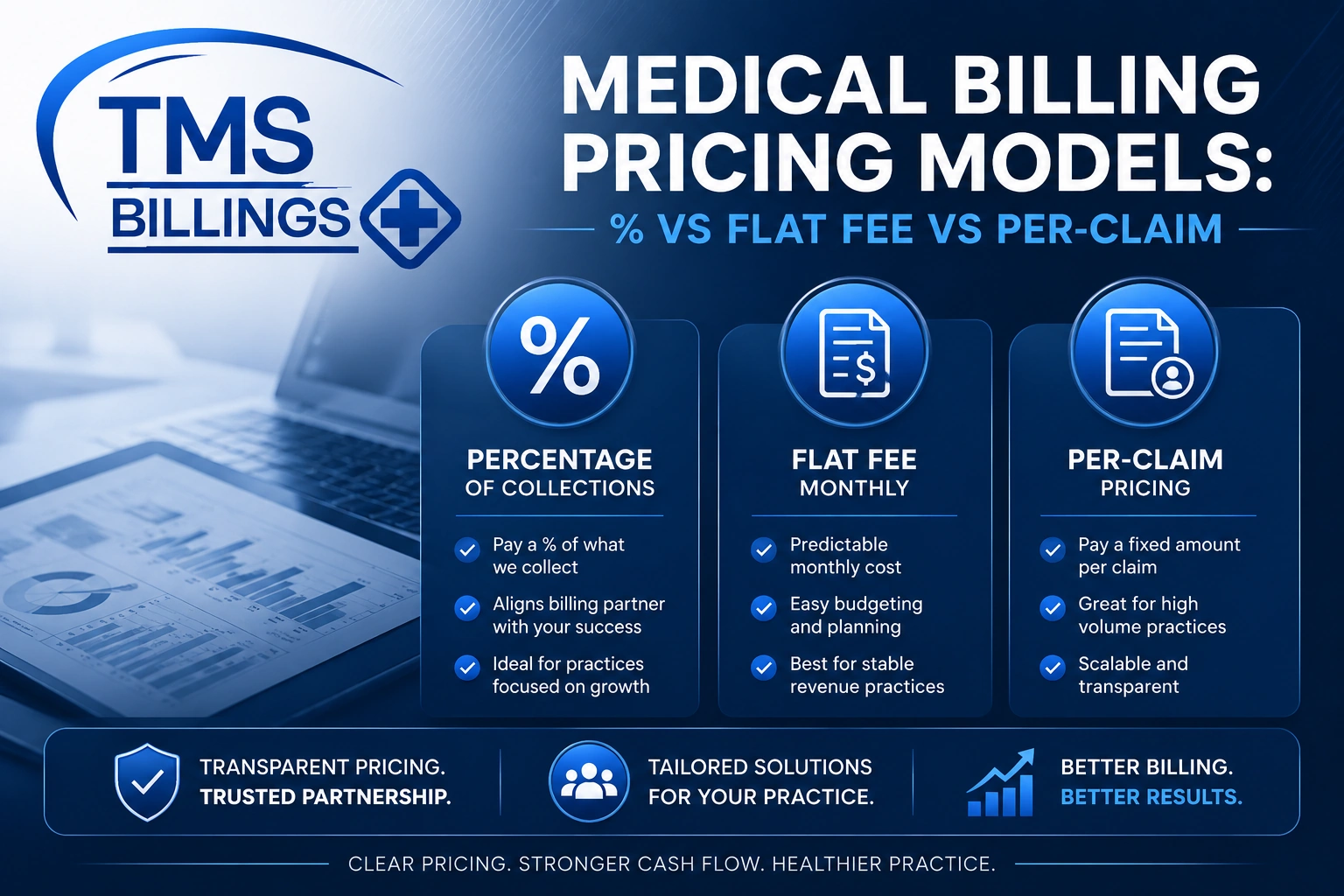
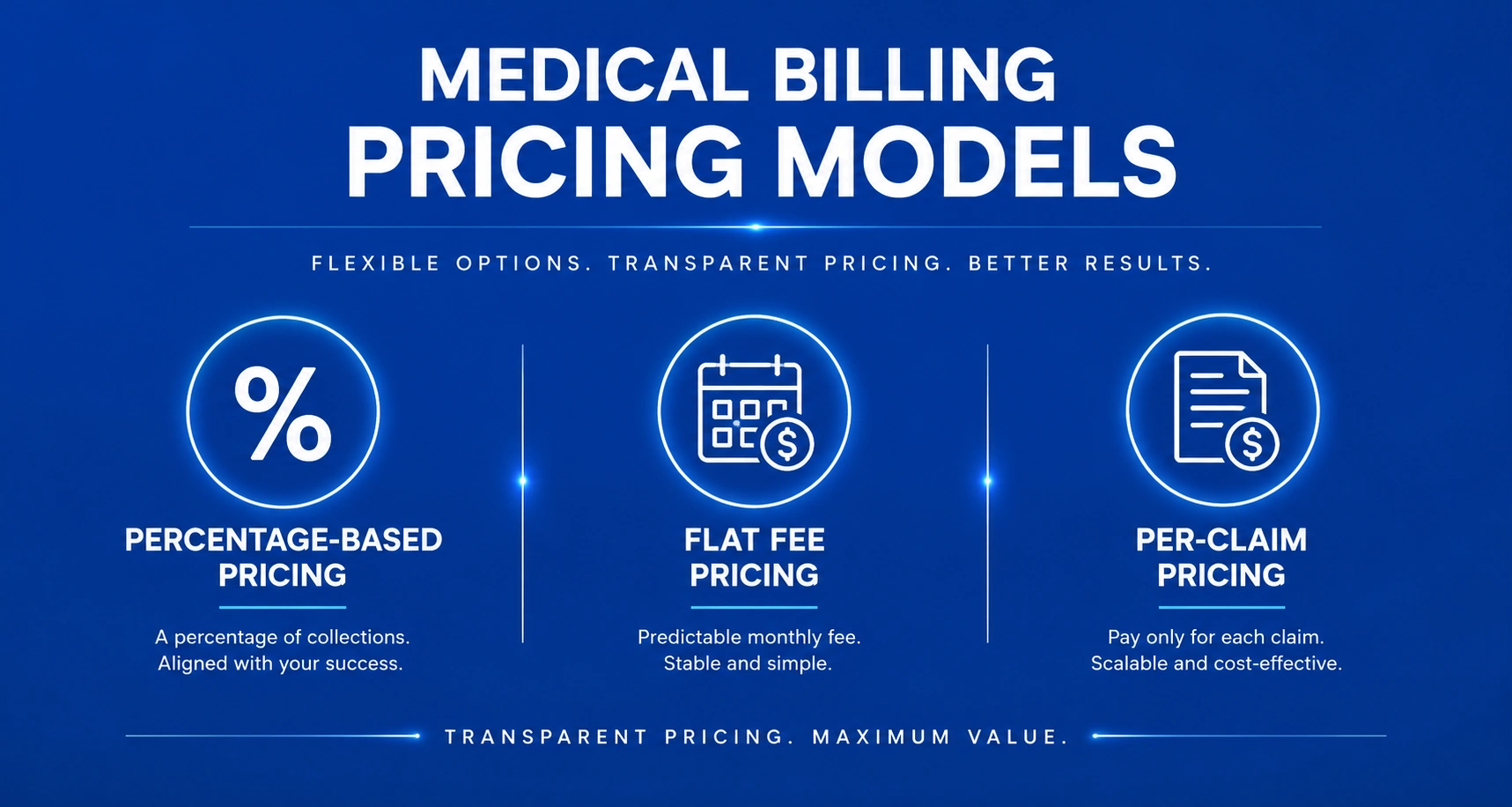
If you’re comparing vendor quotes right now, you’ve likely received three very different numbers for essentially the same job. That happens because there’s no universal pricing standard in this industry—and understanding medical billing pricing models is the first step toward knowing whether your practice is overpaying. Our Medical Billing Services team works with practices of every size and specialty to structure billing arrangements that match their actual claim volume and revenue profile. This guide breaks down every major pricing structure with real numbers, so you can evaluate any quote on an equal footing.
What Are Medical Billing Pricing Models?
Medical billing pricing models are the methods billing companies use to charge for their services: a percentage of collections, a flat fee per claim, a flat monthly fee, or a hybrid blend of these. Rates typically range from 4%–9% of collections, $3–$10 per claim, or $500–$2,500 per month, depending on practice size and specialty.
Why There’s No Single “Standard Rate” for Medical Billing
Medical billing company fees vary because not all claims are created equal. A family medicine practice submitting 500 simple evaluation-and-management claims each month has a fundamentally different billing profile than an orthopedic surgeon billing complex surgical procedures with implants, modifiers, and prior authorization requirements.
How Specialty and Average Claim Value Change the Math
Average reimbursement per claim by specialty is one of the most important variables in any pricing negotiation. Primary care practices often collect $80–$150 per claim. Orthopedic and surgical practices may collect $400–$1,200 per claim. A 7% rate on a $120 claim costs your practice $8.40. That same 7% rate on an $800 claim costs $56.00. The same percentage produces very different outcomes depending on what you bill.
Why the Lowest Quoted Rate Isn’t Always the Lowest Cost
A billing company quoting 4% with an 82% net collection rate will cost your practice significantly more than a vendor quoting 7% with a 95% net collection rate—on the same monthly volume. According to MGMA, in-house billing costs a practice an average of 13.7% of collections when all overhead is factored in, compared to just 5.4% for a well-run outsourced partner. The sticker price is one number. The total cost of billing is another.
The Main Ways Medical Billing Companies Charge
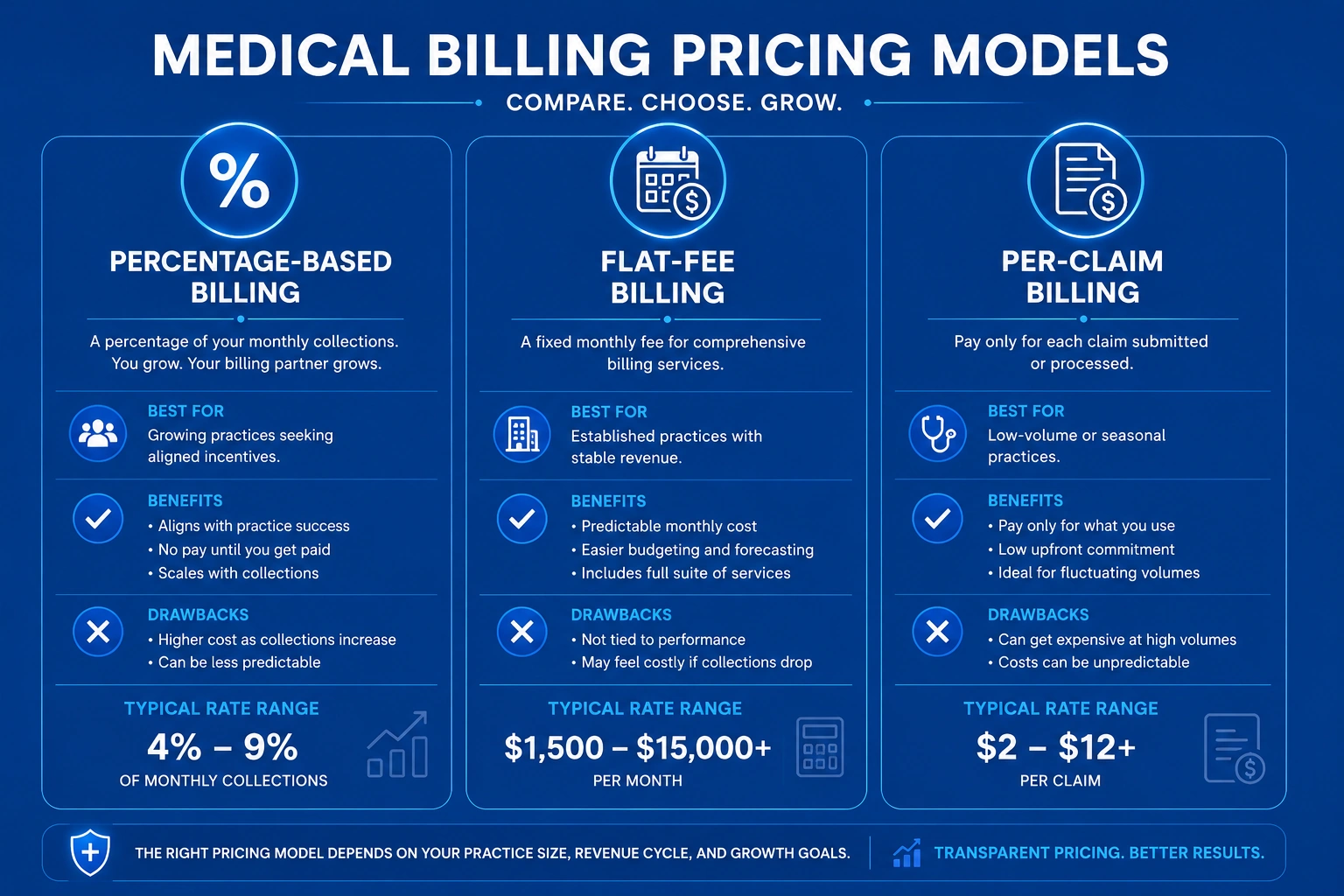
How do medical billing companies charge for their services? The industry uses four core structures. Understanding how medical billing pricing models work begins with knowing exactly what each one means for your monthly invoice.
Percentage of Collections
The billing company takes a percentage of what they actually collect on your behalf—typically 4%–9%. This is the most widely used model in the U.S. market.
Flat Fee Per Claim
You pay a fixed dollar amount for each claim submitted—typically $3–$10—regardless of the claim’s reimbursement value. This is called per-claim pricing.
Flat Monthly Fee
A set monthly fee covers all billing services regardless of claim volume. Rates typically run $500–$2,500 per month depending on practice size.
Hybrid Medical Billing Pricing Models
A hybrid pricing model medical billing arrangement blends two or more structures—for example, a base monthly fee plus a lower percentage of collections, or a flat per-claim rate plus a higher percentage applied only to complex claims above a certain value.
Side-by-Side Model Comparison
| Pricing Model | Typical Rate | Best Fit | Incentive Alignment | Cost Predictability |
|---|---|---|---|---|
| Percentage of Collections | 4%–9% | Most practices | High — vendor earns more when you earn more | Moderate |
| Flat Fee Per Claim | $3–$10/claim | High-volume, high-value specialties | Low | High |
| Flat Monthly Fee | $500–$2,500/mo | Solo/low-volume providers | Low | Very high |
| Hybrid | Custom blend | Multi-specialty practices | Medium | Medium |
Percentage of Collections, Explained
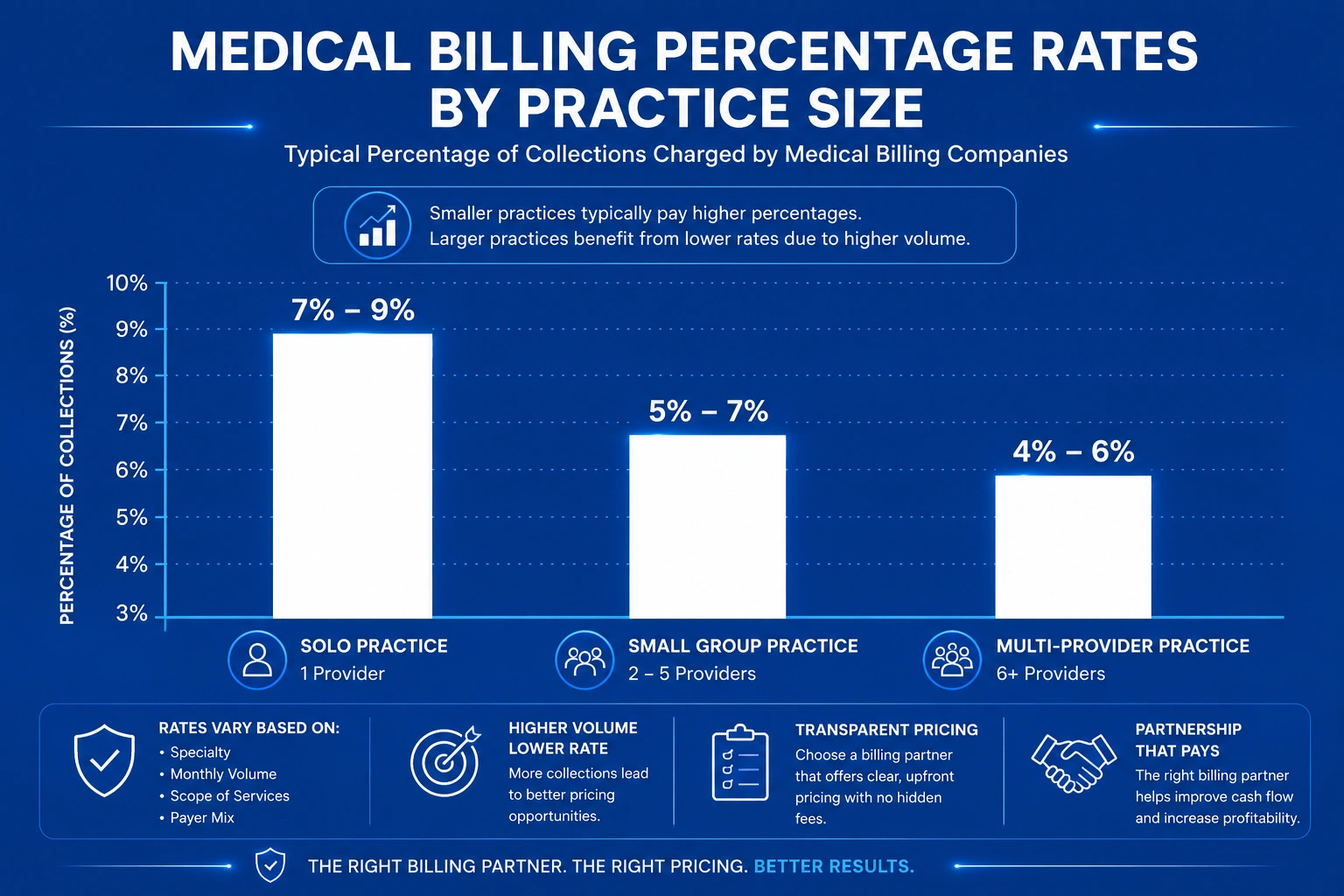
Percentage of collections billing is the dominant model in the U.S. for one clear reason: it aligns your billing company’s incentives with your revenue. They earn more when they collect more.
Typical Percentage Rates by Practice Size
Based on benchmarks from the MGMA 2025 Physician Practice Benchmark Survey and current market data, rates fall in these ranges:
- Solo providers: 7%–9%
- Small group (2–5 providers): 5%–8%
- Multi-provider group (6+ providers): 4%–7%
- High-complexity specialties (cardiology, orthopedics, pain management): up to 10%–12%
What percentage do medical billing companies charge in 2026? The industry standard for full-service billing sits at 4%–9% of net collections for most practices, per benchmarks from MGMA and HFMA.
Net Collections vs. Gross Claims — Why It Matters
This is where many practices get tripped up. There’s a critical difference between net collections vs. gross collections. Gross is the total amount billed. Net is the amount actually collected after adjustments, write-offs, and contractual discounts with payers.
A vendor calculating their fee on gross collections could charge you a percentage of revenue you never received. Always confirm in your medical billing contract whether the percentage applies to net collections or gross charges. Net collections is the correct and industry-standard basis—and any contract that doesn’t specify this deserves a red flag.
Pros and Cons of Percentage-Based Billing
Pros: Aligns vendor incentives with your outcomes; billing company is motivated to follow up on denials; no upfront financial risk if collections dip temporarily.
Cons: Absolute cost grows as your practice revenue grows; can be expensive for high-reimbursement-per-claim specialties; month-to-month cost varies with collections.
Flat Fee Per Claim, Explained
Per-claim pricing charges a fixed dollar amount per claim submitted—regardless of the claim’s reimbursement value. It’s transparent and easy to audit.
Typical Per-Claim Rates and What’s Actually Included
How much does it cost to outsource medical billing per claim? Most vendors charge between $3 and $10 per claim submitted. However, what that rate actually covers varies widely. Some vendors include initial submission only. Denial management and follow-up fees, resubmission charges, and secondary claim filing may be billed as separate add-ons.
Also watch for medical billing setup fees—one-time onboarding charges of $500–$2,000—that don’t appear in the per-claim rate at all. Always ask for a fully itemized fee schedule before comparing quotes.
When Flat Fee Beats Percentage (and When It Doesn’t)
Flat fee medical billing wins when your average claim reimbursement is high. If your average orthopedic claim pays $650 and your billing company charges 7%, you’re paying $45.50 per claim. A per-claim rate of $8 saves your practice $37.50 on every single claim.
But for a pediatric or family medicine practice collecting an average of $100 per claim, a 7% percentage rate costs $7.00 per claim—less than most per-claim pricing structures. The model that costs least depends entirely on your average reimbursement, not your total volume.
Pros and Cons of Per-Claim Billing
Pros: Highly predictable; cost-effective for high-value claims; easy to verify on your monthly statement.
Cons: No vendor incentive to maximize collection per claim; claim volume and billing cost scale directly; denial management and follow-up fees frequently billed separately.
Flat Monthly Fee, Explained
A flat monthly fee charges a fixed amount regardless of claims submitted or dollars collected. It’s the simplest model for budget planning.
Who Flat Monthly Pricing Works Best For
This model works best for solo providers and startup practices with highly consistent, lower claim volumes—typically under 200 claims per month. It’s also common for practices using a billing company for a limited scope of work rather than end-to-end revenue cycle management.
The key risk: if your volume grows, you may be locked into a minimum monthly fee billing contract that no longer reflects the actual workload. Confirm whether your agreement includes volume thresholds or built-in rate review clauses before signing.
Which Pricing Model Actually Costs Less? Real Practice Math
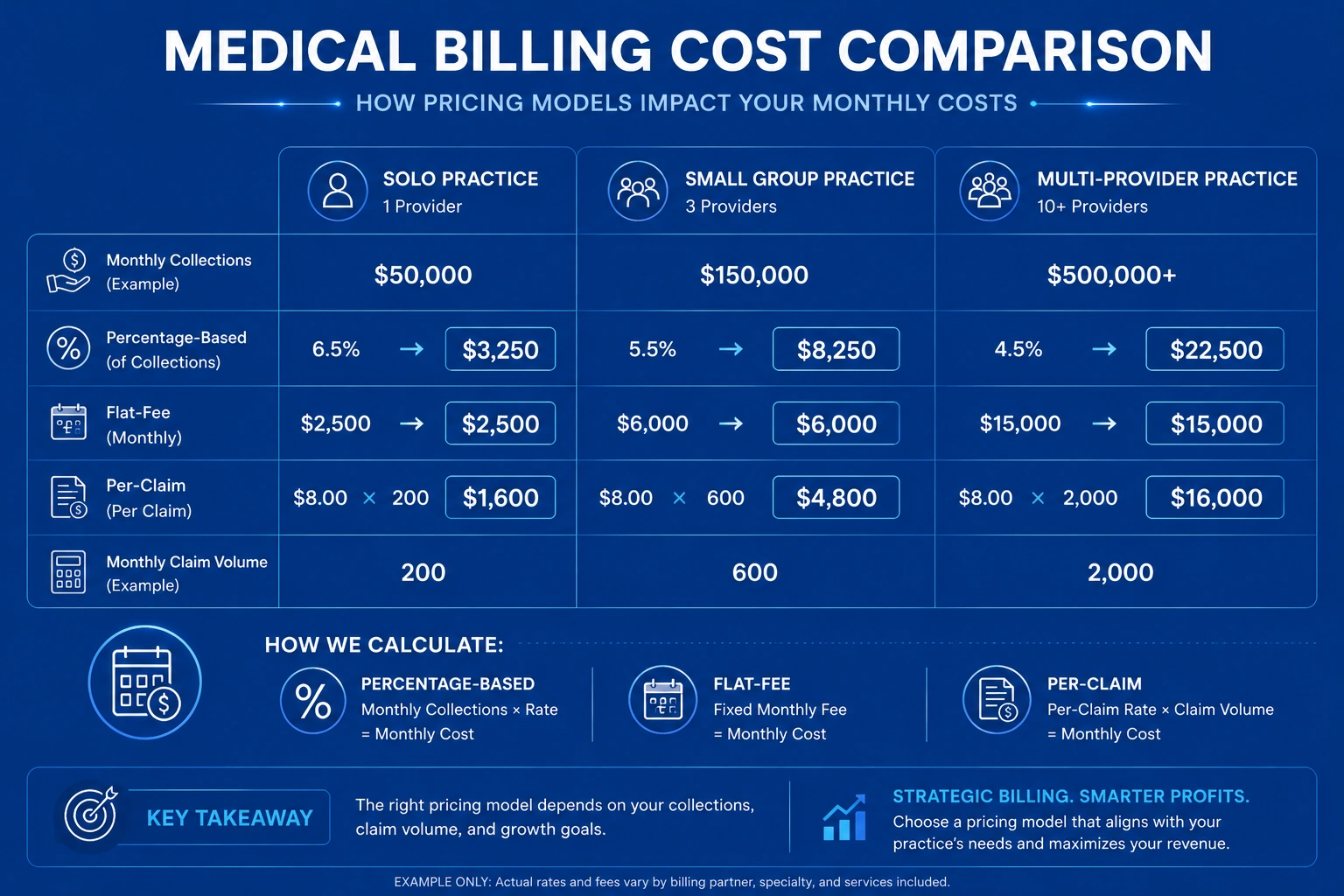
Let’s run the numbers. These examples use realistic 2026 reimbursement figures by specialty.
Example 1 — High-Volume, Low-Balance Practice (Primary Care)
Profile: Family medicine, 400 claims/month, average reimbursement $110, total monthly collections $44,000.
| Model | Rate Applied | Monthly Cost |
|---|---|---|
| Percentage of Collections (7%) | 7% × $44,000 | $3,080 |
| Flat Fee Per Claim ($6) | $6 × 400 claims | $2,400 |
| Flat Monthly Fee | Fixed | $1,800 |
Winner: Flat monthly fee, followed by per-claim pricing. The percentage model costs this practice $1,280 more per month than a flat monthly arrangement—for the same billing work.
Example 2 — Low-Volume, High-Balance Practice (Orthopedics/Surgery)
Profile: Orthopedic surgeon, 80 claims/month, average reimbursement $750, total monthly collections $60,000.
| Model | Rate Applied | Monthly Cost |
|---|---|---|
| Percentage of Collections (7%) | 7% × $60,000 | $4,200 |
| Flat Fee Per Claim ($8) | $8 × 80 claims | $640 |
| Flat Monthly Fee | Fixed | $1,200 |
Winner: Per-claim pricing by a wide margin. The percentage model costs this surgeon $3,560 more per month than per-claim pricing for the same number of claims. This is the most common place practices overpay without realizing it.
Considering a vendor change? Our switching billing providers checklist walks you through how to transition without disrupting your revenue flow.
Example 3 — Hybrid Model Comparison
A hybrid model often closes the gap for multi-specialty practices. A base monthly fee of $1,000 plus a 4% rate applied only to collections above $30,000 can outperform a straight 7% rate and a high per-claim fee in practices with mixed claim complexity.
Is flat fee or percentage billing better for my practice? The honest answer is that it depends entirely on your average claim value, monthly volume, and scope of denial management included. Hybrid arrangements work particularly well for groups using comprehensive Revenue Cycle Management Services across multiple service lines.
Hidden Fees and Contract Red Flags to Watch For
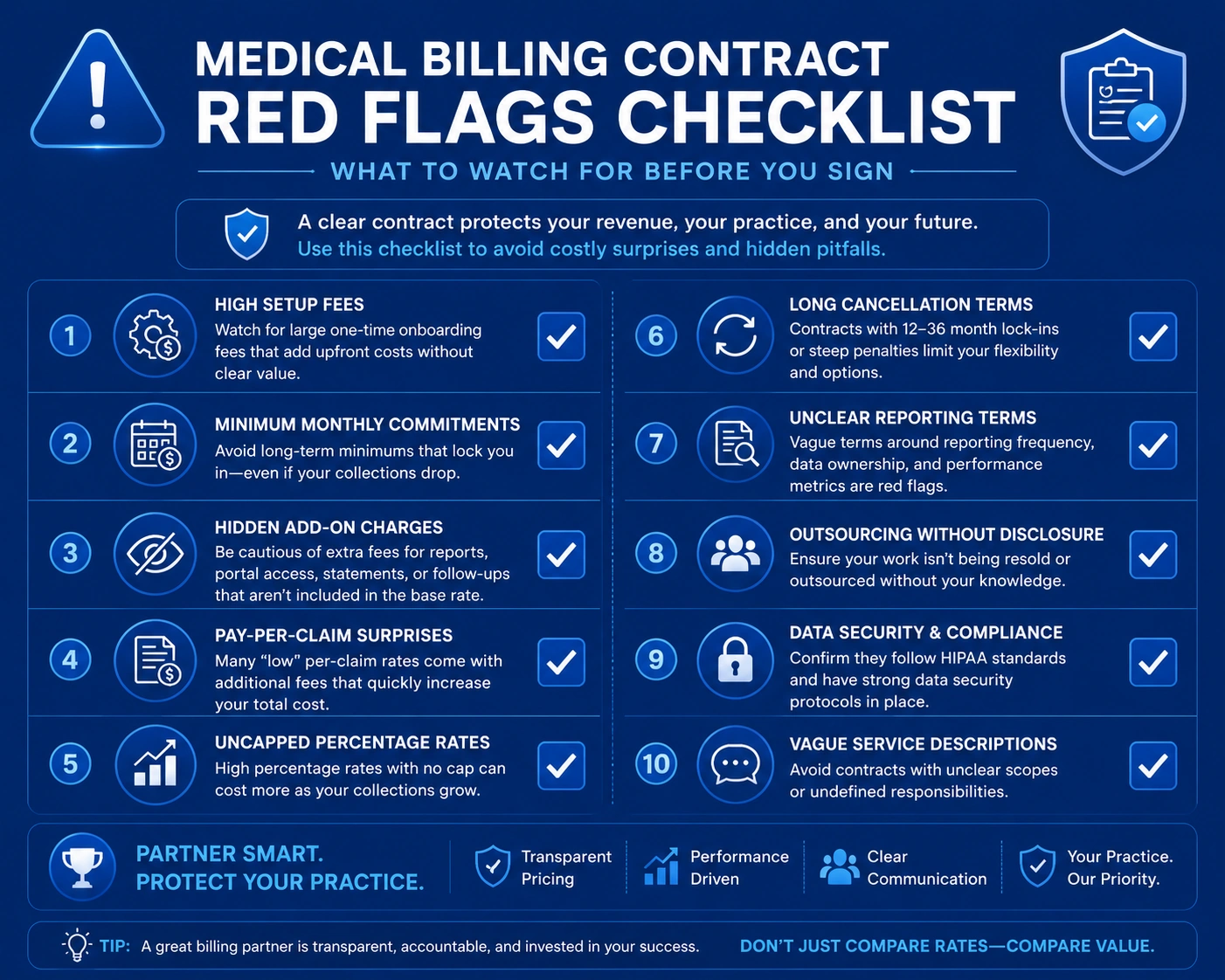
Hidden fees in medical billing contracts are one of the most common sources of billing cost surprises. The quoted rate is rarely the full story.
Setup Fees, Minimums, and Add-On Charges
Watch for these provisions before you sign any medical billing contract:
- Medical billing setup fees: One-time onboarding charges of $300–$2,000, sometimes billed per provider rather than per practice.
- Minimum monthly fee billing contract: A floor fee that applies even when your claim volume drops—common in percentage-based agreements.
- Credentialing fees medical billing: Confirm whether Credentialing Services are included in the quoted rate or billed separately at $200–$500 per provider.
- Denial management and follow-up fees: Some per-claim vendors charge separately for reworks, resubmissions, and appeals—costs that should be covered in a full-service agreement.
- Gross vs. net collections clause: A percentage applied to gross collections rather than net collections inflates your cost significantly, since gross includes amounts you’ll never actually collect.
Questions to Ask Before You Sign
What questions should I ask before signing a medical billing contract? Ask every vendor these six before you commit:
- Is your percentage calculated on net or gross collections?
- Does your per-claim rate include full denial follow-up, or just initial submission?
- Is there a minimum monthly fee, and what triggers it?
- Are credentialing, setup, and clearinghouse fees bundled or separate?
- What is your first-pass claim acceptance rate and average days in AR?
- What are the contract termination terms and required notice period?
According to HFMA, the average cost to rework a single denied claim ranges from $25 to $117. That cost should sit with your billing vendor—not get passed back to your practice as a line-item charge.
How to Choose the Right Pricing Model for Your Practice
The right model comes down to three variables: average claim value, monthly claim volume, and your payer mix’s denial complexity.
Use this framework:
- Average reimbursement above $300/claim: Per-claim pricing almost always wins on total cost.
- Average reimbursement below $150 with volume above 300 claims/month: Flat monthly or a low-percentage rate are most competitive.
- Variable volume or multi-specialty mix: A hybrid pricing model gives the most flexibility and cost control.
- Solo provider or startup practice: Flat monthly eliminates the percentage-model risk of unpredictable monthly invoices.
For a breakdown tailored to your specialty and volume, visit our TMS Billings Pricing page for a customized rate review.
How TMS Billings Prices Its Services

At TMS Billings, we build pricing around your practice’s actual numbers—not a blanket rate applied to every client. Before we quote anything, we look at your claim volume, specialty, payer mix, average reimbursement, and current denial rate.
We offer:
- Percentage-of-collections arrangements calculated on net—never gross—collections
- Per-claim structures for high-value specialties where a percentage model doesn’t serve your interest
- Hybrid arrangements for multi-provider groups with complex or mixed service lines
- No surprise setup fees or separate credentialing charges
- Denial management and follow-up included in every service agreement—not billed separately
We believe your billing cost structure should work for your practice, not against it.
The Real Cost of Medical Billing in 2026
Here’s what current industry data shows about medical billing pricing models across the U.S. market:
1. Industry-average percentage rates: The standard market range for percentage of collections billing in 2026 is 4%–9% for most physician practices. High-complexity specialties (cardiology, orthopedics, oncology) commonly see rates of 10%–12% in full-service agreements. (Source: MGMA 2025 Physician Practice Benchmark Survey)
2. Per-claim flat-fee benchmarks: Standard per-claim pricing continues to hold at $3–$10 per claim submitted, with rates trending modestly upward as denial complexity increases and AAPC-certified coder demand tightens. (Source: AAPC coding cost standards, 2025–2026)
3. Outsourcing adoption: Nearly 60% of practices with fewer than 10 physicians are evaluating outsourcing at least part of their billing operations, per the MGMA 2025 Physician Practice Benchmark Survey. In-house billing vs. outsourced billing cost data is striking: MGMA reports in-house billing averages 13.7% of collections (including salaries, benefits, software, and turnover costs), versus 5.4% for a well-run outsourced partner.
4. Net collection rate improvement after switching: Practices switching to a higher-performing billing partner report average net collection rate improvements of 4–7 percentage points within 90 days. On $500,000 in annual collections, a 5-point NCR gain equals $25,000 in recovered revenue per year.
5. Billing cost as a percentage of revenue by practice size:
- Solo providers: 8%–12% in-house; 6%–9% outsourced
- Small group (2–5 providers): 7%–10% in-house; 5%–8% outsourced
- Multi-provider group (6+ providers): 5%–8% in-house; 4%–6% outsourced
(Sources: MGMA 2025 Benchmark Survey; HFMA Revenue Cycle KPI benchmarks; AAPC coding cost standards)
Key Takeaways
- Medical billing pricing models fall into four main categories: percentage of collections, flat fee per claim, flat monthly fee, and hybrid.
- The right model depends primarily on your average claim value—not just total volume.
- High-value specialties (orthopedics, surgery, cardiology) typically save the most with per-claim pricing.
- High-volume, lower-balance practices (primary care, pediatrics) often do better with flat monthly or low-percentage arrangements.
- Always confirm whether a percentage applies to net or gross collections—it’s one of the highest-stakes terms in any medical billing contract.
- Watch for medical billing setup fees, minimum monthly fees, and denial management and follow-up fees that aren’t included in the quoted rate.
Final Thoughts
Choosing the right medical billing pricing model is not an abstract exercise—it directly determines how much of your collected revenue stays in your practice. The gap between the wrong model and the right one can run to tens of thousands of dollars per year for the exact same billing work.
At TMS Billings, every pricing conversation starts with your numbers. Before we quote a rate, we look at your claim volume, average reimbursement, specialty mix, and current denial rate. That’s the only way to recommend a billing structure that genuinely serves your practice.