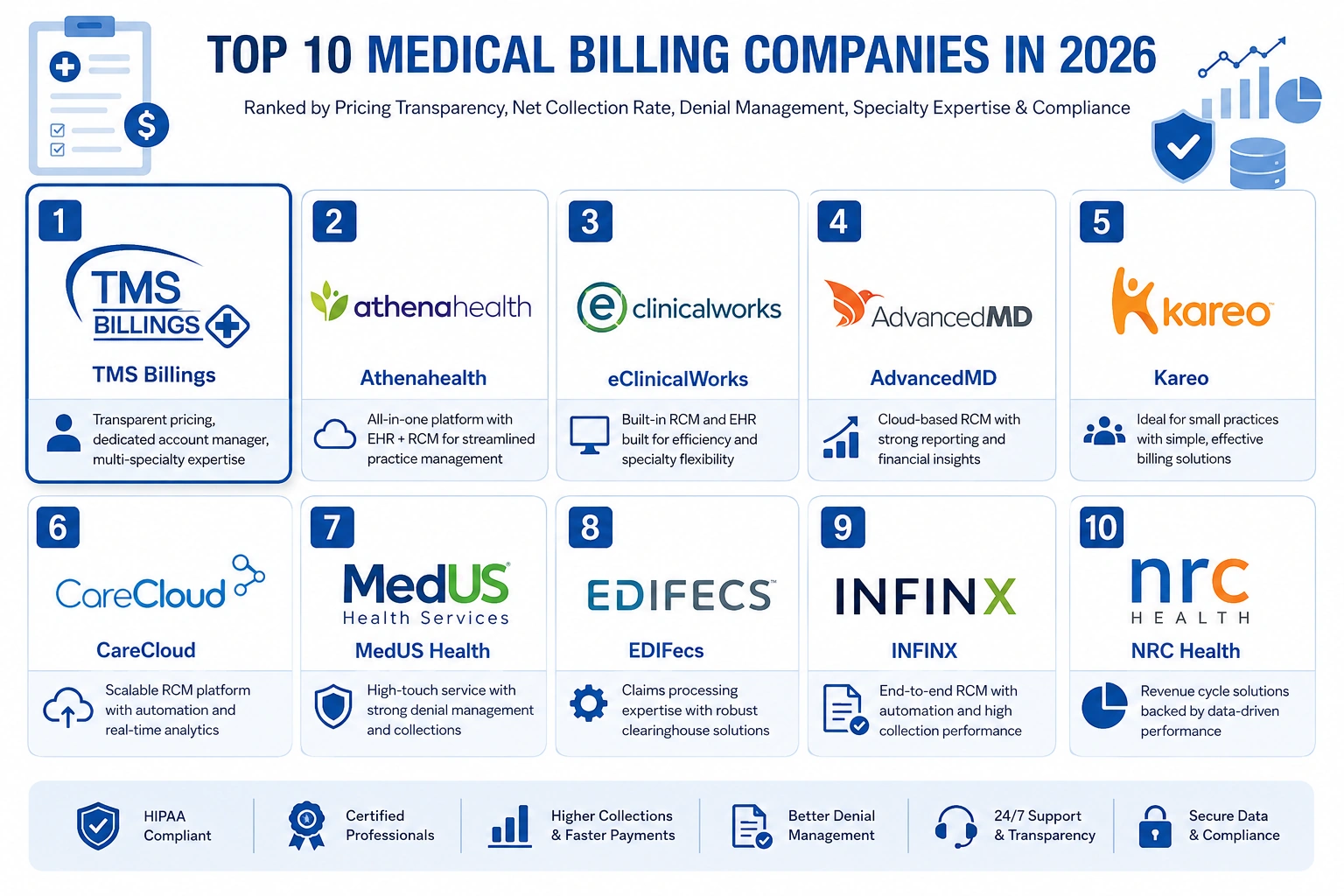
Top 10 Medical Billing Companies in 2026
Written by: TMS Billings Coding & Compliance Team TMS Billings Coding & Compliance Team brings combined decades of hands-on medical billing experience, including CPC and CPB certified billers, supporting practices across multiple specialties nationwide, from credentialing through denial resolution.
Reviewed by: [Jacob White, CPC/CPB — Compliance Director, TMS Billings]
It’s 9 p.m. and you’re five browser tabs deep into different rankings of the top 10 medical billing companies, and every single one ranks a different company #1 with no explanation why. None of them tell you what any of these companies are actually bad at — just feature lists dressed up as reviews.
We built this list differently. Our top 10 medical billing companies ranking uses a transparent scoring method covering pricing, collections performance, denial management, specialty depth, and compliance — and we’ve included our own company, TMS Billings, in that same evaluation. We’re a newer, fast-growing name in medical billing, not the biggest player on this list, and we’ve tried to be upfront about that throughout.
If you’re weighing in-house vs. outsourced medical billing for the first time, or you already outsource and you’re wondering if it’s time to switch, this guide breaks down what each company does well, where each one falls short, and which type of practice fits best — including a section built specifically for behavioral and mental health billing.
What Makes a Medical Billing Company One of the Top 10?
A company earns a spot on any credible top 10 medical billing companies list by proving it can do more than submit claims. Generally speaking, the best medical billing companies combine a transparent pricing model, a track record of clean claims and low denial rates, real specialty expertise, and HIPAA-compliant handling of patient data — not just a polished sales page.
We also looked for practical fit: does the company work inside the EHR your practice already uses? Does it offer credentialing and accounts receivable follow-up, or just basic claim submission? Those details separate the best medical billing companies from a submission service with a nicer website.
The top 10 medical billing companies for 2026 are ranked by pricing transparency, net collection rate, denial management performance, specialty expertise, and compliance record — helping healthcare practices choose a billing partner that increases collections and reduces claim denials.
Disclosure: TMS Billings is included in this list. We’ve aimed to evaluate every company here, including our own, against the same criteria — flaws included.
How We Evaluated the Top 10 Medical Billing Companies
We evaluated the top 10 medical billing companies on six criteria that actually predict whether a billing partner will get you paid: pricing model, net collection rate (NCR), denial management performance, specialty depth, compliance record, and verified customer reviews and ratings. Across the outsourced medical billing services we researched, no single pricing model came out best for every practice size — it depends on your collections volume.
Pricing model matters because percentage-of-collections and flat-fee structures create very different incentives, and they cost very differently depending on how much a practice collects. Net collection rate (NCR) and accounts receivable (A/R) days tell you how much of what you’re owed actually gets collected, and how fast. A high clean claim rate on the front end usually means fewer appeals and faster cash flow on the back end.
We also weighed EHR/EMR integration, since a billing company that can’t work inside your existing system creates more administrative work, not less. HIPAA compliance and coding accuracy are baseline requirements, not differentiators — every company on this list meets them, so we looked closer at how each one handles credentialing, specialty billing depth, and denial appeals beyond the basics. For revenue cycle benchmarks, we leaned on MGMA’s guidance on finding the right revenue cycle benchmarks rather than any single company’s marketing claims.







Top 10 Medical Billing Companies at a Glance
Reading ten company profiles back-to-back makes it hard to compare apples to apples, so here’s the same information side by side. Whether you’re scanning this as a shortlist of top RCM companies or narrowing down by specialty, this medical billing company comparison lines up all ten on the factors that matter most: who each one is really built for, how they charge, which specialties they cover deepest, and the one feature that sets each apart.
Use this table as a shortlist tool, not a final answer — the right choice for your practice still depends on your specialty, your current EHR, and how much control you want to keep over the billing process. This medical billing company pricing comparison should narrow ten options down to two or three worth a real conversation.
| Company | Best For | Pricing Model | Specialty Focus | Standout Feature |
|---|---|---|---|---|
| TMS Billings | Small–mid practices wanting transparent pricing | 1.99% of collections, all-inclusive | Multi-specialty, incl. behavioral health | No long-term contracts + dedicated account manager |
| Athenahealth | Multi-specialty & larger practices | 4–8% of collections | Broad multi-specialty | 150,000+ provider benchmarking network |
| AdvancedMD | Small–mid practices wanting flexibility | 4–8% of collections, or software-only | Multi-specialty | Choice of in-house software or managed RCM |
| CareCloud | Growing, tech-forward practices | 3–7% of collections, typically 3-yr contract | 70+ specialties | AI-driven claim scrubbing + certified coders |
| Tebra (Kareo) | Independent practices | Modular, ~$49–$799/provider/mo | Multi-specialty, incl. behavioral health | Billing bundled with patient engagement tools |
| Transcure | Small–mid multi-specialty practices | ~3–5% of collections | 40+ specialties | Works inside 40+ existing EHR systems |
| eClinicalWorks | Practices wanting EHR + billing combined | ~2.9% RCM, or flat $449–599/mo software | Multi-specialty, incl. behavioral health | Billing built directly into the EHR |
| NextGen Healthcare | Ambulatory & specialty practices | % of collections, rate not published | Multi-specialty | 100+ KPI reporting dashboard |
| Omega Healthcare | Large practices & health systems | Custom enterprise pricing | Multi-specialty, coding-heavy | Global delivery scale + KLAS-ranked coding |
| BehavioralProz | Behavioral & mental health practices only | % of collections, rate not published | Behavioral/mental health exclusively | Parity-law (MHPAEA) appeal expertise |
Pros and Cons of the Top 10 Medical Billing Companies
Feature lists tell you what a company offers. They don’t tell you what you’re trading away by choosing it — and that’s the part most medical billing companies for small practices roundups skip entirely. If you already skimmed the medical billing company comparison table above, this table adds the nuance a plain feature list can’t: real trade-offs, not just checkboxes.
The table below pairs each company’s real strengths with its real limitations, based on public reviews, company documentation, and independent research rather than marketing copy. TMS Billings’ pros and cons are drawn from its own published pricing and service pages. The trade-offs for the other nine companies reflect general industry positioning and third-party reviews rather than company-supplied claims, so treat them as a starting point for your own research, not a final verdict.
| Company | Pros | Cons |
|---|---|---|
| TMS Billings | Transparent 1.99% all-inclusive pricing, no long-term contracts, dedicated account manager, strong behavioral health support | Newer to the market with a smaller public track record than legacy vendors; best suited to small–mid practices |
| Athenahealth | Deep EHR + RCM integration, large provider-benchmarking network, strong multi-specialty support | Collections-based fee (4–8%) can cost more than flat-fee alternatives at higher collection volumes; onboarding typically takes 60–90 days to go live |
| AdvancedMD | Flexible software-only or managed-RCM options, broad specialty pricing tracks | Coding support isn’t included in every plan, so many practices still need in-house or third-party coders; can be pricier than boutique billing firms |
| CareCloud | AI-driven claim scrubbing, certified coders across 70+ specialties, real-time dashboards | Typically requires a three-year contract, longer than most competitors on this list; medical coding isn’t included in the lowest-tier plan |
| Tebra (Kareo) | Combines billing with patient engagement and marketing tools, strong for independent practices | Pricing isn’t published and varies by bundle, which makes upfront cost comparison harder |
| Transcure | Dedicated account management, works inside 40+ existing EHR systems, broad specialty coverage | Independent reviews are limited in volume and more mixed on Trustpilot than on other review platforms |
| eClinicalWorks | Billing built directly into the EHR reduces double data entry, wide specialty coverage | Paid a $155M DOJ settlement in 2017 over false EHR certification claims and remains under added OIG compliance oversight as of late 2025; interface can also feel dated next to newer platforms |
| NextGen Healthcare | Deep KPI reporting (100+ metrics), specialty-matched client managers, à la carte service options | No published pricing — quoted rates ($660–$1,000+/month) and user reviews position it above lighter-weight platforms; full Enterprise implementation typically takes 4–8 months |
| Omega Healthcare | Enterprise-scale coding capacity, KLAS-ranked performance, strong for large health systems | Less personalized service for small practices; offshore-heavy delivery model won’t suit every practice’s compliance comfort |
| BehavioralProz | Deep behavioral-health-only expertise, parity-law appeal knowledge, 42 CFR Part 2 compliance | Narrow specialty focus means it’s not a fit for multi-specialty practices; smaller market footprint than general billing companies |

How to Choose the Right Medical Billing Company for Your Practice
Knowing how to choose a medical billing company comes down to matching five things against your practice, not just reading feature lists: your specialty, your EHR, your growth stage, how hands-on you want to be, and your budget.
Start with specialty fit. A general multi-specialty billing company can handle straightforward primary care claims well, but a behavioral health, ABA, or substance use disorder practice runs into carve-outs, time-based codes, and parity-law rules that a generalist billing team may not handle correctly on the first pass. If your practice sees a lot of denials in one specific area, that’s usually the first sign you need specialty-specific expertise, not just a bigger billing company.
Next, check EHR/EMR integration. Switching your billing company shouldn’t mean switching your EHR too — ask directly whether the company works inside your current system, or whether you’d be looking at a platform migration on top of a billing change.
Then look at the pricing model. Percentage-of-collections pricing is common among outsourced medical billing services because it aligns incentives — the company earns more when you collect more — but it can cost more than a flat fee once your collections grow past a certain point. Run the math on your actual monthly collections before assuming percentage pricing is automatically cheaper.
Finally, vet coding accuracy and compliance directly instead of taking it on faith. Ask what certifications their coders hold, how they handle denial appeals, and how they stay current on payer rule changes — AAPC’s article on the role of medical coders in compliance is a useful benchmark for the kind of oversight a serious billing partner should have in place.
If you’re switching from an existing billing company, get a clear answer on data migration and claims-in-progress before you sign anything — a messy transition can cost you more in delayed collections than a bad pricing model ever would.

Why Behavioral Health and Mental Health Practices Need a Specialized Billing Partner
Behavioral health claims get denied far more often than general medical claims, and the reason isn’t sicker patients — it’s billing rules that don’t exist anywhere else in medicine. Time-based psychotherapy codes, MBHO carve-outs, ABA-specific H- and T-codes, and federal parity law requirements all add complexity that a generalist billing team often gets wrong on the first submission.
That’s why a medical billing company that specializes in mental health billing tends to outperform a general multi-specialty vendor on this specific work, even when the general vendor is larger overall. Specialty knowledge shows up as fewer denials, faster credentialing with mental-health-specific payer networks, and appeals that actually cite the Mental Health Parity and Addiction Equity Act when a payer applies a carve-out incorrectly.
Two companies on this list are built specifically for this work. TMS Billings supports behavioral and mental health billing as one of several specialties it covers, pairing that expertise with transparent, all-inclusive pricing for practices that also want general multi-specialty flexibility. BehavioralProz, by contrast, works exclusively in behavioral health — a fit for practices that want a partner with zero divided attention.
If your practice is losing revenue to behavioral-health-specific denials, that’s usually a sign it’s time to talk to a billing partner that actually specializes in this work, not just one that lists it as a service.

Choosing From the Top 10 Medical Billing Companies
Picking from a list of the top 10 medical billing companies isn’t about grabbing the biggest name — it’s about matching pricing, specialty depth, and denial-management performance to what your practice actually needs day to day.
TMS Billings is one of the fastest-growing names on this list, built around transparent pricing starting at 1.99% of collections, no long-term contracts, and a dedicated account manager who knows your practice — including behavioral and mental health billing. If any part of your revenue cycle is currently costing you more time or money than it should, book a free billing consultation and we’ll walk through where the leaks are.