
2027 Medicare Physician Fee Schedule: Avoid Costly Cuts

CMS has proposed lower Medicare conversion factors for 2027, and practices cannot wait for the final version to learn what that means for revenue. The 2027 Medicare physician fee schedule is the annual CMS rule that sets Medicare Part B payment rates and policies for physician services, and the CY 2027 proposal would apply on or after January 1, 2027. Your revenue cycle decides how much of that change reaches your collections, and our Revenue Cycle Management Services support practices that need added capacity. This guide covers the proposed conversion factors, other key changes, the likely revenue impact, and how to prepare.
What Is the 2027 Medicare Physician Fee Schedule Proposed Rule?
The Physician Fee Schedule (PFS) is the annual rule through which the Centers for Medicare & Medicaid Services (CMS) sets what Medicare Part B pays for physician and practitioner services. CMS released the CY 2027 proposal on July 14, 2026.
Payment follows a formula. Each service carries total relative value units (RVUs) that reflect physician work, practice expense, and malpractice costs. Medicare adjusts those units for geography, then multiplies the result by the conversion factor.
The comment period closed on September 14, 2026, and CMS had not published a final rule as of this review. CMS typically finalizes the rule in the fall, so every figure here remains a proposal. The primary source is CMS’s CY 2027 Physician Fee Schedule proposed rule page (CMS-1848-P).
What the 2027 Medicare Physician Fee Schedule Proposes for Conversion Factors
CMS proposes lower 2027 Medicare conversion factors: one for clinicians in qualifying alternative payment models (APMs) and one for everyone else. The main driver is the expiration of the temporary 2.5% increase provided for CY 2026 only, so current law lowers the factors for 2027.
The table below draws on CMS’s CY 2027 Medicare Physician Fee Schedule proposed rule fact sheet.
| Conversion Factor | CY 2026 | Proposed CY 2027 | Proposed Change |
|---|---|---|---|
| Qualifying APM participants | $33.57 | $33.17 | -$0.40 (-1.19%) |
| Non-qualifying APM clinicians | $33.40 | $32.84 | -$0.56 (-1.68%) |

Medicare physician fee schedule cuts follow directly from the payment formula. Because payment equals RVUs multiplied by the conversion factor, a lower factor reduces payment for every covered code before any other policy change is counted. Your own result still depends on specialty, locality, and code mix.
Other Proposed Changes That Could Affect Your Medicare Revenue
Beyond the conversion factor, CMS proposes payment-method changes, and the E/M and global procedure payment changes carry the most direct billing impact. They govern how evaluation and management (E/M) visits are paid when billed on the same day as certain procedures.
CMS proposes that when the same physician or practice bills a separately identifiable visit and a procedure with a 0-, 10-, or 90-day global period on one day, the higher-paid service would receive full payment and the other would receive 50%. Modifier 25 (a significant, separately identifiable E/M service on the day of a procedure) sits at the center of that policy. Visit codes belong to the CPT code set, and the American Medical Association’s overview of the CPT code set it develops and maintains offers useful background.
CMS also proposes practice expense methodology changes with a multi-year transition. Because practice expense payment differs by specialty and by site of service, the effect will not be uniform across practices.
The rule also includes requests for information (RFIs) on topics such as primary care valuation and global surgical package payment. An RFI is a question to the public, not a proposal. Treat the 2027 Medicare physician fee schedule as a set of linked policies, and read the complete notice in the Federal Register for telehealth and Merit-based Incentive Payment System (MIPS) provisions that apply to your specialty.
How the Proposed Cuts Could Affect Your Practice’s Revenue
The effect depends on your Medicare share of revenue, specialty, code mix, same-day visit and procedure billing, and participation in a qualifying model. A national percentage is only a starting point. A clear view of the 2027 Medicare physician fee schedule impact on practices comes from your own claims, using a method you can repeat.
Pull the last twelve months of Medicare claims and rank the codes by volume. Compare 2026 and proposed 2027 payment amounts for your locality, multiply each difference by volume, and total the result. CMS also publishes specialty-level impact estimates in the proposed rule, but your own claims data is the better guide to Medicare reimbursement 2027 for your practice.
Proposed rates are lower while staffing costs keep moving, and MGMA’s 2026 Management and Staff Compensation Data Report on medical practice staffing costs provides context on that pressure. A billing fee set as a percentage of collections moves with revenue, while fixed staffing costs do not. Our overview of medical billing pricing models shows how each structure behaves.

Which Practices Face the Most Exposure?
Practices with a high Medicare share, thin margins, and heavy same-day visit and procedure billing have the most to model first. That concern applies strongly to Medicare payment cuts for small practices, where lean billing staff and shared front-desk and billing duties leave little room to absorb extra rework.
Exposure varies by specialty. The impact table in the CY 2027 PFS proposed rule shows specialty-level differences, and some specialties may see smaller or different effects. Practices outside qualifying models face the lower of the two proposed factors, and those adding providers or locations should budget for enrollment, including credentialing cost, which is separate from reimbursement but competes for the same margin.
Your specialty society likely tracks payment policy too. The American Society of Interventional Pain Physicians’ overview of coding and reimbursement recognition for the specialty is one example, and you should check your own society for analysis of the Medicare physician fee schedule.
How to Prepare for the 2027 Medicare Physician Fee Schedule: A Step-by-Step Plan
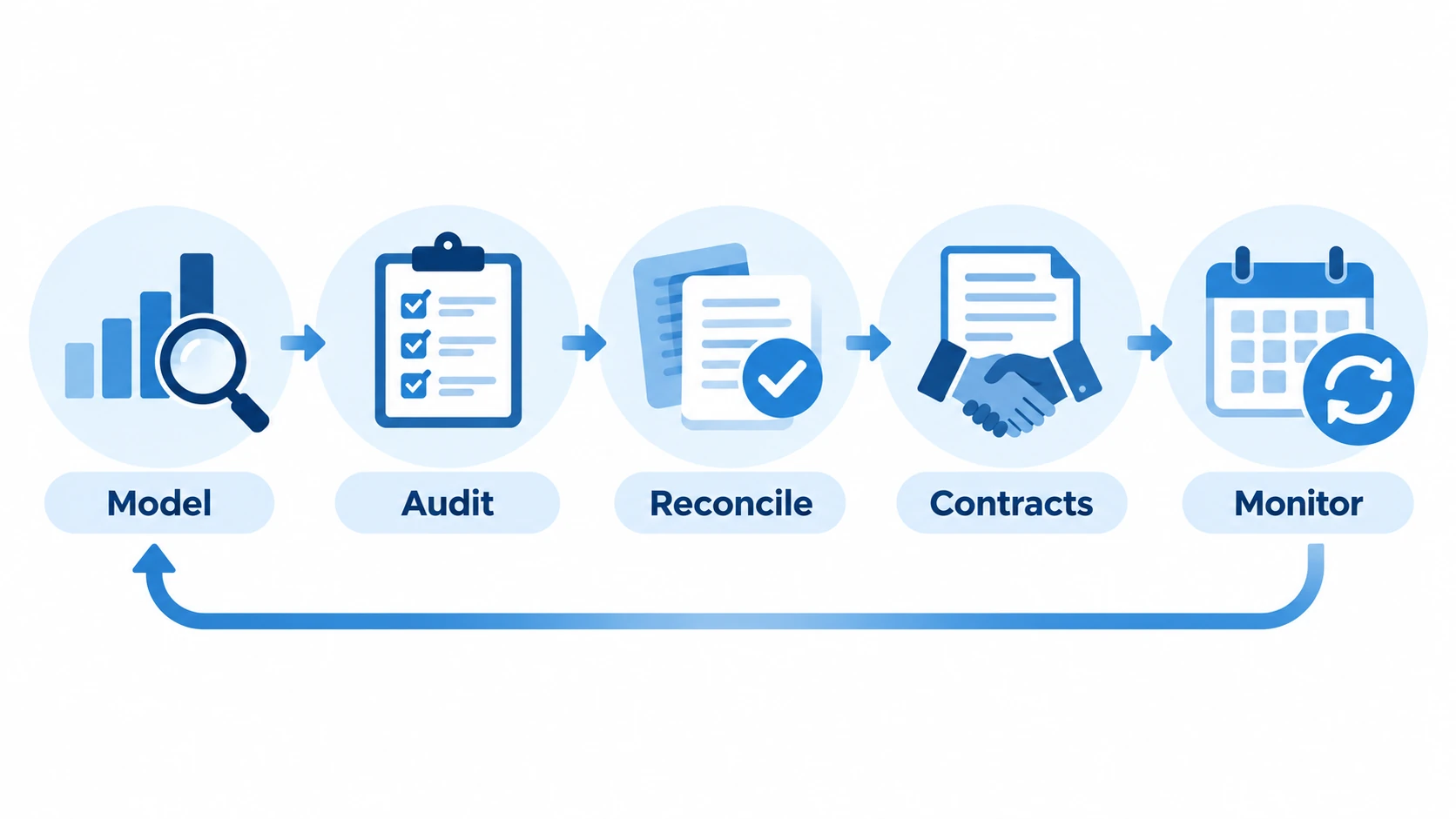
To prepare for the 2027 Medicare physician fee schedule, a practice should model the proposed rates against its top Medicare codes, audit same-day E/M and modifier use, tighten claim and denial follow-up, review payer contracts tied to Medicare rates, and track the final rule before updating its 2027 budget.
The five steps below show how to prepare for Medicare payment cuts, starting with data your practice already holds.
- Model. Rank your top Medicare codes by volume, compare 2026 and proposed 2027 payment amounts, and estimate the net effect on collections from your own claims rather than a national average.
- Audit. Review same-day E/M and procedure claims, modifier 25 documentation, and bundling edits so you know how much revenue the proposed payment policy could affect.
- Reconcile. Compare electronic remittance advice (ERA) allowed amounts with fee schedule rates, separating contractual adjustments from underpayments by claim adjustment reason code (CARC) 45 in X12’s official list of Claim Adjustment Reason Codes.
- Review contracts. Identify every commercial payer contract that references Medicare rates, then calendar renewal dates and escalator language before payers adopt the final 2027 rates.
- Monitor. Track the 2027 Medicare physician fee schedule final rule, update your budget and charge review within one billing cycle of publication, and watch clean claim rate and days in accounts receivable (A/R days) monthly.
Practices weighing their billing capacity can review the in-house versus outsourced section below.
Protect the Revenue You Control: Claims, Coding, and Enrollment
When payment rates fall, each avoidable denial or rework cycle consumes a larger share of what you collect, so clean claims and accurate coding matter more.
National Correct Coding Initiative (NCCI) edits bundle many procedure codes and change regularly, which matters for same-day visit and procedure claims. CMS’s National Correct Coding Initiative program page is the place to check the edits in effect.
The habits that protect revenue include pre-submission claim scrubbing, daily rejection follow-up, and ERA reconciliation, supported by monthly tracking of clean claim rate and denial rate as key performance indicators (KPIs). Remittance adjustment codes such as CARC 45 come from a code set that X12 maintains, so read each adjustment by its code.
Provider enrollment gaps and mismatched provider data cause claim denials that are expensive to rework at lower rates. Our Credentialing Services help practices close those gaps early. Under the 2027 Medicare physician fee schedule proposal, accurate enrollment deserves a place on your checklist.
Keep Billing In-House or Outsource It as Medicare Rates Tighten?
There is no universal answer; the right choice depends on claim volume, denial rate, staffing stability, and how much capacity your billing team has to model Medicare physician fee schedule changes.
In-house billing still makes sense when you have a trained, stable, dedicated team, low turnover, strong denial-tracking tools, and enough volume to justify the fixed cost. Outsourced billing tends to make more sense when turnover is frequent, a queue of denied claims keeps growing, a new provider or service line is starting, or your team lacks the capacity to audit modifier use and reconcile remittances. Small practices with shared front-desk and billing duties often reach that limit first.
Prior authorization adds workload for some services. CMS applies it to certain hospital outpatient department services, as described on CMS’s Prior Authorization for Certain Hospital Outpatient Department Services page, but that program applies to hospital outpatient settings and may not reach every practice’s services. For a worked example of how in-house and outsourced cost categories compare, see our mental health billing cost comparison.
How TMS Billings Supports Practices Planning for 2027 Medicare Changes
TMS Billings provides outsourced billing and revenue cycle management (RCM) support, including claim scrubbing and coding review, ERA and denial follow-up, credentialing coordination, and monthly KPI reporting. Practices preparing for CMS payment changes can learn more about our Medicare billing support team.
Outsourced denial follow-up can shorten the rework cycle compared with handling claim denials in-house, although results depend on payer mix, documentation quality, and claim volume. TMS Billings supports practices that want added capacity or an independent review of their current process, and it does not discount in-house billing teams that are working well. A practice that treats the 2027 Medicare physician fee schedule as a planning prompt can start with that kind of review.
Practice example (hypothetical scenario): A small multi-provider practice ranked its top Medicare codes, found that same-day visit and procedure claims carried the most exposure, and asked its billing team to audit modifier use and denial follow-up before CMS finalizes the rule. The review surfaced documentation gaps to correct while the policy was still proposed.
Key Takeaways
- Both proposed conversion factors are lower because the temporary 2026 increase expires after one year.
- Certain same-day visits and procedures face a proposed payment reduction, so audit those claims early.
- Estimate your exposure by comparing 2026 and proposed 2027 payment amounts for your top Medicare codes.
- Clean claims, accurate coding, current enrollment, and monthly KPIs protect revenue while rates remain uncertain.
- The 2027 Medicare physician fee schedule remains a proposal, so figures may change before CMS finalizes.
Related Reading: further billing cost topics across TMS Billings’ coverage, including medical billing services cost in California and medical billing services cost in Texas.
Final Thoughts
Your practice cannot change the proposed rates, but it can control how accurately it models, bills, and follows up on Medicare claims. The 2027 Medicare physician fee schedule may change before CMS publishes the final rule, and payer rules vary, so confirm current requirements before acting. If your team wants an independent review of its process, Book a Free Consultation.