

Gastroenterology (GI) billing carries specialty-specific rules that generalist billing teams often miss, from colonoscopy reporting that changes with payer and clinical intent to payer-specific modifiers and facility claims. As staffing gaps and denial pressure grow in 2026, more practices choose to outsource gastroenterology billing to a dedicated specialist. TMS Billings brings established experience in outsourced billing and denial management through its Revenue Cycle Management Services. This guide explains what outsourcing means, presents seven best practices, shows how to choose and transition to a partner, and describes how to measure results for your practice.
What Does It Mean to Outsource Gastroenterology Billing?
Outsourced gastroenterology billing means your practice delegates coding, charge entry, claim submission, payment posting, denial management, accounts receivable follow-up, and often payer enrollment to a specialist vendor. Your practice retains clinical documentation, oversight, and control of its financial data.

The benefits of outsourcing gastroenterology billing include access to certified coders, consistent claim follow-up, and reporting that supports better decisions. It fits best when your practice faces staffing gaps, rising denials, expansion of an ambulatory surgery center (ASC), or growing payer complexity. It may not fit a small, stable in-house team that employs certified GI coders and already achieves strong results.
Colonoscopy shows why specialization matters. A screening colonoscopy examines a patient who has no symptoms. A diagnostic colonoscopy evaluates symptoms or a known abnormality. A therapeutic colonoscopy includes an intervention, such as polypectomy. Payers report each one differently.
Because payer enrollment is commonly part of the outsourced scope, review how any vendor approaches Credentialing Services. The American Society for Gastrointestinal Endoscopy (ASGE) practice support hub offers GI-specific coding, payment, and compliance resources.
7 Proven Best Practices to Outsource Gastroenterology Billing
A practice can outsource gastroenterology billing successfully by following seven best practices: choosing a GI-specialized partner, auditing colonoscopy coding, aligning credentialing, verifying eligibility and prior authorization, managing denials, protecting ASC and ancillary revenue, and requiring transparent reporting. Each step can help reduce preventable denials and gives your team clear visibility into results.
The table below summarizes each practice and what your practice should require from a provider of gastroenterology billing services. The sections that follow explain how each practice works.
| Best Practice | Why It Matters | What to Require from Your Billing Partner |
|---|---|---|
| 1. GI Specialization and Certified Coders | Endoscopy coding rules differ from office visit and general surgery coding, and errors repeat across claims. | Certified coders, GI client references, and experience with office, ASC, and hospital outpatient endoscopy claims. |
| 2. Screening, Diagnostic, and Therapeutic Colonoscopy Coding Accuracy | Reporting varies by payer and by whether a screening colonoscopy converts to a diagnostic or therapeutic service. | Documented modifier and diagnosis-sequencing policies by payer type, supported by routine coding audits. |
| 3. Credentialing and Payer Enrollment Alignment | Enrollment gaps and provider-data errors cause denials before a claim receives clinical review. | Completed payer enrollment and provider data setup before go-live, with a tracked status report. |
| 4. Eligibility Verification and Prior Authorization | Coverage and authorization gaps produce avoidable denials and unexpected patient balances. | Pre-procedure verification workflows, authorization tracking, and medical necessity checks against coverage policy. |
| 5. Denial Management with Root-Cause Reporting | Reworking denials without correcting their causes allows the same errors to recur. | Denials tracked by reason code, appeal deadline control, and feedback to coding and front-desk staff. |
| 6. ASC, Professional, and Ancillary Revenue Protection | Facility, professional, and pathology claims follow different rules, and errors reduce payment. | Separate and accurate claim handling, correct multiple-procedure rules, and complete ancillary charge capture. |
| 7. Transparent Pricing, KPI Reporting, and HIPAA Safeguards | Clear pricing and key performance indicator (KPI) reports show whether outsourcing is economical and protect patient data. | Written fee terms, monthly reports, a signed Business Associate Agreement (BAA), and continued access to your data. |
Pricing structure affects every practice above, so compare medical billing pricing models before you sign an agreement. The American Gastroenterological Association (AGA) also publishes a coding guide for colorectal cancer screening that explains screening colonoscopy codes and modifiers by payer type.
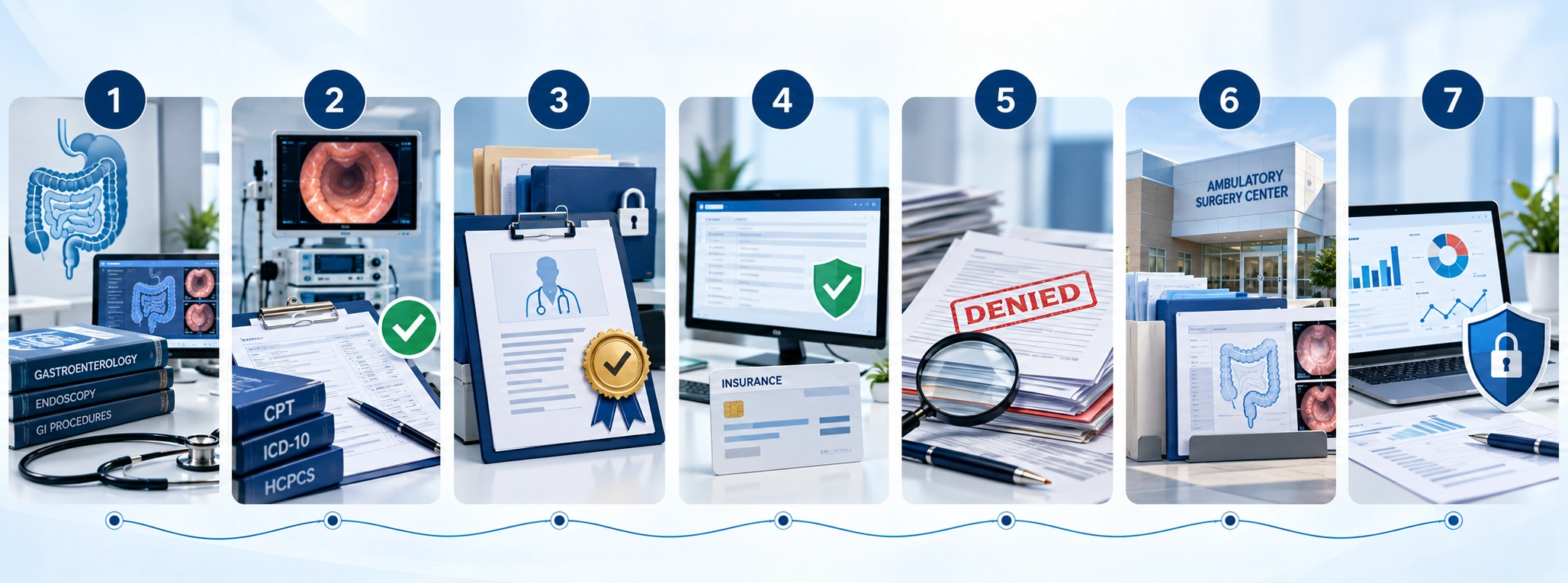
Best Practices 1–4: Front-End Accuracy for Gastroenterology Billing
Front-end accuracy determines whether claims are paid on first submission. These gastroenterology billing best practices govern the work that occurs before and immediately after each procedure.
Practice 1 — GI specialization: Ask for certified coders, such as those holding the AAPC Certified Professional Coder (CPC) or Certified Gastroenterology Coder (CGSC) credential, and request GI client references. Confirm experience with office, ASC, and hospital outpatient endoscopy claims, and with services such as upper endoscopy (EGD), endoscopic retrograde cholangiopancreatography (ERCP), and capsule endoscopy.
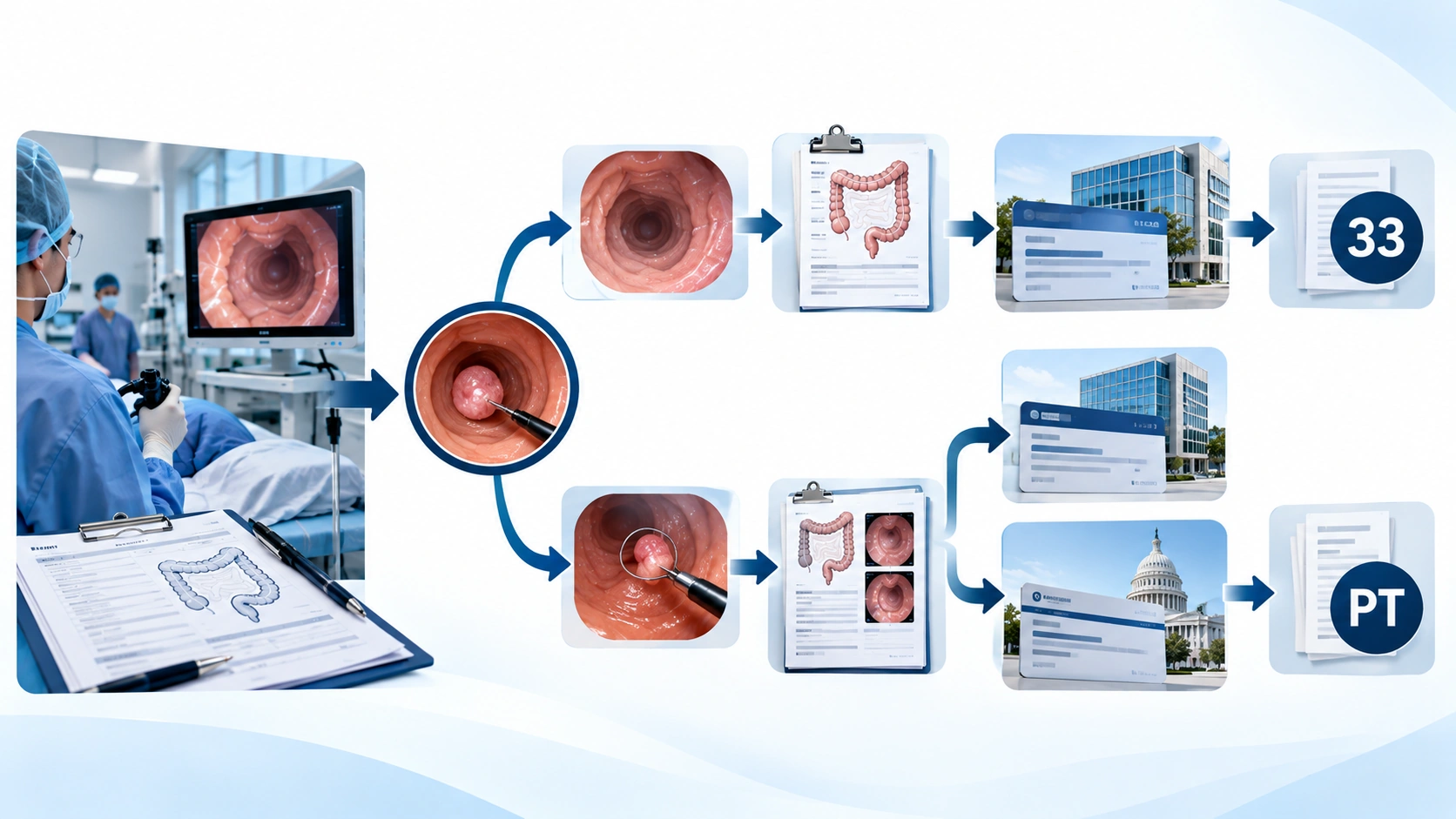
Practice 2 — Colonoscopy coding accuracy: Colonoscopy billing depends on how the encounter begins and what occurs during the procedure. The American Medical Association maintains Current Procedural Terminology (CPT) codes, and the Centers for Medicare & Medicaid Services (CMS) maintains Healthcare Common Procedure Coding System (HCPCS) Level II codes. Commercial payers generally expect modifier 33 when a screening colonoscopy becomes diagnostic or therapeutic.
Medicare uses HCPCS codes G0121 and G0105 for screening, modifier PT when a screening converts to a diagnostic or therapeutic service, and modifier KX in certain scenarios that follow a stool-based test. Report ICD-10 diagnosis code Z12.11, which identifies the screening encounter, first. Plan type and payer policy vary, including for grandfathered and employer-sponsored plans, so confirm each rule with the payer.
Practice 3 — Credentialing and payer enrollment: Complete payer enrollment and provider data setup before go-live so claims are not denied for enrollment or provider-data errors. Ask who owns each enrollment task and how status is tracked. Understanding credentialing cost early also helps you compare vendor proposals accurately.
Practice 4 — Eligibility verification and prior authorization: Verify coverage and prior authorization requirements before each procedure, and check medical necessity against applicable coverage policy. Local and National Coverage Determinations (LCDs and NCDs), maintained by CMS and its Medicare Administrative Contractors, shape coverage for screening and diagnostic endoscopy. Search them in the CMS Medicare Coverage Database.
Best Practices 5–7: Denials, ASC Revenue, and Reporting
These three practices complete the seven gastroenterology billing best practices and determine whether results hold after claims leave your practice. They cover denials, facility and ancillary revenue, and accountability.
Practice 5 — Denial management: Require denial tracking by Claim Adjustment Reason Code (CARC) and Remittance Advice Remark Code (RARC), the codes payers use to explain denied or adjusted claims. X12 maintains the CARC set, and the CMS remittance advice resource explains how both code types work. Meet appeal deadlines, and feed root causes back to coding and front-desk staff so denials are prevented, not only reworked. A qualified gastroenterology billing company treats denial management as a prevention function.
Practice 6 — ASC, professional, and ancillary revenue: Keep professional and facility claims separate and accurate, and apply endoscopy family and multiple-procedure payment rules correctly. Capture pathology and other ancillary services, including biopsy specimen review, where your practice provides them.
Practice 7 — Transparency: Require monthly reporting on clean claim rate (the share of claims accepted without correction), denial rate, days in accounts receivable (A/R), and net collection rate. Require a BAA and documented HIPAA safeguards, and confirm your practice retains access to its own data. Confirm BAA terms and state-specific requirements with your compliance counsel.
How to Choose and Transition to a Gastroenterology Billing Partner
The right partner demonstrates GI experience, transparent reporting, and clear exit terms, and a structured transition protects your revenue during the change. Knowing how to choose a gastroenterology billing company begins with specific evaluation questions.
Ask each vendor about GI experience and references, coder credentials, clearinghouse and technology, sample reports, data security, contract terms, exit provisions, and data ownership. Compare the gastroenterology billing services included in each proposal, because outsourced gastroenterology billing carries risk when a contract lacks clear exit and data-access terms. For an example of how a vendor presents fee structures, review TMS Billings’ current service pricing. Confirm current fees and timelines directly with any vendor.
A structured transition typically follows five steps: baseline KPIs, a parallel-run period, payer and clearinghouse setup, handoff of open A/R, and a post-go-live review. Timing ranges from several weeks to a few months, depending on scope and payer mix. After go-live, measure results against your baseline clean claim rate, denial trends, and days in A/R. Require denial reporting organized by CARC and group code, such as CO for contractual obligations and PR for patient responsibility. The X12 Claim Adjustment Reason Code list defines the CARC set that payers use to explain denials.
How TMS Billings Supports Gastroenterology Practices
TMS Billings applies these practices through GI-focused coding and modifier audits, front-end eligibility and authorization checks, denial trend reporting, and transparent dashboards. These elements apply whether outsourced gastroenterology billing covers professional claims, ASC facility claims, or both.
Within its revenue cycle management (RCM) approach, the RCM and denial management team reviews colonoscopy billing for modifier and diagnosis-sequencing accuracy, confirms coverage and authorization requirements before procedures, and reports denials by reason code. Outsourced denial management can shorten the appeal and resubmission cycle compared with handling it in-house, although results vary by payer mix and case mix. TMS Billings’ gastroenterology billing services complement your clinical documentation and oversight rather than replace them.
Practice example: A multi-provider gastroenterology practice faced recurring denials and unexpected patient balances on screening colonoscopies that converted to polyp removal, a pattern traced to inconsistent use of modifier 33 and modifier PT. After a GI-focused coding audit and modifier and diagnosis-sequencing edits, denials on those claims declined and the resubmission cycle shortened.
Key Takeaways
- Practices that outsource gastroenterology billing successfully start by selecting a GI-specialized partner with certified coders and verifiable client references.
- Colonoscopy claims require precise handling of screening, diagnostic, and therapeutic services, with modifiers and diagnosis sequencing that vary by payer type.
- Credentialing, eligibility verification, and prior authorization help prevent avoidable enrollment and coverage denials before claims are submitted.
- Denial management by reason code and separate handling of professional, ASC, and ancillary claims protect revenue after submission.
- Monthly reporting on clean claim rate, denial rate, and days in A/R shows whether your billing partner performs as agreed.
Related Reading: mental health billing cost comparison, medical billing services cost in California, and medical billing services cost in Texas provide further perspective on billing cost and revenue-cycle topics across TMS Billings’ coverage.
Final Thoughts
As a physician owner or practice administrator, you decide how your practice protects its revenue. When your team reaches the point where it must outsource gastroenterology billing, choose a partner that demonstrates GI expertise, reports transparently, and accepts accountability for measurable results. Coding rules, modifier requirements, and coverage policies update periodically, and payer-specific rules vary, so confirm current requirements with your vendor, payer, or compliance counsel. To discuss how your practice can approach outsourced billing, Book a Free Consultation with TMS Billings.