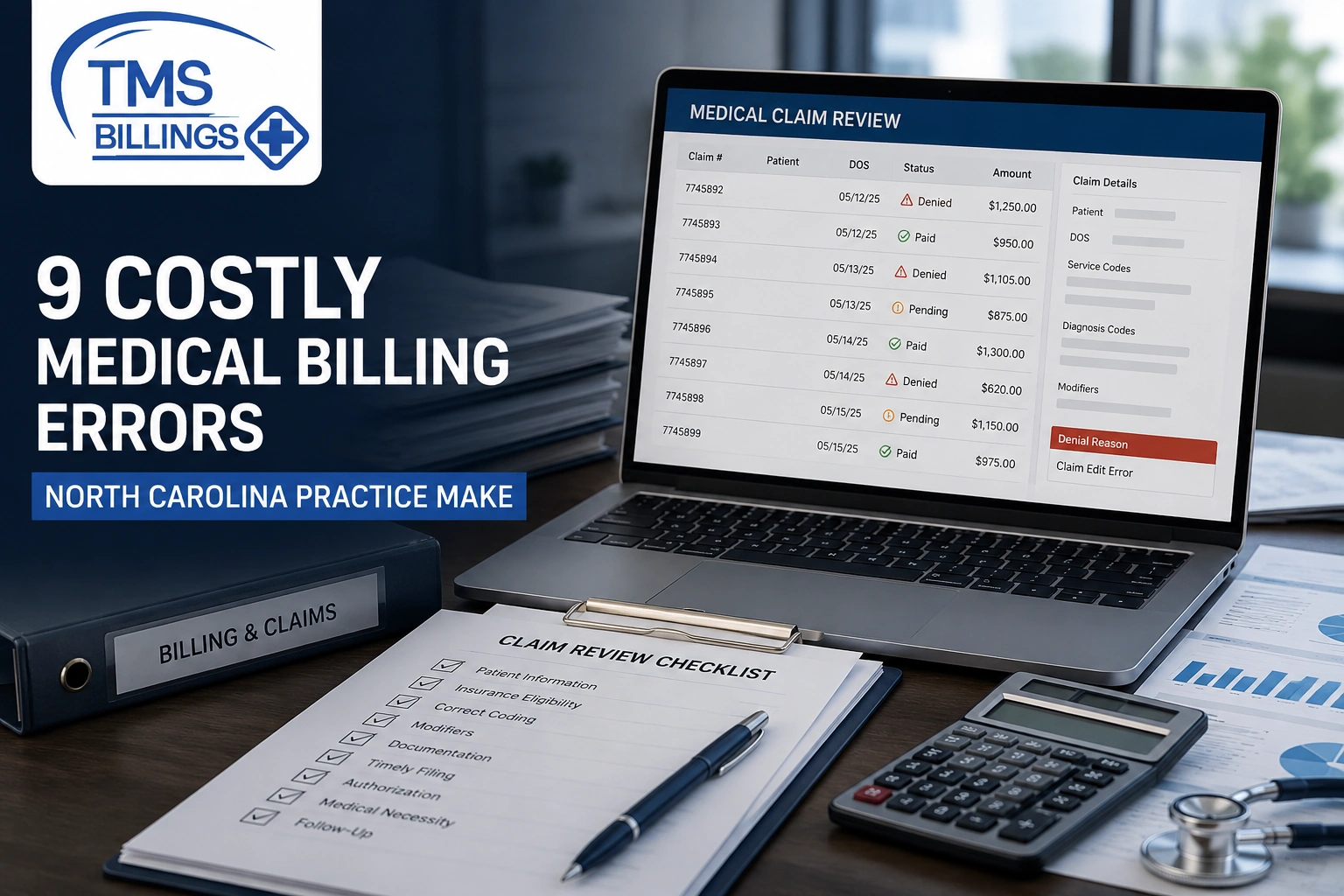

7 Critical Medical Billing Errors North Carolina Practices Make
By the TMS Billings Revenue Cycle Team
North Carolina’s payer landscape does not behave like the national averages most billing guides are written around. Blue Cross NC controls the largest share of the commercial market in the state, and NC Medicaid Managed Care splits coverage between a Standard Plan and a Tailored Plan — two systems with different enrollment rules and different claim edits.
Medical Billing Services in North Carolina exist because generic billing advice rarely accounts for that split. Left unaddressed, the resulting medical billing errors North Carolina practices deal with tend to repeat month after month, quietly eroding revenue already earned. This guide breaks down the seven most common causes, why they keep happening, and what your billing team can change starting with your next claims batch.
7 Errors at a Glance
| # | Error | Why It Happens | Quick Fix |
|---|---|---|---|
| 1 | Outdated CPT/ICD-10 coding | Stale code sets, mismatched modifiers | Quarterly coding audits |
| 2 | Missing prior authorization | Authorization expires mid-treatment | Track auth windows per payer |
| 3 | Eligibility verification errors | Coverage changes go unchecked | Re-verify eligibility every visit |
| 4 | Missed timely filing deadlines | Payer-specific deadlines vary | Build payer-specific filing calendars |
| 5 | NC Medicaid Managed Care mistakes | Wrong Prepaid Health Plan on file | Confirm PHP enrollment annually |
| 6 | Blue Cross NC modifier/bundling errors | Payer-specific claim edits missed | Review Blue Cross NC edit updates |
| 7 | Unworked or unappealed denials | No denial-tracking process | Log every denial by reason code |
What Counts as a Medical Billing Error?
In short: A medical billing error is any mistake — in coding, eligibility checks, documentation, or filing — that causes a clean claim to be denied, delayed, or underpaid. Across North Carolina, medical billing errors North Carolina practices report most often trace back to a handful of preventable causes rather than one single root problem.
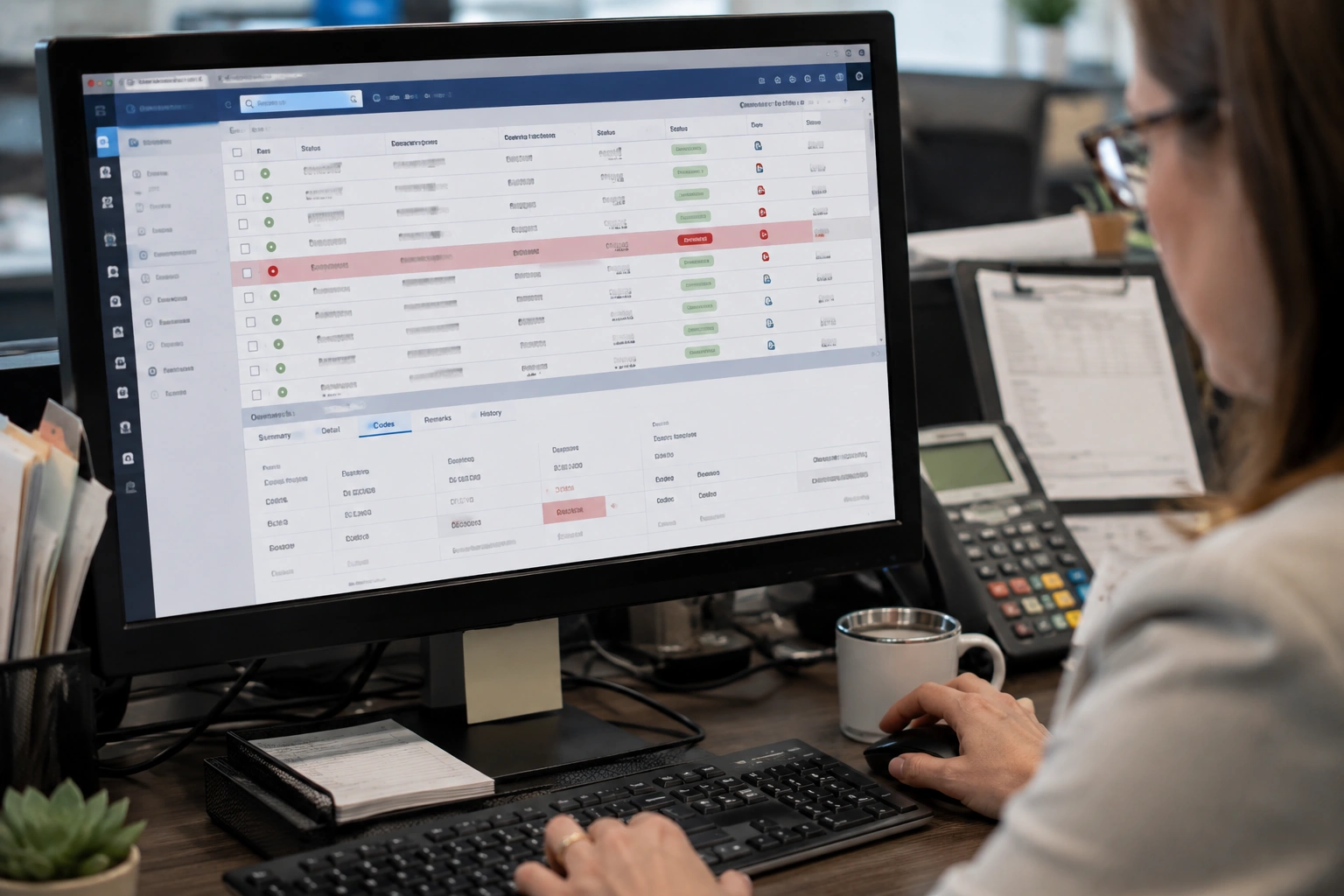
Errors take different shapes depending on where in the revenue cycle they start. Front-office mistakes include eligibility gaps and missing prior authorizations. Mid-cycle mistakes involve incorrect CPT or ICD-10 pairings and incomplete documentation — the medical coding errors North Carolina billing teams flag most often during internal audits. Back-end mistakes show up as missed appeal deadlines and unmonitored accounts receivable. Because denial patterns vary by specialty, reviewing your medical billing specialties is a useful first step before assuming every denial shares the same cause — a behavioral health practice and an orthopedic group in the same building can have entirely different error profiles.
Why Medical Billing Errors Are Costing North Carolina Practices Money
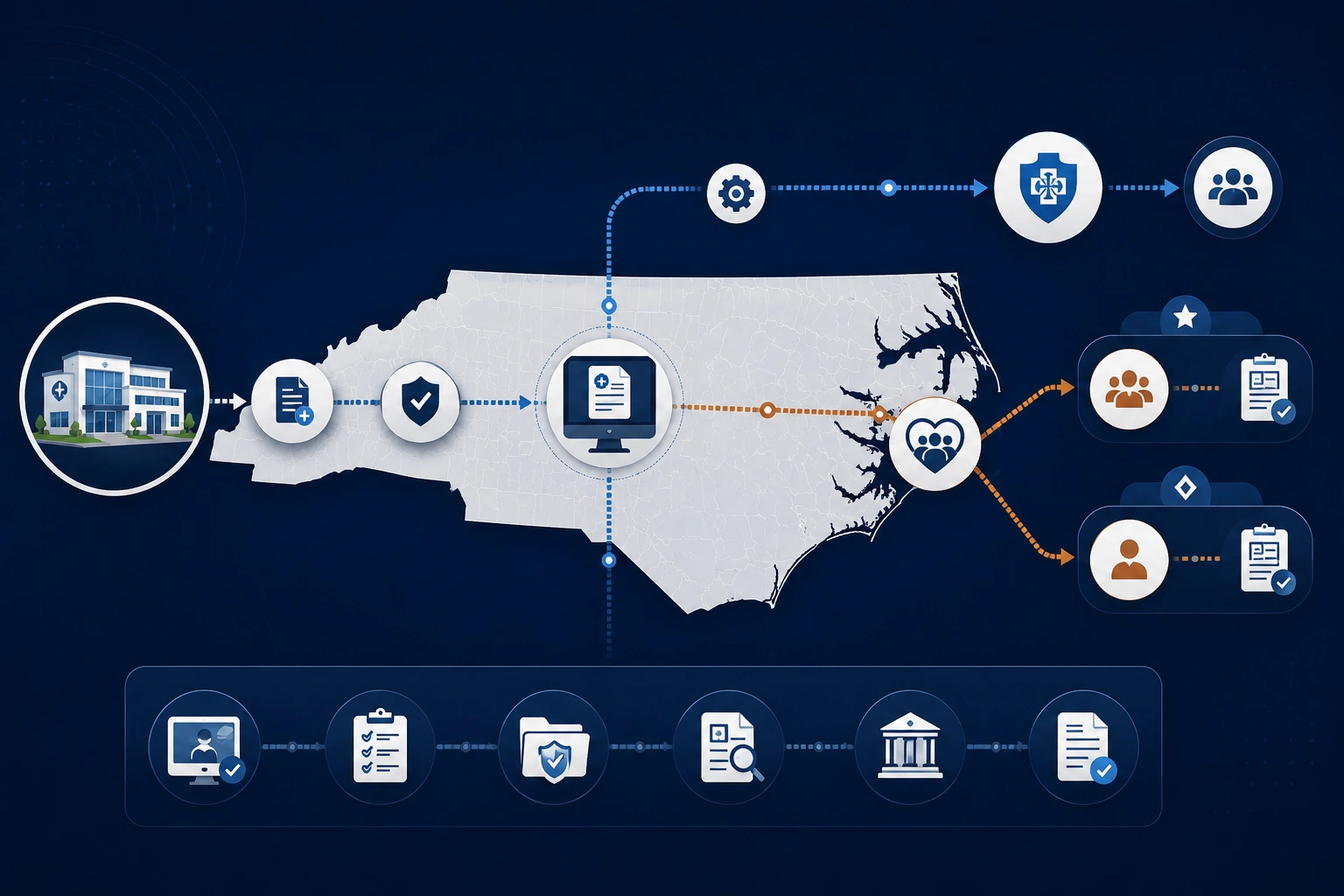
North Carolina adds a layer of complexity that flat national billing statistics do not capture. Blue Cross NC processes the largest volume of commercial claims in the state, and its claim-edit logic changes often enough that a rule your team relied on last year may no longer apply. On the government side, NC Medicaid Managed Care requires practices to track enrollment by Prepaid Health Plan rather than a single statewide system, since coverage now runs through separate Standard Plan and Tailored Plan networks.
These medical billing denials North Carolina practices report tend to cluster around a handful of payers rather than being evenly distributed. If you have asked yourself why are my claims getting denied in North Carolina, the answer is rarely one dramatic mistake — it is usually a small, repeatable gap in how your team handles payer-specific rules. The NC Department of Insurance oversees how claims are handled and disputed in the state, and its guidance is worth reviewing if denial patterns feel inconsistent with what your payer contracts describe.
7 Critical Medical Billing Errors North Carolina Practices Make
These seven mistakes account for most of the denials, delays, and underpayments billing teams across the state report — not a generic national list, but the patterns that show up specifically in North Carolina claims.
1. Incorrect or Outdated CPT/ICD-10 Coding
Medical coding errors North Carolina practices encounter most often involve outdated code sets, mismatched CPT and ICD-10 pairings, or missing modifiers that payers now flag automatically. A code that was valid two years ago may have been replaced, bundled, or restricted to a narrower diagnosis list since then. CPT coding accuracy depends on staying current with annual code set updates, and ICD-10 coding requires matching diagnosis specificity to the service billed — a mismatch here is one of the fastest ways to trigger an automatic denial. The American Medical Association publishes annual coding and documentation guidance that most claim-edit systems are built around, and reviewing it before your next coding audit can catch problems before a payer does.
2. Missing or Incomplete Prior Authorization
Services rendered before an authorization is confirmed are one of the most avoidable causes of denial, yet they remain common when front-office staff are working under time pressure. Prior authorization requirements differ by payer and by service, and an authorization valid at the start of treatment can expire mid-course for extended courses of care — physical therapy, behavioral health, and certain imaging services are frequent examples. When that happens, claims submitted after the expiration date are denied even though the original authorization was legitimate. Building a simple tracking system that flags authorization end dates before treatment concludes prevents this specific error from recurring in your practice.
3. Insurance Eligibility and Verification Errors
Coverage lapses and plan changes are easy to miss when eligibility is checked once at intake and never again. A patient’s plan can change between scheduling and the date of service, a secondary payer can shift, or a Medicaid enrollee can move between plans without notifying your front desk. Insurance eligibility verification performed only at the first visit — rather than at every visit — is one of the more common oversights behind claims denied for coverage that technically existed, just not with the payer billed. Re-verifying eligibility close to the date of service closes most of this gap before it becomes a denial.
4. Missing Timely Filing Deadlines
Timely filing windows vary by payer, and North Carolina practices juggling Blue Cross NC, NC Medicaid Managed Care, and several commercial plans often lose track of which deadline applies to which claim. A claim that is otherwise clean but filed even a few days late is typically denied outright, with limited appeal options available afterward. The Centers for Medicare & Medicaid Services publishes national claims-processing standards that many commercial payers reference when setting their own timely filing policies, though individual payer deadlines can still differ from that federal baseline. Building payer-specific filing calendars into your workflow, rather than relying on one default deadline, is the most direct way to stop this error before it happens.
5. NC Medicaid Managed Care Billing Mistakes
NC Medicaid billing errors are frequently a symptom of Standard Plan and Tailored Plan confusion rather than a coding problem at all. Because coverage now runs through separate Prepaid Health Plans instead of one statewide Medicaid system, a practice can bill correctly and still be denied if the patient’s PHP enrollment on file does not match their actual plan. NC Medicaid publishes managed care billing and provider enrollment requirements that are worth checking against your own records periodically, particularly for patients whose coverage may have shifted during an enrollment period. Confirming Credentialing Services are current with each PHP your practice bills is a preventable step many teams skip until a denial forces the review.
A Raleigh-area behavioral health practice recently traced a wave of Medicaid denials not to a coding mistake at all, but to enrollment with the wrong Prepaid Health Plan — a gap that surfaced only once the billing team began reviewing denials by root cause instead of by claim.
6. Blue Cross NC Claim Denials from Modifier and Bundling Errors
Blue Cross NC claim denials frequently stem from modifier misuse and bundling edits specific to that payer’s claim-processing rules rather than universal coding standards. A modifier that a different payer would accept without issue may trigger an automatic denial under Blue Cross NC’s bundling logic, particularly for services commonly billed together on the same date. Blue Cross NC publishes payer-specific claim-edit and denial guidelines that update periodically, and a billing team relying on general coding references alone — without cross-checking payer-specific edits — will keep encountering the same denial pattern on the same service combinations.
7. Failing to Track and Appeal Denied Claims
Denials that go unworked past the appeal window represent revenue your practice already earned and then quietly wrote off. Without a denial-tracking process that logs each denial by payer, reason code, and deadline, patterns become invisible — the same coding gap or eligibility oversight can repeat for months before anyone notices. A practice with a dedicated denial appeals workflow, not just a spreadsheet of open claims, recovers far more of this revenue. Billing Reporting & Analytics that break claim denial reasons North Carolina practices report into categories — rather than one aggregate denial rate — make it possible to see which of the previous six errors is actually driving your numbers.
How to Reduce Medical Billing Errors in Your North Carolina Practice
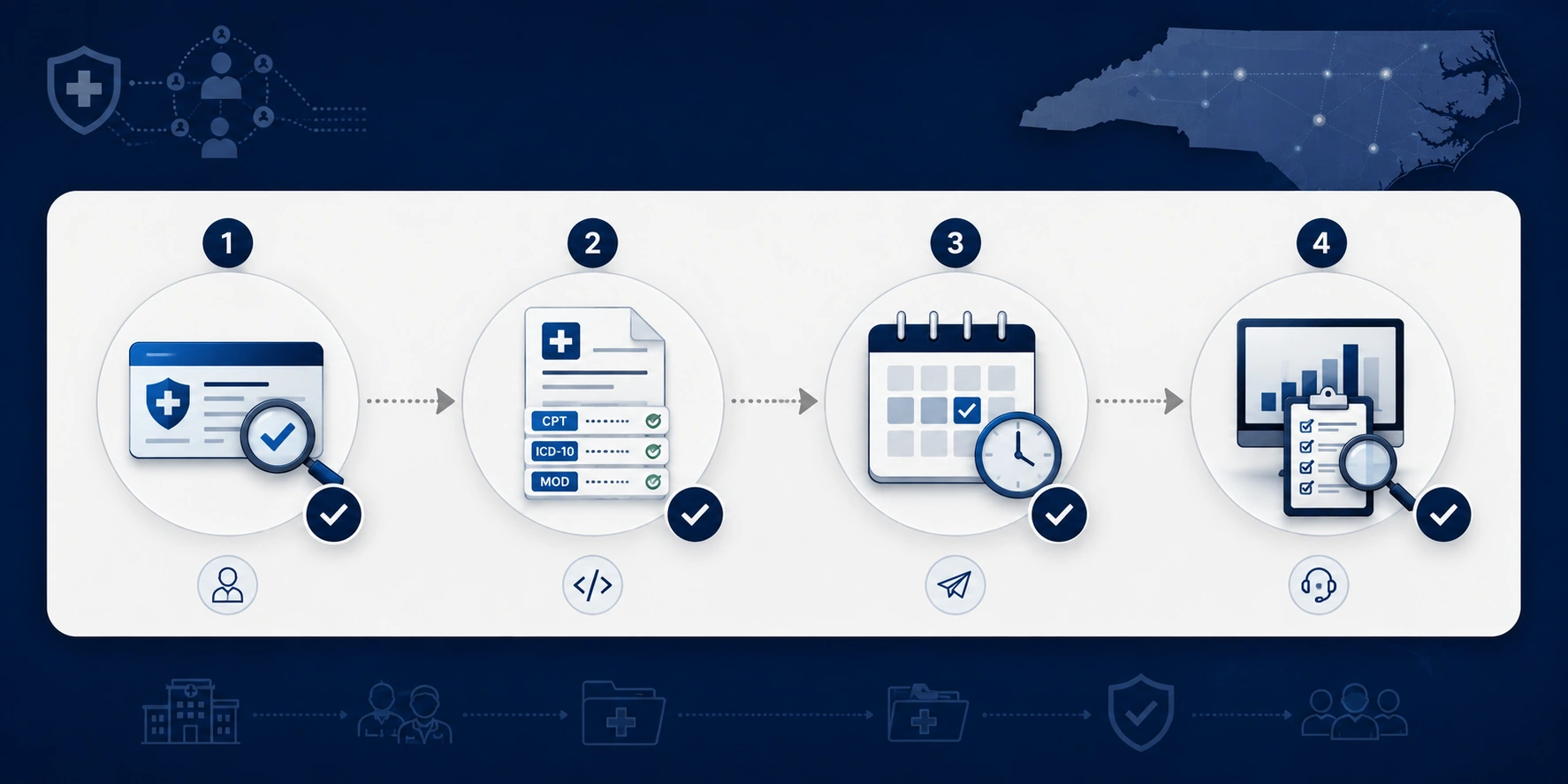
What causes medical billing errors most often is not a lack of staff skill — it is a missing system that catches a gap before a claim goes out. These revenue cycle mistakes North Carolina practices repeat are almost always process gaps, not people problems. Standardize eligibility checks at every visit, not just at intake, and set a recurring schedule for coding audits rather than reviewing codes only after a denial spike. Track denials by payer and reason code so patterns surface early, and confirm NC Medicaid PHP enrollment annually rather than assuming it stays the same. Tightening your claims processing workflow around these habits protects your clean claim rate over time.
These are also the most common medical billing mistakes for small practices, where one person often handles verification, coding, and appeals at once. If you have been searching how to reduce claim denials NC Medicaid enrollees generate specifically, PHP verification is almost always the fastest fix — check it before assuming the problem is coding. When internal capacity cannot keep pace, Revenue Cycle Management support — whether through outsourced medical billing North Carolina practices bring in for overflow work, or a full outsourced arrangement — closes the gap that internal staff alone cannot cover.
How TMS Billings Helps North Carolina Practices Avoid These Errors
Certified coding staff, workflows built around HIPAA compliance, and direct day-to-day experience with Blue Cross NC and NC Medicaid Managed Care claim edits are what actually move the needle on how to fix recurring claim denials — not a generic services list. Our team builds denial tracking by reason code into every account from day one, so a repeating error surfaces after the second occurrence instead of the twentieth. Credentialing is checked against current payer enrollment before claims go out, not after a denial forces the review.
A Charlotte-area primary care practice came to us with a recurring Blue Cross NC modifier denial that had persisted for months despite internal review. A targeted coding audit identified the root cause within days, and the same denial pattern has not recurred since.
Key Takeaways
- Most medical billing errors North Carolina practices face trace back to a handful of repeatable, preventable process gaps rather than isolated mistakes.
- Blue Cross NC and NC Medicaid Managed Care each carry payer-specific rules that generic billing advice tends to overlook entirely.
- NC Medicaid billing errors frequently trace back to enrollment mismatches rather than coding accuracy, so PHP verification deserves its own annual check.
- Coding errors, missed prior authorizations, and lapsed eligibility checks account for the majority of avoidable denials statewide.
- Denial-tracking by reason code turns invisible patterns into fixable ones — and protects revenue your practice already earned.
Final Thoughts
The pattern behind most medical billing errors North Carolina practices deal with is not mysterious — it is a small set of payer-specific gaps that compound when nobody tracks them by root cause. Blue Cross NC’s claim edits and NC Medicaid Managed Care’s Standard Plan and Tailored Plan structure both reward practices that verify, document, and track denials consistently, and both quietly penalize the ones that do not. Payer rules and Medicaid requirements change periodically, so confirm current specifics directly with NCDHHS, Blue Cross NC, or your billing partner before assuming a policy from last year still applies.
If your denial rate has been climbing and you are not sure which of the seven errors above is driving it, Book a Free Consultation and we will help you find out.