
10 Questions to Ask Before Hiring a Medical Billing Company in Illinois
TMS Billings Revenue Cycle Team — Last Reviewed: August 2026
Choosing the wrong billing partner rarely announces itself on day one. It shows up months later, in accounts receivable that keeps aging and denials that never quite reach zero. This guide from Medical Billing Services in Illinois walks your practice through the ten questions that separate a dependable Medical Billing Company in Illinois from a vendor that only sounds capable on a sales call. Ask each one before you sign a contract, and you will know precisely what your billing team is getting — not what it was promised.
Why Choosing the Right Medical Billing Company Matters in Illinois
In short: A Medical Billing Company in Illinois has to manage HFS-administered Medicaid, HealthChoice Illinois managed care plans, and a wide mix of commercial payers at the same time. The right partner shortens your reimbursement cycle. The wrong one adds a new layer of confusion on top of problems your practice already has.
Illinois billing is rarely uniform. A single practice may submit claims to traditional Medicaid administered through the Department of Healthcare and Family Services, several HealthChoice Illinois managed care organizations, and a dozen commercial payers, each with its own filing deadlines and documentation standards. Choosing a medical billing company that understands this layered payer mix is not optional — it is the difference between claims that move and claims that stall. Current requirements are published by the Illinois Department of Healthcare and Family Services, which administers provider enrollment and Illinois Medicaid billing statewide. A vendor unfamiliar with these distinctions tends to compound denials rather than resolve them, leaving your staff to catch errors the billing company should have caught first.

The 10 Questions to Ask a Medical Billing Company in Illinois
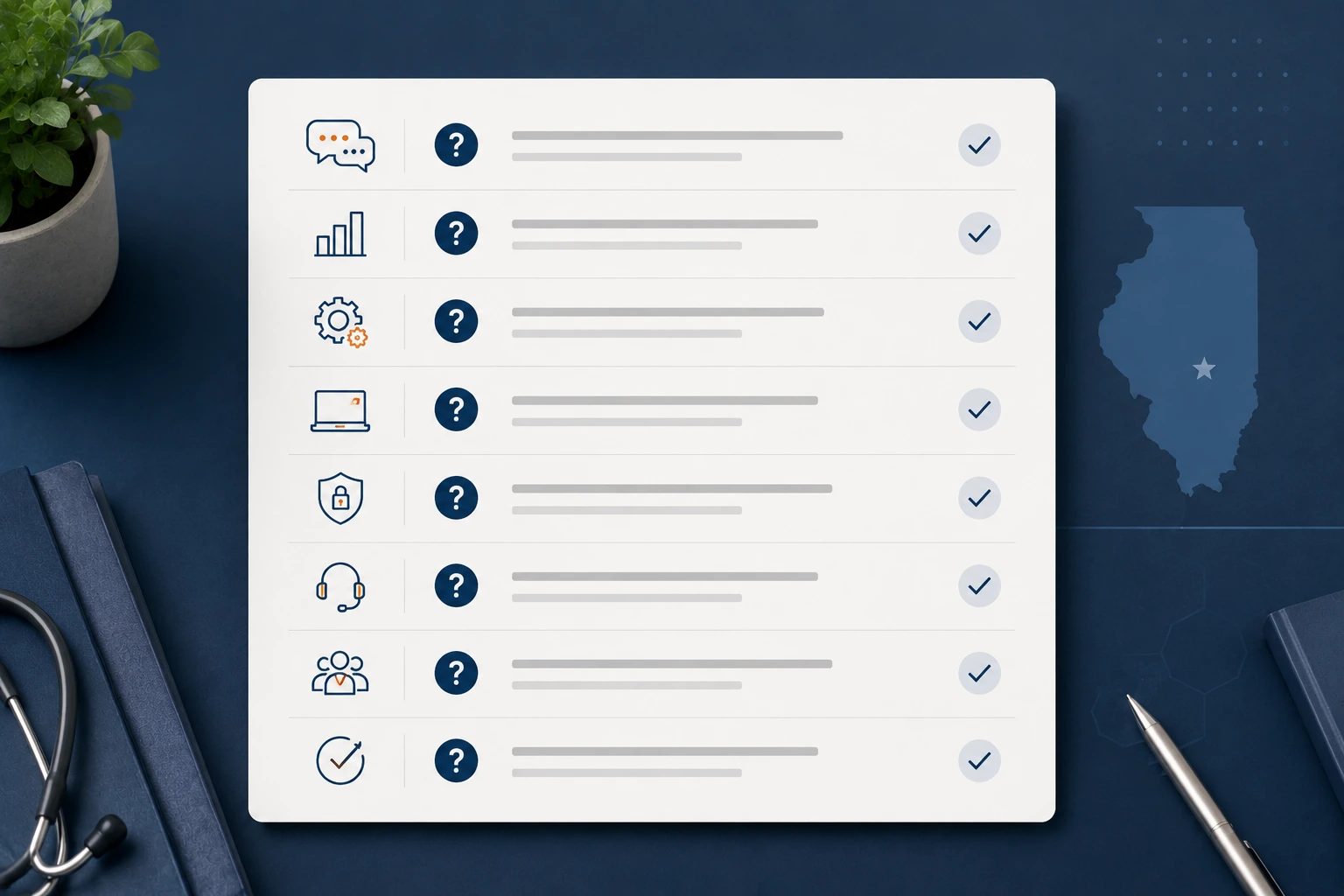
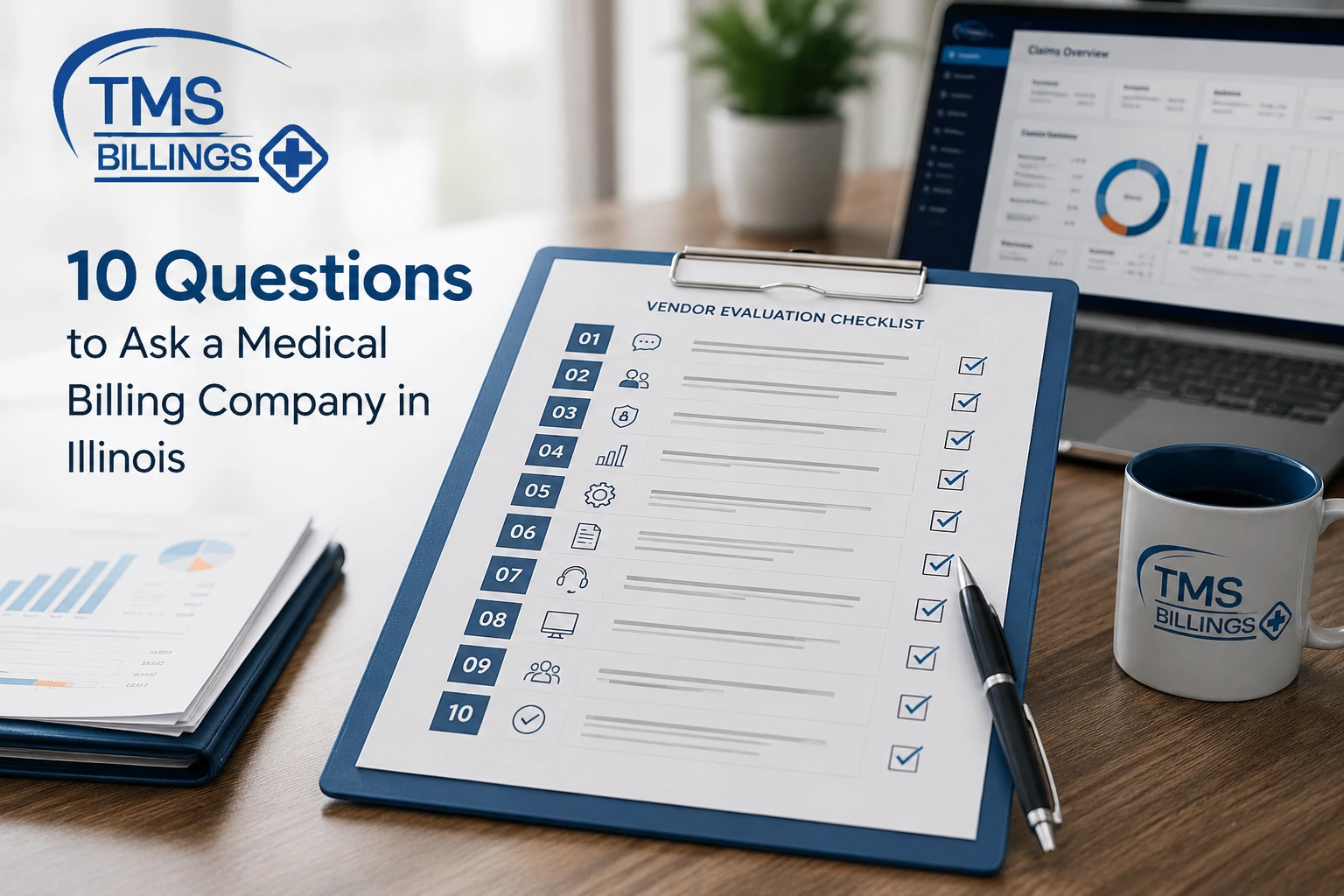
Treat this as a working checklist during every vendor conversation, not a formality to skim. What to look for in an Illinois medical billing partner becomes obvious once you hear how a company answers each question, rather than what it promises in a pitch deck.

1. What Certifications and Experience Does Your Billing Team Have?
Ask who actually codes your claims and what credentials they hold. Coding accuracy depends on staff who stay current with CPT and ICD-10 updates, not a rotating pool of junior coders. Reputable teams reference guidance from the American Medical Association for CPT coding standards and documentation requirements, and they should be able to describe their training and quality-review process without hesitation. If a vendor cannot explain how it keeps coders current, treat that as an early warning sign rather than a minor gap.
2. How Do You Ensure HIPAA Compliance and Data Security?
HIPAA compliance is not a checkbox; it is an operational discipline covering encrypted data transmission, access controls, staff training, and breach-response procedures. Ask for specifics: How is patient data transmitted and stored? Who has access, and how is that access logged? The Centers for Medicare & Medicaid Services publishes compliance standards relevant to claims processing and data security that a serious vendor should reference readily. A hesitant or vague answer here matters more than almost any other question on this list.
3. What Is Your Clean Claim Rate and How Do You Track Denials?
A strong clean claim rate signals fewer resubmissions and faster payment. Ask how the company defines and measures it, and how denial trends are tracked over time. This is one of the core questions to ask before hiring a medical billing company, because a vendor that cannot produce this figure likely is not measuring it internally either. Push past a general percentage claim and ask for the process behind it — how denials are categorized, how root causes are identified, and how that data feeds back into coding and submission practices.
4. Do You Offer Credentialing and Provider Enrollment Support?
Credentialing delays keep new providers from billing at all, so ask whether the company manages payer enrollment, re-credentialing, and CAQH profile maintenance, or whether that work stays on your plate. TMS Billings handles this through its Credentialing Services, and the National Committee for Quality Assurance maintains standards many payers reference for credentialing and provider enrollment. A vendor that treats credentialing as someone else’s problem is leaving a critical revenue gap unaddressed.
5. How Do You Handle Claim Denials and Appeals?
Denials are inevitable; what matters is the appeal process behind them. Ask how quickly denials are worked, who owns the appeal, and how the company distinguishes a documentation fix from a payer policy dispute. TMS Billings addresses this directly through AR Recovery and Denial Management, built around aging claims proactively rather than waiting for a monthly report to surface a problem. A company with no defined denial workflow will let claims sit until someone happens to notice them.
6. What Reporting and Analytics Will I Have Access To?
You should never have to ask your billing company how your own practice is performing. Request a sample dashboard before you sign, not after. TMS Billings’ Billing Reporting & Analytics gives practices visibility into collections, aging accounts receivable, and payment trends in real time. If a vendor can only offer a generic monthly PDF, ask what real-time access looks like — the answer tells you how transparent the relationship will actually be.
7. What Is Your Pricing Structure?
Billing companies typically charge a percentage of collections or a flat monthly fee, and each model suits different practice sizes and claim volumes. Review medical billing pricing structures carefully and ask what is included versus billed separately — credentialing, patient statements, and eligibility checks are common add-ons. Treat any number quoted during a first call as a starting point for discussion, not a fixed figure, and confirm current pricing directly with any vendor before signing.
8. Do You Have Experience Billing for My Specialty?
Behavioral health, cardiology, durable medical equipment, and urgent care each carry distinct coding rules, prior authorization requirements, and payer quirks. Ask for specifics tied to your specialty, not a general claim of experience. TMS Billings’ medical billing specialties page outlines the range of practice types it supports across Illinois. A vendor unfamiliar with your specialty will learn on your dime, and that education shows up as denied claims.
9. Who Will Be My Day-to-Day Point of Contact?
A dedicated account specialist who knows your practice’s history is worth more than a rotating call-center queue. Ask directly: will one person manage my account, or will I explain my situation to someone new every time I call? This single answer often predicts how the entire relationship will feel six months in, long after the sales call is forgotten.
10. Can You Provide Illinois-Specific References or Case Studies?
A billing company that has genuinely worked Illinois claims should be able to point to practices facing your same payer mix — HFS Medicaid, HealthChoice Illinois plans, and regional commercial carriers. Ask for references you can actually call, not testimonials pulled from a website. Hesitation here, after nine confident answers, is worth noticing.
| Question | Why It Matters | Green-Flag Answer |
|---|---|---|
| Certifications & experience | Determines coding accuracy | Names specific credentials and ongoing training |
| HIPAA & data security | Protects patient data and your practice | Describes encryption, access logs, and breach protocol |
| Clean claim rate & denials | Predicts payment speed | Explains how the rate is measured and tracked |
| Credentialing support | Prevents enrollment delays | Manages CAQH and payer enrollment directly |
| Denials & appeals | Recovers stalled revenue | Has a defined, proactive appeal workflow |
| Reporting & analytics | Keeps you informed | Offers a live dashboard, not a static PDF |
| Pricing structure | Avoids surprise costs | Discloses what is and is not included |
| Specialty experience | Reduces avoidable denials | Cites specific specialty-related claim rules |
| Day-to-day contact | Builds continuity | Assigns a dedicated account specialist |
| Illinois references | Confirms local competence | Offers callable, practice-specific references |
One Illinois multi-provider clinic narrowed five billing vendor candidates down to two after asking each one to walk through its denial-appeal process step by step, rather than accepting a vague percentage claim. The exercise revealed which vendors had a real workflow behind their numbers and which did not.
How TMS Billings Measures Up to These Questions
TMS Billings answers these ten questions directly rather than pointing to a generic services page. Coding staff maintain current CPT and ICD-10 credentials. HIPAA-compliant workflows govern every stage of data handling, from intake through claim submission. Illinois practices work with a dedicated account specialist rather than a rotating queue, and credentialing support is built into onboarding rather than treated as an afterthought. Reporting stays transparent through live dashboards rather than delayed monthly summaries, and the underlying approach is grounded in Revenue Cycle Management practices built specifically around Illinois’ payer mix, including Illinois Medicaid and HealthChoice Illinois plans.

A behavioral health practice serving the Chicago area required every prospective vendor to produce a sample reporting dashboard before signing, which immediately ruled out candidates offering only generic monthly summaries. That single request told the practice more about vendor transparency than any sales conversation had.
Key Takeaways
- A Medical Billing Company in Illinois must handle HFS Medicaid, HealthChoice Illinois plans, and commercial payers without compounding denials.
- Coding accuracy, HIPAA compliance, and a documented clean claim rate are non-negotiable baseline requirements.
- Credentialing support and a defined denial-appeal workflow prevent revenue from stalling quietly.
- Transparent, real-time reporting matters more than a polished sales presentation.
- A dedicated account specialist and verifiable Illinois references separate serious vendors from the rest.
- Choosing a medical billing company is a decision best made using direct answers, not marketing claims.
Final Thoughts
If you outsource medical billing in Illinois, the vendor you choose becomes an extension of your practice’s revenue cycle, not just a back-office task you no longer think about. Asking these ten questions before you sign protects your practice from months of quiet losses that are far harder to unwind than they were to prevent. The right Medical Billing Company in Illinois will welcome every one of these questions rather than deflect them, because a confident answer is the easiest way for a vendor to earn your trust. When you are ready to compare your current results against what a dedicated Illinois billing partner can deliver, Book a Free Consultation with our team.