Medical Billing Services Cost California: What Practices Pay in 2026
By the TMS Billings Coding & Compliance Team | Reviewed by Jacob White, CPC, CPB
Three billing quotes sit open on a laptop screen in a Los Angeles internal medicine office: one company wants 4% of collections, another wants 8%, and a third pitches a flat monthly rate with no percentage in sight. Medical billing services cost California practices more than a simple percentage suggests, because the real price tag depends on Medi-Cal claim volume, Knox-Keene-regulated commercial plans, and how clean those claims go out the door in the first place.
Office managers in San Francisco, San Diego, and everywhere between run into the same wall. A national billing-cost average is nearly useless here, because California runs on two separate regulatory tracks that shape how complicated — and expensive — billing really gets: Medi-Cal fee-for-service and managed care through DHCS, and commercial HMO/PPO claims governed by the Knox-Keene Act. (For background on how coding and billing fit together in this state, see our guide to medical billing and coding in California.)
This guide breaks down what practices are actually paying in 2026, the three pricing models behind those numbers, and how to compare quotes without landing on a rate that looks cheap on paper and costs more once denials and aging accounts pile up.
Quick answer: Medical billing services cost California providers typically 4% to 10% of monthly collections when outsourced, or $3 to $12 per claim under flat-fee models. Rates vary by specialty, payer mix, and whether a practice bills Medi-Cal or commercial payers like Anthem or Blue Shield.
What Determines Medical Billing Services Cost California
How much does medical billing cost for a California practice? It depends on five variables that matter more than any single “industry average” figure: the pricing model a vendor uses, the practice’s payer mix, its specialty and claim complexity, its clean claim rate, and its region within the state. Medical billing services cost California practices differently based on how these five factors combine, which is why two practices with similar revenue can end up with very different quotes.
Here’s how each one moves the number:
- Pricing model. Percentage-of-collections, per-claim, and flat monthly retainer arrangements shift risk differently between the practice and the vendor, which is part of why medical billing pricing California quotes can look so different for the same volume of work.
- Payer mix. A panel weighted toward Medi-Cal fee-for-service behaves differently, cost-wise, than one running mostly commercial claims through Anthem, Blue Shield, or Health Net.
- Specialty. Behavioral health, DME, and multi-provider groups carry more coding complexity than a single-provider primary care practice, and that complexity shows up in the quote.
- Clean claim rate. A vendor that gets claims right the first time spends less time on rework — and usually charges less to prove it.
- Region. Staffing and operating costs differ enough between Los Angeles, San Francisco, and San Diego that two practices with identical payer mixes can still see different effective rates.
Medical Billing Pricing Models Explained
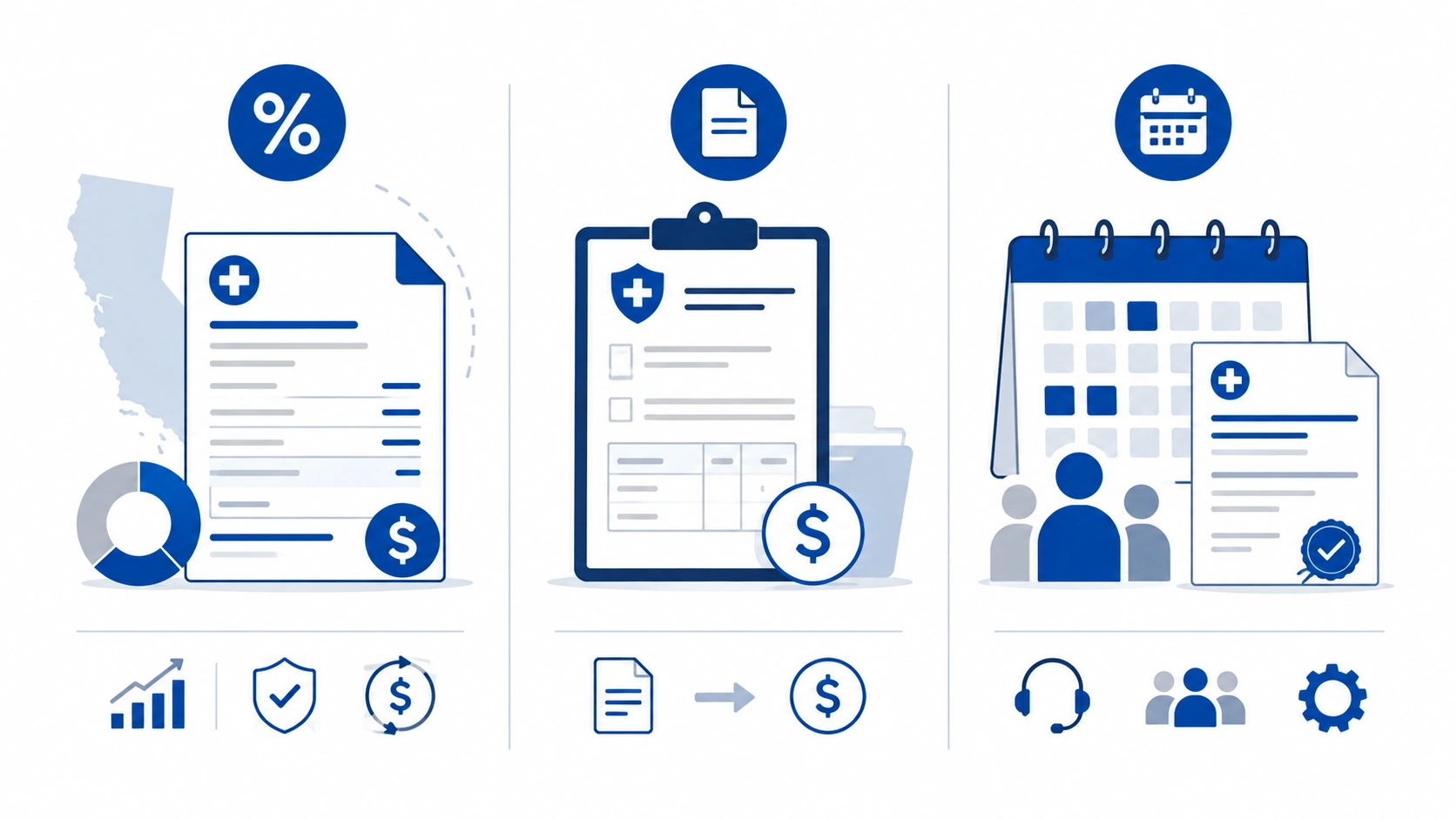
Most billing companies price their services one of three ways, and each medical billing company California pricing structure rewards a different kind of practice. That said, medical billing pricing California quotes can vary widely even within the same model, since scope of service differs vendor to vendor. Before comparing quotes, our transparent pricing page is a useful example of how these models translate into an actual bill.
Percentage-of-Collections Pricing
Percentage-of-collections pricing — sometimes just called percentage of collections — is the most common model for full-service revenue cycle management (RCM), and it ties the vendor’s paycheck directly to what the practice actually collects. Medical billing percentage fees typically range from 4% to 10% of collections, depending on scope and specialty. If a practice collects $100,000 in a month at an agreed rate of 6%, the bill is $6,000 — nothing collected, nothing owed.
This model tends to align incentives well, since the vendor only gets paid when claims pay out, which pushes them to chase denials and protect the clean claim rate rather than just submit volume. It fits practices with fluctuating monthly collections, because cost scales down automatically in slow months instead of sitting fixed on the books. The tradeoff: in a strong collections month, a 4% quote and an 8% quote can cost very different dollar amounts, so the percentage alone never tells the whole story. Ask what’s actually included — denial management, patient statements, credentialing support — before comparing two numbers side by side.
Per-Claim (Flat-Fee) Pricing
Per-claim pricing charges a flat dollar amount for every claim submitted, regardless of whether — or how much — it eventually pays. Medical billing cost per claim in California typically runs $3 to $12, depending on claim complexity and the payer involved.
This model works predictably for high-volume, lower-dollar-value practices, since the vendor’s incentive shifts toward processing volume rather than maximizing each claim’s payout. It can work against a practice if denials climb, because the vendor still gets paid per submission even when a claim never collects, which means the practice absorbs more of the downstream risk than it would under a percentage model. Flat-fee billing tends to suit practices that already have strong documentation and a low denial rate walking in the door, since there’s less room for a vendor to be incentivized around cleanup work.
Monthly Retainer / Staffing-Based Pricing
A monthly retainer charges a fixed fee for a defined scope of work or a set number of billing staff hours, independent of collections or claim count. It’s less common for full RCM outsourcing but shows up often for practices that want predictable, budgetable costs, or that need a specific staffing gap filled — credentialing, A/R follow-up, denial appeals — rather than end-to-end billing.
The upside is budget certainty: the bill doesn’t move with a slow month or a sudden spike in claim volume. The downside is that a retainer doesn’t scale down if collections drop, and it doesn’t reward the vendor for maximizing what gets collected the way a percentage model does. This structure tends to fit larger practices with in-house billing leadership that only need to outsource specific overflow work, rather than a practice looking to hand off its whole revenue cycle.
Average Medical Billing Services Cost California in 2026
Medical billing services cost California practices an average of 4% to 10% of monthly collections when outsourced, or $3 to $12 per claim under a flat-fee model, with most full-service RCM arrangements landing between 5% and 8%. How much does it cost to outsource medical billing beyond that headline number depends heavily on scope — a quote covering only claim submission runs cheaper than one that also includes credentialing, patient billing, and denial appeals.
Specialty practices and Medi-Cal-heavy panels tend to land at the higher end of that range, since more complex coding and a mix of fee-for-service and managed-care claim rules add administrative work on the vendor’s side. A single-specialty primary care practice running mostly commercial claims through Anthem or Blue Shield typically sees quotes closer to the lower end.
Asking “how much does medical billing cost” without naming a payer mix, specialty, and claim volume is a bit like asking what a car costs without naming the car — the honest answer is always a range until those specifics are on the table. Getting an accurate outsource medical billing cost estimate means sharing your specialty, payer mix, and monthly claim volume up front, not just asking for a percentage. A practice that picks a vendor on percentage alone, without checking denial rate and what’s actually included in scope, is the practice most likely to be surprised by the real total at year-end.
In-House vs. Outsourced: Comparing Medical Billing Services Cost California Options
Medical billing services cost California practices differently depending on whether billing stays in-house or moves to a dedicated vendor, and the fully loaded in-house number is usually higher than practices expect once salary, benefits, software, and turnover are counted. HFMA’s roundtable on revenue cycle outsourcing decisions found that health systems weigh the decision largely around staffing cost, accounts receivable (A/R) performance, and denial trends — the same factors that matter for a solo or small-group practice deciding whether to keep billing in-house.
| Cost Factor | In-House Billing | Outsourced Billing |
|---|---|---|
| Typical Cost | ~10–14% of collections fully loaded (salary, benefits, software, turnover) | ~4–10% of collections, or $3–$12 per claim flat-fee |
| Staffing Risk | High — turnover resets institutional knowledge | Low — vendor absorbs staffing/coverage risk |
| Typical Denial Rate | Often 12–18% industry-wide | Typically 2–8% at specialized vendors |
| Best Fit | High-volume practices with a stable, experienced team | Small–mid practices, specialty practices, Medi-Cal-heavy panels |
Figures above are sourced industry-benchmark ranges, not practice-specific guarantees — confirm current figures against a vendor’s actual proposal before publishing or relying on them for a budget decision.
Is outsourcing medical billing worth it? For most small and mid-sized California practices, the math tends to favor outsourcing once turnover, benefits, and software licensing are added to an in-house biller’s salary — a topic covered in more depth in our guide to revenue cycle management in California. Comparing an outsource medical billing cost quote against that fully loaded in-house number, rather than against salary alone, is the only fair way to know which option actually wins. Larger, high-volume practices with an established, low-turnover billing team sometimes come out ahead keeping billing in-house, particularly once they’ve already invested in the software and training.
What Affects Your Medical Billing Services Cost in California
Medical billing services cost California practices more or less depending on how much of a panel runs through Medi-Cal versus commercial insurance, and how that mix intersects with two separate regulatory systems.
Medi-Cal FFS vs. managed care. Fee-for-service Medi-Cal claims follow one set of billing rules; Medi-Cal managed care claims routed through a health plan follow another. DHCS publishes the official Medi-Cal provider manuals covering both, and Medi-Cal billing complexity is one of the biggest reasons two practices with similar revenue can see different billing quotes — a heavier FFS/managed-care mix simply takes more staff time to process correctly.
The Knox-Keene Act. Commercial HMO and PPO claims in California are governed by the Knox-Keene Health Care Service Plan Act, enforced by the Department of Managed Health Care. Claims routed through Knox-Keene-regulated plans like Anthem Blue Cross, Blue Shield of California, and Health Net carry their own timely-filing and dispute rules, which a billing vendor has to track alongside Medi-Cal requirements — not instead of them.
Credentialing. A biller can’t submit a clean claim for a provider who isn’t properly enrolled with a payer. Practices that skip or delay credentialing services in California often see denial rates climb before they ever think to look at billing cost as the cause.
Specialty. Behavioral health, physical therapy, and multi-provider groups typically need specialty-specific billing expertise that a general biller doesn’t have, which shows up as a modest premium on the quote.
Region. Practices in Los Angeles, San Francisco, and San Diego tend to see slightly different effective rates than the rest of the state, largely because vendor staffing costs track local cost of living, and payer mix in dense urban markets often skews more heavily toward Medi-Cal managed care.
All of this ties back to HIPAA compliance and accounts receivable (A/R) management too — a vendor cutting corners on either one isn’t actually cheaper, just riskier.
How to Choose a Billing Partner Without Overpaying
The lowest percentage on paper isn’t always the lowest total cost. A vendor quoting 4% but running a 15% denial rate can cost a practice more in lost revenue than an 8% vendor with a 3% denial rate ever would. Medical billing percentage fees alone don’t tell the whole story — pair the number with denial rate and scope of work before deciding. Every medical billing company California practices seriously consider should be able to state its denial rate and clean claim rate without hesitation.
A few questions cut through most of the noise:
- What’s actually included? Ask whether the quote covers claim submission only, or also denial management, patient statements, credentialing, and eligibility checks. Two quotes with different scopes aren’t really comparable.
- What’s the clean claim rate and denial rate? A vendor should know these numbers cold and be willing to share how they’re calculated.
- How is Medi-Cal handled? Given how much Medi-Cal FFS and managed-care rules drive cost in this state, a vendor without a clear answer here is a red flag on its own.
- Is there a contract lock-in? Month-to-month arrangements put more pressure on a vendor to keep performing, since a practice can leave if service slips.
- Do they specialize in your practice type? A general biller working a specialty practice for the first time tends to take longer — and cost more in denials — while the learning curve plays out.
Our guide to billing solutions for small practices covers this in more detail, including specific questions worth asking before signing anything.