Medical Billing Services Cost Pennsylvania: What Practices Pay in 2026
Reviewed by: Jacob White, CPC, CPMA — Compliance Director, TMS Billings
A Pennsylvania practice manager sits down with three billing quotes open on the screen: one vendor wants 5% of collections, another wants 8%, and a third skips the percentage entirely for a flat monthly fee. The medical billing services cost Pennsylvania practices pay depends on more than which number looks smallest — claim volume, denial follow-up, and payer mix all change what a quote actually costs by year’s end.
A “cheap” 5% quote that lets claims sit unworked can end up costing more than an 8% quote from a team that appeals every denial. Add in Pennsylvania’s own payer landscape — Highmark, Independence Blue Cross, UPMC Health Plan, and Medicaid billed through PROMISe — and the real number depends on more than a single percentage on a sales sheet. This guide breaks down what drives medical billing services in Pennsylvania pricing in 2026, what the average practice actually pays, and how to compare quotes without overpaying.
What Determines Medical Billing Services Cost Pennsylvania
Medical billing services cost Pennsylvania providers typically 4% to 9% of monthly collections when outsourced, or $4 to $8 per claim under flat-fee models. Pricing depends on specialty, claim volume, payer mix, and whether your practice bills Pennsylvania Medicaid (PROMISe) or commercial payers like Highmark.
Medical billing services cost Pennsylvania practices pay is set primarily by pricing model, claim volume, specialty complexity, and payer mix — which is exactly why how much does medical billing cost varies so much from one practice to the next, rather than following a single flat industry rate. A billing company doing revenue cycle management (RCM) for a high-volume family practice with mostly commercial claims prices very differently than one handling a small behavioral health practice with a heavy PA Medicaid panel.
Four factors move the number most:
- Pricing model. Percentage-of-collections, per-claim, and flat monthly retainer structures each shift financial risk differently between practice and vendor.
- Specialty. Higher-complexity specialties — cardiology, orthopedics, behavioral health — require more coding expertise and prior authorization handling, which raises fees.
- Claim volume. Larger practices can often negotiate lower percentage rates because a vendor’s fixed costs spread across more claims.
- Payer mix. Practices billing Highmark, Independence Blue Cross, UPMC Health Plan, or PA Medicaid (PROMISe) face different documentation and appeal requirements, and pricing reflects that.
Medical Billing Pricing Models Explained
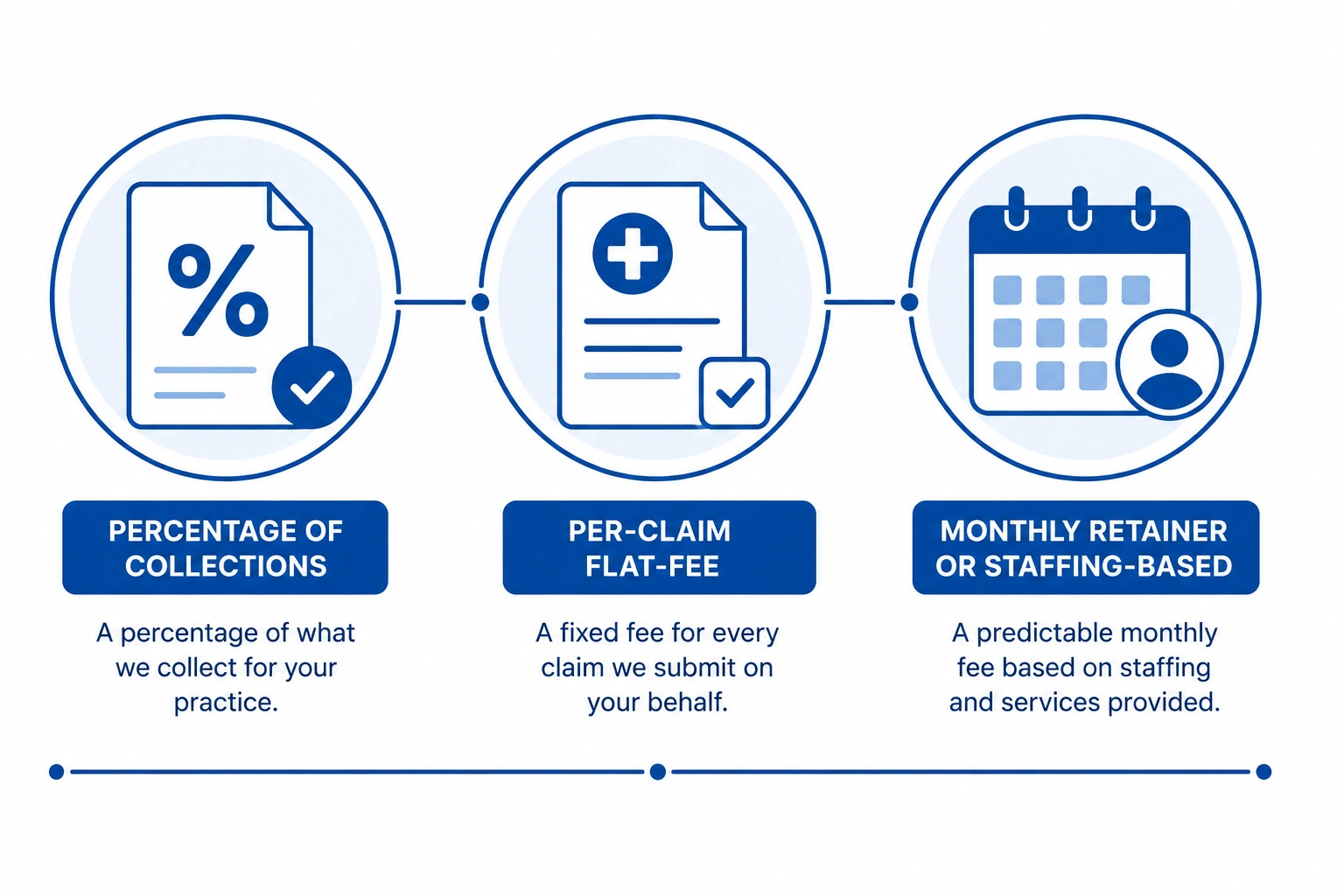
Pennsylvania billing companies price their services three main ways: a percentage of what they collect, a flat rate per claim, or a monthly retainer based on staffing. Nearly every medical billing company Pennsylvania pricing sheet falls into one of these three structures, or some blend of them, and the right model for medical billing pricing Pennsylvania practices depends on claim volume and average claim value — see our transparent pricing for how these models compare on an actual rate card.
Percentage-of-Collections Pricing
Percentage-of-collections is the most common pricing model in Pennsylvania, and it means the billing company earns a percentage of collections — a set share of whatever it actually brings in on your behalf — with nothing collected, nothing charged. Most Pennsylvania vendors price this between 4% and 9% of net collections, with simpler specialties like primary care toward the lower end and higher-complexity specialties toward the upper end.
The appeal of this model is aligned incentives: the billing company only gets paid when your practice gets paid, so it has a direct financial reason to chase denials and follow up on aging claims. The trade-off is that a practice with a low denial rate and a clean claim rate above 95% may pay more under this model than it would per-claim, since the vendor is paid on total revenue rather than volume of work. Knowing typical medical billing percentage fees in advance makes it easier to spot a quote that’s out of line with the Pennsylvania market.
Per-Claim (Flat-Fee) Pricing
Per-claim pricing charges a fixed dollar amount for every claim submitted, regardless of how much that claim eventually pays. In Pennsylvania, medical billing cost per claim under this model typically runs $4 to $8, though complex claims with heavy documentation requirements can push toward the higher end.
This flat-fee billing approach works well for practices with high-dollar claims, since a $6 flat fee on a $3,000 surgical claim is a fraction of what a percentage model would charge. It’s also easier to budget month to month, since the fee doesn’t move with a strong or slow collections period. The downside is a misaligned incentive: a vendor earns the same $6 whether the claim pays in full or gets denied outright, so confirm what denial follow-up is actually included before signing — it isn’t automatic the way it is under percentage-based pricing.
Monthly Retainer / Staffing-Based Pricing
A monthly retainer charges a fixed fee, often tied to the number of dedicated billing staff assigned to your account, rather than a percentage of collections or a per-claim rate. This model gives practices predictable, salary-like billing expenses without carrying the staff in-house.
Retainer pricing tends to fit larger practices or multi-provider groups with steady, high claim volume, where a percentage fee would add up to more than a staffing-based rate. It’s less common for solo and small practices, since a retainer assumes enough volume to justify a dedicated team. Before agreeing to a retainer, ask exactly which tasks are covered — coding, claim submission, denial appeals, patient statements — because scope varies widely, and a low headline fee can hide gaps that shift real work back onto your front desk.
Average Medical Billing Services Cost Pennsylvania in 2026
The average medical billing services cost Pennsylvania practices pay in 2026 runs 4% to 9% of monthly collections for percentage-based pricing, or $4 to $8 per claim under flat-fee models, consistent with current industry benchmarking. Most competitive quotes for small and mid-sized Pennsylvania practices land between 5% and 7%.

So how much does it cost to outsource medical billing for a typical practice? For a solo or small practice collecting $500,000 a year, a 6% rate works out to roughly $30,000 annually. A multi-provider group collecting $3 million might negotiate down to 4–5% given its volume, while a high-complexity specialty practice with heavier prior authorization and appeal work could land closer to 9%.
These figures are industry-wide benchmarks, not a guaranteed quote — the number your specific practice pays depends on your denial rate, your current clean claim rate, and how much of your revenue moves through Pennsylvania Medicaid versus commercial payers. Outsource medical billing cost estimates are only useful once they’re grounded in your actual claim volume and payer mix, which is why generic national percentages rarely match what a Pennsylvania practice ends up paying.
In-House vs. Outsourced: Comparing Medical Billing Services Cost Pennsylvania Options
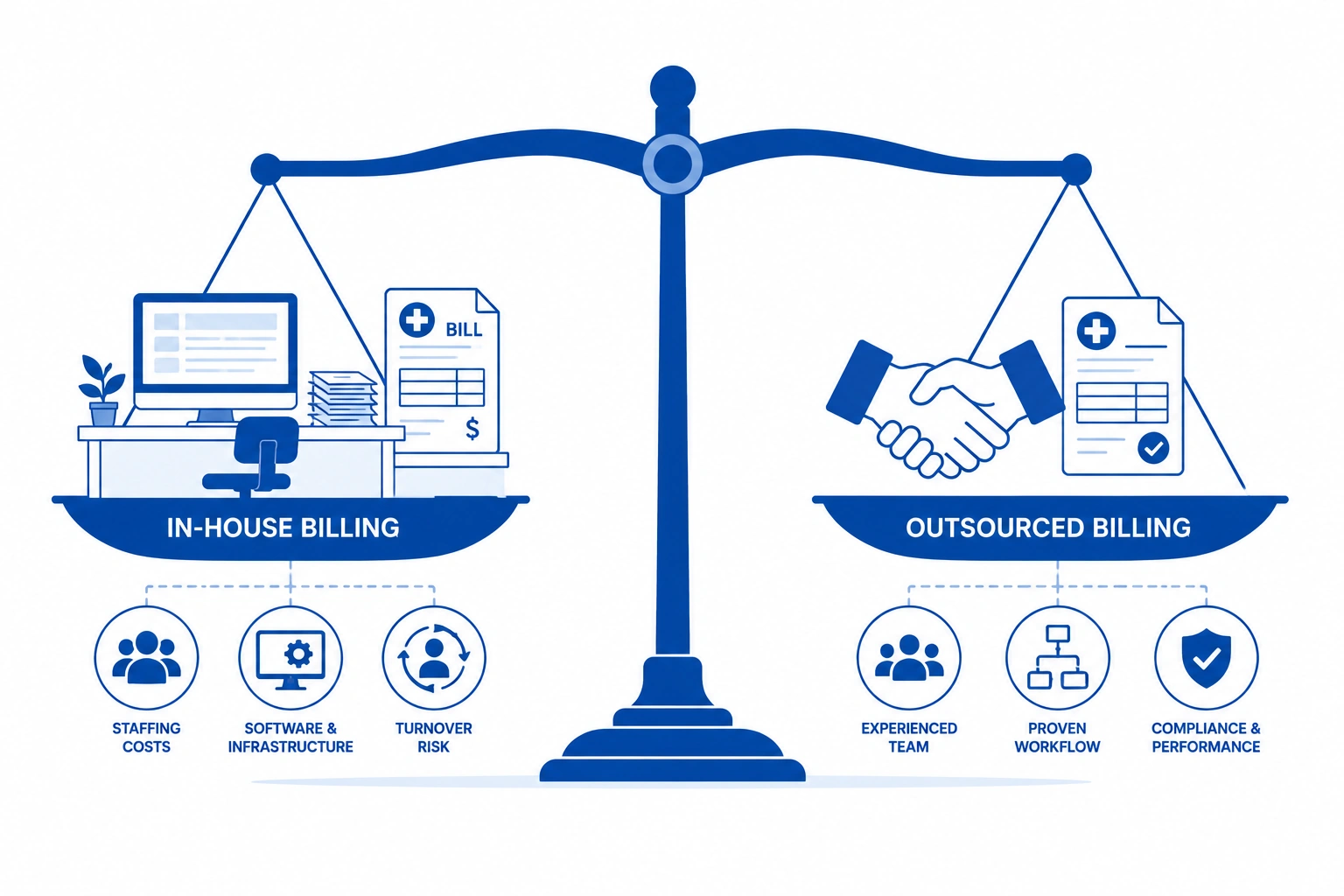
Comparing medical billing services cost Pennsylvania options side by side means looking past the headline percentage and counting everything in-house billing actually requires: salaries, benefits, software licenses, and the cost of turnover when a trained biller leaves. Once those are added up, in-house billing typically runs 10% to 14% of collections fully loaded, even though a biller’s salary alone looks cheaper than an 8% outsourced fee. A fair outsource medical billing cost comparison has to include all of that overhead, not just the sticker price of a paycheck.
Is outsourcing medical billing worth it for every Pennsylvania practice? Not automatically — high-volume practices with a stable, experienced in-house team and low staff turnover can sometimes match or beat outsourced pricing. But for most small and mid-sized practices, especially those juggling Pennsylvania Medicaid claims alongside Highmark and other commercial payers, outsourcing tends to win on both cost and accounts receivable (A/R) performance, since dedicated billing companies typically resolve claims faster and carry lower denial rates than an in-house team stretched across other front-desk duties.
In-House vs. Outsourced Medical Billing Costs in Pennsylvania
| Cost Factor | In-House Billing | Outsourced Billing |
|---|---|---|
| Typical Cost | ~10–14% of collections, fully loaded (salary, benefits, software, turnover) | ~4–9% of collections, or $4–$8 per claim flat-fee |
| Staffing Risk | High — turnover resets institutional knowledge | Low — vendor absorbs staffing and coverage risk |
| Typical Denial Rate | Often 12–18% industry-wide | Typically 2–8% at specialized vendors |
| Best Fit | High-volume practices (25,000+ claims/year) with a stable, experienced team | Small–mid practices, specialty practices, PA Medicaid-heavy panels |
Source: Figures reflect industry-benchmark ranges consistent with HFMA revenue cycle outsourcing guidance and national billing-cost surveys; individual results vary by practice. These are not TMS Billings-specific guarantees.
What Affects Your Medical Billing Services Cost in Pennsylvania
Your medical billing services cost in Pennsylvania is shaped less by a national average and more by which payers make up your panel. Highmark, Independence Blue Cross, and UPMC Health Plan each have their own prior authorization rules, claim-edit logic, and appeal timelines, and a billing team that doesn’t already know those rules spends more staff time per claim — time that shows up in your fee.
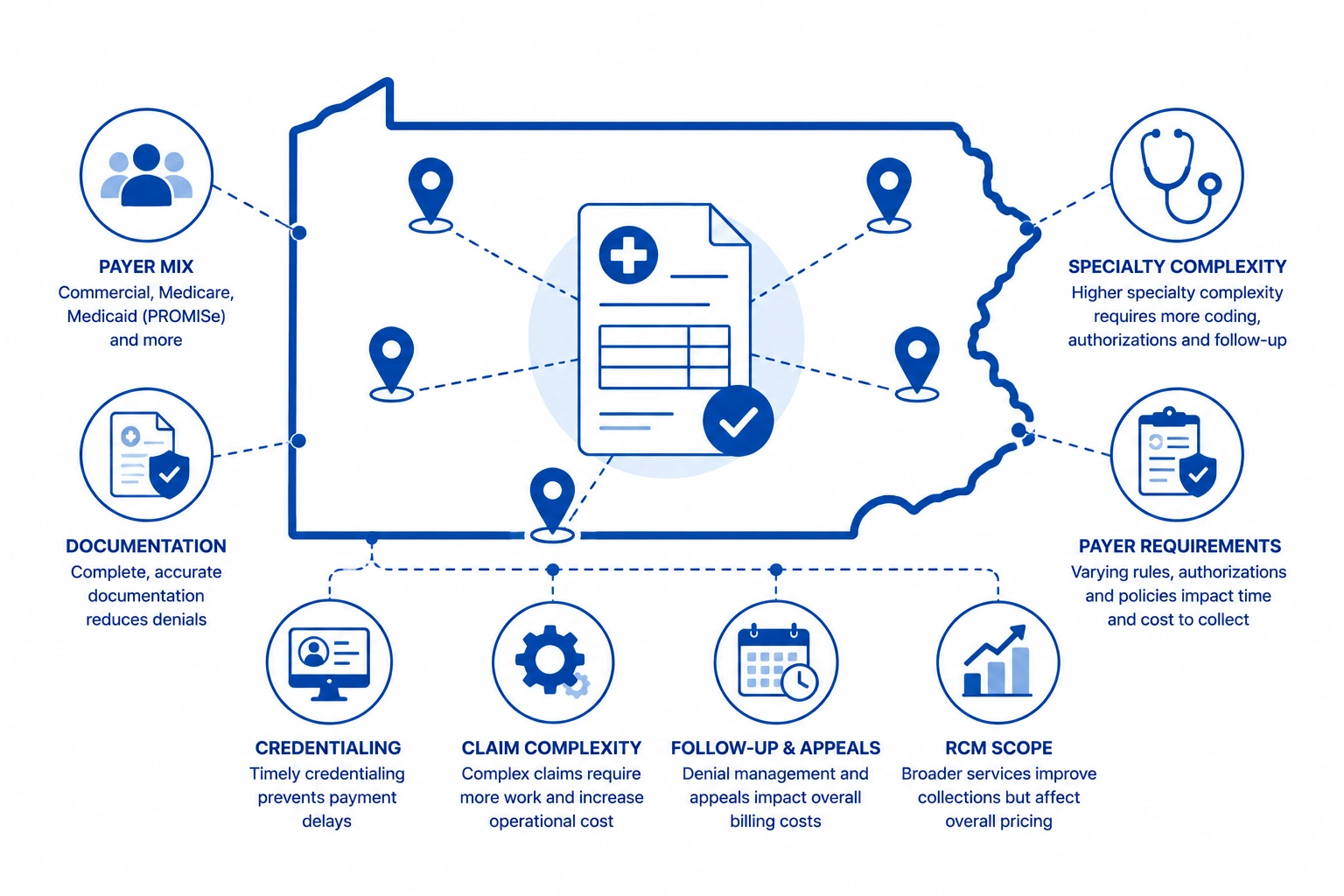
PA Medicaid billing complexity adds another layer most national cost guides never mention. Claims run through PROMISe, Pennsylvania’s Medicaid Management Information System, and practices with behavioral health services face additional carve-outs through ODP and OMHSAS. The Pennsylvania Department of Human Services publishes official PROMISe billing guidance, and practices with a Medicaid-heavy panel typically see higher per-claim effort — and sometimes higher fees — because PROMISe claims carry stricter documentation and timely-filing requirements than most commercial payers.
Specialty also matters: specialty-specific billing expertise reduces first-pass denials for complex coding areas like behavioral health or orthopedics. Credentialing status, HIPAA compliance requirements, and whether your billing partner offers full revenue cycle management services or claims-only support all shift the final price too.
How to Choose a Billing Partner Without Overpaying
Choosing the right medical billing company Pennsylvania practices can trust starts with comparing scope, not just the percentage on the quote — and knowing typical medical billing pricing Pennsylvania vendors charge helps you spot an outlier fast. Two vendors quoting 6% can deliver very different value if one includes denial management, credentialing support, and patient billing while the other only submits claims and stops there.
Ask each medical billing company Pennsylvania candidates to disclose their average clean claim rate, typical days in accounts receivable, and denial rate for practices similar to yours — real vendors track and share these numbers. Request references from other Pennsylvania practices, ideally ones with a similar payer mix, since a vendor strong with commercial claims isn’t automatically strong with PROMISe.
Watch for contracts with long lock-in periods, minimum monthly fees regardless of collections, or vague language about what’s “included.” Our billing solutions for small practices are built to be transparent about pricing before you sign, not after your first invoice arrives. The cheapest quote on paper is rarely the cheapest option once denials, delays, and hidden scope gaps are factored in.