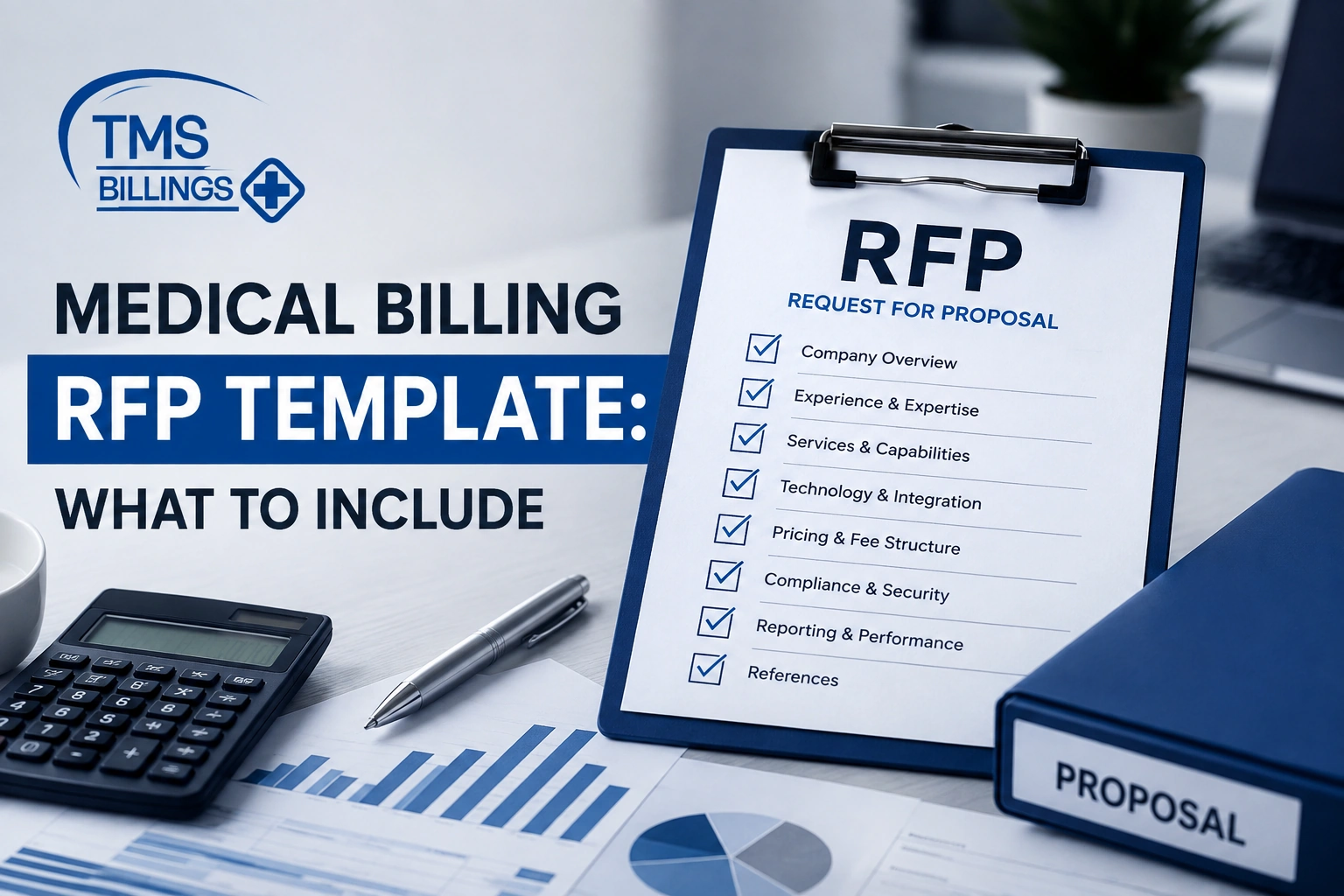
Medical Billing RFP Template: What to Include When Comparing Vendors
Written by: TMS Billings Coding & Compliance Team — CPC- and CPB-certified billing and coding specialists with a combined 15+ years across primary care, specialty, and behavioral health billing. Reviewed by: Angela Ruiz, CPC, CPCO — Compliance Reviewer, TMS Billings
Three vendor proposals are open on the desk, and a medical billing RFP template is the only thing that’s going to make them comparable. One bundles denial management into the base fee. Another calls it an add-on. A third skips it entirely, with no way to tell if that’s an oversight or a hidden cost. This is exactly the problem a structured RFP for medical billing services is built to solve — it forces every vendor to answer the same questions, in the same order, so a practice manager can compare pricing, compliance, and technology side by side instead of guessing at what “full-service billing” actually means.
This guide covers what a strong RFP for medical billing services should include, the specific questions worth asking, and a ready-to-use scoring rubric for evaluating responses once they land back on your desk. Bookmark it as a free medical billing RFP template and medical billing RFP checklist, with a section built specifically for behavioral and mental health practices, where CPT code depth and payer-specific documentation rules can make or break a vendor relationship.
A medical billing RFP template is a structured document practices use to request and compare proposals from medical billing vendors, covering scope of services, compliance, technology, pricing, and references — so every vendor answers the same questions and responses can be evaluated side by side.
What Is a Medical Billing RFP Template?
A medical billing RFP template is a standardized set of questions and required documents that a practice sends to potential billing vendors, structured so every response can be compared apples-to-apples. RFP stands for request for proposal (RFP) — a formal ask for vendors to submit details on their services, pricing, and qualifications, rather than a general sales pitch.
Without a template, vendor proposals arrive in wildly different formats. One vendor leads with a glossy overview of its account managers. Another jumps straight into a fee schedule. A third skips compliance details entirely, assuming you’ll ask if you care. A template solves this by requiring the same sections from every vendor: company background, scope of services, compliance and HIPAA safeguards, technology, pricing, and references.
For practices comparing multiple billing companies, that consistency matters more than any single answer. A vendor’s pricing only means something once you know exactly what’s included in it, and you can only know that if every vendor is answering the exact same question in writing.
Why Use an RFP Template to Compare Medical Billing Vendors
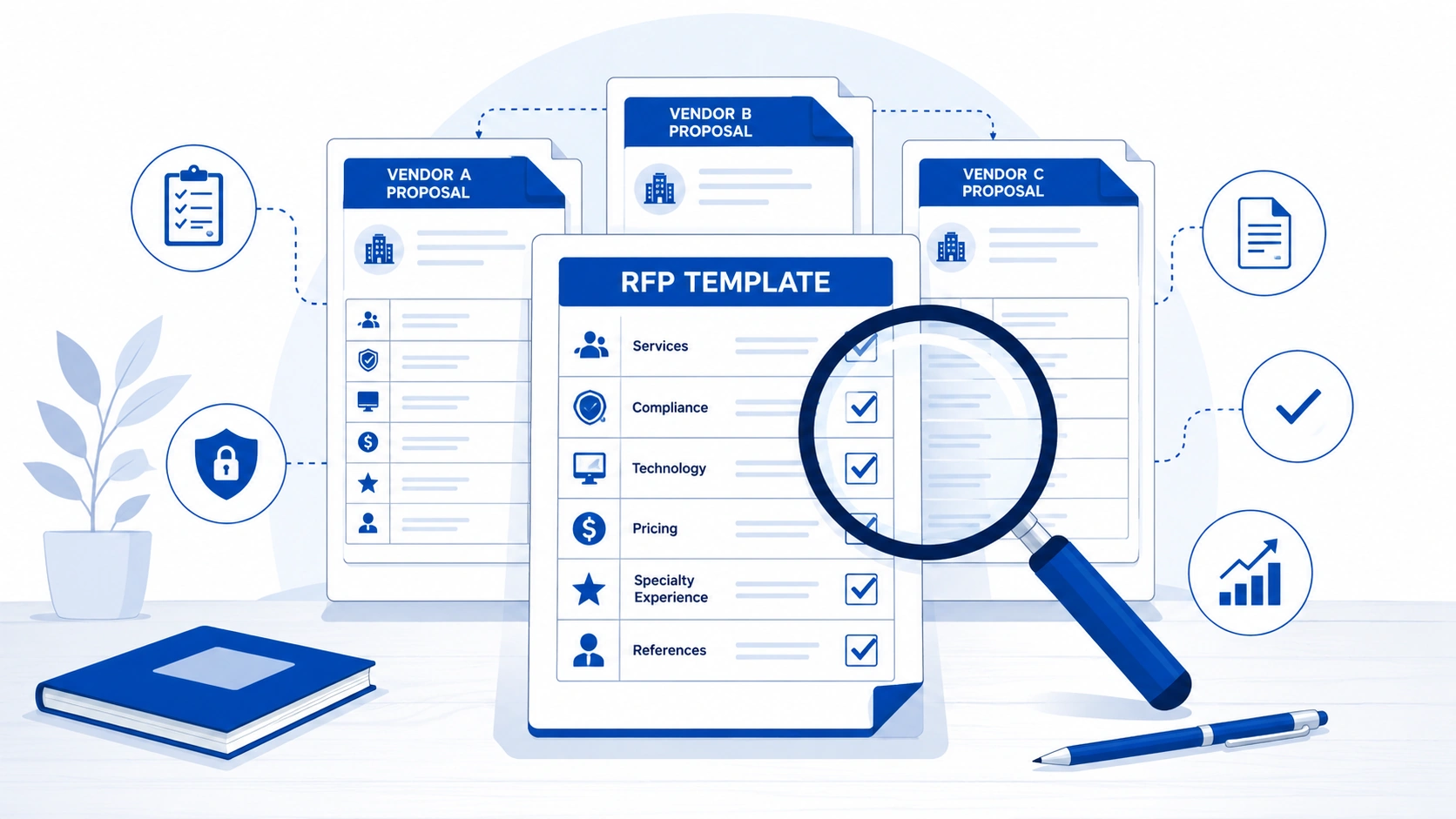
An RFP template turns a vague vendor search into a structured medical billing vendor comparison. Instead of taking each proposal at face value, you’re scoring the same categories across every vendor, which makes it harder for polished sales language to hide a weak compliance program, a confusing fee structure, or gaps in revenue cycle management (RCM) reporting.
Industry guidance backs up the formal approach.The best way for a practice to assess potential vendors is through a request for proposal process, according to a director of healthcare finance policy for the Healthcare Financial Management Association (HFMA), who recommends soliciting proposals from at least three or four vendors to get a feel for the market. That gives you a real market baseline for pricing and service levels instead of one vendor’s version of “standard.”
If you’re still figuring out how to choose a medical billing company, the RFP process does a lot of that thinking for you — it surfaces gaps in a vendor’s compliance program, technology stack, or specialty experience before you’ve signed anything.
What to Include in a Medical Billing RFP Template
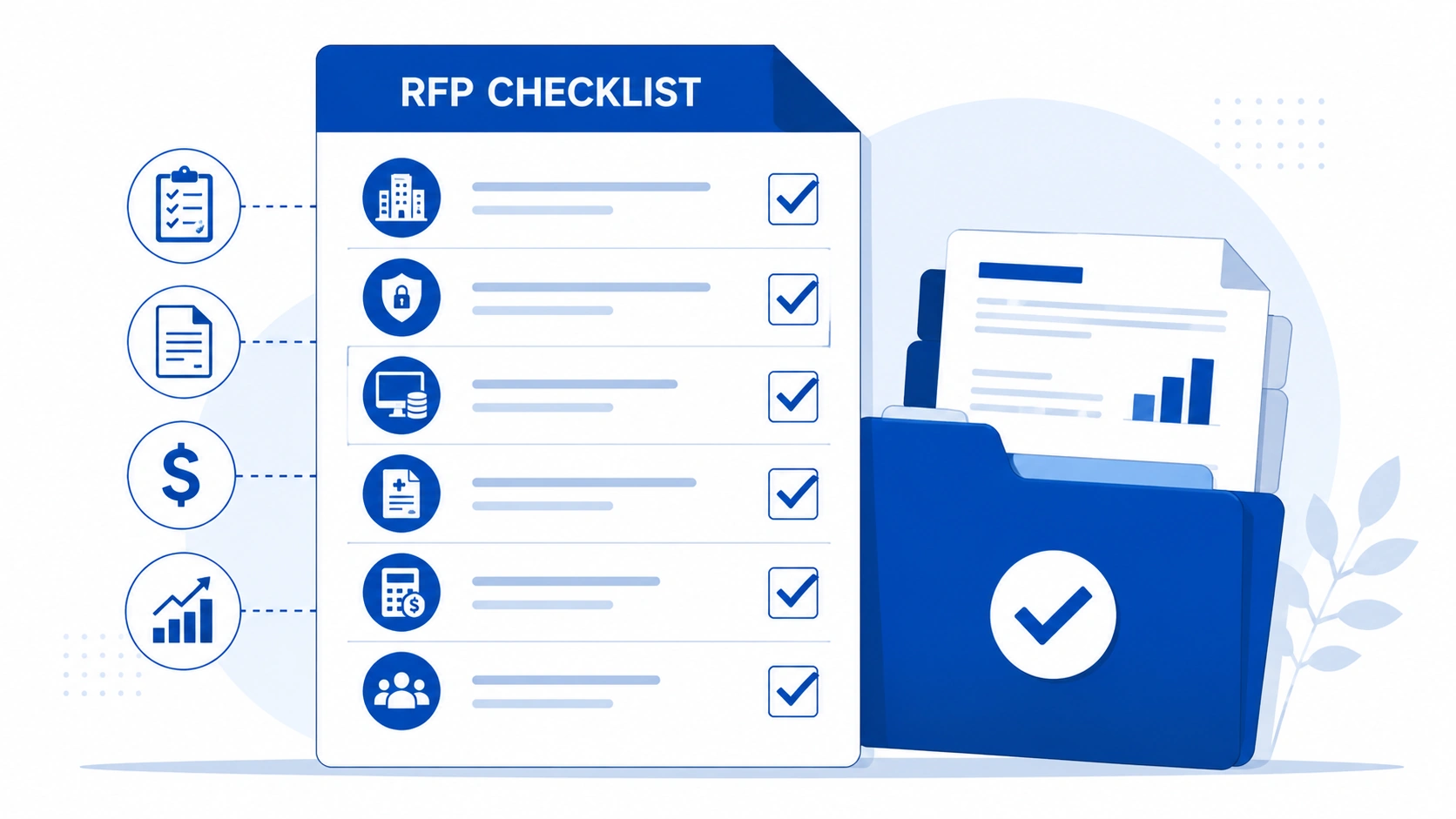
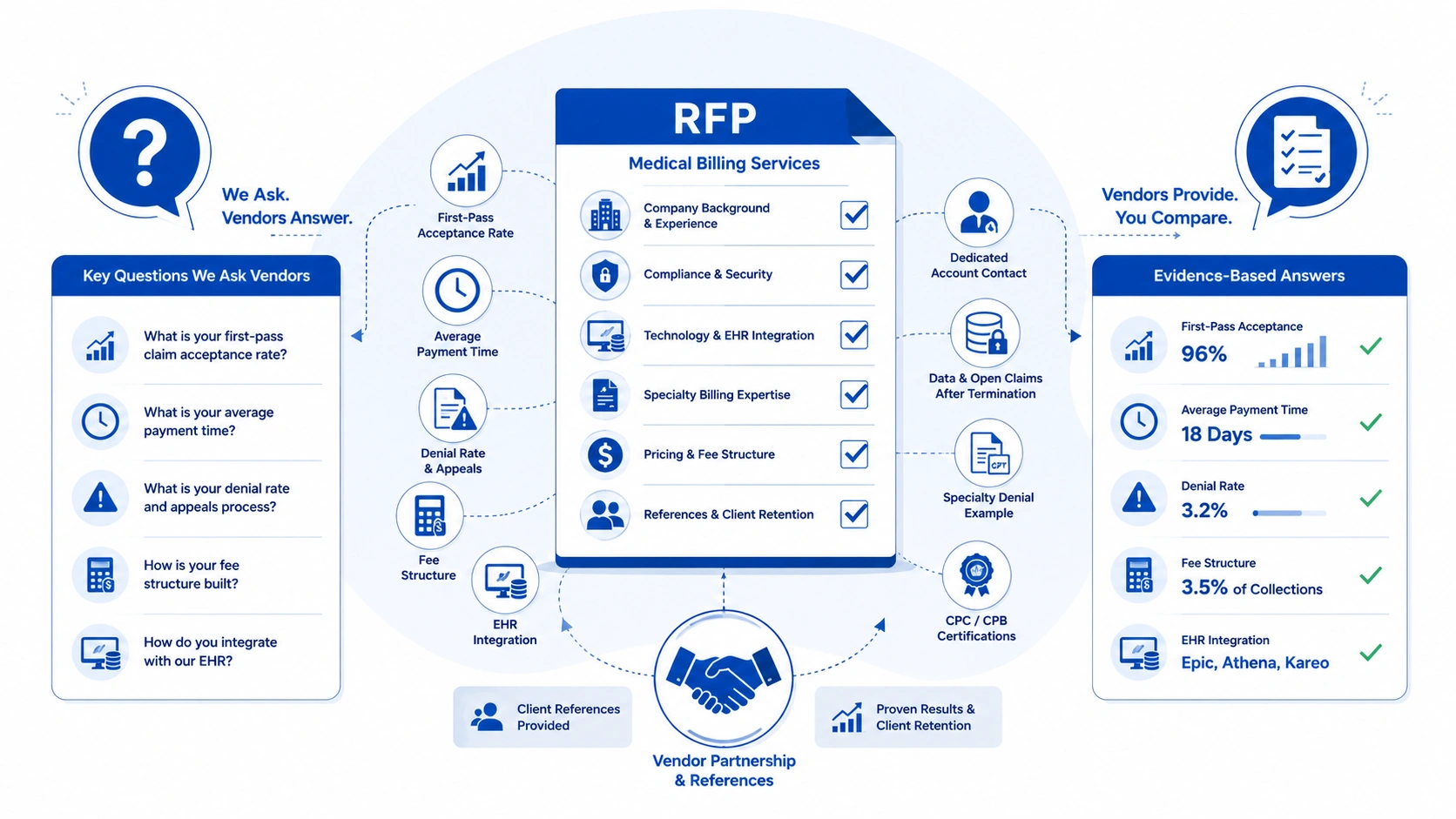
A complete medical billing RFP template covers six areas: company background, compliance and security, technology, specialty expertise, pricing, and references. Each section below breaks down what to ask for and why it matters.
Company Background & Industry Experience
Start by asking each vendor to describe its history, size, and the specialties it actually bills for — not just a general claim of “full-service billing.” Ask how long the company has operated, how many practices your size and specialty it currently serves, and what percentage of its client base has stayed for more than three years.
Independent RFP guidance lists organization background as a core component of a medical billing RFP, covering values, specialties served, and current billing processes — because a vendor’s experience with your specific patient mix predicts how quickly they’ll get your claims paid correctly. A billing company that mostly handles primary care claims may struggle with the coding nuances of an orthopedic or behavioral health practice, even if its general RFP for medical billing services reads well on paper.
Request three current client references you can actually call, not just names on a slide.
Compliance, Security & HIPAA Safeguards
Every vendor should walk through its HIPAA compliance program without hesitation — this isn’t optional detail, it’s the section that protects your practice from liability if something goes wrong. Ask for a signed Business Associate Agreement (BAA), a summary of how patient data is encrypted in transit and at rest, and a description of any security incidents in the past five years, including how they were resolved.
Ask about staff training frequency, access controls, and whether the vendor carries cyber liability insurance. A vendor that gets vague about any of these questions is telling you something important before you’ve signed a contract.
This section should also cover audit rights — your ability to review the vendor’s compliance documentation on an ongoing basis, not just at onboarding.
Technology, EHR/EMR Integration & Reporting
Ask exactly how the vendor’s system connects to your existing setup — real EHR/EMR integration is very different from a vendor who manually re-keys data from exported reports. Manual re-entry introduces errors and slows down claims scrubbing before submission, which is one of the biggest levers on your first-pass acceptance rate.
Request a sample of the reporting dashboard, including how often it refreshes and which metrics are tracked by default — accounts receivable aging, denial rate by payer, and days in AR are the ones that matter most. Ask whether reporting is self-service or something you have to request from an account manager each time.
Confirm what happens to your data and reporting history if you ever switch vendors — that transition question gets overlooked until it’s urgent.
Specialty Billing Expertise
Generic billing experience doesn’t automatically transfer to your specialty, and this is where RFP responses often fall apart under closer questioning. Ask each vendor to name the CPT codes they bill most often for practices like yours, and to walk through how they handle a claim denied for a documentation issue specific to your specialty.
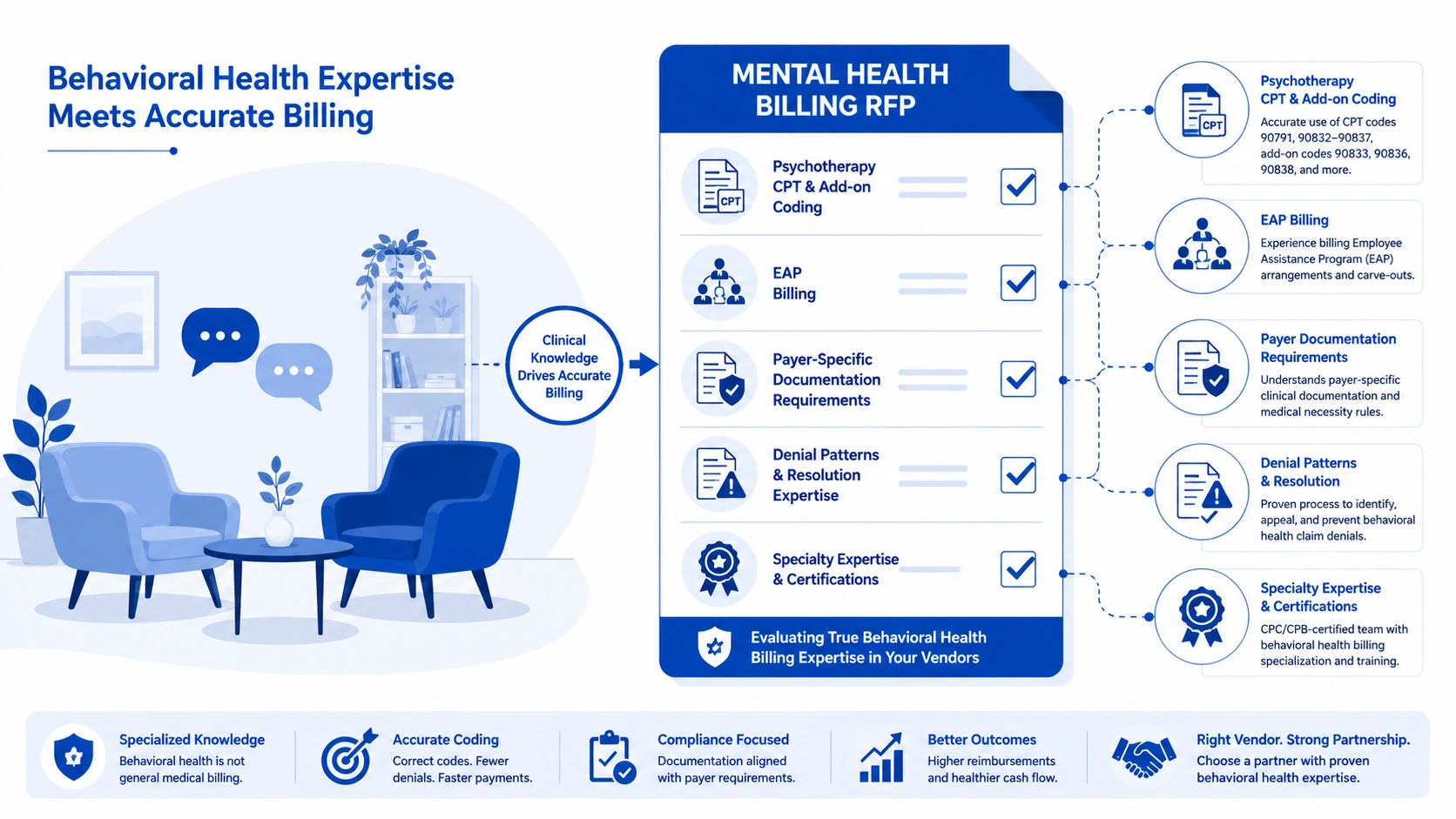
This matters most for behavioral and mental health practices. A medical billing RFP for mental health practices needs to dig into psychotherapy add-on codes, EAP billing arrangements, and payer-specific documentation rules that general billing companies routinely miss. Ask directly about a vendor’s specialty billing for behavioral health practices rather than assuming it’s covered under “we bill for all specialties” — specialty billing expertise is easy to claim and hard to prove without specific examples.
If a vendor can’t speak fluently about your specialty’s denial patterns, that’s worth weighing heavily.
Pricing, Fee Structure & Contract Terms
Ask each vendor to lay out its complete fee structure in writing: percentage of collections versus flat per-claim pricing, startup or implementation fees, monthly minimums, and termination fees if you end the contract early. A percentage-based fee sounds simple until you learn it applies to gross charges instead of actual collections — a meaningful difference in what you’ll pay.
Request the contract length, renewal terms, and any service level agreement (SLA) covering claim submission turnaround and support response times. These details belong at the center of your medical billing vendor evaluation criteria, since a lower headline rate can still cost more once startup fees, minimums, and slower turnaround are factored in.
Ask what happens to outstanding claims and data if the relationship ends — that clause matters more than it seems at signing.
Key RFP Questions to Ask Medical Billing Vendors
The most useful questions to ask medical billing vendors are the ones that force specifics instead of marketing language. Build your RFP around questions that require examples, numbers, or named references, not yes-or-no answers.
Consider including:
- What is your average first-pass claim acceptance rate, and how is it calculated?
- How many active clients share our specialty, and can we speak with three of them?
- What is your average time from claim submission to payment?
- How do you calculate and report denial rate, and what’s your process for appeals?
- What does your fee structure include, and what triggers an additional charge?
- How does your system integrate with our specific EHR or practice management software?
- Who is our dedicated point of contact, and what is their average caseload?
- What happens to our data and open claims if we terminate the contract?
- Can you describe a claim that was denied for a reason specific to our specialty, and how you resolved it?
- What certifications do your billers and coders hold (CPC, CPB, or equivalent)?
Vague answers to any of these are worth following up on directly — a vendor who can’t produce a number probably doesn’t track it internally, which says something about their reporting discipline.
How to Score and Compare Vendor RFP Responses
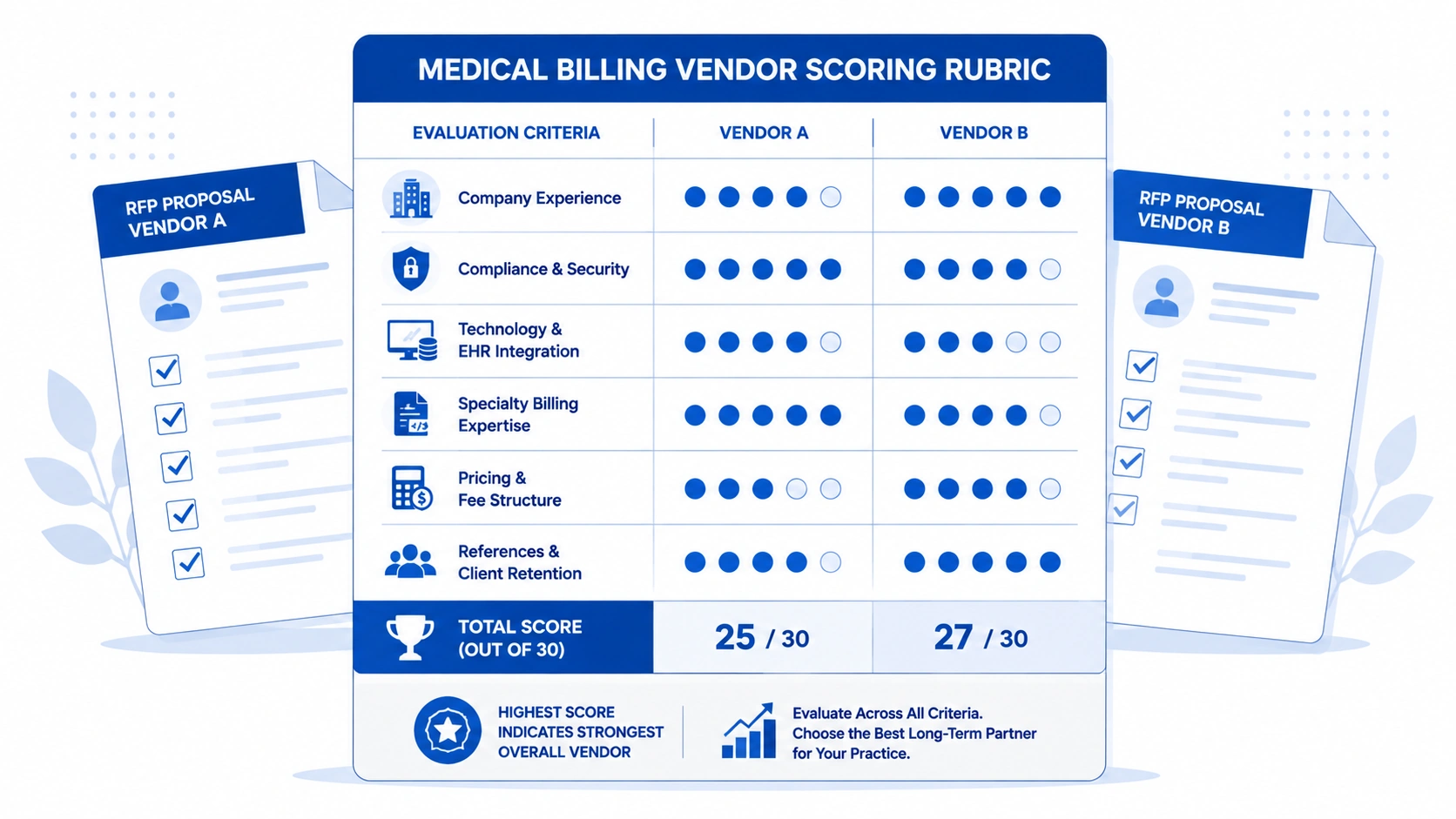
Once responses come in, the fastest way to compare them fairly is a simple vendor scorecard — score each vendor on the same criteria, using the same scale, before looking at the total. This keeps a polished proposal or an aggressive sales call from outweighing a vendor that’s actually stronger on compliance or technology.
Use a 1–5 scale for each category in your medical billing RFP template, where 5 means the vendor fully meets or exceeds the requirement and 1 means they don’t meet it at all. Score every vendor on one category before moving to the next — scoring category by category, rather than vendor by vendor, keeps you from being swayed by whichever proposal you read last. References and client retention numbers are worth weighing here too, since they reflect real performance rather than a proposal’s promises.
The table below is the core of how to compare medical billing companies once proposals are in hand. Leave the score column blank and fill it in as you review each response, then total the columns to see how vendors stack up.
Medical Billing RFP Template Scoring Rubric
| Evaluation Criteria | What to Look For | Score (1–5) |
|---|---|---|
| Company Background & Experience | Years in business, relevant specialty experience, client retention rate | |
| Compliance & Security | HIPAA safeguards, signed BAA, breach/incident history | |
| Technology & EHR Integration | Compatibility with your EHR, claims scrubbing, real-time reporting dashboard | |
| Specialty Billing Expertise | CPT code depth for your specialty, payer-specific documentation rules | |
| Pricing & Fee Structure | Percentage vs. flat fee, startup/termination fees, contract length | |
| References & Client Retention | Verified references, average client tenure |
A vendor that scores well across every row of these medical billing vendor evaluation criteria — not just on price — is the one most likely to actually deliver on what its proposal promises.
Common Mistakes to Avoid With Your Medical Billing RFP Template
Even a well-built medical billing RFP template can lead you to the wrong vendor if you fall into a few common traps during the review process.
Comparing price before compliance. The lowest percentage rate means nothing if the vendor can’t produce a signed BAA or explain its security protocol. Screen out anyone who can’t clear the compliance bar before you look at pricing at all.
Accepting vague answers as “good enough.” A proposal that says it “handles denials efficiently,” with no process or number attached, hasn’t actually answered the question. Push for specifics, and treat evasiveness as data.
Skipping reference calls. Names on a page mean little. A five-minute call with a current client, asking directly about response times and billing accuracy, tells you more than another paragraph of marketing copy.
Ignoring the paper trail. Watch for red flags it’s time to switch billing partners even during the RFP stage — inconsistent numbers between sections of a proposal, an unwillingness to put promises in writing, or reluctance to share a sample report are all red flags in a medical billing proposal worth taking seriously before you sign.
Rushing the timeline. Give vendors enough time to submit a thorough response — a rushed proposal often means a rushed relationship once you’re a client. Working through these traps carefully is most of how to choose a medical billing company that actually delivers.