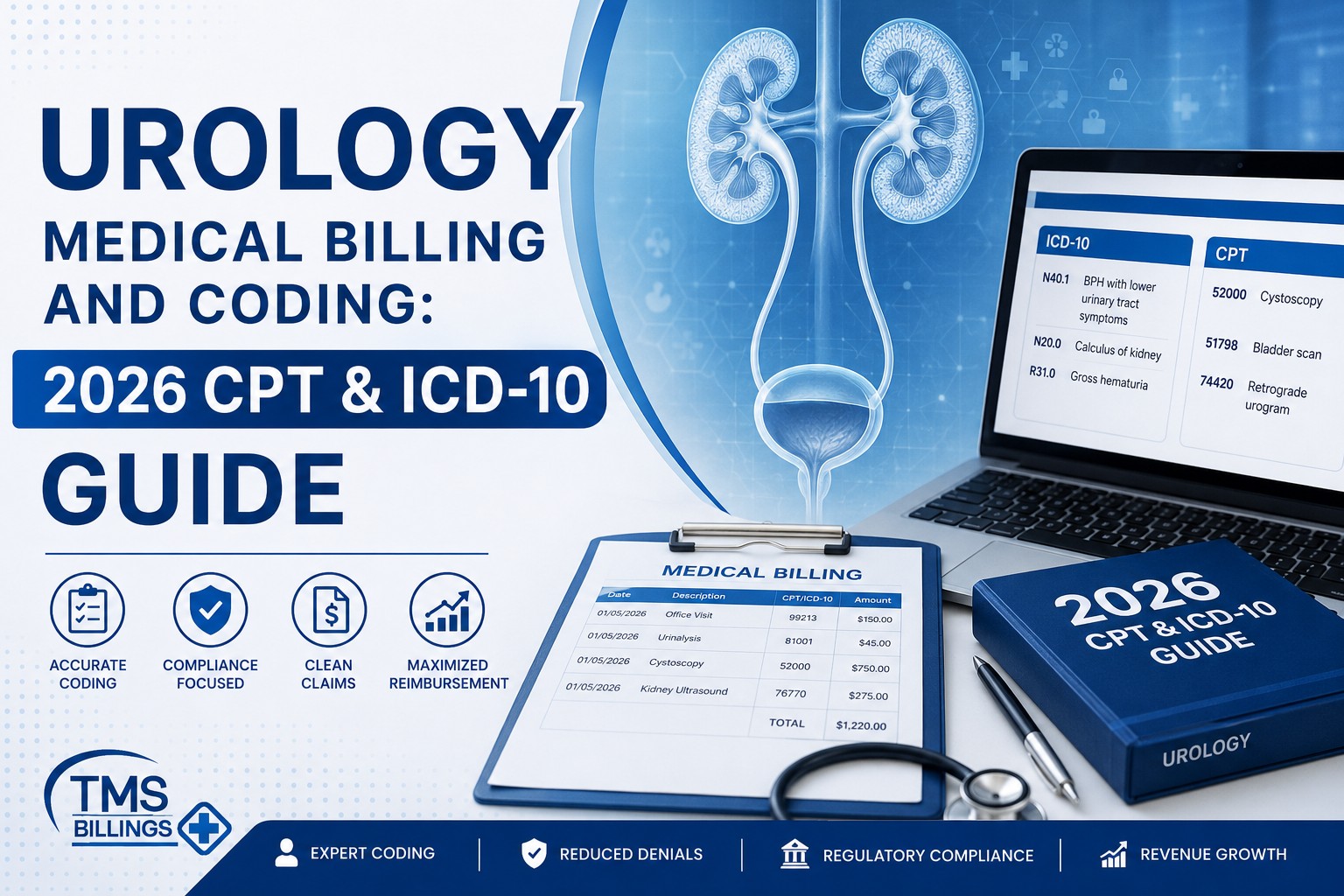

Urology Medical Billing and Coding: 2026 CPT & ICD-10 Guide
If there’s one thing urology practices across the country have in common, it’s this: billing and coding mistakes are quietly draining revenue every single day. Between constantly shifting payer policies, annual CPT updates, and the ever-growing complexity of ICD-10 documentation requirements, even experienced billing teams can find themselves fighting an uphill battle. That’s why staying current with urology medical billing and coding isn’t just good practice — it’s essential for financial survival in 2026.
This guide is built for urologists, billing managers, and practice administrators who want a clear, authoritative walkthrough of what’s changed, what’s stayed the same, and where most practices continue to leave money on the table. Whether you’re dealing with cystoscopy billing, prostate procedure coding, or kidney stone diagnoses, you’ll find practical, actionable guidance here.
Why Urology Billing and Coding Demands Specialized Expertise
Urology is not a generalist specialty. The procedures are highly specific, the documentation requirements are exacting, and payers scrutinize urology claims more closely than most. From lithotripsy to robotic-assisted prostatectomy, each service carries its own set of CPT codes, modifiers, and coverage criteria that can make or break a claim.
Practices that rely on generalist billing staff — or outdated coding references — almost always see higher denial rates, slower reimbursements, and compliance exposure. Specialized knowledge of urology coding guidelines isn’t optional anymore. It’s the difference between a healthy revenue cycle and one that bleeds money through undercoding, unbundling errors, and missed modifiers.
This is precisely why many high-performing urology groups are partnering with dedicated billing services rather than trying to manage everything in-house. Professional urology medical billing support provides the specialized focus that general billing teams simply can’t replicate.
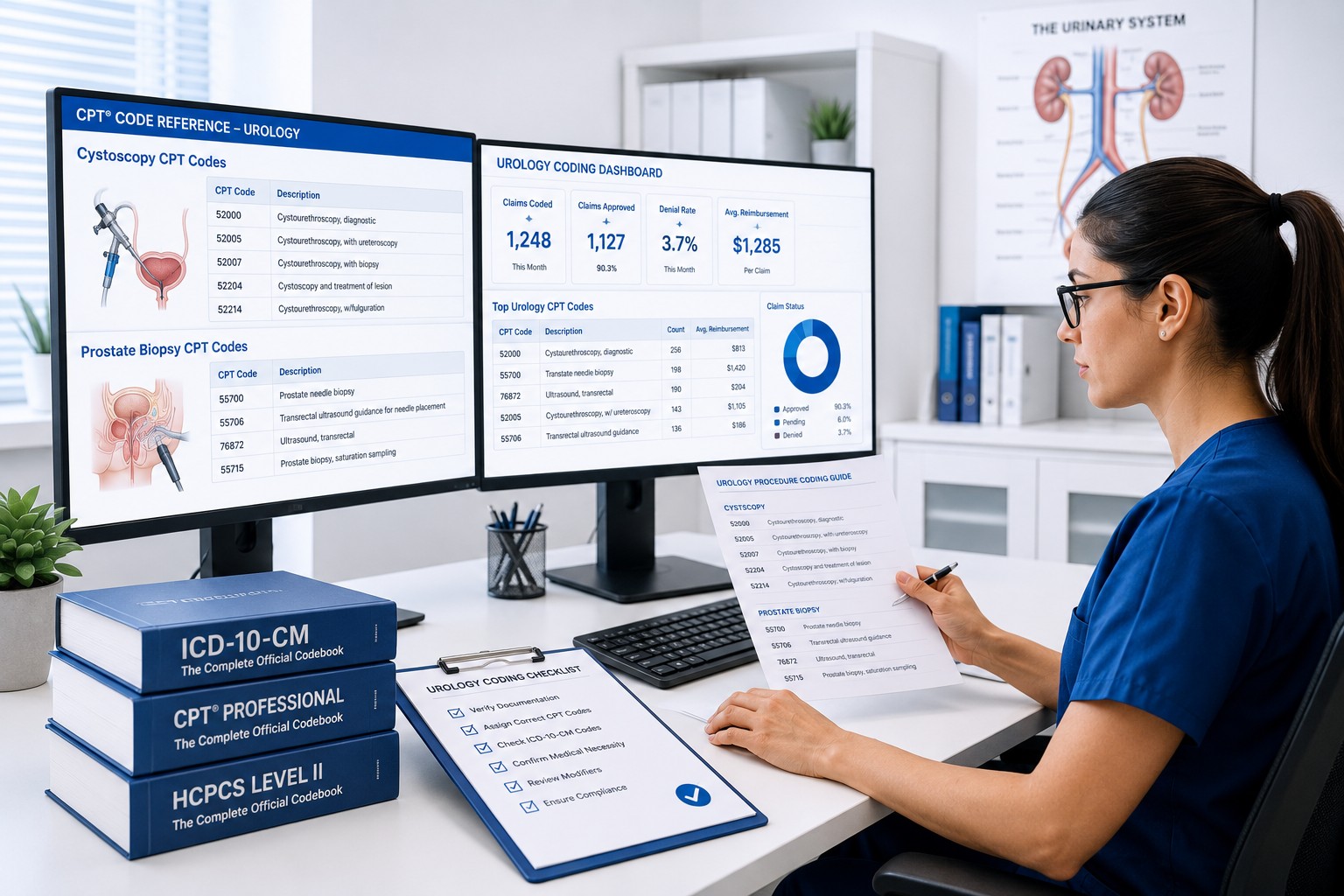
2026 CPT Code Updates Every Urology Coder Must Know
The AMA releases CPT updates annually, and 2026 brought meaningful changes that directly affect urology practices. Here’s a breakdown of the key areas:
Cystoscopy and Endoscopic Procedures
Cystoscopy billing remains one of the highest-volume coding areas in urology, and it’s also one of the most commonly miscoded. The base code for diagnostic cystoscopy is CPT 52000, but complications arise quickly when therapeutic or diagnostic add-ons are performed during the same encounter.
For 2026, coders need to pay close attention to bundling edits associated with cystoscopy. Many payers apply the National Correct Coding Initiative (NCCI) edits that prevent separate billing of certain add-on services without appropriate modifiers. When a urologist performs cystoscopy with ureteroscopy or with biopsy, the correct CPT codes must reflect the exact services rendered — not a single bundled code that undersells the complexity of the encounter.
Key cystoscopy CPT codes to know:
- CPT 52000 – Cystourethroscopy (diagnostic)
- CPT 52204 – Cystourethroscopy with biopsy
- CPT 52332 – Cystourethroscopy with ureteral stent placement
- CPT 52351 – Cystourethroscopy with ureteroscopy, diagnostic
- CPT 52356 – Ureteroscopy with lithotripsy, including ureteral stent placement
When billing these, always ensure the operative note explicitly documents medical necessity and describes the complete procedure — partial documentation is a leading cause of denials and audits.
Prostate Biopsy CPT Codes

Prostate procedures represent a significant portion of urology revenue, and the coding landscape here has evolved in recent years. Prostate biopsy CPT codes underwent notable restructuring with the 2024 updates that continue to shape how 2026 encounters are billed.
The current approach distinguishes between transperineal and transrectal routes, reflecting the shift in clinical practice toward transperineal biopsies:
- CPT 55700 – Prostate biopsy, any method (this code was revised)
- CPT 55706 – Prostate biopsy, transperineal, including image guidance
- CPT 76942 – Ultrasonic guidance for needle placement (separate when applicable)
Coders who haven’t updated their reference materials may still be reaching for outdated codes, which creates claim rejections and potential fraud-and-abuse risk. The distinction between fusion biopsy approaches and standard biopsies is also worth noting for high-volume urology practices.
Urodynamics and Office-Based Procedures
Urodynamics coding continues to require careful attention to component vs. global billing. Many payers have specific policies about whether the technical and professional components can be billed separately, particularly in freestanding office settings versus hospital outpatient departments.
Key codes include:
- CPT 51725 – Cystometrogram, simple
- CPT 51726 – Cystometrogram, complex
- CPT 51772 – Urethral pressure profile
- CPT 51784 – Electromyography of anal or urethral sphincter
Always check modifier 26 (professional component) and TC (technical component) applicability based on your practice’s setting and ownership of equipment.
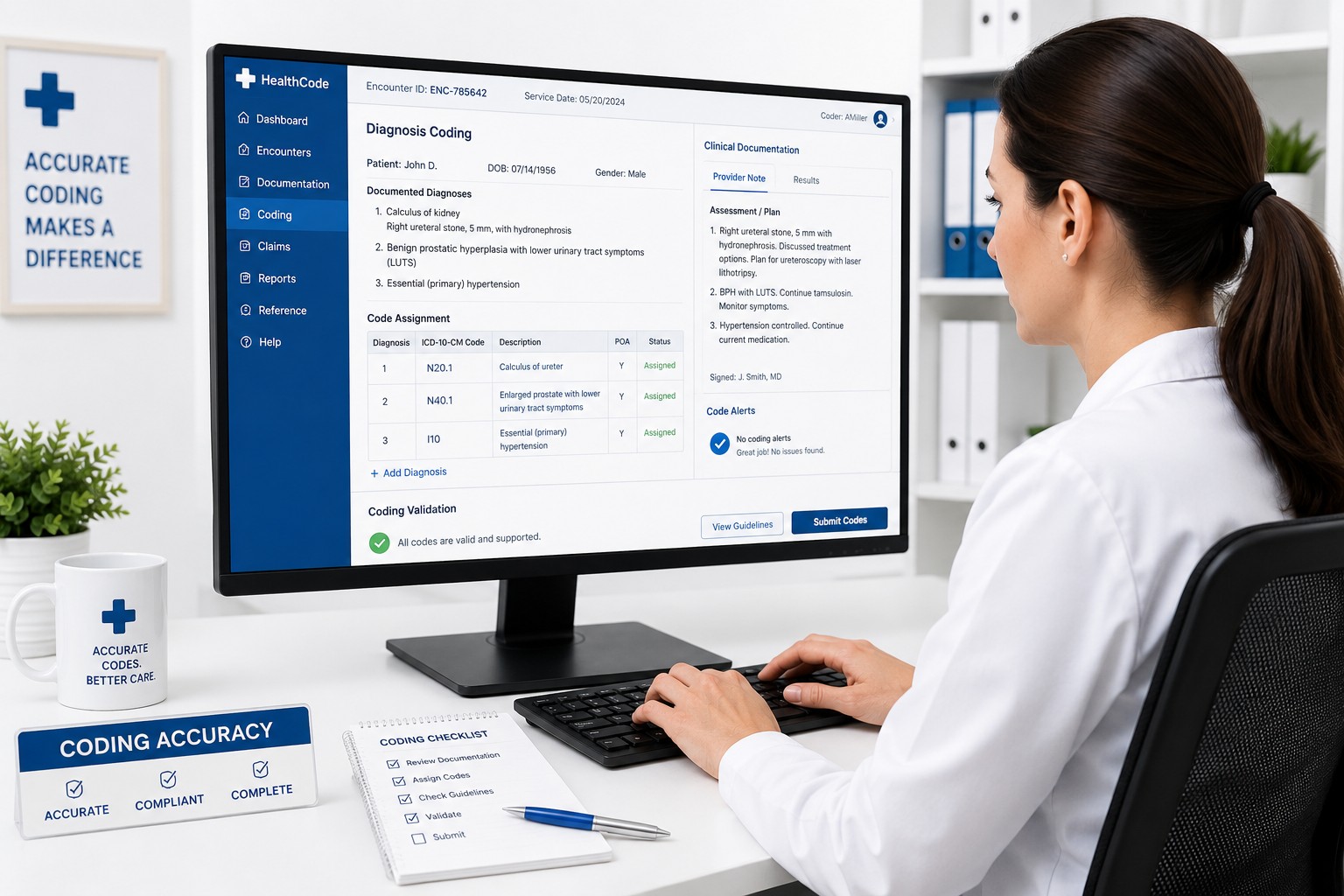
ICD-10 Coding for Urology: Getting the Diagnosis Right
Accurate ICD-10 coding is just as important as getting the CPT codes right. Payers are increasingly applying clinical edits that check for alignment between the procedure performed and the diagnosis code submitted. A mismatch — even when the procedure was clinically appropriate — triggers a denial.
ICD-10 Urology Diagnosis Codes You’ll Use Every Day
Here are some of the most common ICD-10 urology diagnosis codes in 2026:
Kidney Stones:
- N20.0 – Calculus of kidney
- N20.1 – Calculus of ureter
- N20.2 – Calculus of kidney with calculus of ureter
- N21.0 – Calculus in bladder
BPH (Benign Prostatic Hyperplasia):
- N40.0 – Benign prostatic hyperplasia without lower urinary tract symptoms
- N40.1 – Benign prostatic hyperplasia with lower urinary tract symptoms
Bladder Conditions:
- N30.00 – Acute cystitis without hematuria
- N30.01 – Acute cystitis with hematuria
- N32.81 – Overactive bladder
- C67.9 – Malignant neoplasm of bladder, unspecified
Prostate:
- C61 – Malignant neoplasm of prostate
- N42.31 – Prostatic intraepithelial neoplasia I
- Z12.5 – Encounter for screening for malignant neoplasm of prostate
For practices managing urology ICD-10 codes for kidney stones and BPH in high volumes, building a curated, payer-validated code set into your EHR encounter templates can dramatically reduce coding errors at the point of care. Learn more about how dedicated ICD-10 coding services can support your practice’s documentation workflows.
E/M Coding in Urology: What’s Still Tripping Up Practices
The 2021 E/M coding overhaul shifted documentation requirements from time-based counting to medical decision-making (MDM) complexity, and many urology practices are still not fully leveraging this change.
Under the current guidelines, a urologist seeing a patient with recurrent nephrolithiasis, ordering additional imaging, and adjusting a treatment plan is likely justifying a 99214 or even 99215 — but if the provider’s note doesn’t clearly document the complexity of the data reviewed and the risk of the management decision, the coder downcodes to avoid audit risk.
This is leaving real money behind. E/M coding in urology requires providers and coders to work closely together so the documentation actually supports the level of service rendered.
For time-based billing — increasingly used in follow-up consultations and post-operative care — make sure the total time spent on the encounter date is documented clearly, including time spent on charting, care coordination, and counseling outside the face-to-face encounter.
Modifier 25 in Urology: A Common Source of Denials
Few modifiers cause as much confusion — and claim denials — in urology as Modifier 25. This modifier is used when a significant, separately identifiable E/M service is provided on the same day as a procedure or other service.
Consider this common scenario: A patient presents with urinary symptoms, the urologist evaluates the patient (E/M service), and then performs an in-office cystoscopy. Without Modifier 25 appended to the E/M code, the payer bundles both services and reimburses only for the procedure.
However, misuse of Modifier 25 is also one of the top audit triggers for urology practices. The E/M service must be medically necessary and documented independently from the procedure note. If the only documentation of an E/M is a brief line within the procedure note, it won’t survive scrutiny.
Best practices for Modifier 25 in urology:
- Document the E/M service in a separate section of the encounter note
- Clearly distinguish the clinical decision to perform the procedure from the E/M itself
- Train providers on what constitutes a “significant and separately identifiable” service
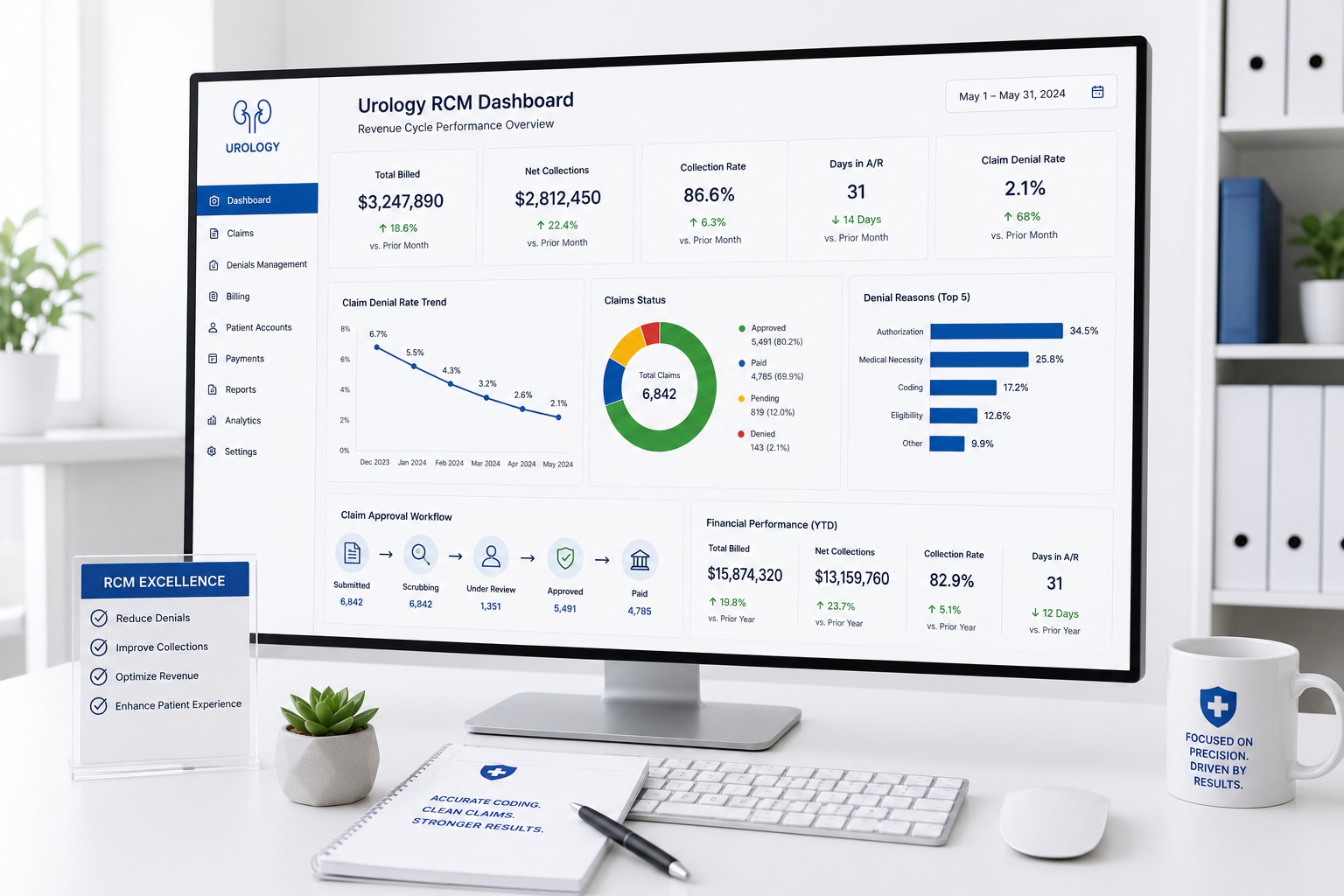
How to Reduce Claim Denials in Urology Billing
Claim denials are expensive — not just in lost revenue, but in the staff time spent working appeals. Urology practices that consistently achieve denial rates below 5% share a few common practices.
Front-End Verification
Most urology claim denials are preventable before the encounter ever happens. Verifying insurance eligibility, confirming prior authorization requirements for procedures like ESWL or robotic surgery, and checking for active coverage for specific urology services eliminates a significant portion of denials at the front end.
Clinical Documentation Integrity
The link between what the physician documents and what the coder submits is where most urology billing mistakes occur. A urologist may perform a complex ureteroscopy with laser lithotripsy and stent placement, but if the operative report doesn’t specify the approach, the laterality, and the medical necessity, the coder either undercodes or codes without adequate support.
Implementing a clinical documentation improvement (CDI) program — even a lightweight one — can meaningfully improve first-pass acceptance rates.
Denial Trend Analysis
Practices that track denial reasons by CPT code, payer, and provider can identify systematic problems quickly. If cystoscopy claims from a specific payer are denying at a higher rate than expected, there may be a policy-specific issue that can be addressed proactively.
For a deeper dive into building a denial reduction strategy, the American Urological Association’s coding resources offer payer-specific guidance and coding reference materials updated annually.
Urology Revenue Cycle Management: The Bigger Picture
Billing and coding accuracy is the foundation, but urology revenue cycle management extends well beyond claim submission. Practices that optimize their full revenue cycle — from patient access to payment posting to denial management — consistently outperform those that focus only on coding accuracy.
Key revenue cycle benchmarks for urology practices in 2026:
- Days in AR: Should be under 35 days for a healthy urology practice
- Net collection rate: Best-performing practices achieve 95–98%
- Denial rate: Under 5% on first submission
- Clean claim rate: Above 95%
If your practice isn’t hitting these benchmarks, the problem may not be coding alone. It could be scheduling workflows, authorization processes, patient financial counseling, or how your billing team handles secondary claims.
The Healthcare Financial Management Association (HFMA) publishes detailed benchmarks for specialty practices that can help you identify where your revenue cycle is losing efficiency.
Common Urology Billing Mistakes and How to Avoid Them
Even experienced teams fall into patterns. Here are the most frequent urology billing mistakes seen across practices in 2025–2026:
1. Unbundling procedures incorrectly. Billing separately for services included in a comprehensive code inflates charges and triggers payer audits. Always cross-check against NCCI edits before submitting multiple procedure codes for the same encounter.
2. Missing or incorrect modifiers. Beyond Modifier 25, laterality modifiers (RT, LT, 50 for bilateral) are frequently omitted on urological procedures involving paired organs. A bilateral orchiectomy billed without Modifier 50 will often be paid at 50% — or denied entirely.
3. Outdated fee schedules. Medicare urology reimbursement rates change annually with the Physician Fee Schedule update. Practices that don’t update their fee schedules and compare against Medicare allowables may be systematically undercharging or failing to identify payer underpayments.
4. Inadequate documentation for medical necessity. Payers increasingly apply automated clinical edits. A claim for prostate biopsy without a supporting PSA result or documented clinical indication in the record can deny even when the procedure was clearly appropriate.
5. Failure to capture all billable services. Many urologists perform ancillary services — bladder instillations, penile injections, urethral dilations — that are billable but frequently not captured because providers don’t think to document them separately.
For practices that want a comprehensive review of their current billing performance, CPT coding services designed specifically for urology can identify revenue leakage and compliance gaps quickly.
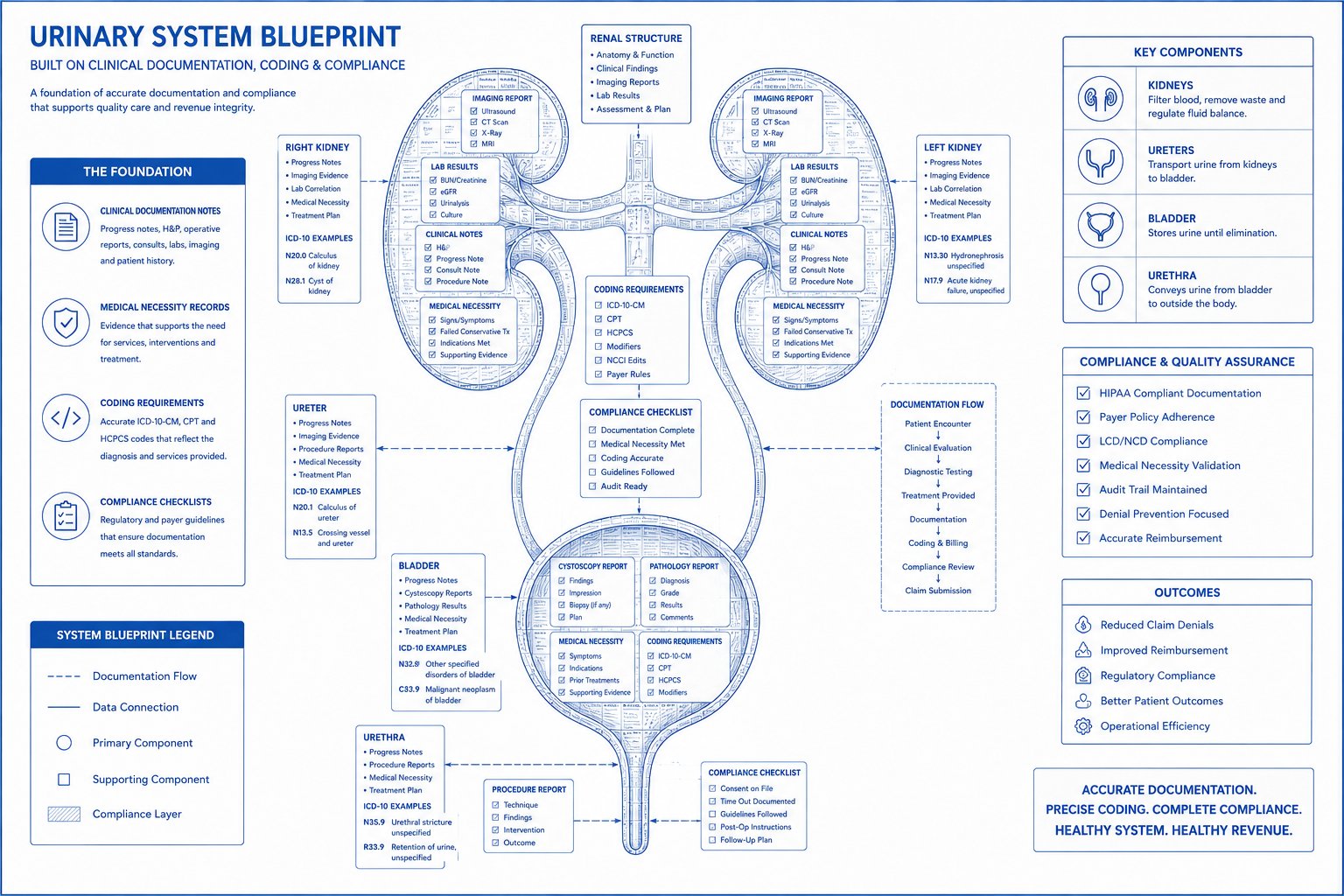
Documentation Requirements: The Non-Negotiable Foundation
Everything in urology medical billing and coding comes back to documentation. No modifier, no CPT code, no ICD-10 combination will hold up to payer scrutiny without solid clinical documentation underneath it.
For surgical and procedural services, the operative report must include:
- Patient identification and procedure date
- Preoperative and postoperative diagnoses
- Name of the procedure(s) performed
- Surgeon name and any assistants
- Detailed description of the technique, findings, and any complications
- Specimen information when applicable
For office-based E/M services, the note must support the selected level through documented history, exam, and medical decision-making (or total time) per current AMA guidelines.
The Centers for Medicare & Medicaid Services (CMS) publishes documentation guidelines and LCD (Local Coverage Determination) policies that are worth reviewing regularly, especially for high-volume urology services like lithotripsy and incontinence procedures.
Choosing the Right Urology Billing Partner for 2026
Given the complexity of urology billing and coding guidelines, many practices are reassessing whether to manage billing in-house or work with a specialized partner. The calculus is shifting. Certified urology coders with current CPT and ICD-10 expertise, dedicated denial management workflows, and real-time analytics dashboards offer a level of sophistication that most in-house teams simply can’t match — especially in smaller to mid-sized practices.
When evaluating a billing partner, look for:
- Coders with CPC or CUC (Certified Urologic Coder) credentials
- Transparent reporting on denial rates, collection rates, and AR aging
- Experience with your specific EMR platform
- Proven track record with urology-specific payers and policies
If you’re exploring what specialized support could do for your practice, our urology medical billing services are built specifically for the complexity that urology demands.
Final Thoughts
Urology medical billing and coding in 2026 is more demanding than it’s ever been — but it’s also more manageable when you have the right knowledge, tools, and team in place. From staying current on prostate biopsy CPT codes to applying Modifier 25 correctly, from accurate ICD-10 coding for kidney stones and BPH to building a denial reduction strategy that actually works, the practices that invest in billing excellence consistently outperform those that treat it as an afterthought.
The financial health of your urology practice depends on clean claims, accurate coding, and a revenue cycle that runs efficiently from end to end. Whether you’re managing billing internally or considering a specialized partner, the most important step is knowing where your current gaps are — and taking action before those gaps become a bigger problem.
Sources and further reading: