
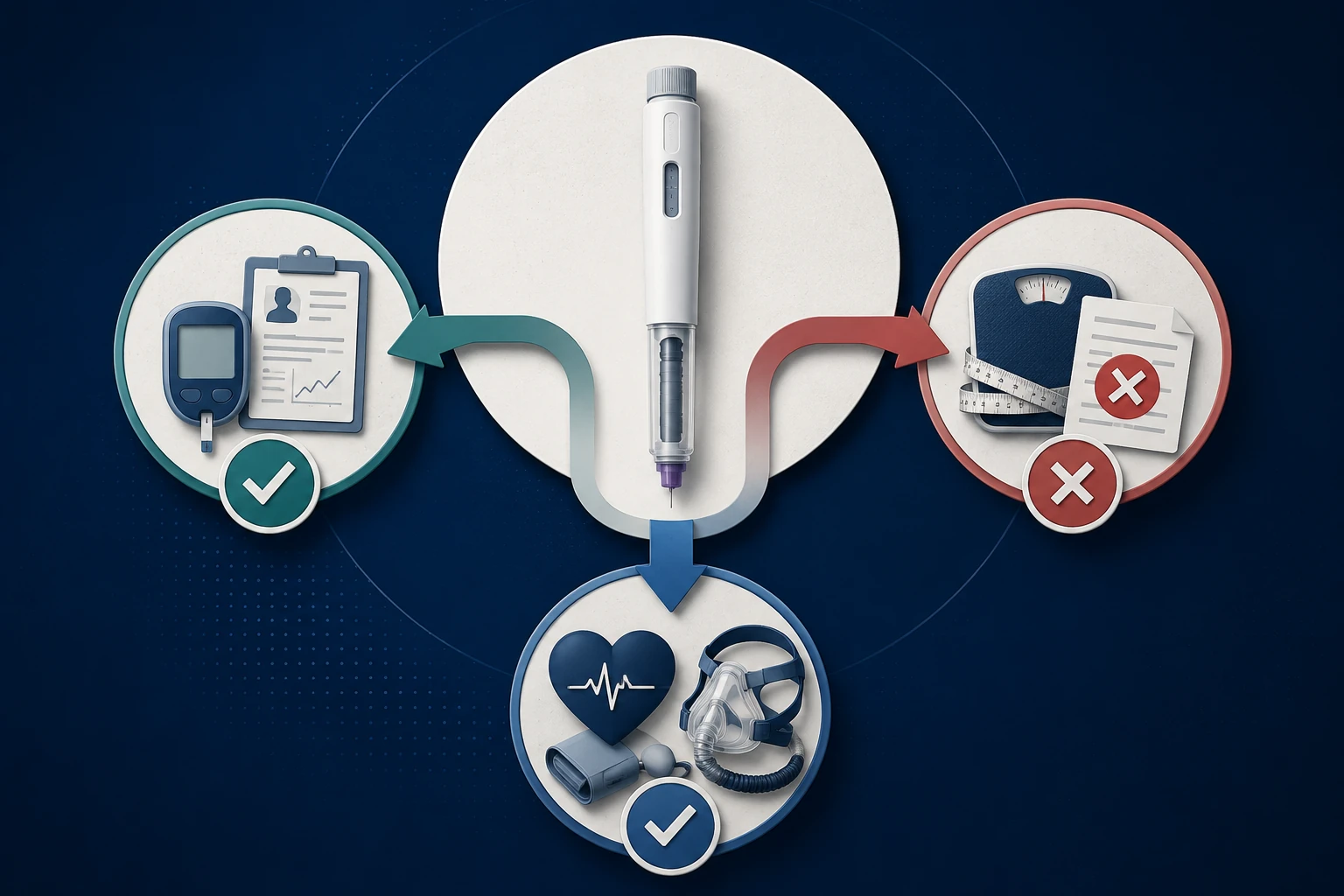
A single injection pen can be billed three different ways — a covered diabetes drug, a denied weight-loss prescription, or a covered cardiovascular or sleep-apnea treatment — depending only on the diagnosis code attached to the claim and the payer reading it. That instability is what makes GLP-1 billing one of the least predictable areas in medicine today. Our Medical Coding Services team at TMS Billings tracks these shifts daily, translating fast-moving payer policy into clean, defensible claims for the practices we support.
This guide walks your billing team through the correct codes for Wegovy and Zepbound, the reasons GLP-1 claims get denied, how coverage differs across Medicare, Medicaid, and commercial payers, and the concrete steps that reduce denials going forward.
Challenges at a glance
| Challenge | Why It Happens | Quick Fix |
|---|---|---|
| Wrong benefit routing | Pen billed to the medical benefit when the payer requires pharmacy or specialty-pharmacy routing | Confirm benefit type before billing |
| Diagnosis code mismatch | Obesity code billed to a payer that excludes weight-loss indications | Match the diagnosis to the payer-approved indication |
| Missing PA documentation | BMI, comorbidities, or step therapy not attached | Complete documentation at the visit, not after |
| Mid-year formulary changes | Coverage shifts without a pre-visit check | Verify formulary status before each refill |
| Medicare exclusion confusion | Bridge pilot rules conflated with the standard Part D exclusion | Confirm which pathway applies before billing |
| State Medicaid variation | Coverage differs, and changes, by state | Check current state policy before scheduling |
| Missed appeal deadlines | Each payer sets its own appeal window | Track denials and deadlines by payer |
What Counts as a “GLP-1 Billing” Challenge?
Quick answer: GLP-1 billing challenges are the coding and documentation gaps that turn a clinically appropriate prescription into a denied claim: routing a self-administered pen to the wrong benefit, mismatching the diagnosis code to the payer’s approved indication, submitting incomplete prior-authorization documentation, or missing a mid-year formulary change.
Each of these breakdowns traces back to one of four root causes: confusion over medical benefit vs. pharmacy benefit routing, a diagnosis code that doesn’t match the payer’s approved indication, prior-authorization documentation submitted late or incomplete, or a formulary change the practice didn’t catch before the visit. The American Medical Association publishes the coding and documentation standards behind most of these requirements, and following them closely is the first line of defense against denials.
These patterns are not identical across specialties. An endocrinology practice manages GLP-1 billing issues differently than a cardiology group prescribing Wegovy for cardiovascular risk reduction, which is one reason our medical billing specialties resources are organized by prescribing specialty rather than treated as one generic drug-billing category.
Why GLP-1 Billing Has Become So Unstable in 2026
So why are GLP-1 claims denied at a higher rate than most other injectable therapies? Largely because the same molecule carries different approved uses depending on the brand and the diagnosis attached to the claim. Semaglutide is sold as Wegovy for chronic weight management and cardiovascular risk reduction, and as Ozempic for type 2 diabetes. Tirzepatide follows the same pattern as Zepbound and Mounjaro. One drug, several billing outcomes, decided largely by the diagnosis code on the claim.
Medicare compounds the confusion. Part D has long excluded weight-loss drugs by statute, while GLP-1 drugs prescribed for diabetes, cardiovascular risk reduction, or obstructive sleep apnea have followed separate coverage rules. The Medicare GLP-1 Bridge pilot, a temporary demonstration that began in mid-2026, now offers a narrow path to coverage for select weight-management indications — a real option, but one easy to confuse with standard Part D coverage.
Medicaid adds another layer. Coverage for weight-loss drug billing is a state-by-state decision rather than a federal one; Medicaid.gov confirms that states retain broad discretion over which outpatient drugs their programs cover, which is why the same claim can be paid in one state and denied in the next.
GLP-1 Billing Challenges Every Practice Should Know
The seven patterns below account for most preventable GLP-1 billing denials our coding team encounters. None require a payer appeal to fix — each is addressed at the point of coding, documentation, or benefit verification, before the claim ever leaves your practice.
1. Billing the Self-Administered Pen as a Medical-Benefit Drug
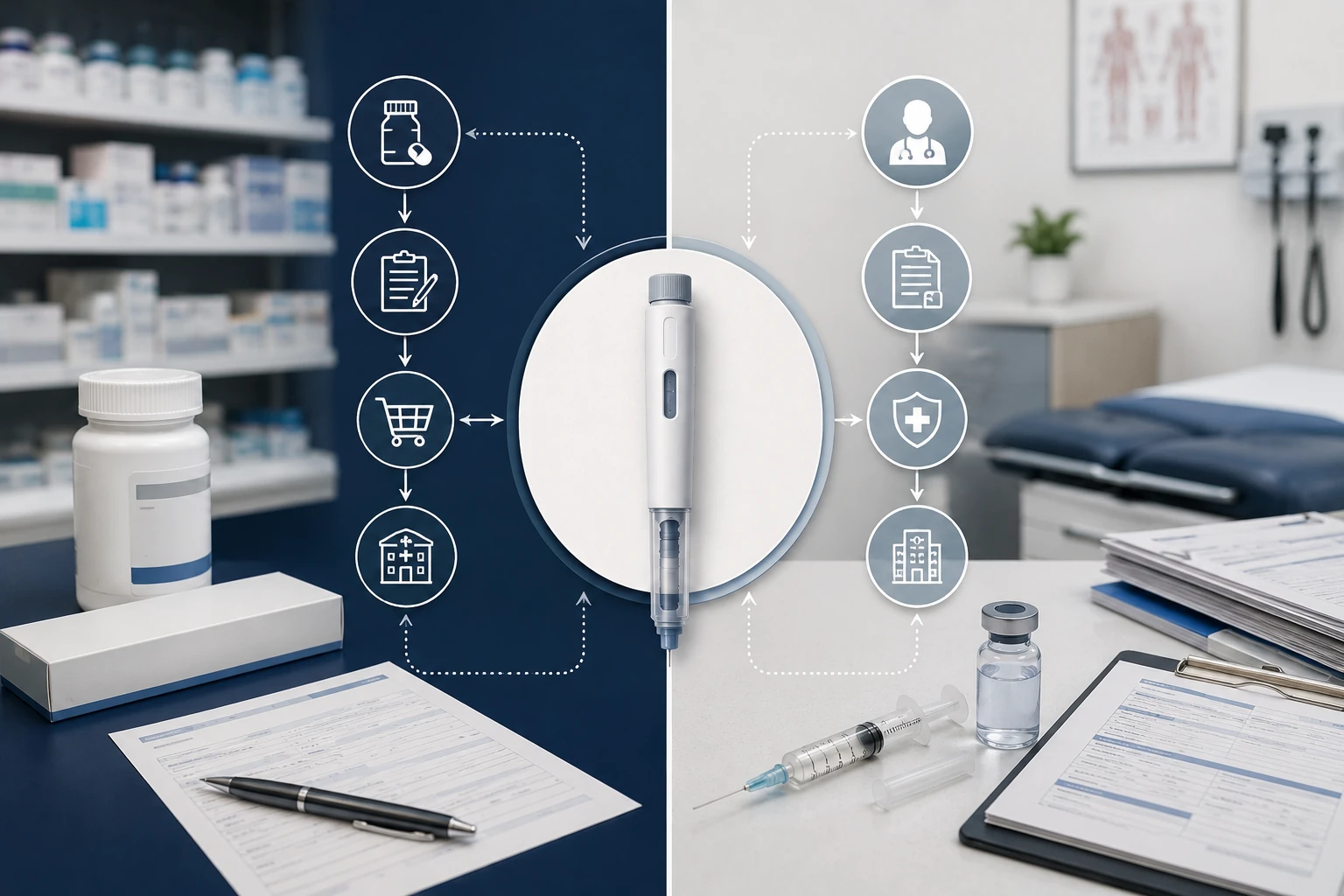
Wegovy and Zepbound are self-administered pens, which means many payers expect them routed through the pharmacy benefit and filled by a specialty pharmacy, not billed as a medical-benefit drug the way a buy-and-bill infusion would be. Practices that bill the pen under the medical benefit run into a second problem: neither semaglutide nor tirzepatide currently has a dedicated GLP-1 J-codes assignment, so the claim depends on the unclassified drug code J3490 (or C9399 in a hospital outpatient setting), reported with the specific NDC for the product dispensed. Skip the NDC billing detail, and even a correctly routed claim can bounce back.
So what J-code to use for GLP-1 injections billed under the medical benefit? J3490 with the matching NDC is the current standard, though Wegovy billing and Zepbound billing outcomes still depend on the individual payer’s benefit-routing policy. Our Medical Billing Services team verifies benefit type before submission specifically to catch this.
A multi-provider family medicine practice recently traced a wave of GLP-1 denials to exactly this pattern: the pen had been billed under the medical benefit with an unclassified code, when every payer involved required pharmacy-benefit or specialty-pharmacy routing instead. Once the practice corrected the routing at intake, the denials tied to that specific cause stopped.
2. Diagnosis Code Mismatch: Obesity vs. Diabetes vs. Cardiovascular Risk
A claim can be coded correctly and still deny if the diagnosis doesn’t match what the payer has approved for that specific brand. Billing an obesity ICD-10 code (the E66.x series) to a plan that excludes weight-loss indications will deny even when the same drug is separately approved, and covered, under a different diagnosis. The FDA label is the starting point for confirming which diagnosis each brand actually supports before the claim goes out.
| Molecule | Brand | Typical Approved Use |
|---|---|---|
| Semaglutide | Wegovy | Chronic weight management, cardiovascular risk reduction |
| Semaglutide | Ozempic | Type 2 diabetes |
| Tirzepatide | Zepbound | Chronic weight management, obstructive sleep apnea |
| Tirzepatide | Mounjaro | Type 2 diabetes |
Confirming brand-to-diagnosis alignment before submission catches this mismatch before it becomes a denial.
3. Missing BMI, Comorbidity, and Step-Therapy Documentation
Most commercial payers will not approve a GLP-1 prior authorization request without three specific pieces of documentation: a recorded BMI at or above the payer’s threshold, at least one qualifying comorbidity, and proof that lower-cost step-therapy options were tried and failed first. Cigna’s published GLP-1 coverage policy is a useful real-world illustration of how detailed these BMI-and-comorbidity criteria can get.
Because GLP-1 prior authorization requirements by payer vary in threshold and format, a documentation set that satisfies one plan can fall short with another. Building BMI documentation, comorbidity documentation, and step-therapy proof into the visit note itself, rather than assembling it after a denial arrives, is what turns a practice’s GLP-1 medical necessity documentation from reactive to routine.
4. Mid-Year Formulary and Coverage Changes
Formularies are not fixed for the plan year. A payer that covered Wegovy or Zepbound in January can drop it, add a new prior-authorization requirement, or move it to a higher tier by summer, often with limited advance notice to prescribers. A claim submitted against last quarter’s formulary assumption denies even when every other part of the submission is correct.
Running a formulary and prior-authorization check before each refill, not just at the first fill, catches these mid-year shifts before they reach a claim. This is especially relevant for practices refilling GLP-1 prescriptions on a recurring monthly or quarterly cycle, since a single missed formulary update can generate the same denial across an entire patient panel rather than a single claim.
5. Medicare’s Statutory Exclusion vs. the New GLP-1 Bridge Pilot
Medicare Part D has excluded weight-loss drugs from standard coverage since the benefit began, a statutory restriction that predates GLP-1 medications entirely. That exclusion still applies to routine Part D coverage of Wegovy or Zepbound prescribed purely for weight management.
The Medicare GLP-1 Bridge pilot is a separate, time-limited demonstration that began in mid-2026 and runs outside the standard Part D benefit through the end of 2027. It gives qualifying beneficiaries access to select GLP-1 medications for weight management at a reduced copay, processed through a central system rather than the beneficiary’s regular Part D plan. The two rules are easy to conflate: one is a long-standing exclusion, the other a temporary bridge with its own eligibility window. CMS maintains current guidance on both, and practices should confirm which pathway applies to a given patient before billing.
6. Medicaid Coverage That Varies State to State

GLP-1 payer coverage under Medicaid is set state by state, not federally, and several states narrowed or eliminated weight-loss coverage as recently as the start of 2026. California’s Medi-Cal Rx program is one real example: its provider coverage bulletin confirms the program removed Wegovy and Zepbound coverage for the weight-loss indication as of early 2026, while coverage for diabetes, cardiovascular disease, and obstructive sleep apnea indications continued under standard prior authorization.
Practices billing Medicaid claims across multiple states cannot rely on a single coverage assumption. What is billable in one state’s Medicaid program may be a denial in the next, and the rules shift often enough that a policy check from even a few months earlier can be out of date. Our Medical Billing Services in California team tracks these state-specific Medi-Cal Rx changes directly.
7. Missing Payer-Specific Appeal Deadlines After a Denial
A GLP-1 denial is not the end of the claim — but only if it is worked inside the payer’s specific appeal window. There is no universal timeline for denial appeals across GLP-1 claims; each payer sets its own deadline, required forms, and supporting documentation, and commercial, Medicare, and Medicaid appeals rarely follow the same clock.
Denials that sit unworked past a payer’s deadline become unrecoverable revenue, regardless of how strong the original clinical case was. Practices with a growing GLP-1-related accounts-receivable backlog often trace it to exactly this gap: not a shortage of appealable denials, but a lack of a system for tracking which payer’s clock is running out first. Our AR Recovery Services team builds that tracking into the recovery process from the start.
How to Reduce GLP-1 Billing Denials in Your Practice
Reducing denials starts before the claim is ever generated. Four habits address most of the patterns above:
Confirm the benefit type. Verify whether the payer routes Wegovy or Zepbound through the medical or pharmacy benefit before your billing team submits the claim, rather than defaulting to whichever route was used last time.
Check formulary and prior-authorization status before every refill, not just the first fill, since coverage and requirements can shift mid-year.
Document BMI, comorbidities, and step therapy at the visit itself, so your chart already supports medical necessity if a payer requests it.
Track denials by payer and reason code, not just total volume, so recurring patterns — a specific plan, a specific diagnosis mismatch — surface early enough for your team to fix.
Together, these habits answer the practical question of how to bill Wegovy and Zepbound correctly: confirm the route, confirm the coverage, document the necessity, and track what comes back. Practices that build this into standard Revenue Cycle Management workflows, rather than treating each denial as a one-off, see the pattern shrink over time.
How TMS Billings Helps Practices Manage GLP-1 Billing

TMS Billings addresses each challenge above directly rather than offering a generic billing service wrapped around a new label. On the coding side, our team confirms medical-benefit versus pharmacy-benefit routing and applies GLP-1 J-codes and NDC-level detail correctly the first time a claim goes out. On the documentation side, we track BMI, comorbidity, and step-therapy requirements against each payer’s current criteria, so prior-authorization submissions go out complete rather than needing a resubmission.
We also monitor GLP-1 payer coverage and formulary changes by plan, flagging mid-year shifts before they reach a claim, and we track denials by payer and reason code so recurring patterns get fixed at the source. For practices asking how to appeal a GLP-1 prior authorization denial, we manage the payer-specific deadlines and documentation each appeal requires, rather than letting them lapse.
One internal medicine practice we support had a recurring pattern of GLP-1 prior-authorization denials tied to inconsistent documentation. Building a standardized BMI-and-comorbidity checklist completed at the visit, before submission, resolved the pattern within a few billing cycles. Our Billing Reporting & Analytics tools gave the practice visibility into exactly which payer-and-diagnosis combination had been driving the denials.
Key Takeaways
- Most GLP-1 billing denials trace back to benefit-routing errors, diagnosis mismatches, incomplete prior-authorization documentation, or missed formulary changes — not clinical ineligibility.
- Wegovy and Zepbound currently bill under unclassified code J3490 (or C9399 in hospital outpatient settings) with the matching NDC, since neither has a dedicated J-code yet.
- Medicare’s Part D exclusion and the temporary GLP-1 Bridge pilot are separate rules; confirm which one applies before billing a claim.
- Medicaid coverage for weight-loss indications is decided state by state and has narrowed in several states since early 2026.
- Documenting BMI, comorbidities, and step therapy at the visit, before submission, prevents most preventable prior-authorization denials.
- Tracking denials and appeal deadlines by payer keeps recoverable GLP-1 revenue from lapsing unworked.
Final Thoughts
GLP-1 billing will keep shifting as long as Medicare, Medicaid, and commercial payers keep adjusting coverage for weight-management indications — which, based on the pace of change since early 2026, shows no sign of slowing. The practices managing it best are not the ones reacting fastest to each new denial; they are the ones who have already built benefit verification, documentation, and payer-specific tracking into their standard workflow, so most denials never happen in the first place.
If your practice is seeing a growing GLP-1-related AR backlog, a recent spike in prior-authorization rejections, or simply wants a second set of eyes on how these claims are coded and routed, our coding and compliance team can review your current process and show you where the gaps are. Book a Free Consultation to get started.
GLP-1 coverage rules, codes, and prior-authorization criteria change frequently by plan year, state, and individual payer. The details in this guide reflect policy as of publication (September 2026); confirm current requirements with the specific payer, CMS, the applicable state Medicaid agency, or your compliance counsel before submitting or appealing a claim.