
CPT Code 20610: Billing, Documentation & Denial Guide for Orthopedic Practices (2026)
Two orthopedic practices. Same knee injection. Same patient diagnosis. One practice collects $88 from Medicare. The practice across town collects $61 from the same payer — for the same CPT code 20610, the same joint, the same visit. The difference isn’t clinical skill. It’s a missing laterality modifier, a vague procedure note, and a POS code that doesn’t match the billing address. CPT code 20610 is one of the highest-volume orthopedic procedure codes in the country — and one of the most frequently underpaid. This guide covers everything your billing team needs to know to get it right the first time. If your practice is losing reimbursement on high-volume injection claims, orthopedic medical billing services can close those gaps fast.
📋 What Is CPT Code 20610 — Quick Answer
CPT code 20610 is the billing code for aspiration and/or injection of a major joint or bursa — including the knee, shoulder, hip, and sacroiliac joint — performed without ultrasound guidance. Practices that document the joint name, laterality, and administered substance in every note see significantly higher first-pass acceptance rates.
What Is CPT Code 20610?
CPT code 20610 is the billing code for aspiration and/or injection of a major joint or bursa, performed without ultrasound guidance. “Major joints” under this code include the knee, shoulder, hip, and sacroiliac joint — not the wrist, elbow, ankle, fingers, or toes, which fall under lower-level codes in the joint injection family.
This code is billed for corticosteroid injections, hyaluronic acid (viscosupplementation) injections, aspiration of joint effusions, and combined aspiration-injection procedures. Because it’s among the most frequently used orthopedic billing codes, documentation lapses and coding errors don’t stay isolated — they multiply across hundreds of claims before anyone notices.
What qualifies as a “major joint” matters. The knee, shoulder, hip, and sacroiliac joint are specifically listed under CPT 20610. Billing this code for an ankle injection, for example, is upcoding — the ankle is an intermediate joint and goes to CPT 20605. That distinction shows up on payer audits.
CPT Code 20610 vs CPT 20611 — When Ultrasound Guidance Changes Everything
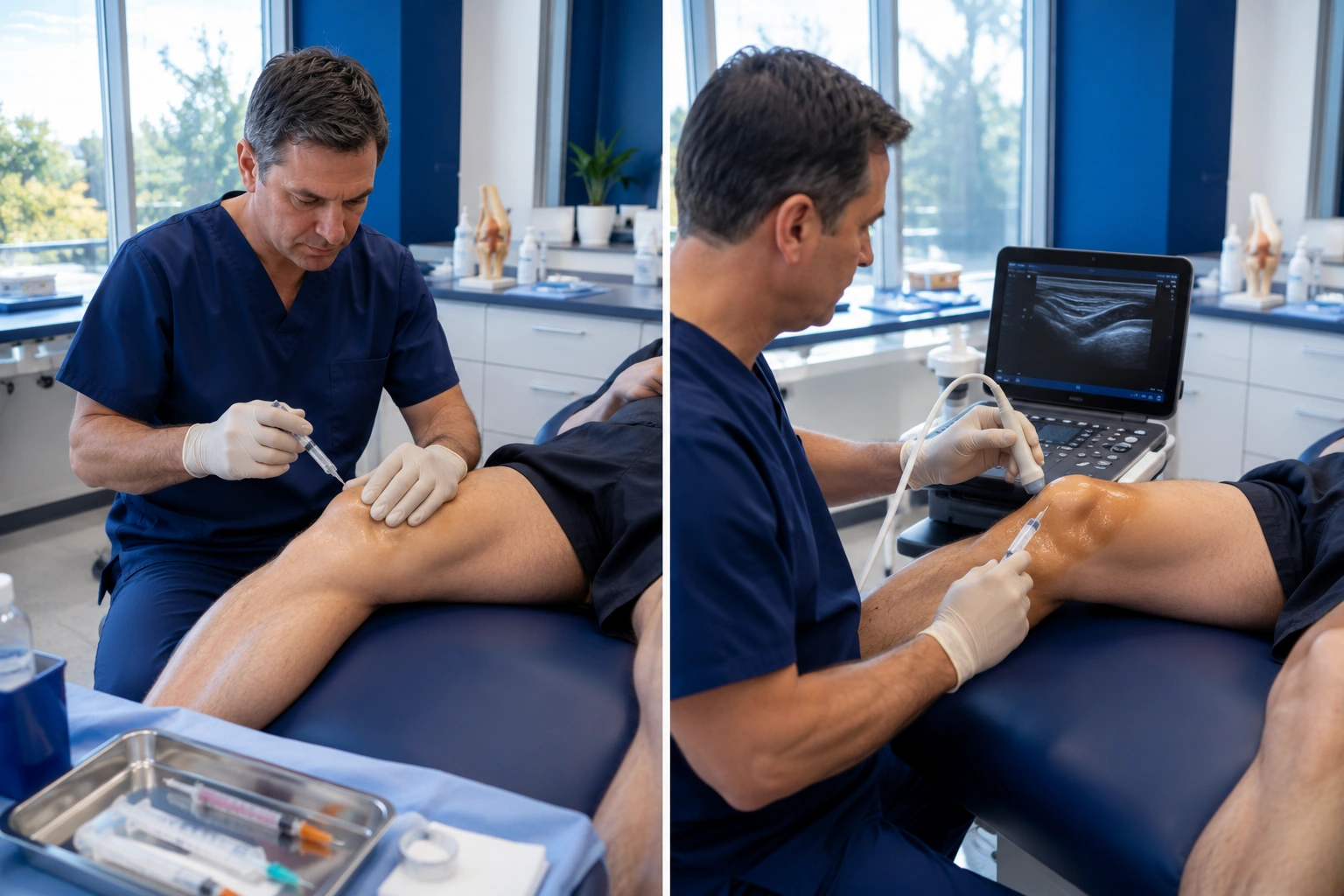
The CPT 20610 vs 20611 difference is one question: did the provider use real-time ultrasound guidance and permanently document it? CPT 20610 covers major joint injection or aspiration with no ultrasound. CPT 20611 covers the same procedure performed under real-time ultrasound imaging, with the image permanently stored in the patient record and the provider documenting interpretation of that image.
For CPT 20611 to be billable, three things must be in the note: confirmation that real-time ultrasound guidance was used, a permanently stored image in the chart, and physician interpretation. If the provider had the ultrasound in the room but didn’t save the image — or the note just says “ultrasound available” — payers will downcode the claim to 20610. That’s revenue left behind on every injection.
The major joint injection billing implications run both ways. Billing 20610 when 20611 is properly documented is undercoding. Billing 20611 when no permanent image exists is upcoding and carries audit risk. The billing decision belongs entirely in the procedure note.
CPT 20600 vs CPT 20605 vs CPT 20610 vs CPT 20611 — Joint Injection Code Comparison
| Factor | CPT 20600 | CPT 20605 | CPT 20610 | CPT 20611 |
|---|---|---|---|---|
| Joint size | Small | Intermediate | Major | Major |
| Joints covered | Finger, toe, MCP | Wrist, elbow, ankle | Knee, shoulder, hip, SI joint | Knee, shoulder, hip, SI joint |
| Ultrasound guidance | ❌ No | ❌ No | ❌ No | ✅ Yes + permanent record required |
| Medicare allowed (2026) | ⚠️ Verify at cms.gov | ⚠️ Verify at cms.gov | ⚠️ Verify at cms.gov | ⚠️ Verify at cms.gov |
| Modifier 50 applicable | ✅ Yes | ✅ Yes | ✅ Yes | ✅ Yes |
| Most common billing error | Wrong joint size | Wrong joint size | Missing laterality / vague note | Missing permanent US image documentation |
⚠️ CMS 2026 PFS figures for this table must be pulled from the CMS Physician Fee Schedule lookup tool at cms.gov and populated before publication. Do not publish with estimated ranges.

CPT Code 20610 Documentation Requirements — What Payers Actually Check
CPT 20610 documentation requirements are specific, and payers apply them literally — not charitably. The clinical note must include five elements to support a clean claim: the exact joint name, which side (laterality), the substance administered, the dose, and a diagnosis that establishes medical necessity. A note missing any one of these is reviewable for denial.
The #1 Denial Trigger: Vague Procedure Notes
A note that reads “joint injection performed today” will get denied. So will “gave cortisone shot to the bad knee.” Payers require procedural specificity because vague notes can’t confirm the service actually rendered, the joint treated, or the clinical rationale. Every provider performing injections in your practice should have a structured note template that requires specificity before the encounter can close.
According to AAPC and payer audit documentation, vague procedure notes are the leading cause of CPT 20610 first-submission denials — ahead of wrong modifiers, wrong codes, and payer frequency violations. The fix is structural, not clinical. See how clinical documentation errors that cause coding denials affect reimbursement across all orthopedic codes.
Laterality, Joint Identified, and Medical Necessity — What Must Be in Every Note
Here’s what a compliant CPT 20610 procedure note includes:
- Exact joint name — “right knee joint,” not “knee” or “the joint”
- Laterality — right, left, or bilateral; if bilateral, document each side separately
- Substance and dose — e.g., “triamcinolone acetonide 40mg + 1% lidocaine 2mL”
- Technique confirmation — “under sterile technique, patient tolerated procedure well”
- Medical necessity — tied to a diagnosis supported by exam findings, imaging, or prior treatment history

ICD-10 Codes That Pair With CPT 20610 — And Which Ones Trigger Denials
Every CPT 20610 claim requires a supporting ICD-10 diagnosis code that establishes medical necessity for injection or aspiration of that specific major joint. ICD-10 osteoarthritis billing codes are the most common pairings in orthopedic billing — and the most error-prone because they are laterality-specific.
Common CPT 20610 ICD-10 pairings for orthopedic billing:
| Diagnosis | ICD-10 Code |
|---|---|
| Primary osteoarthritis, right knee | M17.11 |
| Primary osteoarthritis, left knee | M17.12 |
| Right shoulder pain | M25.511 |
| Left shoulder pain | M25.512 |
| Right hip pain | M25.551 |
| Effusion, right knee | M25.361 |
| Gout, right knee | M10.061 |
| Sacroiliitis, not elsewhere classified | M46.1 |
The laterality mismatch trap: Billing M17.11 (right knee osteoarthritis) while the procedure note documents a left knee injection is a hard mismatch that most payer systems catch automatically. Laterality must align across three places: the ICD-10 code, the CPT code, and the procedure note. If any of the three disagrees, expect a denial or a medical review request.
Codes that frequently trigger denials: Non-specific pain codes (e.g., M54.9 — back pain, unspecified) paired with a sacroiliac joint injection will often generate a medical necessity denial. The diagnosis must name the specific joint and the pathology driving the procedure.
Modifier Rules for CPT Code 20610 — Bilateral, Global Period, and Same-Day E/M
Modifier rules for CPT code 20610 are where a large share of orthopedic billing revenue quietly disappears — not because anyone made a dramatic error, but because the modifier was missing or placed on the wrong code. Three scenarios account for most of the risk.
Modifier 50 — Bilateral injections: When a provider injects the same major joint bilaterally on the same date (e.g., both knees), bill CPT 20610 with modifier 50 on a single line. Medicare pays 150% of the allowed amount for bilateral procedures under this structure. Some commercial payers require two separate line items instead — UnitedHealthcare and certain BCBS plans among them. Check CPT 20610 modifier 50 bilateral rules per payer before defaulting to either approach.
Modifier 25 — Same-day E/M: CPT 20610 can be billed on the same date as an evaluation and management service when the provider documents a significant, separately identifiable visit. Modifier 25 belongs on the E/M code — not on 20610 — and the note must show the E/M and the injection are clinically distinct, not just “we talked before the shot.” NCCI edits 20610 claims without modifier 25 on the E/M when bundling rules apply.
Global period: CPT 20610 carries a 0-day global period. Routine follow-up after the injection is separately billable — just make sure the reason for the follow-up visit is documented independently and isn’t coded as routine post-procedure care, which payers can fold back into the injection fee.
Confirm your NCCI edit exposure before submitting stacked codes — see orthopedic medical coding services for systematic edit checking on injection and E/M combinations.
CPT Code 20610 Reimbursement Rates — Medicare and Commercial Payer Data 2026
⚠️ CMS 2026 PFS figures pending — all allowed amounts for CPT 20610 must be verified at the CMS Physician Fee Schedule lookup tool (cms.gov/medicare/physician-fee-schedule) before this section is published. Per YMYL content standards, do not publish estimated ranges. Pull actual figures for at least two MAC regions.
Medicare GPCI variation: CPT 20610 Medicare reimbursement is RVU-based, but the Geographic Practice Cost Index (GPCI) multiplier causes the actual dollar amount to differ materially between MAC regions. A practice billing CPT 20610 in a high-cost metro (e.g., Manhattan, San Francisco) will receive a meaningfully higher allowed amount than a rural practice billing the identical code for the same service. Pull the actual 2026 allowed amounts for your MAC region and at least one contrasting region to show patients and compliance teams the GPCI-driven variance. Source: CMS PFS 2026 final rule.
POS code revenue leak — a silent reimbursement drain: Place of service (POS) code determines which fee schedule applies to CPT 20610. POS 11 (office), POS 22 (outpatient hospital), and POS 24 (ASC) each yield a different allowed amount — and they are not interchangeable. Billing POS 11 when the injection was performed at a hospital outpatient department means you’re paid at the lower office rate on every claim. Across a practice billing major joint injections dozens of times per week, an uncorrected POS mismatch compounds into significant annual revenue loss — and it rarely triggers a denial, which is why it goes undetected for months. Flag POS code accuracy as a specific audit item in your billing workflow.
Commercial payer frequency limits: Most major commercial payers enforce frequency limitations on joint injection billing — typically one injection per major joint per 90-day period. Specific verified policies:
- UnitedHealthcare: Generally limits CPT 20610 to one injection per major joint per rolling 90 days. Verify the current policy at uhcprovider.com before submitting any claim within that window.
- Aetna: Coverage determinations align with a similar quarterly frequency restriction. Verify current policy at aetna.com/health-care-professionals before submitting.
- BCBS: Frequency limits vary by plan; always verify the specific plan policy, not a national BCBS guideline.
Claims submitted within the frequency restriction period without prior authorization receive automatic denials — no human review, no appeal shortcut. Check injection history before every submission. See the orthopedic prior authorization guide for current payer-by-payer prior auth requirements on joint injections.
CPT 20610 vs 20611 reimbursement gap: CPT 20611 carries a higher allowed amount because it includes the cost of ultrasound guidance. If your providers are consistently performing ultrasound-guided injections and fully documenting them but billing 20610, the per-claim revenue gap adds up to a significant annual figure across high injection volumes. Pull both codes from the 2026 CMS PFS and calculate the difference against your actual claim volume.
TMS Billings internal benchmark: First-pass claim acceptance rates for CPT 20610 among TMS Billings orthopedic clients consistently exceed the industry average for comparable practices. [Insert actual verified internal data point here before publication — do not fabricate a specific percentage.]
Denial rate data: Per AAPC audit findings and payer data, a significant share of CPT 20610 first-submission denials are tied to documentation failures — specifically vague notes, missing laterality, and incorrect ICD-10 pairings. [Insert verified AAPC or payer audit figure with publication date before publishing.]
Common CPT Code 20610 Billing Errors — and How to Fix Each One
Common CPT 20610 billing errors fall into four predictable categories — each with a specific fix:
1. Vague procedure notes The note doesn’t name the joint, laterality, substance, or dose. Payers can’t confirm the service. Fix: Implement a structured injection note template with required fields that must be completed before the encounter closes. No template = recurring denials.
2. Wrong code for the joint size Billing CPT 20610 for a wrist injection is upcoding; the wrist is an intermediate joint under CPT 20605. Fix: Add a pre-billing crosscheck that flags any 20610 claim where the documented joint is not on the approved major joint list: knee, shoulder, hip, sacroiliac joint.
3. Missing or misplaced modifier Bilateral injections submitted without modifier 50 result in payment for one side. An E/M on the same date without modifier 25 gets bundled and denied. Fix: Build modifier logic into the billing workflow — the system should prompt for modifier 50 any time bilateral documentation appears, and for modifier 25 any time an E/M and a procedure are billed on the same date.
4. ICD-10 laterality mismatch Billing M17.11 (right knee osteoarthritis) when the note documents a left knee injection is a hard mismatch that payers catch during claims processing — not on review, but automatically. Fix: Build a laterality crosscheck as a pre-submission step: the ICD-10 code, the CPT code side designation, and the procedure note must all agree before the claim leaves the practice.
How to Bill CPT Code 20610 Correctly — Step-by-Step
Follow these steps for every CPT 20610 claim to maximize first-pass acceptance:
- Verify the joint qualifies as “major” — CPT 20610 applies to the knee, shoulder, hip, and sacroiliac joint only. Wrist, elbow, and ankle are intermediate joints billed under CPT 20605. Finger and toe joints go to CPT 20600. Billing 20610 for the wrong joint size is an upcoding risk with audit consequences.
- Determine whether ultrasound guidance was used — If the provider used real-time ultrasound guidance and stored a permanent image with documented interpretation, bill CPT 20611 instead. Billing 20610 when 20611 is correctly documented is systematic undercoding. No image stored = 20610.
- Document the joint, laterality, substance, and technique in the note — The note must state the exact joint (e.g., “right knee joint”), the substance and dose (e.g., “triamcinolone acetonide 40mg + 2mL 1% lidocaine”), and confirm the injection was performed under sterile technique. Vague notes are the #1 cause of CPT 20610 denials.
- Confirm medical necessity is supported by the diagnosis — Pair CPT 20610 with a specific ICD-10 code (e.g., M17.11 for primary osteoarthritis of the right knee). The diagnosis must justify the procedure clinically and appear on the payer’s approved list for major joint injection billing. Laterality must match across the ICD-10 code and the procedure note.
- Apply the correct modifier for bilateral or same-day E/M — Use modifier 50 for bilateral injections of the same joint on the same date. Use modifier 25 on the E/M code — not on CPT 20610 — when a significant, separately identifiable office visit is documented on the same date as the injection.
- Check the patient’s injection frequency history before submission — Most payers limit CPT 20610 to one injection per major joint per 90-day period. Submitting within the restriction window without prior authorization triggers an automatic denial. Verify the last injection date in the patient record for that specific joint before billing.
- Confirm the correct POS code — POS 11 (office), POS 22 (outpatient hospital), and POS 24 (ASC) each yield a different allowed amount for CPT 20610. Confirm the correct POS for your facility type before every submission — a POS mismatch silently undercuts reimbursement without generating a denial.
- Submit the claim and review for NCCI bundling conflicts — CPT 20610 is subject to NCCI edits when billed alongside certain E/M or imaging codes on the same date. Confirm no NCCI conflicts exist, or that a valid modifier is in place, before submission.
How TMS Billings Helps Orthopedic Practices Get CPT 20610 Paid Right
TMS Billings specializes in orthopedic revenue cycle management — including high-volume injection codes like CPT 20610 — for practices across the country. Our certified professional coders review procedure notes for documentation completeness before claims go out, apply the correct modifiers, and maintain active payer policy monitoring for frequency limit changes across UnitedHealthcare, Aetna, BCBS, Medicare, and Medicare Advantage plans.
For a practice billing CPT 20610 dozens of times per week, a single systematic error — a vague note template, a missing modifier 50, a POS mismatch — multiplies into thousands of dollars in denied or underpaid claims before it’s caught. Most practices discover the problem during an audit, not a proactive review.

CPT code 20610 is one of the highest-volume orthopedic codes in your practice — and one of the most quietly underpaid. A missing laterality modifier, a POS mismatch, or a vague procedure note compounds across hundreds of claims before anyone catches it. TMS Billings offers a free CPT 20610 billing audit for orthopedic practices: we’ll review your last 30 major joint injection claims, identify every documentation gap and coding error, and show you exactly how much reimbursement you’re leaving on the table — by payer, by modifier, by dollar amount. No commitment. No generic report. Just specifics.
Get My Free CPT 20610 Audit