
CPT 27447: Total Knee Arthroplasty — Billing, Documentation & Audit Guide 2026
Billing total knee arthroplasty is one of the highest-stakes procedures in orthopedic revenue cycle management — and one of the most scrutinized. Incomplete documentation triggers claim denials before your staff even knows there’s a problem. A missed modifier puts you in front of a Recovery Audit Contractor. Pre-authorization that doesn’t match the procedure performed means the reimbursement you earned gets clawed back months later.
CPT 27447 sits at the center of all of it, and the margin for error is narrow. Our Revenue Cycle Management team at TMS Billings has built this guide specifically for orthopedic surgeons, practice owners, and billing teams who need a definitive 2026 reference — covering documentation requirements, modifier rules, code selection, and the financial cost of getting this wrong in either direction.
CPT 27447 — What Does This Code Actually Cover?
CPT 27447 describes total knee arthroplasty — the surgical replacement of all three compartments of the knee joint (femoral, tibial, and patellar) with prosthetic components. It applies to primary procedures on one or both knees and includes patellar resurfacing whether or not it is performed in the same operative session.
What does CPT 27447 include and exclude? The code covers the full tricompartmental replacement using any approved implant system. It does not cover unicompartmental replacements (CPT 27446) or revision of total components (CPT 27487). Knowing this boundary is where accurate billing starts.
The AMA and CMS Guidelines That Govern CPT 27447 Billing
Every orthopedic practice managing knee replacement procedure billing operates within a two-layer framework: AMA CPT guidelines, which define the procedure, and CMS procedure billing guidelines, which govern documentation, reimbursement, and modifiers for Medicare beneficiaries. Misreading either layer is where silent compliance risk enters your practice.
Our Orthopedic Medical Billing Services team works from both frameworks on every claim — not only at audit time.
Procedure Description — What CPT 27447 Involves
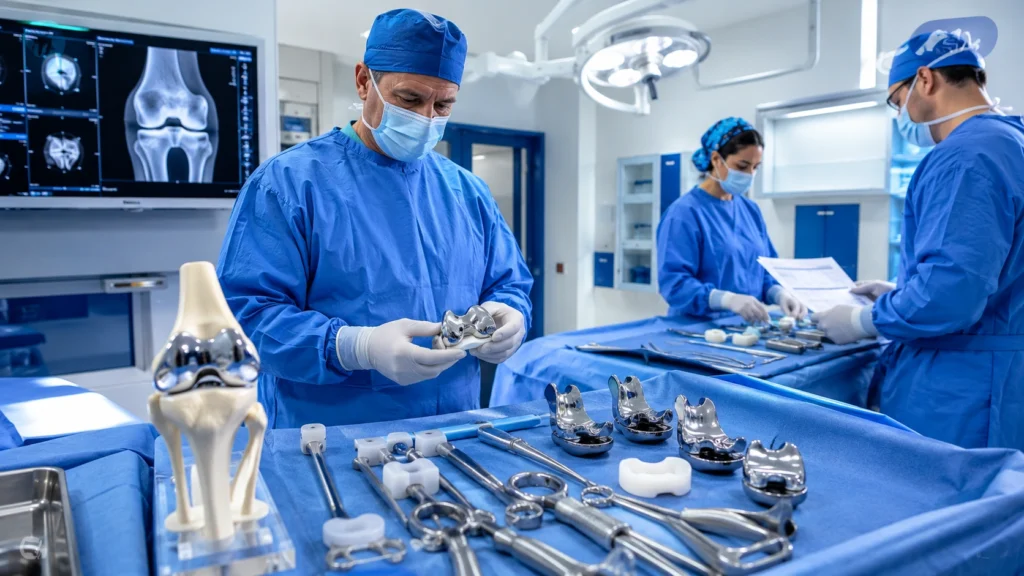
Total knee arthroplasty involves surgical resection of the distal femur, proximal tibia, and optional patellar resurfacing, followed by implantation of prosthetic components to restore knee joint function. All three compartments are addressed.
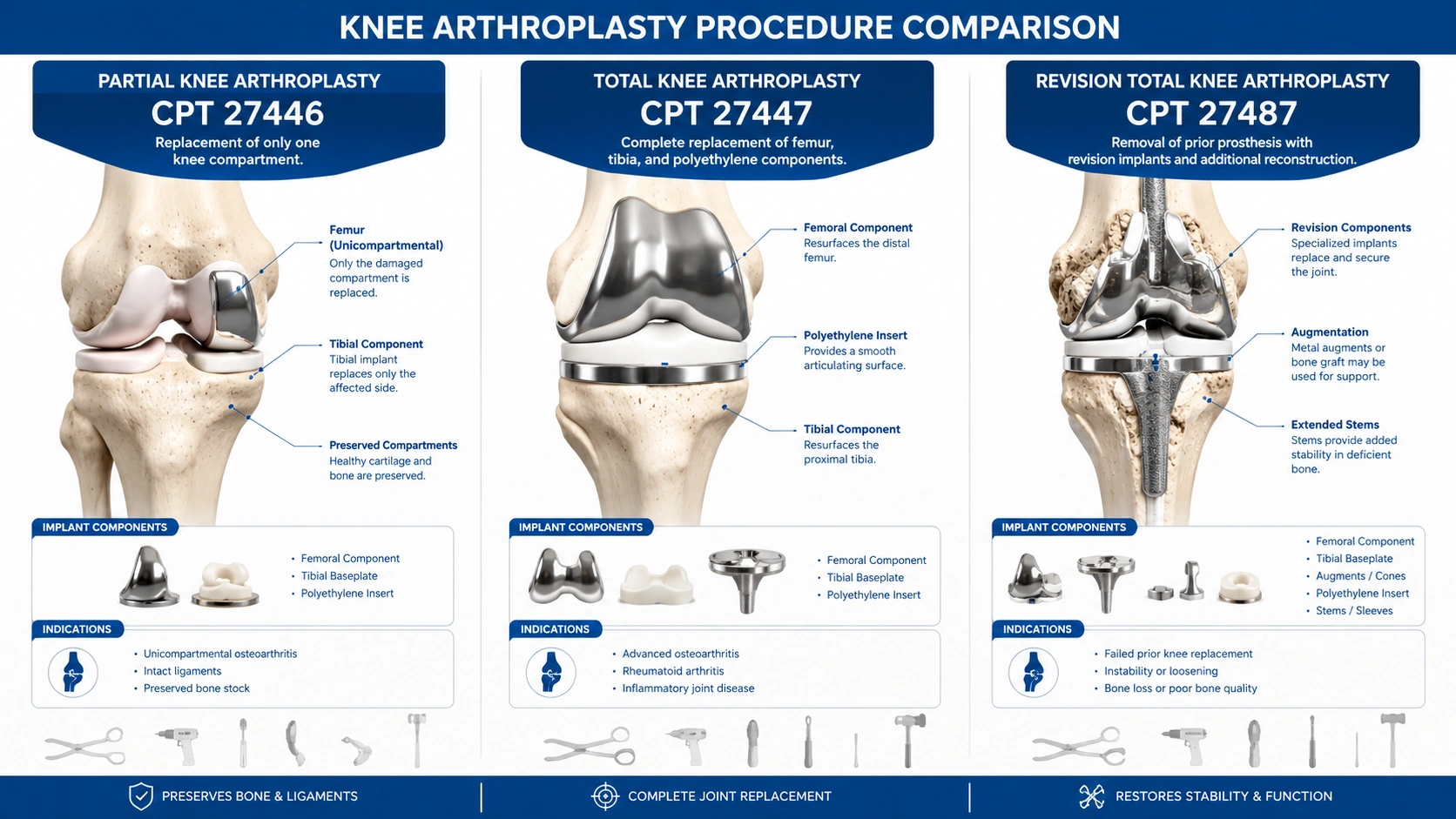
Patellar resurfacing is included in the CPT 27447 description whether or not it is performed — it does not warrant a separate code. A surgeon replacing a severely arthritic knee with a tricompartmental implant system bills 27447. A surgeon replacing only the medial compartment bills 27446. Code selection depends entirely on what the operative report documents.
How to document medical necessity for total knee replacement starts here: the clinical record must connect the patient’s diagnosis, failure of conservative treatment, and the scope of procedure performed. Per AMA CPT guidelines, code selection must reflect the actual procedure documented — not the intent.
CPT 27447 vs. 27446 vs. 27487 — Choosing the Right Code
The CPT 27447 vs 27446 vs 27487 differences follow a clear hierarchy:
- CPT 27446 — Unicompartmental (partial) knee arthroplasty; one compartment replaced
- CPT 27447 — Total (tricompartmental) knee arthroplasty; all three compartments with primary components
- CPT 27487 — Revision of total knee arthroplasty; femoral and entire tibial component exchange
What separates each: the number of compartments replaced, whether components are primary or revision, and the extent of resection documented in the operative report. Billing 27446 when the operative report supports 27447 is one of the most common orthopedic billing errors and a direct audit trigger, per AMA procedure classification standards.
Co-Surgeon and Bilateral Billing — When to Add Modifiers to CPT 27447
The bilateral procedure modifier and co-surgeon rules are applied inconsistently across most orthopedic practices.
For co-surgeon billing (modifier -62), two surgeons of different specialties must each perform a distinct, medically necessary portion of the same procedure — and both must submit separate operative reports documenting their individual contributions. A shared note does not support two claims.
When to use bilateral modifier with CPT 27447: when bilateral knee arthroplasty is performed in the same session, modifier -50 applies — or separate line items, depending on payer-specific rules. Per CMS modifier documentation standards, medical necessity for each knee must be independently documented, with separate ICD-10 diagnosis coding for each side and payer pre-authorization confirmed for each procedure.
CPT 27447 Documentation Requirements — What Your Record Must Show

A defensible claim starts with a defensible record. CPT 27447 documentation requirements extend beyond the operative report — your full clinical record must tell the story from diagnosis through procedure. When auditors review a claim, they check for specific elements. When those elements are missing, the claim fails.
| Documentation Element | CPT 27447 Requirement |
|---|---|
| Procedure Identified | Total knee arthroplasty with laterality documented (right, left, or bilateral) |
| Procedure Performed | All components explicitly described: femoral, tibial, and patellar component if resurfaced; technique and approach documented |
| Medical Necessity | ICD-10 diagnosis (e.g., M17.11 primary osteoarthritis, right knee) with documented failure of conservative treatment |
| Implant Documentation | Manufacturer name, model/catalog number, lot number, and size of each component; implant sticker or log attached to operative report |
| Pre-Authorization | Payer prior authorization reference number documented; approval on file before procedure |
| Co-Surgeon (if billed) | Modifier -62 on both surgeon claims; each operative report must demonstrate a distinct, medically necessary surgical contribution |
| Bilateral (if applicable) | Modifier -50 or separate line items per payer requirements; separate medical necessity documented for each knee |
| Signature | Operating surgeon signature on operative report with date and time of procedure |
Operative report documentation is where most claims break down. A vague report — one that omits implant lot numbers, skips patellar resurfacing decisions, or fails to specify laterality — is indefensible in an audit and a routine pre-pay review trigger. Your record must support the code submitted.
Why Billing CPT 27447 Incorrectly Costs Your Practice
Most practices focus on overbilling as the compliance risk. Underbilling is equally costly — it just never shows up on a denial report. Both failure modes share the same root cause: a billing process that doesn’t systematically verify procedure tier against operative documentation.
Our Medical Billing Audit team regularly surfaces revenue gaps and compliance exposures that practices have carried for years. Pairing that review with dedicated Medical Coding Services closes both gaps before a claim reaches the payer.
Unbundling — The Audit Magnet
Unbundling means billing separately for services already included in the global CPT 27447 description. Common examples include billing a bone graft add-on code, submitting a manipulation code, or billing post-operative evaluation and management coding visits that fall within the 90-day global surgical period without a required modifier.
Audit triggers include: statistical outliers in a provider’s code distribution, OIG Work Plan targets for high-cost surgical procedures, Recovery Audit Contractor (RAC) activity, and payer-specific pattern analysis comparing your procedure mix against specialty benchmarks. Per AMA audit exposure data, practices with outlier utilization rates face significantly elevated review risk.
An orthopedic group in Grand Rapids received an RAC audit notice after its CPT 27447 utilization rate significantly exceeded specialty benchmarks. Billing records showed multiple post-operative E&M visits submitted inside the global period without required modifiers — and no documentation explaining why a modifier was warranted. The consequences of audit risk procedure billing at that level include repayment demands, False Claims Act exposure, civil monetary penalties, and exclusion from Medicare and Medicaid.
Downcoding — The Revenue Leak You Don’t See
Downcoding is billing CPT 27446 when the operative report clearly documents a total tricompartmental replacement qualifying for CPT 27447. It’s a silent, compounding revenue loss — not a compliance risk, but a direct hit to your bottom line that never generates a denial report.
The financial impact is concrete. According to MGMA, if a practice performs 15 total knee procedures monthly and underselects the procedure tier on 25% of cases, annual revenue loss can exceed $15,000–$25,000 per surgeon.
A solo orthopedic surgeon in Lansing discovered more than $18,000 per year in uncollected revenue after a coding audit revealed consistent downcoding of tricompartmental knee replacements to CPT 27446 — driven entirely by intake staff misreading operative summaries. When to use bilateral modifier with CPT 27447, and when to select the correct procedure tier, both require trained coder review — not clerical interpretation of a summary sheet.
The Denial Problem — Missing Medical Necessity and Prior Authorization
The two most common denial reasons for this procedure code are preventable and well-documented. First: insufficient evidence of failed conservative treatment — a missing or inadequate record of prior physical therapy, injections, or NSAIDs. Second: missing or expired pre-authorization that doesn’t match the procedure performed.
SOAP note documentation quality connects directly to claim acceptance. The clinical record must tell the story of why conservative care was no longer sufficient. Diagnoses must align with and justify the procedure billed. Incorrect tier selection amplifies this problem — when the operative report supports CPT 27447 but the claim was submitted as 27446, the CPT 27447 vs 27446 vs 27487 distinction becomes a direct denial reason. Total knee arthroplasty billing requires full alignment between the operative record, the submitted code, and the authorization on file.
Common CPT 27447 Billing Mistakes and How to Avoid Them
These mistakes appear in orthopedic practices of every size. The problem is systemic — not a sign of careless billing teams, but of a process that doesn’t verify at every step in the claim lifecycle.
Failing to Document Failed Conservative Treatment
Most commercial payers and Medicare Advantage plans require 6 weeks to 6 months of documented conservative care before approving total knee arthroplasty. Correct CPT 27447 documentation requirements include naming specific treatments: physical therapy with visit count and duration, corticosteroid or hyaluronic acid injections with dates, and NSAID regimens — along with clinical response and the physician’s documented rationale for surgical escalation.
Inadequate Operative Report Documentation
A vague operative report is indefensible in an audit. A report that doesn’t name each implant component, describe the surgical approach, or document patellar decisions will not hold under pre-pay review. Defensible operative report documentation identifies every implant (manufacturer, model, lot number, size), describes the surgical technique, specifies laterality and compartment involvement, and is signed and dated by the operating surgeon before claim submission.
Common failures: templated notes that don’t reflect the actual procedure, missing implant stickers or logs, and unsigned or late-signed reports. These documentation gaps drive how to avoid billing errors for total knee arthroplasty — because medical necessity documentation failures are among the top denial drivers in orthopedic procedure billing.
Misapplying Modifiers for Co-Surgeon and Bilateral Procedures
The most common modifier errors: billing modifier -62 for a single-surgeon procedure, submitting bilateral claims without separate medical necessity documentation, or using modifier -50 when the payer requires separate line items. Per CMS modifier documentation requirements, each surgeon’s operative report must demonstrate a distinct contribution, and bilateral surgical billing policy requires payer-specific compliance — not a universal approach.
In-House Coding vs. Professional Medical Coding for CPT 27447 Accuracy
This is a decision-support section. Here’s the full picture.
| Factor | In-House Coding | Professional Coding (TMS Billings) |
|---|---|---|
| Coder credentials | Variable; dependent on individual staff training | Certified coders (CPC, CCS) trained on current AMA CPT and 2026 CMS guidelines |
| Procedure coding accuracy | 75–85% (industry average) | 95–98% first-pass accuracy |
| Audit preparedness | Reactive — documentation reviewed only after audit notice arrives | Proactive — coding reviewed and validated before claim submission |
| Unbundling risk | Higher — global period violations and add-on code misuse without systematic oversight | Minimized — structured global period review applied per encounter |
| Downcoding risk | High — common when staff misread operative summaries or misapply procedure tiers | Eliminated — coders verify compartment documentation and procedure type per claim |
| Modifier accuracy | Inconsistent; bilateral and co-surgeon modifiers frequently misapplied | Verified per payer-specific billing policies for every claim |
| Provider training feedback | Rarely provided | Regular provider education and real-time documentation feedback loops |
| Scalability | Limited by headcount and training capacity | Immediate capacity for volume increases or new surgeon onboarding |
What Your In-House Team May Be Missing
The risk isn’t negligent staff — it’s a training and tooling gap that most practices never address systematically. Billing teams without recent training on the CPT arthroplasty classification hierarchy misapply tiers and mismanage the global surgical period, often without realizing it.
The first-pass claim acceptance rate is the metric that exposes this gap fastest. Most in-house teams don’t track it. A rate below 90% signals underlying coding accuracy problems compounding across every billing cycle. Per AMA administrative burden data, training lag in physician practices is a leading contributor to procedure-level coding errors — and most in-house coders are working diligently with insufficient tools and infrequent access to current training.
What a Professional Coding Partner Delivers
TMS Billings applies a structured review to every claim: procedure tier verification against operative documentation, medical necessity and ICD-10 alignment review, implant documentation validation, modifier accuracy checks, global period monitoring, and audit-ready record confirmation.
This is also where orthopedic surgery billing codes accuracy compounds over time. Practices typically see measurable improvement within 30–60 days of onboarding. Provider Credentialing Services matter here too — a surgeon’s enrollment status directly affects payer-specific coverage policy for total knee arthroplasty, and enrollment gaps generate claim-level denials that look like coding problems.
See the full scope of what we verify on every claim at Orthopedic Billing Services.
CPT 27447 by Practice Setting — 2026 Breakdown
How this procedure code is billed depends heavily on where the procedure is performed. Each setting carries distinct place-of-service (POS) codes, facility fee structures, and payer coverage policies.
Hospital Inpatient (POS 21): Accurate knee replacement procedure billing in this setting requires the professional fee to be billed separately from the facility fee. Medicare reimburses under MS-DRG 470 for major joint replacement without MCC. Implant documentation must accompany the operative record for facility billing, and inpatient pre-authorization policies are payer-specific.
Hospital Outpatient Department / HOPD (POS 22): Since CMS removed total knee arthroplasty from the inpatient-only list in 2018, outpatient procedure coding here has grown significantly. The facility side uses the Ambulatory Payment Classification (APC) system; the physician fee follows the Medicare Physician Fee Schedule. Pre-authorization requirements are often more stringent than inpatient.
Ambulatory Surgery Center (POS 24): ASC billing applies a separate payment rate that differs materially from both hospital inpatient and HOPD rates. The Grand Rapids orthopedic group’s RAC exposure originated in an ASC setting where global period management wasn’t adapted to ASC-specific post-op billing rules — a common configuration risk.
Multi-Provider Orthopedic Group Practices: Group practices face the most complex environment. Rendering provider NPI must be accurate on every claim, co-surgeon billing requires careful coordination, and ICD-10 coding must remain consistent across all providers treating the same patient. Payer contracts often vary by provider within the group, directly affecting CPT 27447 reimbursement rates per surgeon.
Key Procedure Billing Metrics Every Practice Owner Should Track

Track these metrics consistently and they become diagnostic tools — not just report outputs.
Procedure code distribution by tier: If your 27446/27447/27487 mix doesn’t reflect surgical volume, something is wrong. A higher-than-expected 27446 rate typically signals downcoding.
CPT 27447 utilization rate vs. specialty benchmark: An outlier rate — high or low — triggers scrutiny. Per MGMA benchmarks, know where your practice lands relative to peers before an auditor does.
First-pass claim acceptance rate: Industry standard is 95%+. Anything below 90% signals systematic coding, documentation, or eligibility issues.
Procedure-specific denial rate: Track denials by code. A high denial rate for this procedure specifically points to documentation or authorization gaps, not general billing problems.
Global period violation rate: Any non-zero rate is a compliance problem. The 90-day global surgical period requires strict modifier discipline for all post-operative visits.
Overall coding accuracy rate: Benchmark against 95–98% for professional coding teams, per HFMA standards. In-house teams averaging 75–85% leave revenue on the table and increase audit risk simultaneously.
How Getting CPT 27447 Right Impacts Your Bottom Line
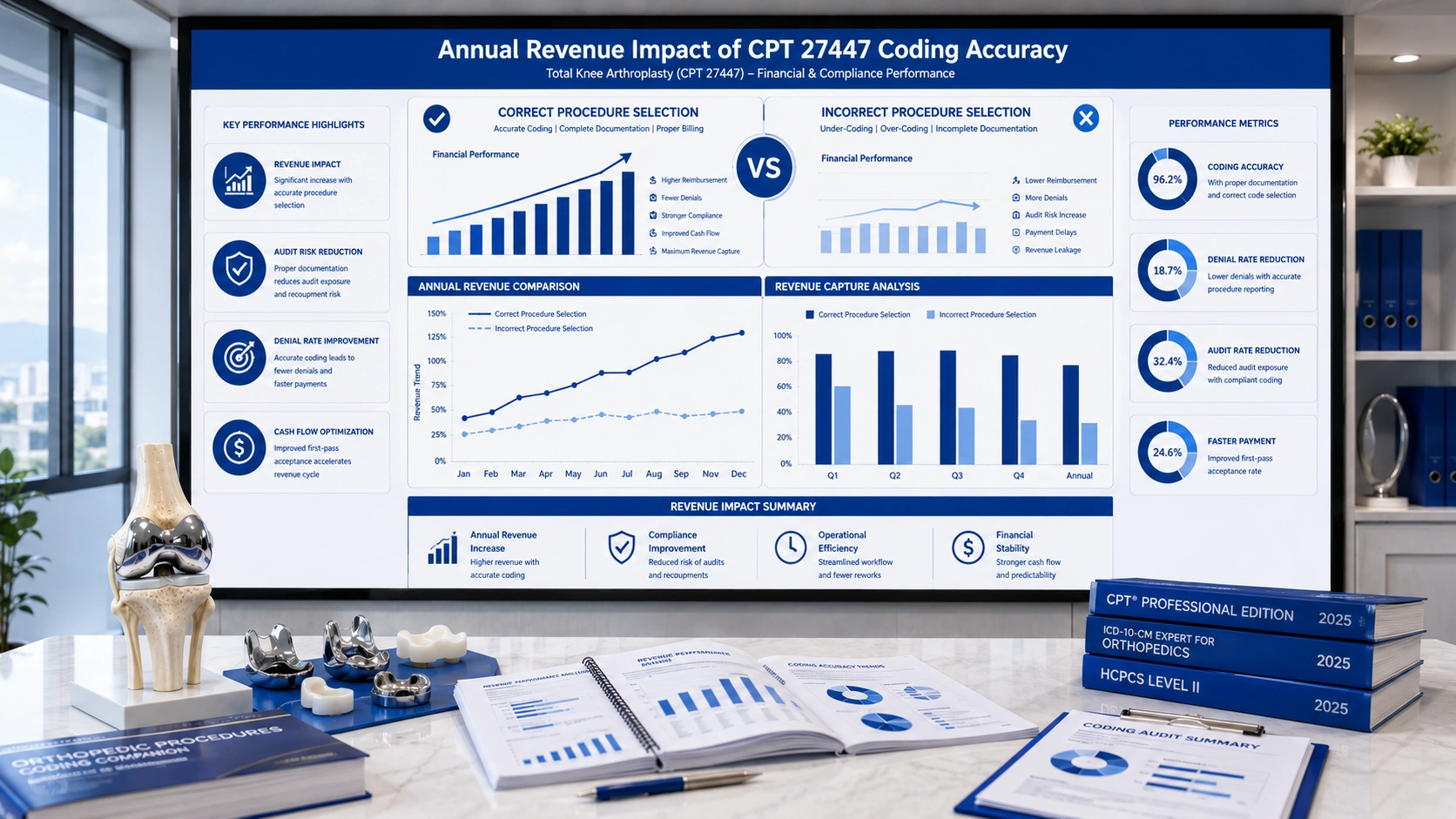
The numbers speak plainly. In-house coding teams average 75–85% accuracy on procedure-level selection; professional coders reach 95–98%, per MGMA benchmarks. That gap translates directly into revenue and risk.
On the revenue side: practices that consistently underselect procedure tiers lose an estimated $15,000–$25,000 per surgeon annually in uncollected total knee arthroplasty billing revenue. These are real dollars that a denial report will never show you.
On the compliance side: the OIG has flagged high-cost orthopedic surgical procedures — including total joint replacement — as Medicare compliance priorities. Per AMA audit exposure data, procedure miscoding generates hundreds of millions in overpayments annually. A practice billing outside specialty benchmarks will be found. CPT 27447 reimbursement recovery after a recoupment demand typically covers only a fraction of what proper upfront documentation would have protected.
The upside of correction is equally concrete. Practices implementing professional coding review for surgical procedure services typically see 10–20% revenue improvement within 90 days, per HFMA benchmarks. Professional coding support saves an average of 8–15 hours per week in documentation review and rework — at $22–$28/hour for billing staff, that equals $9,000–$22,000/year in direct labor savings, before accounting for recaptured revenue and avoided audit costs.
A multi-specialty practice in Detroit reduced procedure coding errors by 94% within 60 days of outsourcing coding review to TMS Billings. The gains were immediate and traceable, claim by claim.
How TMS Billings Helps Orthopedic Practices Get CPT 27447 Right — Every Time

Getting this procedure code right consistently requires more than knowing the code definition. It requires per-claim procedure tier verification, medical necessity alignment review, implant documentation validation, modifier accuracy checks, global period monitoring, and a clear audit trail — built before the claim leaves your system.
TMS Billings works with orthopedic surgeons, group practices, ASCs, and hospital-based systems. Our certified coders (CPC, CCS) are current on AMA CPT guidelines, 2026 CMS reimbursement standards, and the full range of orthopedic surgery billing codes across the arthroplasty and joint reconstruction spectrum. We verify procedure tier against operative documentation on every claim. We confirm ICD-10 alignment, validate implant records, and check modifier logic before submission.
We also provide ongoing provider feedback — not just at audit time. When documentation patterns create billing risk, your surgeons hear about it in real time. How to document medical necessity for total knee replacement is something our team actively coaches throughout the engagement.
What to look for in a coding partner: certified coders current on AMA CPT, systematic documentation review, global period monitoring, audit-ready recordkeeping, provider feedback loops, HIPAA-compliant workflows, and transparent performance reporting. TMS Billings delivers all of it — for practices that can’t afford to find out what’s going wrong after the fact.
Book a Free Consultation to see how the engagement works for a practice your size.
Key Takeaways
- CPT 27447 covers total tricompartmental knee arthroplasty only — code selection must be supported by operative documentation that matches every element of the code definition.
- Documentation gaps — missing conservative treatment records, vague operative reports, absent implant logs — are the leading cause of claim denials and audit exposure for this procedure.
- Downcoding to CPT 27446 when the operative report supports CPT 27447 costs practices $15,000–$25,000 per surgeon per year in silent, undetected revenue loss.
- Co-surgeon and bilateral modifiers require distinct operative reports and independently documented medical necessity — a shared note does not support separate billing.
- Global period violations are a direct audit trigger; post-operative E&M visits within the 90-day window require proper modifier documentation or create an unbundling problem.
- The first-pass claim acceptance rate is the most useful single metric for diagnosing coding accuracy problems before they compound across a billing cycle.
- Professional coding review typically delivers 10–20% revenue improvement within 90 days — with audit preparedness built into every claim from the start.
Final Thoughts
If your practice performs total knee arthroplasties at any volume, CPT 27447 billing errors are costing you — in denied revenue, in uncaptured reimbursement, or in audit exposure you may not yet know about. The documentation requirements are specific, the modifier rules are strict, and the financial stakes cut in both directions.
Your practice deserves a billing process that gets this right on the first submission — not reactively, not after a denial report, but before the claim reaches the payer. TMS Billings’ orthopedic coding team is built for exactly that.



20 Responses
What’s up, all the time i used to check blog posts here in the early hours
in the daylight, for the reason that i love to gain knowledge of more and more.
It’s a shame you don’t have a donate button! I’d most certainly donate to this outstanding blog!
I suppose for now i’ll settle for bookmarking and adding your RSS feed to my Google account.
I look forward to new updates and will talk about this website with my Facebook group.
Talk soon!
This is very fascinating, You’re an overly professional blogger.
I have joined your rss feed and sit up for in quest of extra of your magnificent post.
Additionally, I’ve shared your site in my social networks
Excellent items from you, man. I have consider your stuff prior to and you are
just extremely magnificent. I actually like what you’ve
bought right here, certainly like what you’re stating and the best way during which you say it.
You’re making it entertaining and you continue to care for to stay it
smart. I can’t wait to learn far more from you. This is
really a wonderful web site.
Aw, this was an exceptionally good post. Taking the time and actual effort to
generate a really good article… but what can I say… I hesitate a whole lot and never manage to get
nearly anything done.
Its not my first time to pay a quick visit this
site, i am browsing this website dailly and obtain nice information from here everyday.
I am extremely impressed with your writing skills and also with the layout on your weblog.
Is this a paid theme or did you customize it yourself?
Either way keep up the excellent quality writing, it’s rare to see a great blog like this one nowadays.
Excellent post. I used to be checking constantly this
blog and I am impressed! Extremely useful info specially the ultimate phase 🙂 I care for such information a lot.
I used to be seeking this particular info
for a long time. Thanks and good luck.
Whoa! This blog looks just like my old one! It’s on a entirely different topic but it has
pretty much the same page layout and design. Wonderful choice of colors!
This is a topic that’s near to my heart… Best wishes!
Exactly where are your contact details though?
Hello, of course this piece of writing is actually fastidious and I have learned lot of things from it concerning blogging.
thanks.
Spot on with this write-up, I absolutely believe that this website
needs a lot more attention. I’ll probably be returning to read through more, thanks for the info!
Aw, this was an incredibly nice post. Taking the
time and actual effort to make a good article…
but what can I say… I procrastinate a whole lot and don’t
seem to get nearly anything done.
This is my first time visit at here and i am truly impressed to
read everthing at single place.
An outstanding share! I’ve just forwarded this onto a friend who
has been conducting a little research on this. And he in fact
bought me breakfast because I stumbled upon it for him…
lol. So allow me to reword this…. Thank YOU for the meal!!
But yeah, thanks for spending some time to talk about this matter here on your
internet site.
Hello mates, good piece of writing and good arguments commented here,
I am genuinely enjoying by these.
My brother recommended I might like this blog.
He was totally right. This post actually made my day. You cann’t
imagine just how much time I had spent for this info! Thanks!
Thanks for sharing your thoughts. I really appreciate your efforts and
I will be waiting for your next post thanks once again.
Have you ever considered about adding a little bit more than just your articles?
I mean, what you say is valuable and everything. But
just imagine if you added some great graphics or videos to give your
posts more, “pop”! Your content is excellent but with pics and videos, this blog could definitely be one of the very best in its field.
Wonderful blog!
Thanks for finally talking about CPT 27447: Total
Knee Replacement Billing Guide Loved it!