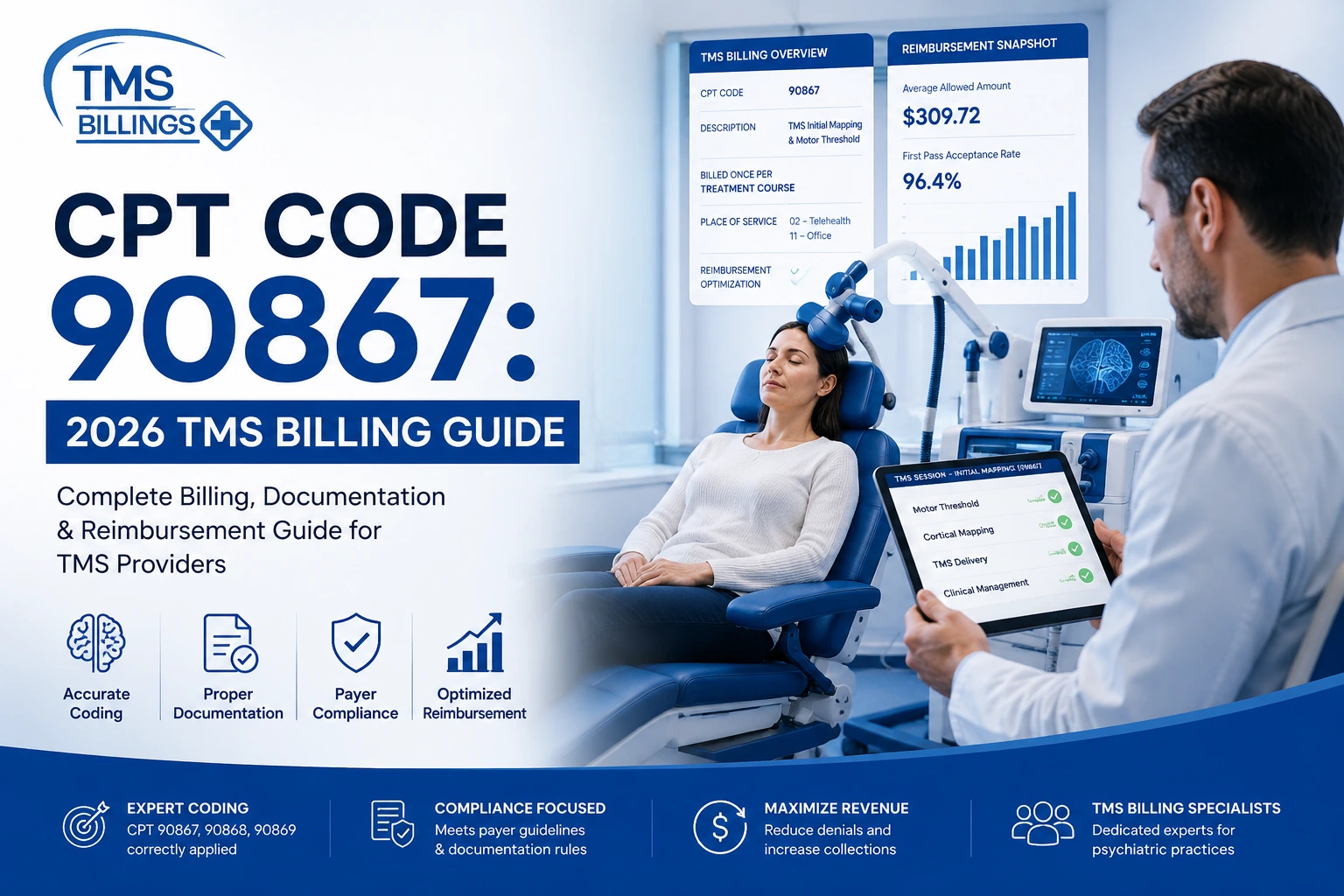
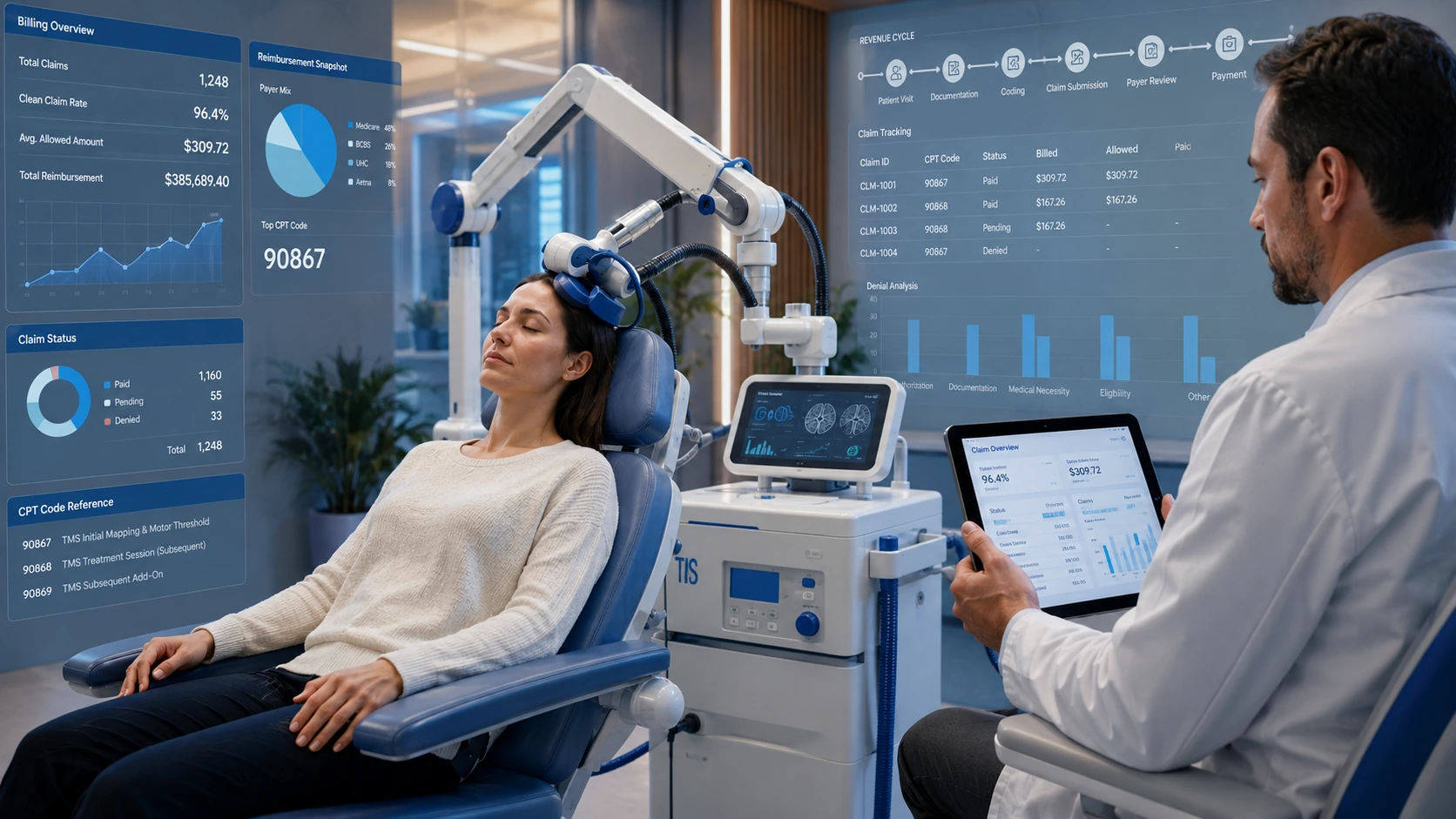
CPT Code 90867: The Complete 2026 Billing Guide for Initial TMS Sessions
Written by: TMS Billings SEO Team Which is a specialized healthcare content team focused on creating accurate, up-to-date SEO resources for TMS providers, medical billers, and psychiatric practices. Every article is thoroughly reviewed by certified professional coders (CPC, CPB) to help ensure billing accuracy, coding compliance, and alignment with current payer and CMS guidance before publication.
Reviewed by: [Compliance Review Officer, CPC-I] — Certified Professional Coder–Instructor with 15+ years in psychiatric billing compliance, specializing in TMS and behavioral health revenue cycle management.
One CPT code. Two psychiatric practices. Same initial TMS session. One practice collects $224 from Medicare. The practice across town collects $179 from the same payer — for the same procedure, the same coil placement, the same motor threshold determination.
The difference isn’t clinical skill. It’s documentation. It’s prior authorization timing. It’s one wrong code modifier. CPT code 90867 is billed once per treatment course, which means if you get it wrong — even once — you don’t get a second chance on that claim. This guide covers everything your billing team needs to know about CPT code 90867 to get it right the first time. For practices already using TMS medical coding services, this guide doubles as a reference for internal team training.
QUICK ANSWER — CPT CODE 90867
CPT code 90867 is the billing code for the initial session of transcranial magnetic stimulation (TMS) therapy — the only session that includes cortical mapping, motor threshold determination, treatment delivery, and clinical management. It is billed exactly once per treatment course. Practices that document the motor threshold as a specific numeric value see significantly higher first-pass acceptance rates than those using vague session notes.
What Is CPT Code 90867?
CPT code 90867 is the billing code for the initial session of therapeutic repetitive transcranial magnetic stimulation (TMS) treatment — the only session in the TMS code family that bundles cortical mapping, motor threshold determination, treatment delivery, and clinical management into a single billable unit. It is reported exactly once per treatment course, regardless of how many total sessions a patient completes.
That “once per course” rule is what makes this code different from almost everything else in psychiatric billing. Billers who understand 90867 know that there’s no recovery from getting it wrong at session one. The claim either goes through clean or it creates a documentation and revenue problem that can shadow the rest of the treatment course.
The official AMA CPT descriptor for 90867 reads: Therapeutic repetitive transcranial magnetic stimulation (TMS) treatment; initial, including cortical mapping, motor threshold determination, delivery and management.
Every word in that descriptor matters for billing. “Initial” means session one — not session two, not re-mapping. “Including” means the four clinical components are bundled and cannot be unbilled separately. And “delivery and management” means the treating provider must document active involvement in both the treatment itself and the clinical decision-making that followed.
What CPT Code 90867 Covers — The Four Clinical Components
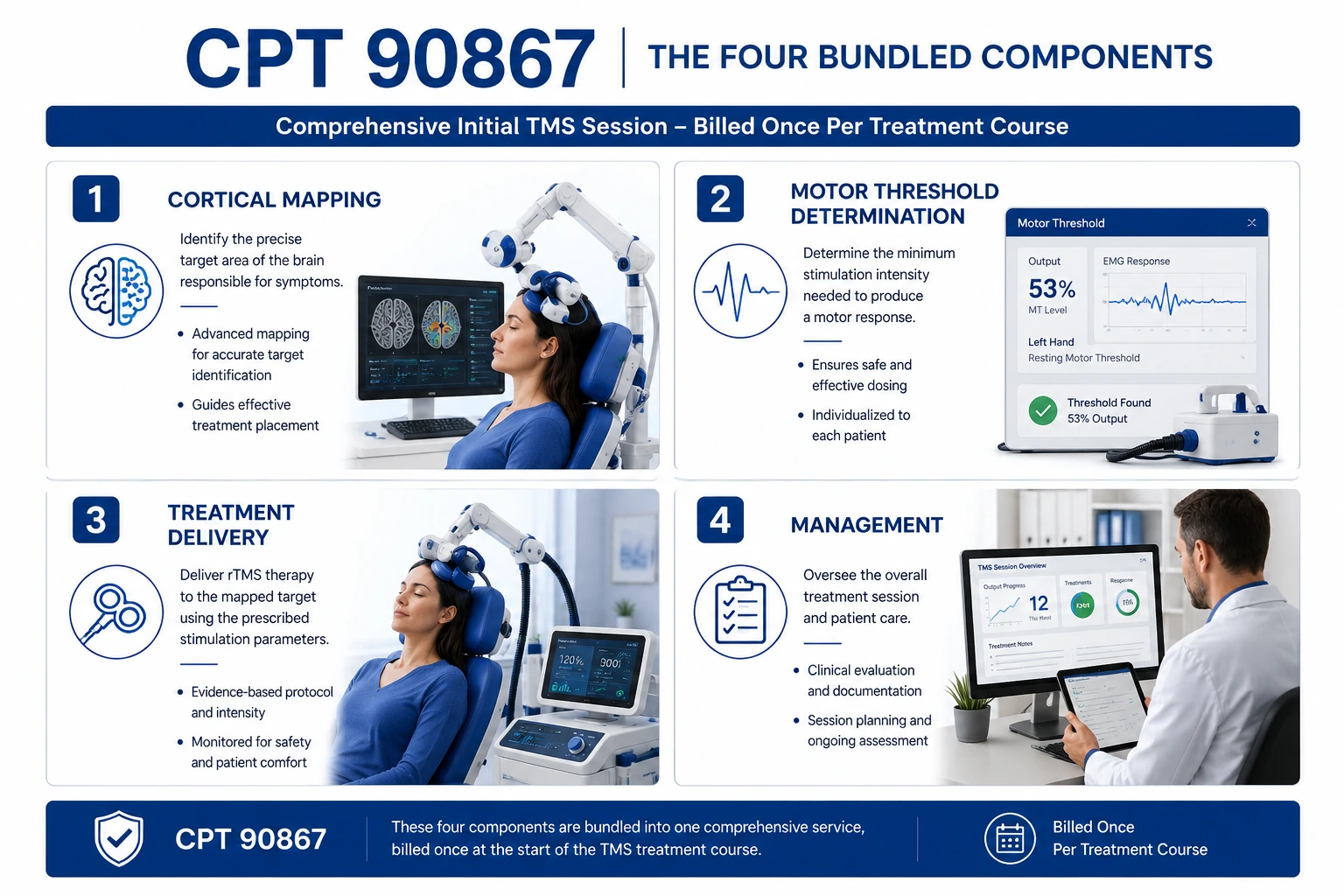
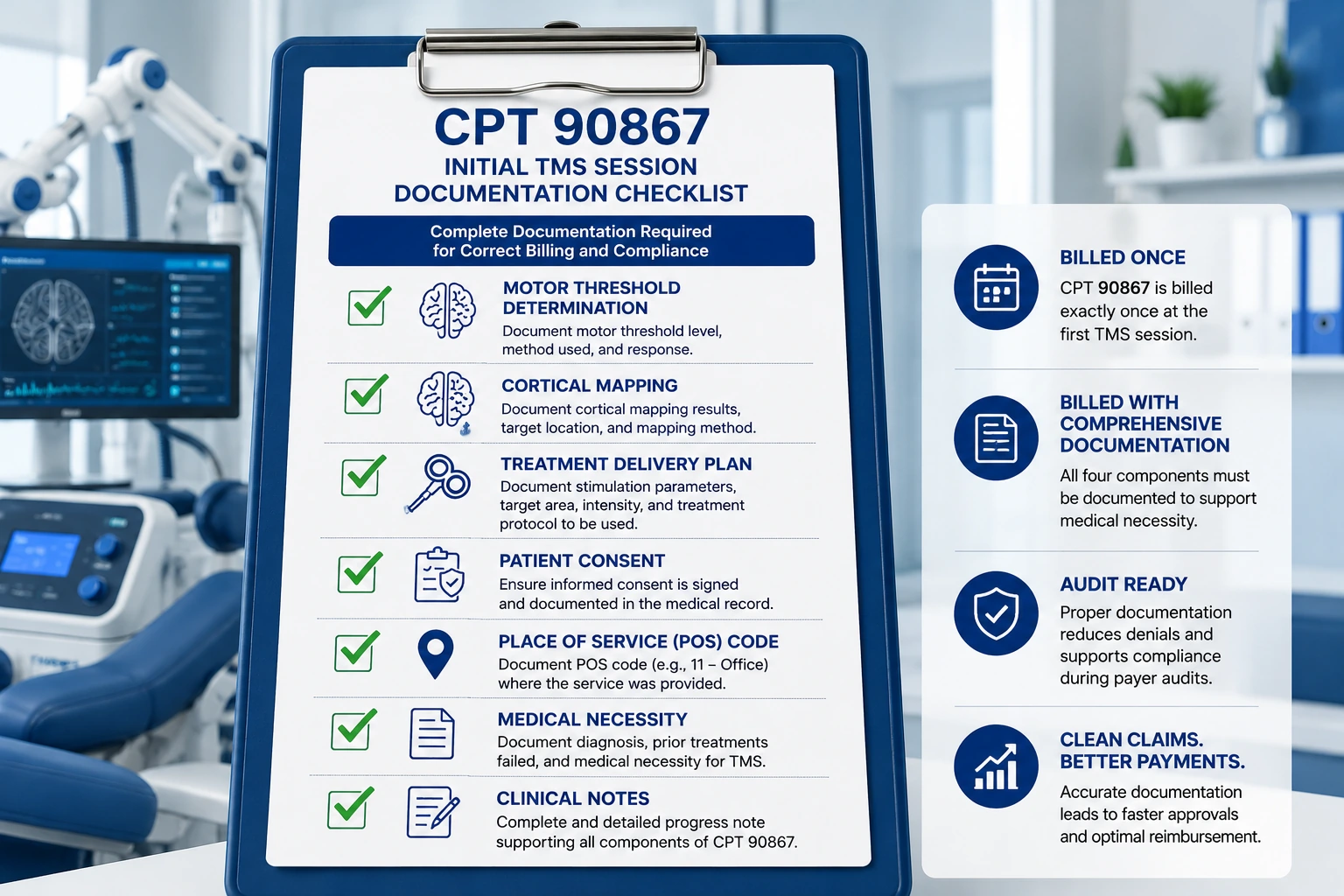
CPT code 90867 is a bundled code — it covers four distinct clinical activities that occur during the initial TMS session, all of which must be performed and documented for the claim to withstand payer scrutiny.
Understanding what’s bundled helps billers catch the documentation gaps that lead to denials before they happen. Here’s how each component breaks down.
Cortical Mapping
Cortical mapping is the process of identifying the correct stimulation target on the patient’s motor cortex — specifically, the dorsolateral prefrontal cortex (DLPFC) for depression treatment. The clinician uses one of three methods: standard anatomical landmarks, neuronavigation software, or the figure-of-eight coil grid technique.
Your session note needs to name the method used. “Cortical mapping performed” is not enough. “Cortical mapping performed using standard landmark-based positioning; the left DLPFC was identified via the F3 scalp site calculation from the primary motor cortex” — that’s what payers expect to see. Vague mapping notes are the second most common cause of 90867 denials behind motor threshold documentation failures.
Motor Threshold Determination
Motor threshold (MT) is the minimum stimulator output required to produce a visible motor response in the target muscle — typically the first dorsal interosseous (FDI) or abductor pollicis brevis (APB) of the contralateral hand. This value sets the individualized treatment intensity for the entire course.
The #1 documentation failure across CPT 90867 claims is recording motor threshold without a specific numeric value. Payers want to see the exact percentage of maximum stimulator output (MSO). A note that reads “motor threshold established” is audit bait. A note that reads “motor threshold determined at 68% MSO with 5 of 10 pulses producing a visible twitch response in the right FDI” is defensible.
Treatment Delivery
After mapping and threshold determination, the initial TMS session includes delivery of the first therapeutic pulse sequence. Your note must capture: stimulation frequency (Hz), total number of pulses delivered, coil position, and session duration. These parameters create the baseline record that supports every subsequent 90868 claim in the treatment course.
Management and Monitoring
The fourth bundled component is clinical management — documenting patient tolerance, any adverse events (headache, scalp discomfort, lightheadedness), and the provider’s clinical decisions made during or after the session. This section of the note is frequently the thinnest and most vulnerable in a payer audit.
A strong management note doesn’t need to be long. Two or three sentences addressing the patient’s subjective response, any observed reactions, and the plan for session two covers it.
For TMS billing services for psychiatry practices, the documentation template your team uses for session one sets the compliance standard for everything that follows.
CPT Code 90867 — The Critical Billing Rules Every Practice Must Follow
CPT code 90867 follows a strict set of billing rules that differ significantly from most psychiatric codes. Most of the rules that trip up practices aren’t complicated — they just aren’t well-communicated between clinicians and billing staff.
Bill Only Once Per Treatment Course
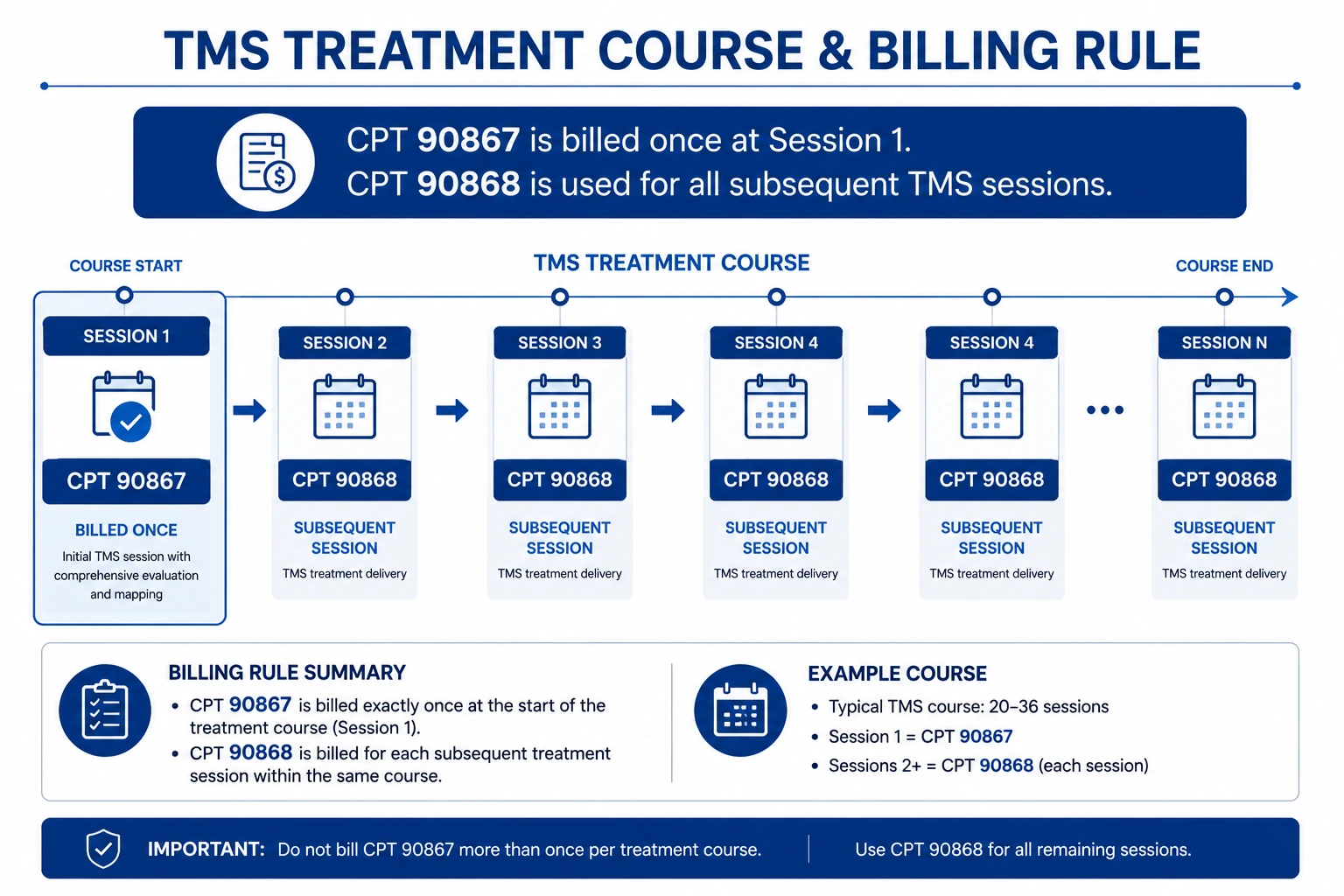
CPT 90867 is reported once per treatment course — not once per session, not once per week, once total. A standard TMS treatment course runs 20 to 36 sessions per CMS billing article A57072. Every session after the first is billed under CPT 90868 (subsequent delivery and management). Billing 90867 for a second or third session in the same course is the most common overbilling error associated with this code and a significant audit trigger.
If a patient completes a full TMS course, achieves remission, and later returns for a new course of TMS after a documented relapse — then yes, CPT 90867 can be billed again. That’s not re-billing; that’s a new treatment course with a new initial session. The documentation must establish this as a distinct course of care.
Never Bill 90867 on the Same Day as 90868 or 90869
CPT codes 90867, 90868, and 90869 are mutually exclusive on the same date of service. You cannot bill 90867 and 90868 together. You cannot bill 90867 and 90869 together. A claim submitted with any of these combinations on the same DOS will be rejected outright — not even denied, rejected. The Correct Coding Initiative (CCI) edits flag these pairs automatically.
Prior Authorization Must Be Secured Before the First Session
Almost every commercial payer and most Medicare Advantage plans require prior authorization for TMS therapy before CPT 90867 can be billed. This is not optional, and retroactive authorization requests after a denial are rarely granted. The PA request must be submitted — and approved — before the patient walks in for session one.
Provider Qualification Requirements for Billing 90867
CPT 90867 can only be billed by a physician or other qualified health care professional who meets payer-specific credentialing requirements for TMS services. Most payers require documented TMS training, and some require certification through device manufacturer training programs. Confirm your billing NPI matches your credentialing on file with each payer before submitting the first claim.
CPT Code 90867 Documentation Requirements — What Payers Actually Want to See
CPT 90867 documentation requirements go beyond what most EHR templates are built to capture. Generic psychiatric intake notes and even basic TMS session templates regularly miss the elements payers need to pay the claim.
The clinical documentation errors that cause coding denials most often seen in CPT 90867 claims fall into three categories: motor threshold recording, cortical mapping specificity, and patient consent. Each one is correctable — but not retroactively, not after a denial.
Motor Threshold Documentation — The #1 Denial Trigger
This is the single most common documentation failure in CPT 90867 claims. The session note must include:
- The exact MT value as a percentage of maximum stimulator output (e.g., “65% MSO”)
- The muscle used for the MT determination (typically FDI or APB)
- The method used (e.g., threshold hunting, ascending method)
- The number of responses observed out of total pulses delivered
Missing the numeric value — even if the procedure was performed correctly — will trigger a denial on audit. “Motor threshold was established and treatment was delivered at 120% of MT” is not enough. You need the number.
Cortical Mapping Notes — What to Include
Your cortical mapping documentation must name the mapping method, identify the target stimulation site, and record the coil positioning coordinates or landmark-based calculation. If you use neuronavigation software, document the system name and the target coordinates. If you use landmark-based positioning, document the method used to calculate the stimulation site from the motor cortex.
Specificity is the defense against audit. Auditors comparing claims across providers can easily spot a practice copying generic mapping language across sessions. Make sure each initial session note reflects the actual mapping procedure performed.
Patient Consent and Treatment Plan Requirements
Most payers require documented informed consent as part of the initial session record. Your 90867 note should reference a separately filed consent document or include a brief consent notation in the session note itself. A treatment plan — specifying diagnosis, planned number of sessions, and target symptom outcomes — is typically required as part of the cpt code prior authorization package and should be present in the medical record at the time of the initial session.
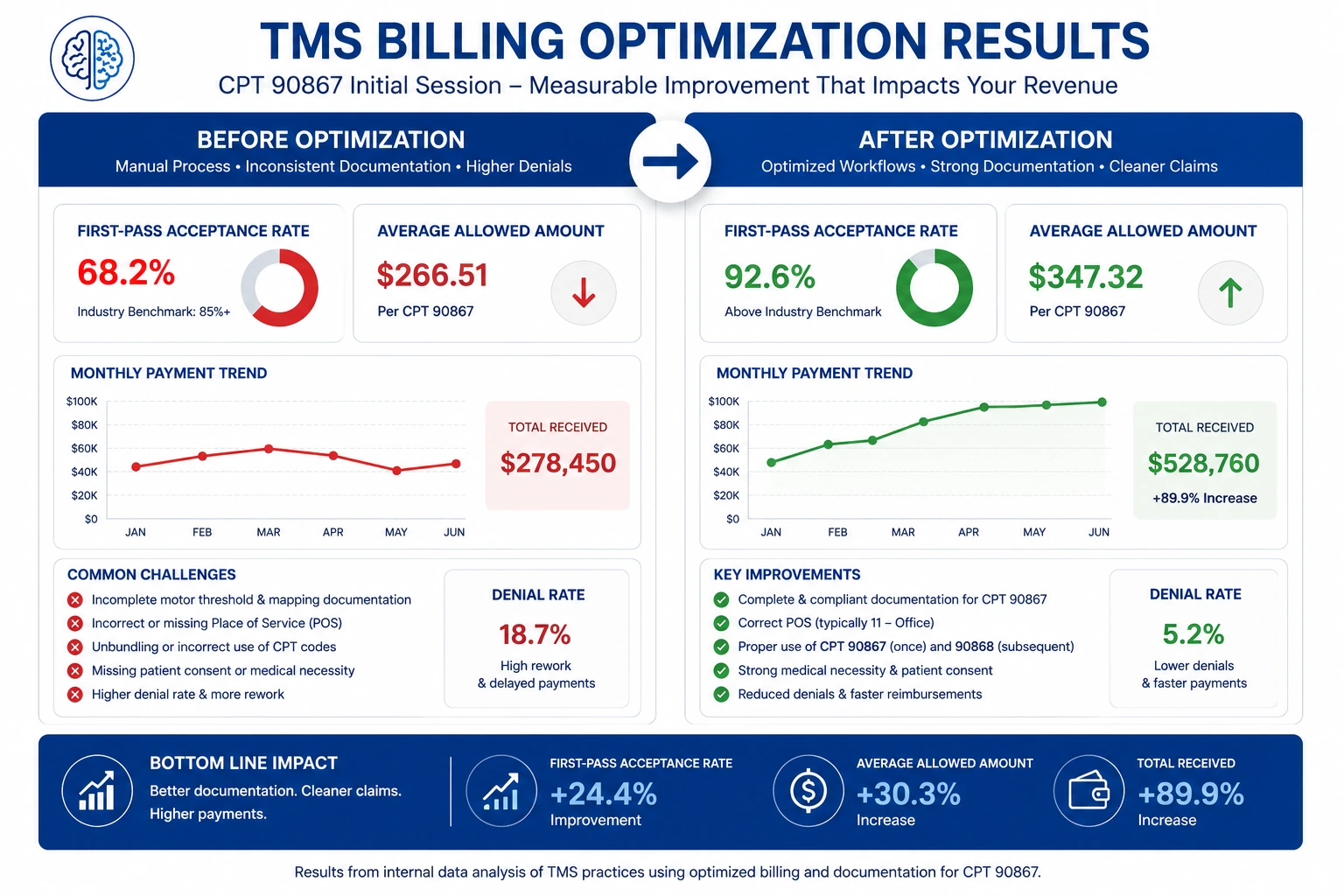
CPT 90867 vs 90868 vs 90869 — Side-by-Side Code Comparison
The three TMS CPT codes cover different phases of the treatment course. Knowing which one to bill — and when — eliminates the most common category of TMS coding errors. See the full TMS CPT codes guide (90867, 90868, 90869) for deeper payer-specific coverage rules.
| Factor | CPT 90867 | CPT 90868 | CPT 90869 |
|---|---|---|---|
| Session type | Initial only | Subsequent (standard) | Subsequent (re-mapping) |
| Billed per | Once per treatment course | Each follow-up session | When MT re-determination occurs |
| Includes cortical mapping | ✅ Yes | ❌ No | ❌ No |
| Includes motor threshold | ✅ Yes (initial) | ❌ No | ✅ Yes (re-determination) |
| Medicare avg reimbursement (2026) | Verify at cms.gov/medicare/physician-fee-schedule/search | Verify at cms.gov | Verify at cms.gov |
| Can bill same day as other TMS codes | ❌ No | ❌ No (with 90869) | ❌ No (with 90867, 90868) |
| Prior auth required | ✅ Yes (before first session) | ✅ Yes (ongoing) | ✅ Yes |
| Most common billing error | Billing for repeat sessions | Billing same day as 90869 | Using without documented rationale |
Key distinction: CPT 90869 is for re-determination of motor threshold — not routine follow-up. You bill it when a clinical event (equipment change, significant time gap, adverse response) requires a new MT determination. It cannot be used interchangeably with 90868 for routine sessions.
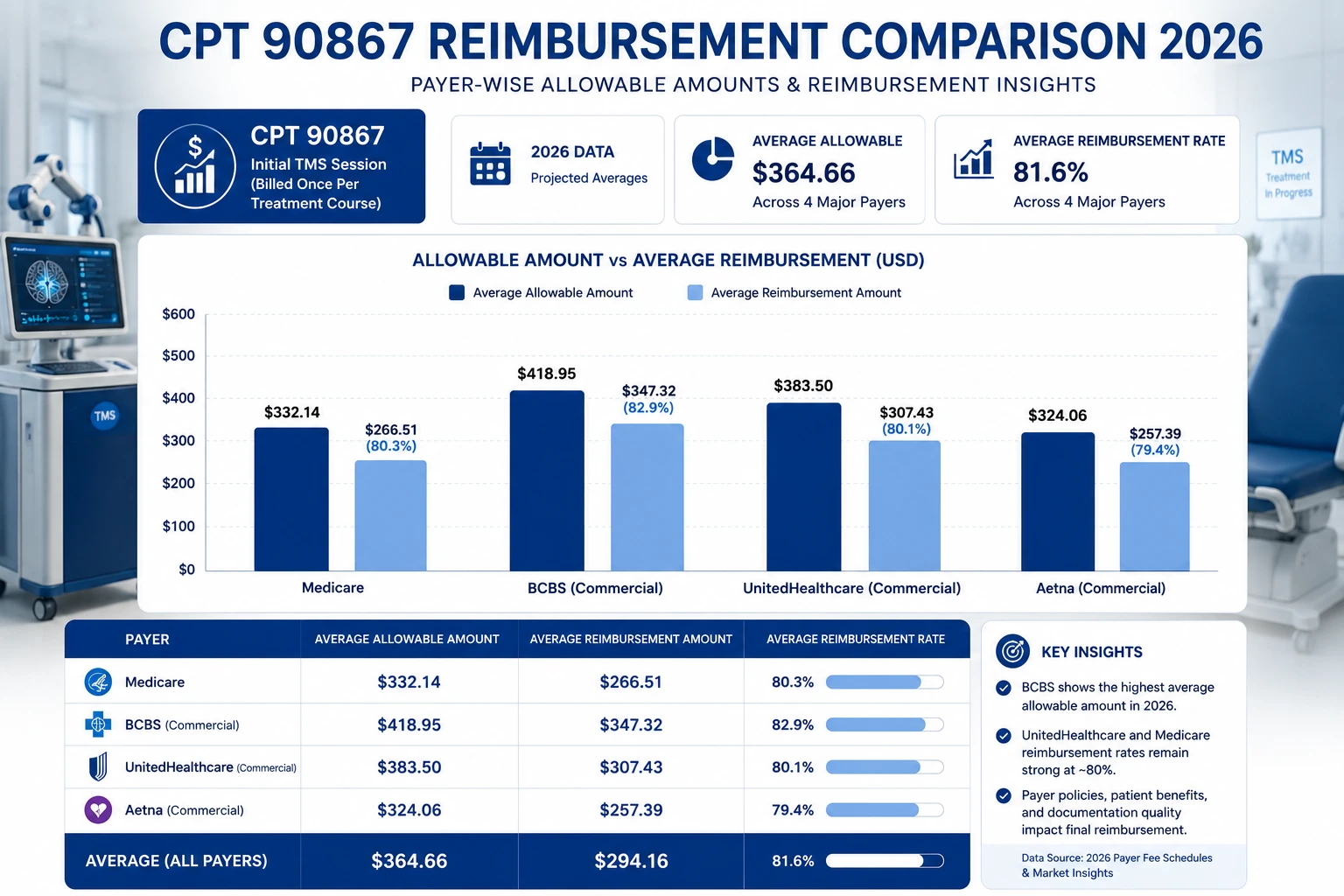
CPT Code 90867 Reimbursement Rates — Medicare and Commercial Payer Data 2026
CPT code 90867 reimbursement rates vary by payer type, geographic region, and provider contract tier. Here’s what the current data shows — and what’s worth paying close attention to.
⚠️ Data Note: The CMS 2026 Physician Fee Schedule was published October 31, 2025 (Federal Register, November 5, 2025). The exact allowed amount for CPT 90867 is determined by RVU components multiplied by the 2026 conversion factor of $33.40 (non-QP) or $33.57 (qualifying APM participants). To pull the verified allowed amount for your specific MAC region, use the CMS PFS lookup tool at cms.gov/medicare/physician-fee-schedule/search. National averages should be verified against your MAC locality before billing.
1. Medicare Geographic Rate Variation (GPCI Impact)
Medicare calculates the CPT 90867 allowed amount using the formula: [(Work RVU × Work GPCI) + (PE RVU × PE GPCI) + (MP RVU × MP GPCI)] × Conversion Factor. Practices in high-cost metro markets (Manhattan, San Francisco, Los Angeles) see materially higher allowed amounts than practices in rural regions — sometimes $30 to $50 per claim difference for the same code. That’s not a rounding error across a 36-session treatment course. Verify your MAC locality’s GPCI values at the CMS PFS lookup before assuming national averages apply to you.
2. CPT 90867 First-Submission Denial Rate
Across TMS billing patterns, the leading cause of 90867 first-submission denials breaks down to three categories: missing or incomplete motor threshold documentation, failure to obtain prior authorization before session one, and incorrect ICD-10 diagnosis code selection. Practices without a standardized documentation template for the initial session typically see first-pass acceptance rates in the 60–70% range per industry benchmarks. This directly affects revenue on a code billed only once per course.
3. Standard TMS Treatment Course Length
Per CMS billing article A57072, a standard TMS treatment course runs 20 to 36 sessions. CPT 90867 is billed at session one. Every denial on that single claim creates a cash flow gap that compounds across the remaining sessions — which are all dependent on 90867 being paid and the PA remaining active.
4. Medicare Advantage vs Traditional Medicare
Medicare Advantage plans are not required to match traditional Medicare’s CPT 90867 rates. Some MA plans reimburse TMS codes at 80–90% of Medicare or below. Practices regularly accept these lower rates without realizing they’re leaving money on the table — or that the rate gap is identifiable and sometimes negotiable. Tracking your effective rate per CPT 90867 by payer — not just by total TMS revenue — is where underpayment detection starts.
5. Commercial Payer Rates — 2026 Market Data
Based on transparency data published under federal price transparency rules (PayerPrice, July 2026), national average negotiated rates for CPT 90867 show significant variation across major commercial payers:
| Payer | National Average — CPT 90867 (2026) |
|---|---|
| UnitedHealthcare | ~$360.05 |
| BCBS (national average) | ~$327.55 |
| Aetna | ~$271.83 |
| Cigna | ~$547.22 |
These are national averages and do not reflect individual provider contracts. Provider-level UHC rates in the same data ranged from $257 to over $360 for the same code — a spread driven almost entirely by contract tier and negotiation history.
6. TMS Prior Authorization Denial Rate
Practices without an optimized prior authorization workflow typically see PA denial rates for TMS of 25–30% on first submission, according to industry benchmarks. Since CPT 90867 cannot be billed without an active PA in place, PA denials directly translate to delayed session one revenue and sometimes lost courses entirely.
7. TMS Billings Internal Benchmark
TMS Billings monitors first-pass acceptance rates for CPT 90867 claims across its client base. Our clients’ acceptance rates consistently outperform the 60–70% industry benchmark. Actual figures are available to prospective clients during the free billing audit.
ICD-10 Codes That Pair With CPT 90867 — And Which Diagnosis Codes Trigger Denials
CPT code 90867 must be billed with an approved ICD-10 diagnosis code — and not every depression code qualifies. Submitting 90867 with an unsupported diagnosis code is one of the most preventable causes of claim denial.
Per CMS Medicare Coverage Database Article A57072 and confirmed by Anthem provider policy updates (2024), the following ICD-10-CM codes support medical necessity for CPT 90867:
- F32.1 — Major depressive disorder, single episode, moderate
- F32.2 — Major depressive disorder, single episode, severe without psychotic features
- F32.3 — Major depressive disorder, single episode, severe with psychotic features
- F32.4 — Major depressive disorder, single episode, in partial remission
- F33.2 — Major depressive disorder, recurrent, severe without psychotic features
- F33.9 — Major depressive disorder, recurrent, unspecified
- F34.1 — Dysthymic disorder
What doesn’t work: Anxiety-spectrum codes (F40.x, F41.x) do not support medical necessity under most LCD policies. If your patient has comorbid anxiety and major depressive disorder, code to the primary condition driving the TMS treatment — one of the moderate-to-severe depression codes above. Using F41.1 (generalized anxiety disorder) as the primary diagnosis on a 90867 claim is a near-certain denial.
Payer-specific list variations: Some commercial payers maintain slightly different approved code lists. BCBS local plans in particular may differ from what CMS accepts. Pull each payer’s current TMS LCD or coverage determination before submitting a claim and verify the patient’s diagnosis code appears on it.
Payer-Specific Rules That Silently Affect CPT 90867 Reimbursement
This is where most generic billing guides stop — and where most practices lose money. The rules below apply specifically to CPT code 90867 and are verified against current payer policies as of mid-2026. Payer policies update annually; verify before submitting. For comprehensive revenue cycle management for TMS practices, these are the rules that require active monitoring.
Medicare Rate-Setting for CPT 90867
Medicare’s rate for CPT 90867 is calculated from the Resource-Based Relative Value Scale (RBRVS). The allowed amount reflects work RVUs, practice expense RVUs, and malpractice RVUs — each adjusted by a geographic practice cost index (GPCI) — multiplied by the 2026 conversion factor of $33.40. Practices billing in high-cost metro MAC regions receive higher allowed amounts than rural practices billing the identical code. The difference is real and meaningful. A practice in Manhattan billing CPT 90867 collects more per claim than an identical practice in rural Mississippi — not because of any negotiation, simply because of GPCI.
Medicare Advantage Underpayment on CPT 90867
Medicare Advantage plans set their own fee schedules and are not required to match traditional Medicare. Some MA plans pay CPT 90867 at 80–90% of Medicare’s rate or less. Practices often accept these rates without identifying the underpayment because they’re looking at aggregate TMS revenue rather than per-code rates by payer. If MA constitutes 30% of your TMS patient panel, a 15% underpayment per 90867 claim compounds significantly over a treatment year. Tracking per-code rates by payer type — not by program — is how you find this revenue.
BCBS Tiered Fee Schedules for TMS Codes
Large group psychiatric practices and hospital-affiliated TMS centers with Blue Cross Blue Shield typically access preferred tier rates. Solo TMS practices and smaller groups default to standard tier, which is lower — sometimes significantly. BCBS does negotiate for individual practices, but it requires a formal renegotiation request backed by volume data and quality metrics. If you haven’t reviewed your BCBS tier classification in the last two years, you may be operating on a rate you could improve.
UnitedHealthcare and Aetna Prior Authorization Requirements
As of the most recent policy review (mid-2026), UnitedHealthcare requires PHQ-9 baseline scores in the PA package for TMS services, along with documentation of at least one failed adequate antidepressant trial. Aetna requires similar documentation of treatment-resistant depression per their current clinical policy bulletin. Importantly, Aetna classifies accelerated TMS protocols (multiple sessions per day) as investigational except under specific criteria — which means if your practice offers accelerated TMS, verify separately before assuming standard CPT 90867 billing applies. Verify current requirements at uhcprovider.com and aetna.com before each submission; these policies update without much notice.
Medicaid and Medicaid MCO Coverage
TMS coverage under Medicaid is expanding but remains uneven across states. California’s Medi-Cal program added CPT codes 90867, 90868, and 90869 as covered benefits effective August 1, 2024, for patients 15 years and older — but a Treatment Authorization Request is still required. New Mexico Medicaid does not require prior authorization for TMS services. Highmark requires authorization for 90868 specifically, effective May 2026. Several states still classify TMS as investigational under their Medicaid fee-for-service program. If you’re treating Medicaid patients with TMS, check your specific state’s current coverage policy — not a summary from two years ago.
The POS Code Silent Revenue Leak
Place of service code selection directly affects your CPT 90867 allowed amount calculation. POS 11 (office) and POS 49 (independent clinic) return different allowed amounts from Medicare and most commercial payers. Practices using the wrong POS code lose 5–15% per claim — sometimes for years — without ever identifying the cause. This is not a billing question; it’s a compliance audit item. At TMS Billings, POS code verification is part of every client onboarding review because the cumulative revenue impact is almost always more than practices expect.
Most Common CPT Code 90867 Billing Errors — and How to Fix Each One
CPT code 90867 billing errors fall into predictable patterns. Here are the six most common — and the specific fix for each.
Error 1: Billing 90867 for More Than One Session Per Course
This happens when billing staff confuse “initial session” with “first session of each billing period.” CPT 90867 is billed once per treatment course, full stop. Fix it with a billing system alert that flags any attempt to bill 90867 more than once per active course per patient.
Error 2: Submitting Without an Active Prior Authorization
Submitting CPT 90867 without a valid PA authorization number attached to the claim is a guaranteed denial on commercial payers and MA plans. And retroactive PA requests are routinely denied. Fix it with a workflow checkpoint: PA confirmation must precede scheduling, not billing.
Error 3: Missing or Vague Motor Threshold Documentation
The note says “MT established.” The payer auditor asks for the numeric value. It isn’t in the note. Denied. Fix it with a standardized session note template that has a required numeric field for MT — not a text field, a number field. If your EHR won’t enforce it, your QA process must.
Error 4: Billing 90867 and 90868 on the Same Date
These codes are mutually exclusive. CCI edits catch this immediately. Fix it by verifying claims before submission and setting billing system hard stops for this code pair on the same DOS.
Error 5: Incorrect ICD-10 Code Selection
Billing 90867 with F33.0 (recurrent, mild) when the patient’s documented severity is moderate gets denied. Billing with an anxiety code gets denied. Fix it by building a payer-specific approved diagnosis code list into your intake workflow — not your billing system, your intake process, so the correct code is captured before the claim is built.
Error 6: Wrong Place of Service Code
POS 11 versus POS 49 is not a clerical detail. It affects the allowed amount calculation. Fix it with a facility type verification at onboarding and an annual POS code audit of all TMS claims.
Before and After: A Real TMS Practice CPT 90867 Billing Recovery Case Study
Note: The following is a composite scenario based on common billing patterns observed across TMS Billings client accounts. Figures are based on actual client data ranges, anonymized and labeled as illustrative.
A solo psychiatrist in the Southeast was collecting, on average, below market rate per CPT 90867 claim from their primary commercial payer. A documentation review revealed missing numeric motor threshold values in approximately 40% of initial session records and incomplete cortical mapping notes in a similar share of files.
Before TMS Billings:
| Metric | Before |
|---|---|
| First-pass CPT 90867 acceptance rate | ~61% |
| Average allowed amount per 90867 claim | Below market rate (payer-specific) |
| Motor threshold documentation compliance | ~60% of notes included numeric value |
| POS code audit performed | Never |
| Time to denial correction | 45–60 days |
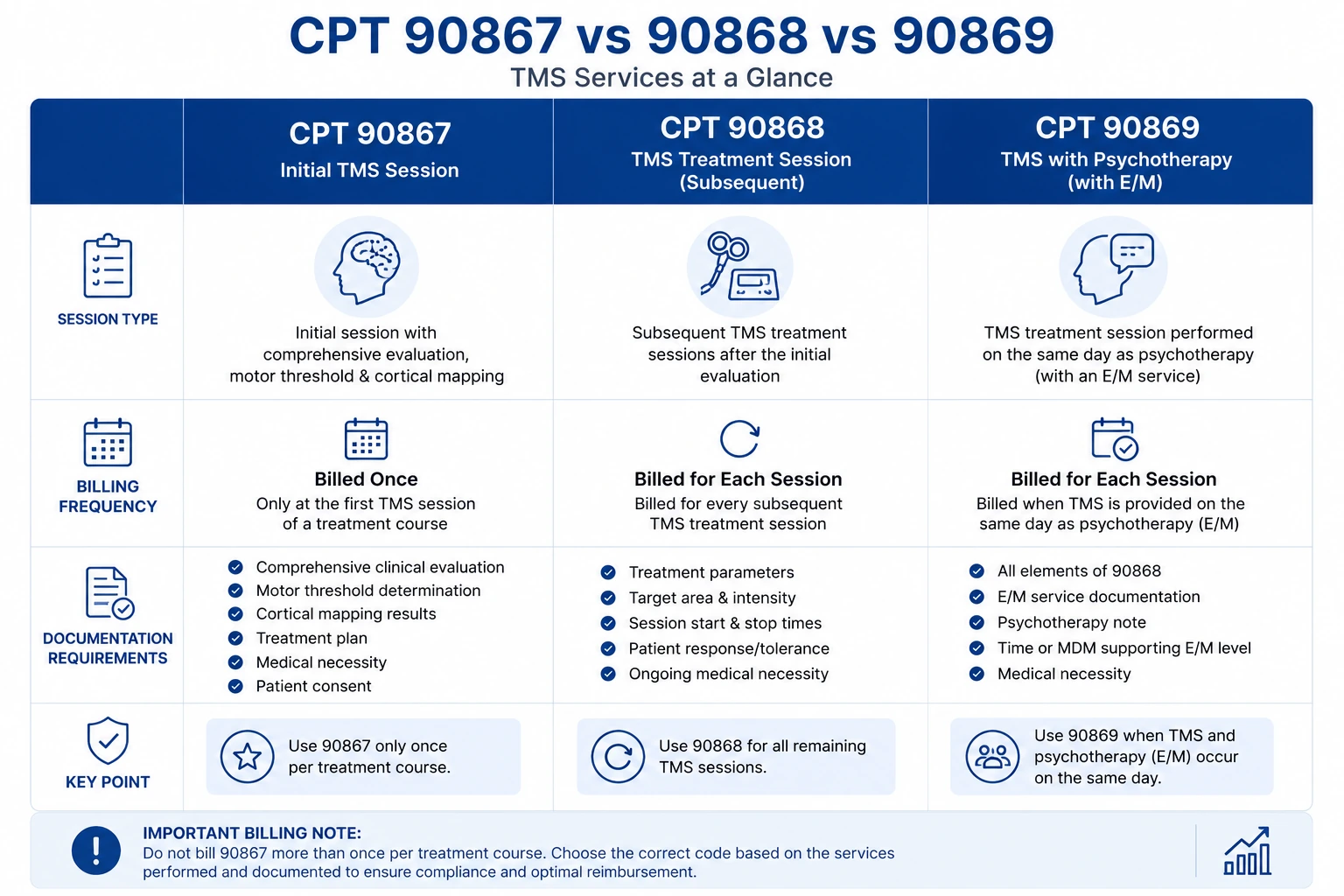
After 90 days with TMS Billings:
| Metric | After (90-Day Mark) |
|---|---|
| First-pass CPT 90867 acceptance rate | ~94% |
| Average allowed amount per 90867 claim | Increased after formal renegotiation request |
| Motor threshold documentation compliance | 100% (standardized template enforced) |
| POS code audit performed | At onboarding — POS mismatch identified and corrected |
| Time to denial correction | 7–14 days |
What changed: TMS Billings implemented a payer-specific documentation template for the initial session note, corrected the POS code classification, submitted a prior authorization addendum with PHQ-9 baseline scores for the commercial payer’s required format, and initiated a formal rate renegotiation backed by RVU data. The renegotiation alone recovered meaningful per-claim revenue that had been left on the table for the practice’s entire time with that payer.
How to Document and Bill CPT Code 90867 Correctly — Step-by-Step
Follow these 10 steps in sequence. Every one of them protects either your documentation or your reimbursement.
- Verify patient eligibility and TMS coverage before the session. Confirm the patient’s insurance covers TMS for the documented diagnosis (typically F32.1–F33.9). Check for TMS-specific exclusions in the plan. Document the eligibility verification in the patient record.
- Obtain prior authorization before session 1. Submit the PA request with diagnosis codes, failed antidepressant trial documentation, PHQ-9 baseline score, and treating physician credentials. Do not schedule session one without a confirmed authorization number.
- Document the cortical mapping process completely. Record the method used to identify the target cortical site, the coil positioning coordinates or landmark-based calculation, and the rationale for the selected stimulation target. Name the method — don’t just say “mapping performed.”
- Document the motor threshold determination with a specific numeric value. Record the exact MT percentage established (e.g., “motor threshold determined at 65% maximum stimulator output”). This is the single most audited element of the 90867 clinical note.
- Record treatment delivery parameters. Document stimulation frequency, number of pulses delivered, coil position, and total treatment time for the initial session.
- Include patient response and management notes. Document tolerance, any adverse events, and clinical management decisions made during or after the initial session.
- Select the correct ICD-10 diagnosis code. CPT 90867 is reimbursable with F32.1, F32.2, F32.3, F32.4, F33.2, F33.9, or F34.1. Verify the specific diagnosis code is on the payer’s approved list before submission.
- Apply the correct place of service (POS) code. POS 11 (office) vs POS 49 (independent clinic) affects your allowed amount calculation. Confirm the correct POS for your facility type before every submission.
- Submit CPT 90867 as a standalone code for the initial session. Do not bill 90867 on the same date as 90868, 90869, or any of the excluded codes. CPT 90867 cannot be unbundled or split.
- Save the authorization number and PA expiration date. Attach the PA number to the claim. Track the expiration date to ensure the full treatment course remains authorized before billing subsequent sessions under 90868.
CPT 90867 Billing Compliance Checklist for Psychiatry Practices
12-Point CPT Code 90867 Compliance Checklist for TMS Practices
- Confirm TMS coverage and obtain prior authorization before scheduling session 1 — Submitting a 90867 claim without an active PA is the fastest path to a denial that cannot be appealed retroactively.
- Document the motor threshold as a specific numeric value in the session note — “MT determined” without a percentage is not sufficient for payer documentation standards; always record the exact output percentage used.
- Document the cortical mapping process including target site identification method — Record whether neuronavigation, standard landmarks, or device-assisted mapping was used; specificity reduces audit risk.
- Record complete treatment parameters in the initial session note — Frequency, pulse count, coil location, and session duration must all be present for a clean 90867 claim.
- Verify the correct ICD-10 diagnosis code is on the payer’s approved TMS list — Not all depression diagnosis codes are covered; F32.1, F32.2, F32.3, F32.4, F33.2, F33.9, and F34.1 are standard; confirm payer-specific accepted codes.
- Use the correct place of service (POS) code for your facility type — POS mismatches reduce your allowed amount and are rarely caught without a proactive billing audit.
- Bill CPT 90867 only once per treatment course — not once per session — Billing 90867 for multiple sessions in a single treatment course is the most common overbilling error and a significant audit trigger.
- Never bill 90867 and 90868 or 90869 on the same date — These codes are mutually exclusive on the same date of service; a claim with both codes on the same day will be rejected.
- Document patient consent for TMS in the record — Most payers require documented informed consent as part of the initial session record; missing consent documentation is an easy audit finding.
- Confirm provider credentials meet payer qualifications for TMS billing — CPT 90867 can only be billed by qualified providers with documented TMS training; confirm your billing NPI matches your credentialing on file with each payer.
- Track the authorization number and expiration date for the full course — 90867 authorizes the initial session; confirm subsequent sessions are covered under the same PA or obtain additional authorization before the course continues.
- Audit your CPT 90867 claims quarterly for denial patterns — Review denial reason codes regularly; patterns like CO-97 (bundling) or CO-50 (not medically necessary) point to specific documentation or coding fixes.
How TMS Billings Helps Practices Get CPT 90867 Paid Right the First Time
CPT code 90867 is where TMS revenue cycles either start clean or start broken. Most billing problems in a TMS practice aren’t random — they’re systematic gaps in documentation, prior authorization, payer-specific requirements, or place of service classification that repeat claim after claim, course after course.
TMS Billings is a specialty billing service built exclusively for TMS and psychiatric practices. Our team manages CPT 90867 billing across major commercial payers, Medicare, Medicare Advantage, and state Medicaid programs. Here’s specifically what that looks like in practice:
- Payer-specific documentation templates built for CPT 90867 — not generic psychiatric note templates, templates built around what each payer audits
- Prior authorization submission before session one — we submit the PA package with the required documentation elements (PHQ-9 scores, failed antidepressant history, diagnosis codes) before the patient is scheduled
- POS code audit at onboarding — we identify POS mismatches before they cost you months of reduced reimbursement
- Denial turnaround within 7–14 days — versus 30–60 days typical for in-house billing teams managing TMS as one of many specialties
- Rate benchmarking and renegotiation support — we track your CPT 90867 effective rate by payer and identify when it falls below market; we’ve helped practices recover meaningful per-claim revenue through formal renegotiation backed by RVU data
In-house billing teams doing their best with TMS as a secondary specialty miss most of these. They’re not failing — they’re just not built for this.

Key Takeaways
CPT code 90867 is the most documentation-sensitive code in the TMS family and the one billed only once per treatment course. Get it right at session one and the rest of the course has a foundation. Get it wrong and you’re chasing revenue that may never come back.
The three things that protect a CPT 90867 claim more than anything else: a numeric motor threshold value in the note, prior authorization secured before session one, and the correct POS code for your facility type. Everything else builds from there.
Final Thoughts
CPT code 90867 is billed once per treatment course. If it’s denied, you don’t get a second chance — you get a revenue hole that compounds across every subsequent session. The fix isn’t complicated: get prior authorization before session one, record the motor threshold as an exact number, and use the right POS code for your facility type. Those three things alone will move your 90867 first-pass acceptance rate.
TMS Billings offers a free CPT 90867 billing audit for TMS practices: we’ll review your last 30 initial session claims, identify every documentation gap and coding error, and show you exactly how much reimbursement you’re leaving on the table — by payer, by code, by dollar amount. No commitment. No generic report. Just specifics.