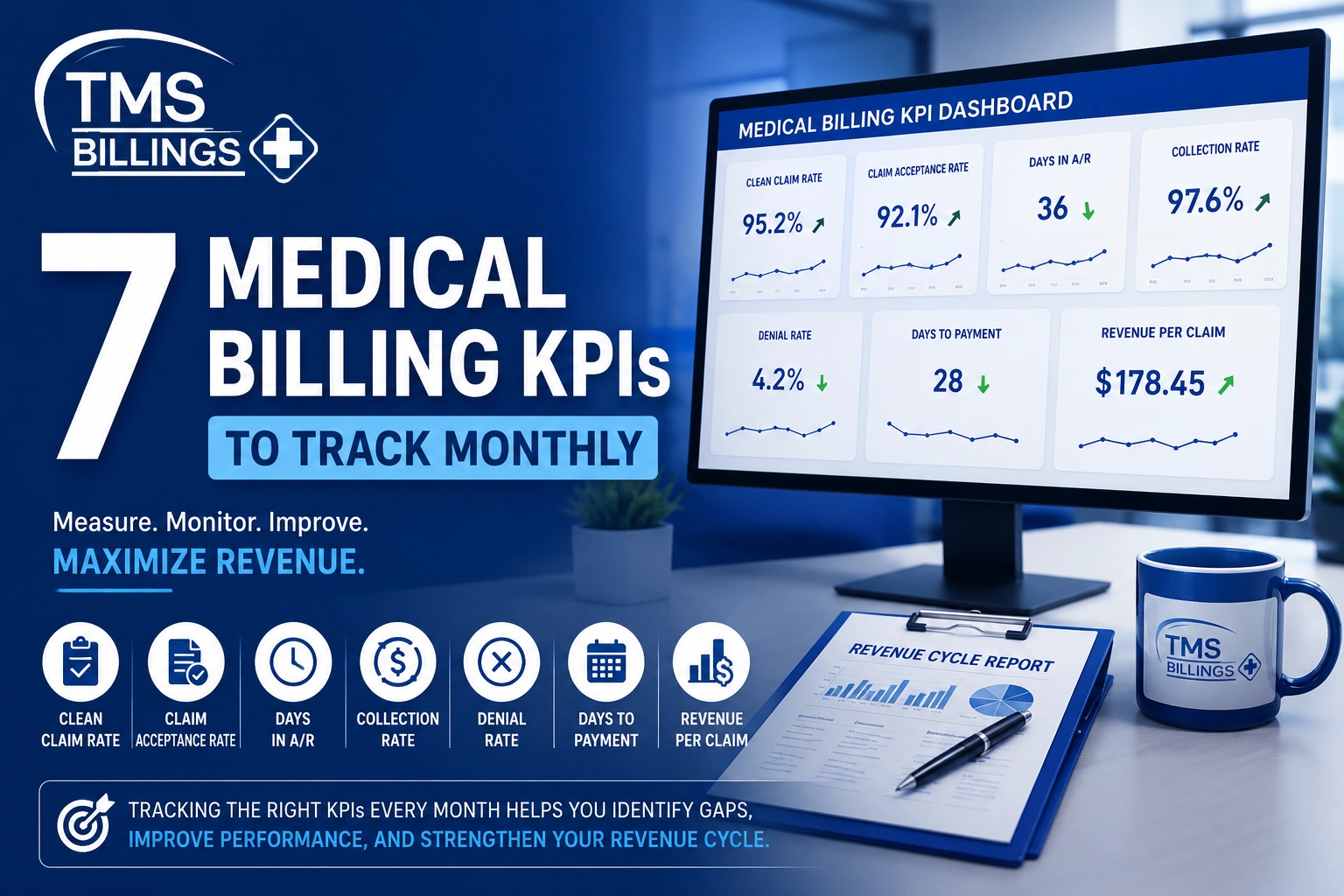
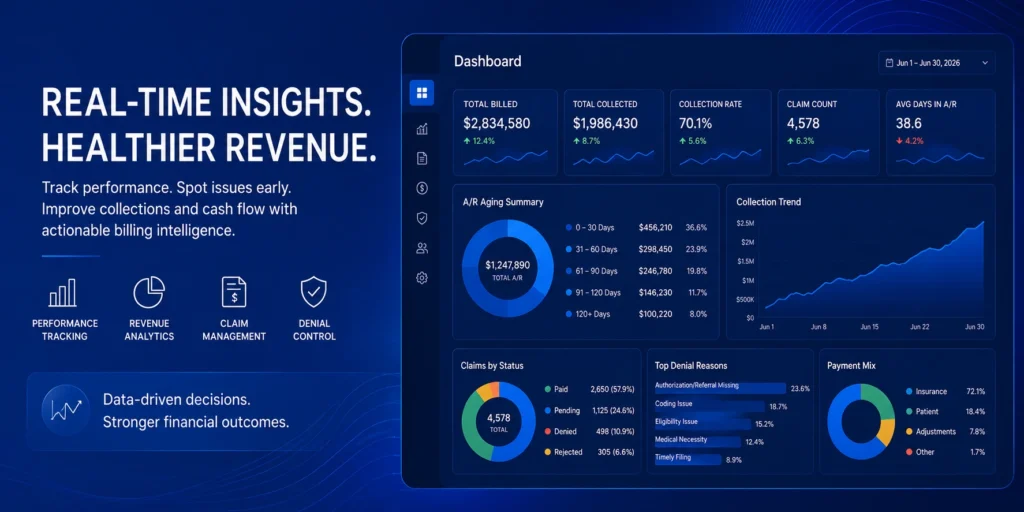
If your patient volume is stable but revenue keeps slipping, the answer is in your numbers. Tracking the right medical billing KPIs monthly gives your practice a diagnostic dashboard — not a collection of vanity metrics — that identifies exactly where revenue is leaking before it becomes a cash flow crisis. Our Revenue Cycle Management services are built around these indicators. This guide covers the seven KPIs every practice owner must monitor, the benchmarks that matter, and how to act when a number falls below threshold.
What Are Medical Billing KPIs?
Medical billing KPIs are the key performance indicators practices use to measure the health of their revenue cycle — including clean claim rate, net collection rate, days in AR, and denial rate. Tracking them monthly helps practice owners spot revenue leaks early and keep cash flow predictable.
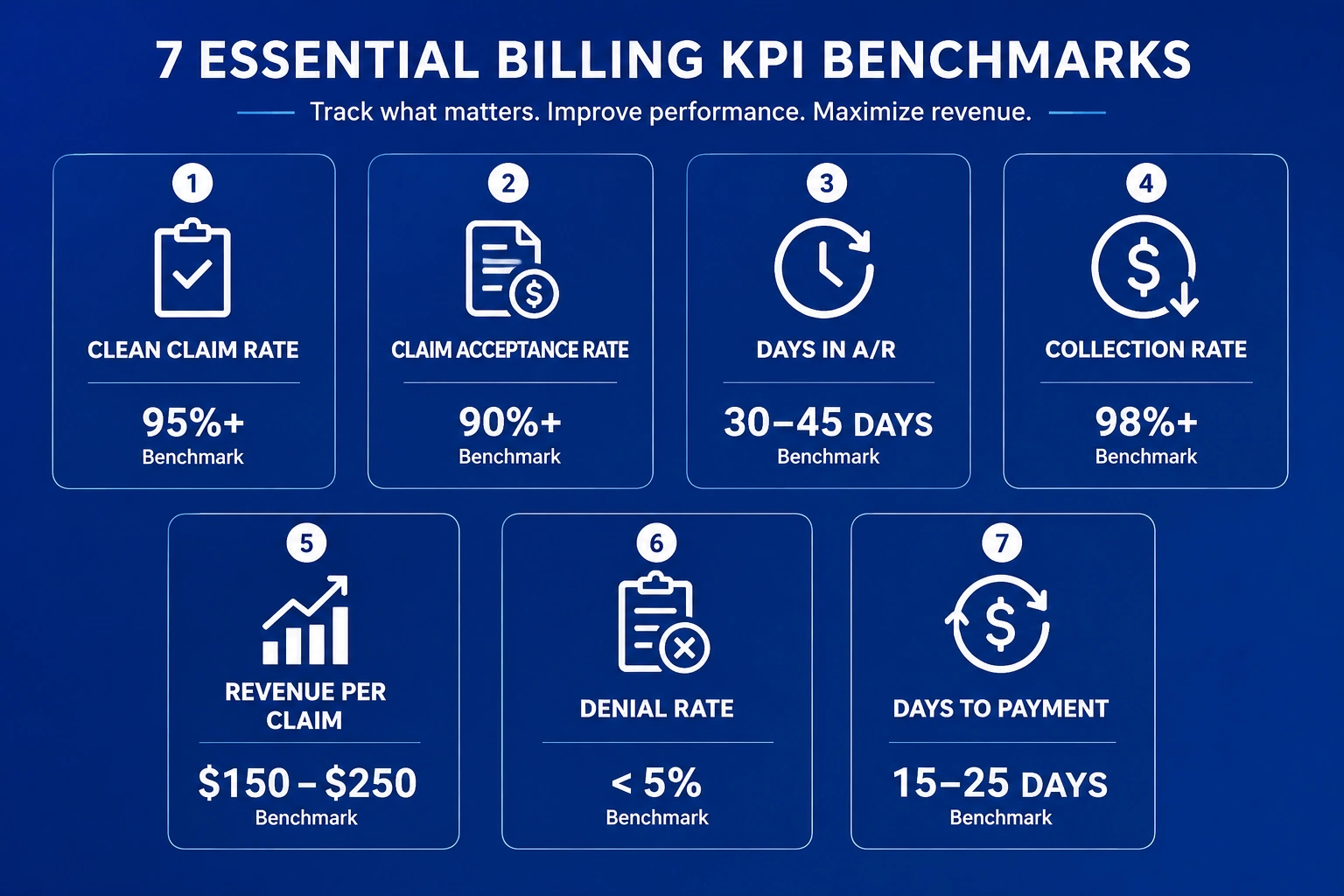
Medical billing KPIs measure how efficiently your practice submits, follows up on, and collects payment for services delivered. Think of them as vital signs: individually, each tells you something; together, they reveal the health of your revenue cycle management.
KPIs in medical billing differ from raw reports. A denial report shows which claims were rejected. Your denial rate KPI tells you what percentage of all submitted claims were denied, whether that number is trending upward, and how urgently you need to act.
The 7 Medical Billing KPIs to Track Every Month
1. Clean Claim Rate
Your clean claim rate is the percentage of claims accepted on the first submission without errors. Benchmark: 95% or higher (MGMA). When this drops from 95% to 85% across 500 monthly claims, approximately 50 claims need rework — each adding 15–30 days to your reimbursement cycle and increasing administrative cost significantly.
2. Net Collection Rate
Net collection rate measures the percentage of collectible revenue your practice actually receives after contractual adjustments. Benchmark: 95–99%. A 2-point drop — from 97% to 95% — on $500,000 in monthly billing equals $10,000 in lost revenue every month, or $120,000 annually.
3. Days in Accounts Receivable (Days in AR)
Days in accounts receivable (days in AR) tracks how long it takes to collect payment after a claim is submitted. Benchmark: under 30–35 days for most specialties. Over 50 days signals a serious collections problem driven by slow follow-up, payer bottlenecks, or systemic coding errors.
4. Denial Rate
Your denial rate should stay below 5% (MGMA). Above 10% demands immediate review of your claim denials in medical billing workflow. Common codes under the X12 CARC system — CO-45 (charge exceeds fee schedule) and CO-97 (service included in another procedure) — point directly to the fix needed.
5. First Pass Resolution Rate
First pass resolution rate (FPRR) measures the percentage of claims paid in full on first submission. Benchmark: 90% or higher. A low FPRR often indicates a mismatch between your billed codes and the payer reimbursement terms defined in your contracts.
6. Gross Collection Rate
Gross collection rate compares total payments received to total charges billed before adjustments. This billing performance metric evaluates charge capture efficiency. A persistently low gross collection rate may signal that your fee schedule needs updating against current payer reimbursement rates.
7. Cost to Collect
Cost to collect divides total billing expenses by total revenue collected. Best-in-class practices maintain a cost to collect below 3%. Above 8% means your claims processing overhead is cutting deeply into margins — and immediate intervention is warranted.
Why Are My Medical Billing KPIs Declining?
Steady volume with declining collections is the most common — and most frustrating — pattern in practice management. The issue is almost never fewer services delivered; it’s a breakdown in your revenue cycle.
Common Causes of Poor Medical Billing KPI Performance
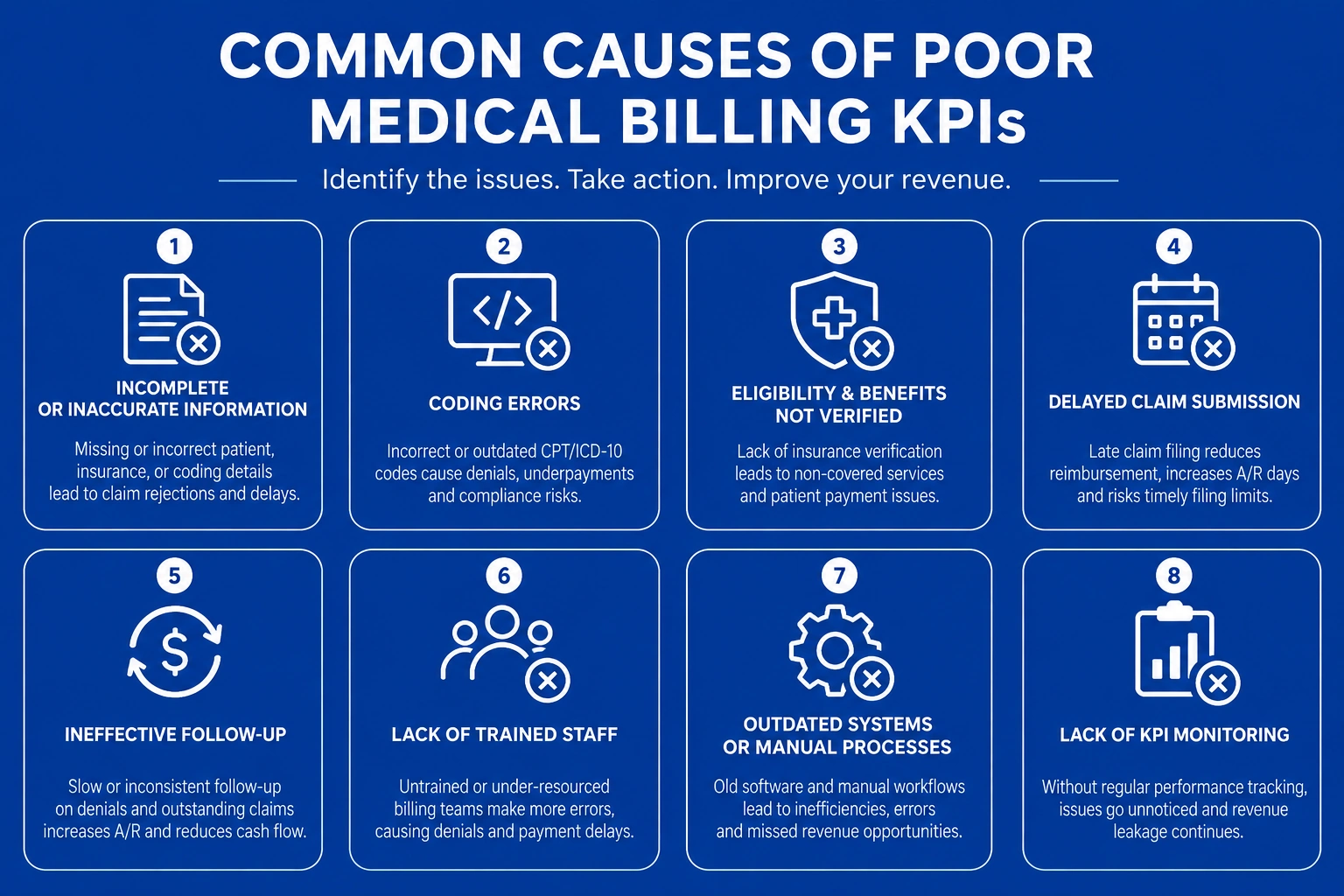
- Coding errors and specificity gaps — Missing modifiers, undercoding, or upcoding triggers automatic denials and audit risk.
- Slow AR follow-up — Claims left unworked past 30 days push days in AR above benchmark and reduce collectibility.
- Prior authorization failures — Expired or missing authorizations are one of the fastest-growing denial drivers in 2026, particularly for orthopedic and imaging practices.
- Credentialing lapses — A mismatched provider NPI or taxonomy code can reject an entire payer’s claims in a billing cycle.
- Front-desk eligibility errors — Incorrect insurance verification at scheduling creates downstream billing problems no billing team can fully recover from.
Fixing these requires dedicated AR recovery services and disciplined root-cause analysis — not just reworking individual denied claims.
Medical Billing KPIs vs Other Billing Reports
Medical practice KPIs and individual billing reports serve different purposes. Confusing the two leads to slow reaction times and invisible revenue trends.
KPIs vs A/R Aging Report
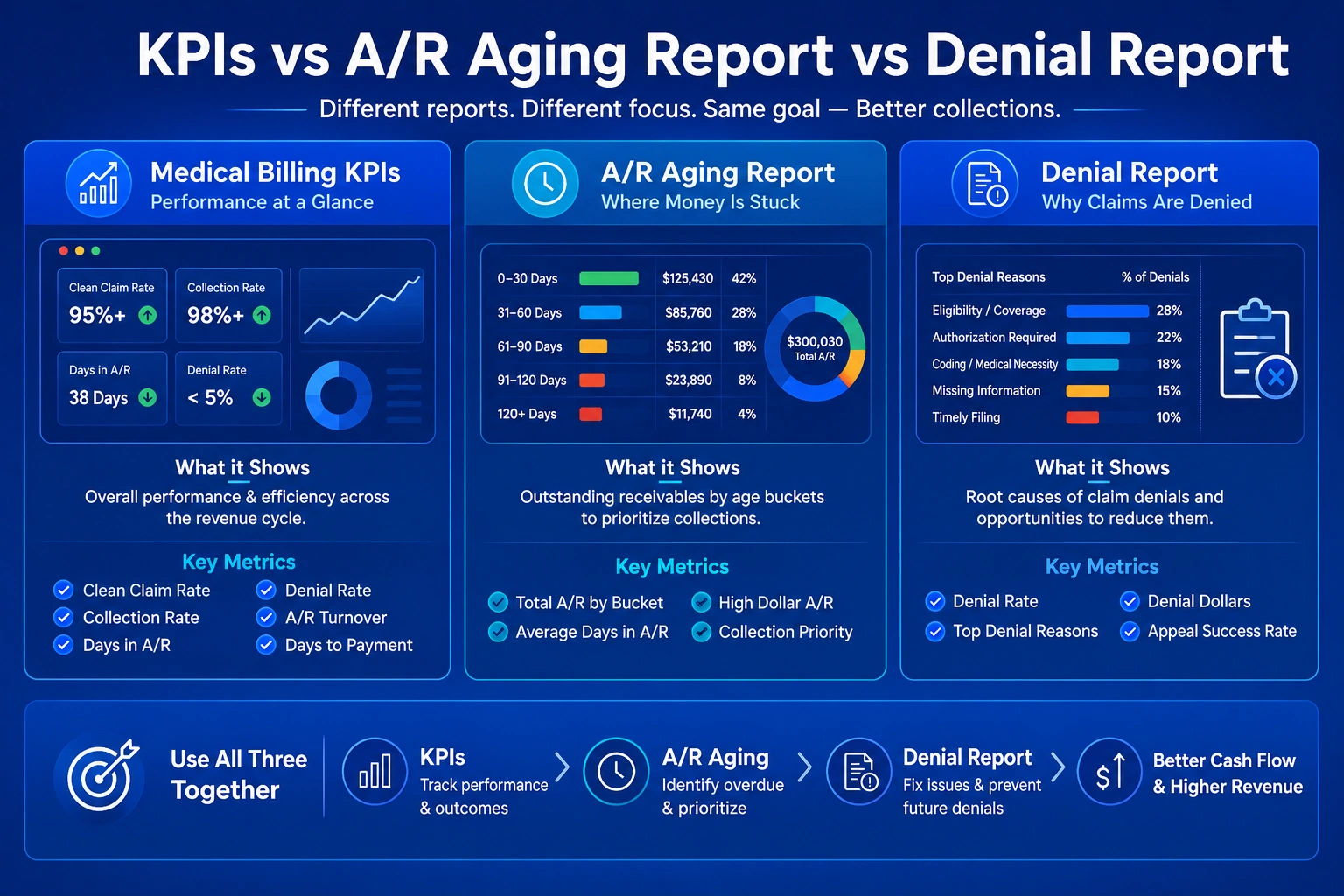
| Feature | Medical Billing KPIs | A/R Aging Report | Denial Report |
|---|---|---|---|
| What it shows | Overall performance trends | Outstanding balances by age | Individual claim rejections |
| Frequency | Monthly (minimum) | Weekly or monthly | Daily or weekly |
| Best for | Strategic decisions | AR prioritization | Claim-level triage |
| Alerts you to | Revenue leakage patterns | Aging balances at risk | Specific denial codes |
| Owned by | Practice owner / vendor | Billing manager | Billing team |
KPIs vs Denial Report
A denial report is raw data; your denial rate KPI is the signal. The report tells you which claims were rejected last week; the KPI tells you whether denials are rising as a percentage of submissions — and whether you need a process change, not just rework.
What Are Good Medical Billing KPI Benchmarks?
Medical billing KPI benchmarks vary by specialty. The billing performance metrics table below uses MGMA and CMS guidance as its baseline. Medical billing KPIs by specialty shift these targets: orthopedic and imaging practices typically run days in AR 5–10 days higher than primary care due to complex payer mixes.
| KPI | Best Practice | Warning Zone | Intervention Required |
|---|---|---|---|
| Clean Claim Rate | ≥ 95% | 90–94% | < 90% |
| Net Collection Rate | 95–99% | 90–94% | < 90% |
| Days in AR | < 30 days | 30–50 days | > 50 days |
| Denial Rate | < 5% | 5–10% | > 10% |
| First Pass Resolution Rate | ≥ 90% | 85–89% | < 85% |
| Cost to Collect | < 3% | 3–8% | > 8% |
| Gross Collection Rate | > 50% | 40–50% | < 40% |
Medical Billing KPI Trends in 2026
Understanding how to track medical billing KPIs means accounting for the external forces moving them right now.
- Declining clean claim rates: MGMA data shows the average clean claim rate across specialties now sits near 91% — below the 95% billing benchmarks — with nearly 40% of practices failing to hit that standard monthly.
- KPI tracking gap: Approximately 60% of independent practices do not formally track revenue cycle KPIs on a monthly cadence or lack a dedicated billing performance dashboard (AAPC workforce surveys).
- Net collection rate dollar impact: A 2-point drop in net collection rate across a $600,000/month practice translates to $12,000 in monthly revenue loss — $144,000 per year before any corrective action.
- 2026 payer pressures: Prior authorization delays, AI-driven denials, and electronic claims processing backlogs — partly from payer system transitions in Q1 2026 — are collectively pushing denial rates upward across commercial and Medicare Advantage payers. CMS has signaled review of certain Medicare Advantage denial practices.
- Staff hours on reporting: AAPC benchmarks indicate billing staff spend 6–9 hours per month on KPI reporting and reconciliation in practices without automated dashboards — time better directed at denial follow-up.
How to Improve Your Medical Billing KPIs — Step-by-Step
Here’s how to improve medical billing KPIs without restructuring your operation:
- Baseline your current numbers. Pull 90 days of billing data and calculate each KPI before attempting fixes. You cannot improve what you have not measured.
- Target your lowest-performing KPI first. Clean claim rate and denial rate are typically the fastest levers; days in AR usually follows when those two improve.
- Run root-cause analysis on your top denial codes. Identify the top five CARC codes driving rejections, then trace each back to the intake, coding, or submission step where the error originated.
- Set 90-day improvement targets. If your denial rate is 12%, target 9% in 90 days through a specific workflow change — not a general directive.
- Assign KPI ownership. Every metric needs a named owner — a biller, manager, or your vendor — accountable for monthly reporting.
- Review your fee schedule. Outdated charge masters suppress gross and net collection rates. Audit your medical billing pricing models against current payer contracts at least annually.
When to Escalate a KPI Problem to Your Billing Team or Vendor
Escalate immediately when:
- Days in AR exceeds 50 days for two consecutive months
- Denial rate climbs above 10% without a clear one-time cause
- Net collection rate drops below 90% and continues declining
- Clean claim rate falls below 90% despite workflow corrections
- Cost to collect exceeds 8% with no corresponding increase in claim complexity
These thresholds signal systemic failure. Your vendor should deliver a corrective action plan within 30 days of any trigger.
Medical Billing KPIs — Side-by-Side Benchmark Comparison
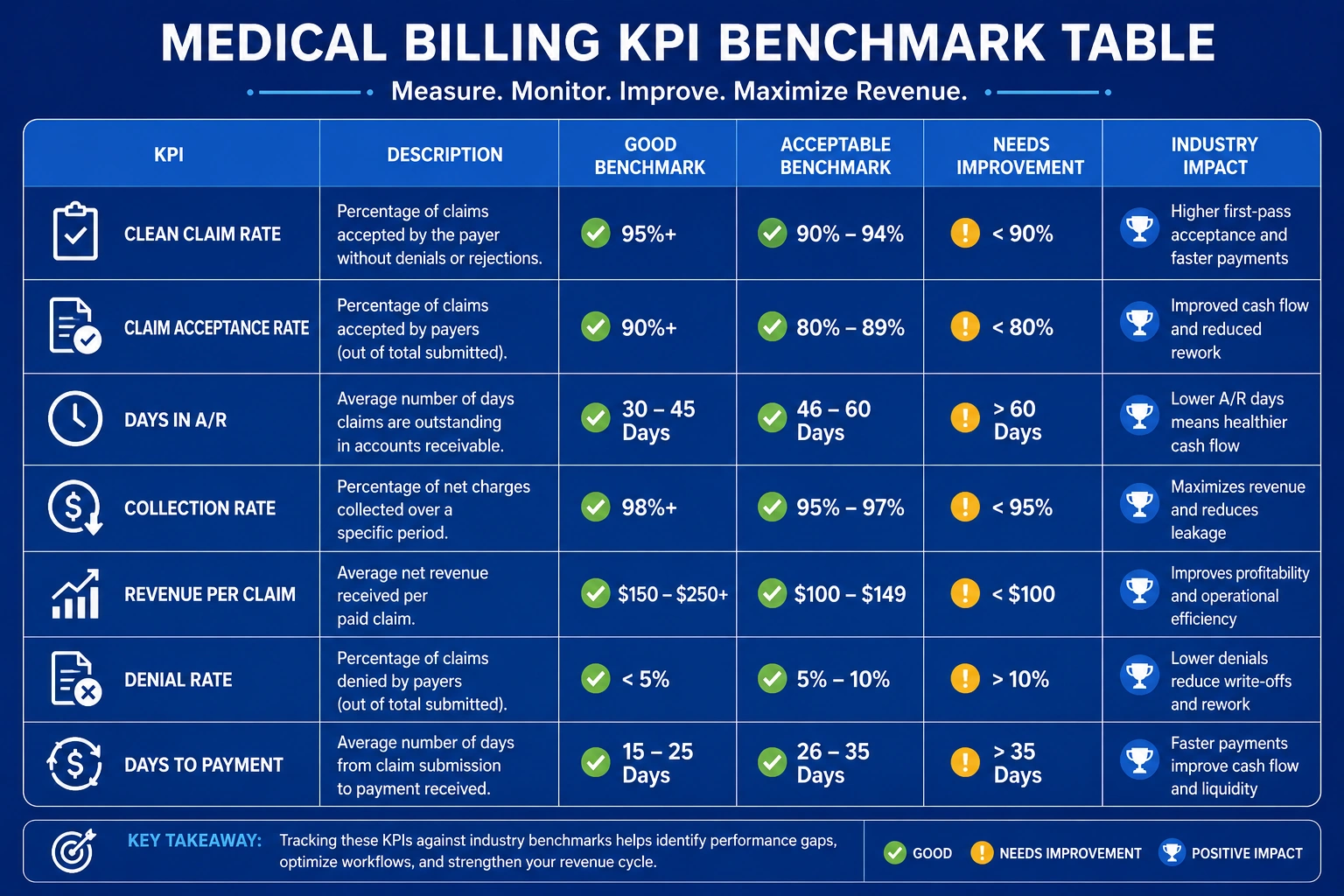
Reference the benchmark table above during every monthly KPI review. Any metric in the Intervention Required column becomes a standing agenda item until it returns to a healthy range for at least 60 consecutive days.
Best Practices to Keep Your Billing KPIs Healthy
Medical practice KPIs stay healthy when these habits are embedded in daily operations:
- Verify eligibility at every visit. Payer changes between appointments are more common than most front desks realize.
- Submit claims within 24–48 hours of service delivery. Late submission is one of the most preventable causes of high days in AR.
- Conduct a monthly denial trend review — not just a claim-by-claim report — to catch patterns before they become systemic.
- Update your fee schedule annually against CMS fee schedule releases to ensure your billed charges reflect current payer reimbursement.
- Train front-desk staff on financial policy. Patient responsibility collection improves when staff confidently explain benefits, copays, and payment plans at point of service.
How TMS Billings Helps Practices Track and Improve Billing KPIs

At TMS Billings, tracking and improving medical billing KPIs is built into every client engagement — not offered as an add-on.
- Monthly KPI dashboard delivery: Every client receives a structured monthly report covering all seven core billing performance metrics, benchmarked against specialty-specific MGMA standards.
- Denial trend analysis: We don’t just rework denied claims — we identify the root cause of every denial pattern and implement workflow corrections at the source.
- AR aging management: Our team actively manages your accounts receivable with claims tiered by payer, age, and dollar value so nothing ages past the point of collectibility.
- Revenue cycle consulting: When your KPIs reveal a deeper issue — credentialing lapse, fee schedule misalignment, payer contract problem — our revenue cycle management team engages directly.
We help practices move from reactive billing to proactive financial management.
Key Takeaways
- Medical billing KPIs are a diagnostic dashboard — not optional reporting — for any practice serious about financial performance.
- The seven KPIs that matter: clean claim rate, net collection rate, days in AR, denial rate, first pass resolution rate, gross collection rate, and cost to collect.
- A 2-point drop in net collection rate on $500K monthly billing equals $10,000 per month in preventable losses.
- Review KPIs monthly. Assign clear ownership. Act on thresholds before they become crises.
- KPIs are distinct from individual billing reports — they synthesize raw data into actionable signals.
Final Thoughts
Revenue doesn’t decline because patients stop coming through the door. It declines because the right numbers aren’t being watched. Tracking your medical billing KPIs monthly is the most effective way to catch revenue leakage early, hold your billing team accountable, and protect your practice’s financial health.
Ready to take control of your billing performance? Contact TMS Billings for a complimentary KPI audit of your practice today.