Patient collections in healthcare is no longer a back-office afterthought — it is one of the most critical levers in your practice’s financial performance. As insurers shift more cost burden onto patients through higher deductibles and coinsurance, your patients have become your biggest payer. If your Revenue Cycle Management Services are not built to handle this shift, your practice is leaving real money on the table — and potentially damaging the patient relationships that keep your schedule full.
This guide breaks down why patient collections in healthcare has changed so dramatically, what it is costing practices that have not adapted, and the specific strategies you can implement right now to improve recovery rates without sacrificing patient satisfaction.
What Is Patient Collections in Healthcare?
Patient collections in healthcare is the process of collecting payments directly from patients for services rendered — including copays, deductibles, coinsurance, and self-pay balances. As patient financial responsibility continues to grow, effective patient collections in healthcare has become central to practice revenue, often representing 30–40% of total practice income.
Why Patient Collections in Healthcare Has Become a Revenue Priority
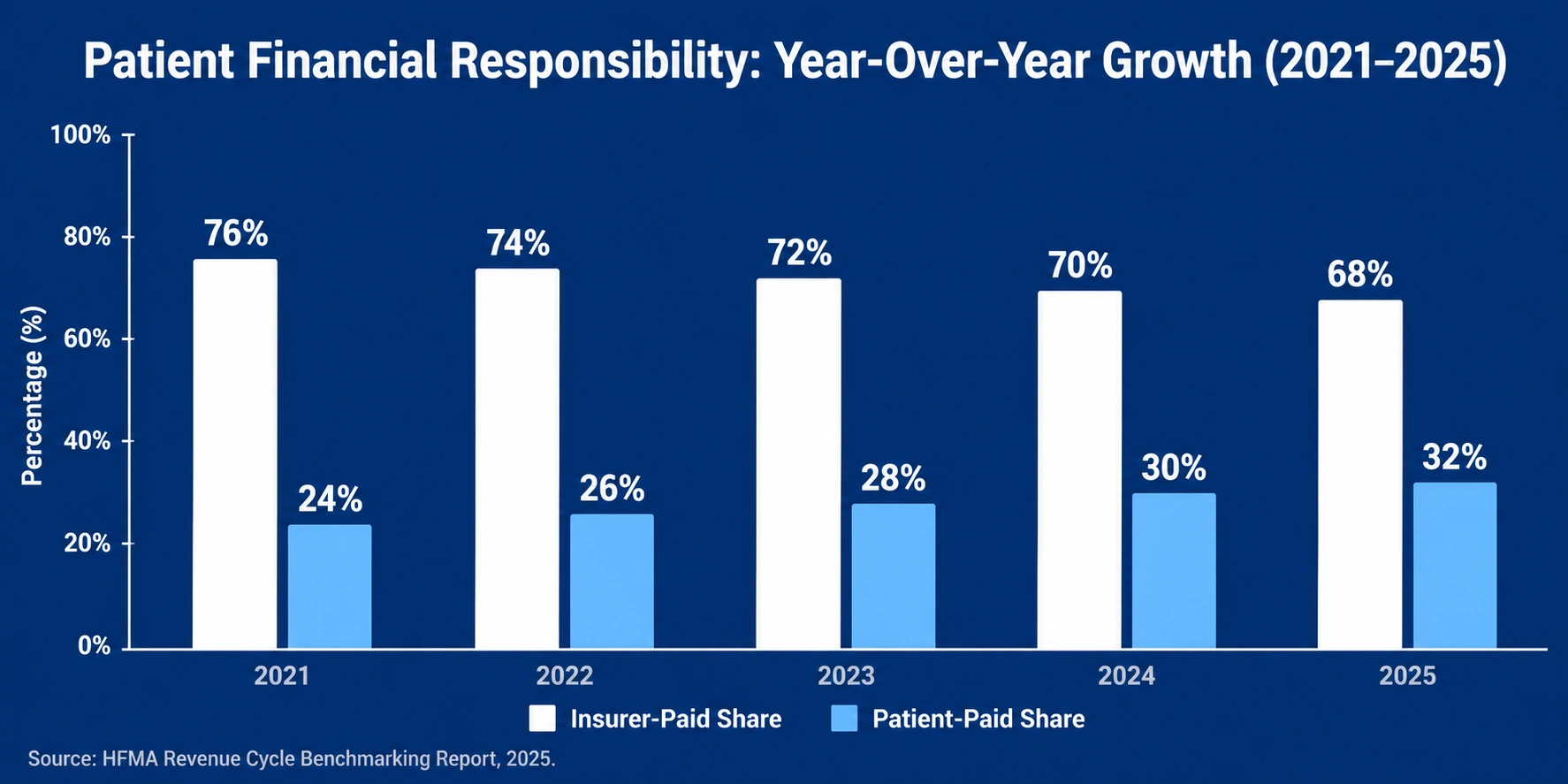
A decade ago, most of your revenue came from insurers. Today, that balance has shifted — and it will not shift back.
The Shift From Payer-Driven to Patient-Driven Revenue
Employers and insurers have steadily transferred financial risk to patients through high-deductible health plans (HDHPs), higher coinsurance requirements, and narrower covered services. For many practices today, patient payments represent 30% or more of total revenue — and that share is still climbing.
Your billing team can no longer treat patient balances as secondary. They require the same rigor, technology, and communication discipline as insurance claims.
How High-Deductible Health Plans Changed the Math
The high-deductible health plan (HDHP) impact on collections has been fundamental. When a patient carries a $3,000 deductible, your practice may be responsible for collecting the full balance on a $400 visit — not the insurer. Multiply that across hundreds of appointments per month, and the math becomes urgent.
HDHPs are now the most common employer-sponsored plan type in the United States. That means a growing share of your patients arrive at the front desk already owing you money before their coverage activates.
Why “Sending More Statements” Doesn’t Fix the Problem
Many practices respond to declining collection rates by sending more statements. It does not work. Research consistently shows that patients who do not pay within 30 days of receiving a paper bill become dramatically less likely to pay at all. The fix is not volume — it is timing, channel, and clarity.
The Biggest Drivers Behind Rising Patient Financial Responsibility
Deductible and Coinsurance Growth
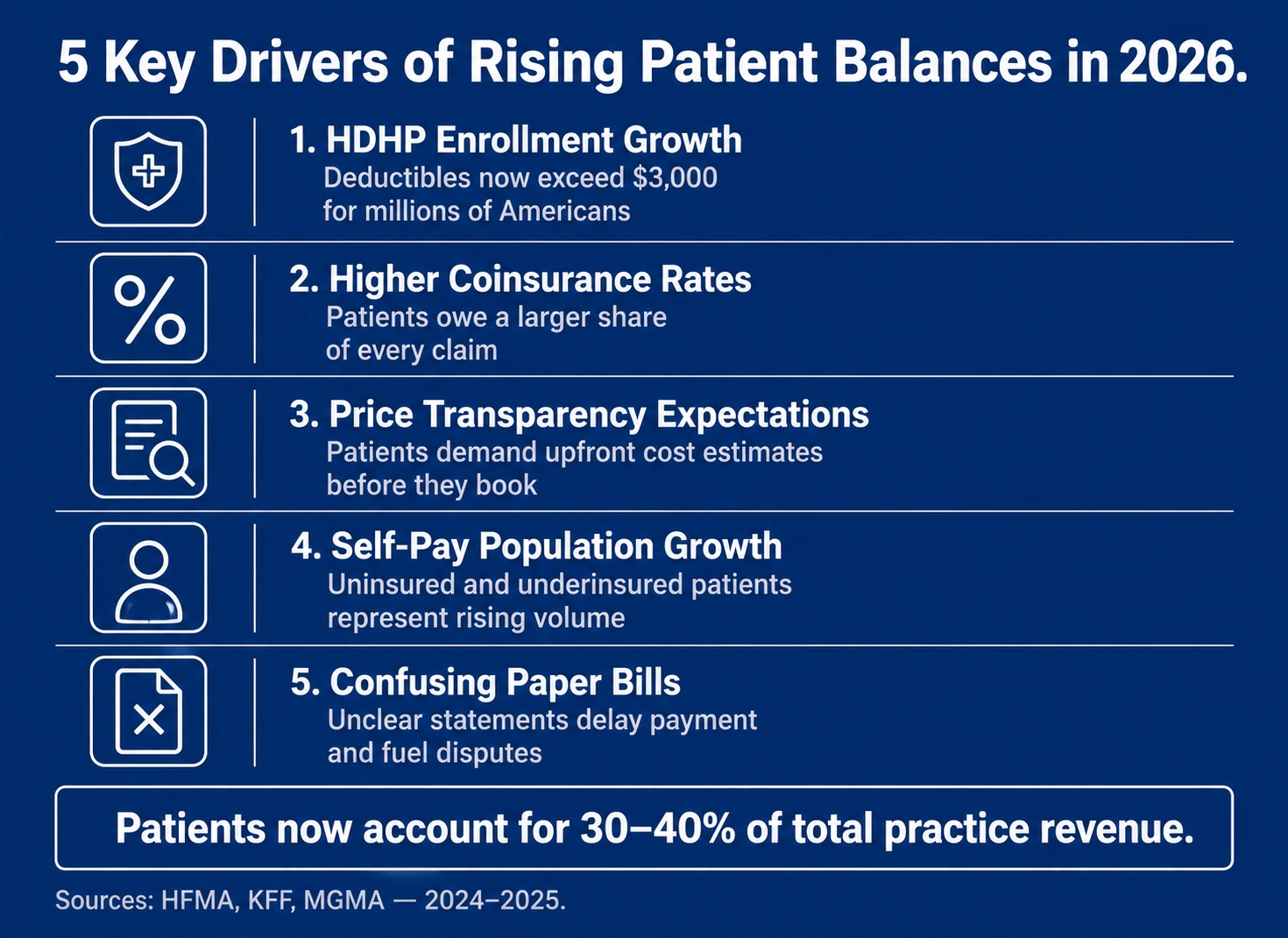
Average individual deductibles for employer-sponsored plans have more than doubled over the past decade. Patients are reaching mid-year still carrying thousands of dollars in outstanding responsibility — and your practice is the one trying to recover it. Patient financial responsibility is not just rising; it is rising faster than most patients’ ability or willingness to pay.
Price Transparency Rules and Patient Expectations
Price transparency in healthcare billing is no longer optional. Federal rules now require providers to publish costs upfront, and more importantly, patients expect it. When they do not receive a clear cost estimate before their appointment, confusion and distrust follow — both of which are direct barriers to collection. Patient cost estimate tools are no longer a competitive differentiator; they are a baseline expectation.
Confusing Bills and Patient Distrust
According to survey data from KFF, a significant share of insured adults report receiving medical bills they did not understand or believed were inaccurate. When patients cannot decipher what they owe — or do not trust the number — they delay payment, dispute charges, or ignore statements entirely. Plain-language patient statements are one of the most underutilized tools in the patient collections toolkit.
Self-Pay and Underinsured Patient Growth
Self-pay patient collections present a distinct challenge. Uninsured and underinsured patients may face genuine financial hardship, but many have real payment potential if approached with the right tools, tone, and timing. Routing this segment directly to external collections agencies is both a financial and reputational mistake.
Bad Debt and Write-Off Trends
Bad debt in medical billing has been climbing for years. When practices fail to collect at the point of service or neglect to offer structured payment options, balances age — and aged balances are dramatically harder to recover. According to MGMA benchmarking data, bad debt above 5% of net patient revenue typically signals a process problem, not just a patient affordability issue.
How Patient Collections Affects Revenue by Practice Type
High-Deductible-Exposed Specialties (Dermatology, Orthopedics, Elective Procedures)
In specialties such as dermatology and orthopedics, procedures are high-cost and frequently fall within the patient’s active deductible period. Patient financial responsibility is highest in these settings, and practices that do not collect aggressively at the point of service routinely see 20–30% of patient balances go unrecovered.
Primary Care and High-Volume, Low-Balance Practices
For primary care, the math is different. Individual balances may be small, but volume is high. The challenge is not recovering large amounts from a few patients — it is recovering small amounts from thousands. Point-of-service collections and self-service digital payment options become especially valuable here, where staff time per dollar collected must be minimized.
Example: Two Practices, Two Collection Strategies
Practice A (orthopedic group, 4 providers): Collects copays at check-in but sends paper statements post-visit for deductibles and coinsurance. Recovery rate: 58%. Approximately $340,000 in annual patient revenue goes uncollected.
Practice B (same size, same specialty): Verifies eligibility the day before, provides a written cost estimate, collects estimated patient responsibility at check-in, and follows up within 48 hours via text-to-pay. Recovery rate: 81%. The annual uncollected gap is reduced to under $90,000.
Same specialty. Same payer mix. A 23-point gap in recovery — driven entirely by process.
How Much Revenue Could Your Practice Recover With Better Patient Collections?
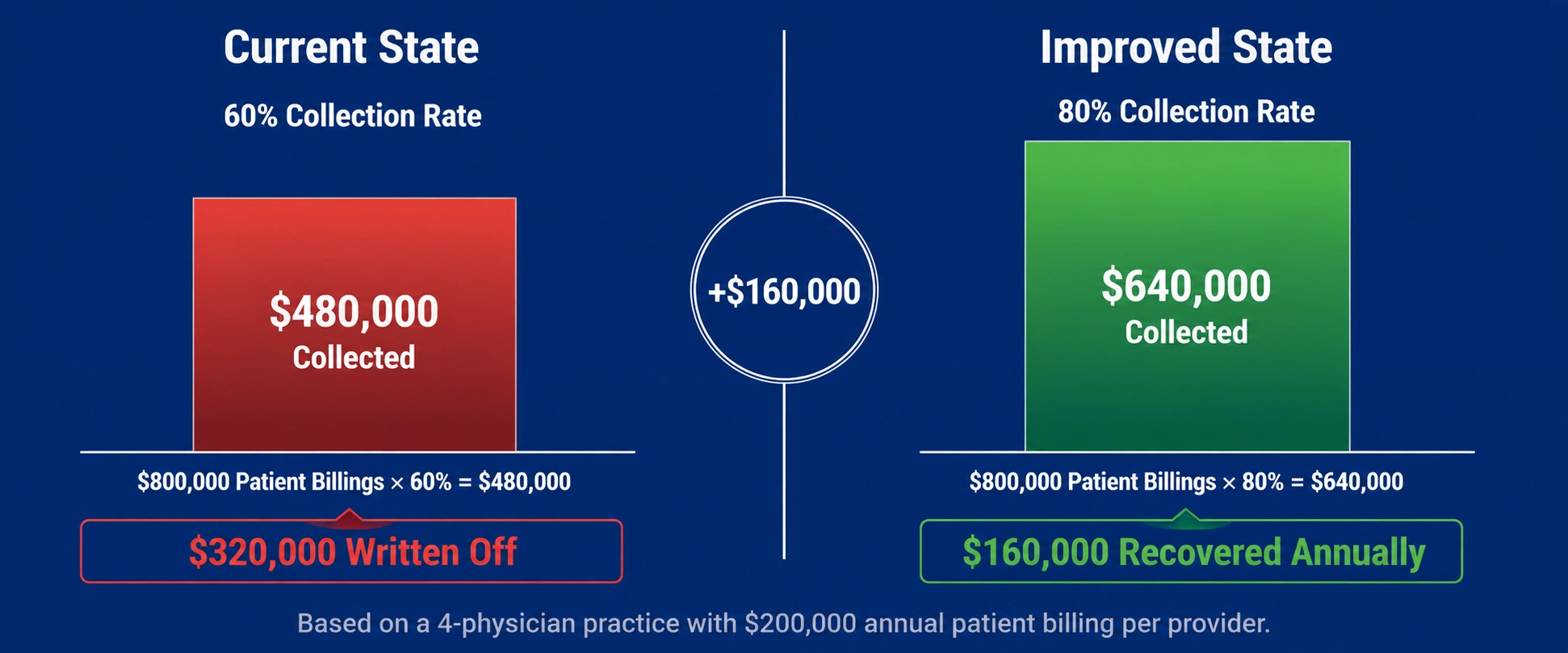
Example 1 — Improving Collection Rate From 60% to 80%
Consider a four-physician practice generating $200,000 per provider in annual patient billings — $800,000 in total patient revenue at stake. At a 60% collection rate, the practice recovers $480,000 and writes off $320,000.
Improve that rate to 80%, and recovery jumps to $640,000. That is $160,000 in additional annual revenue — without adding a single new patient, service line, or payer contract.
A 20-point improvement in collection rate is achievable with the right combination of upfront collections, structured patient payment plans, and digital payment tools.
Example 2 — Point-of-Service Collections vs. Post-Visit Billing
Point-of-service collections — collecting estimated patient responsibility at or before the visit — consistently outperform post-visit billing. MGMA data indicates that practices collecting at the time of service recover significantly more than those relying on statements. Once a patient leaves without paying, the probability of full recovery drops sharply with each passing week.
Post-visit billing is not just slower. It is fundamentally less effective.
Example 3 — Practice Offering Payment Plans and Financing
Patient payment plans change the recovery math on large balances. A patient who owes $1,200 for a procedure may not pay a lump-sum statement — but will often commit to $200 per month if the option is presented clearly and early. Healthcare financing options like CareCredit take this further, removing the practice from the financing relationship entirely while delivering full payment upfront.
Practices offering both structured payment plans and third-party financing typically see 15–25% higher recovery on balances over $500.
Patient Collections vs. Patient Experience: Finding the Balance
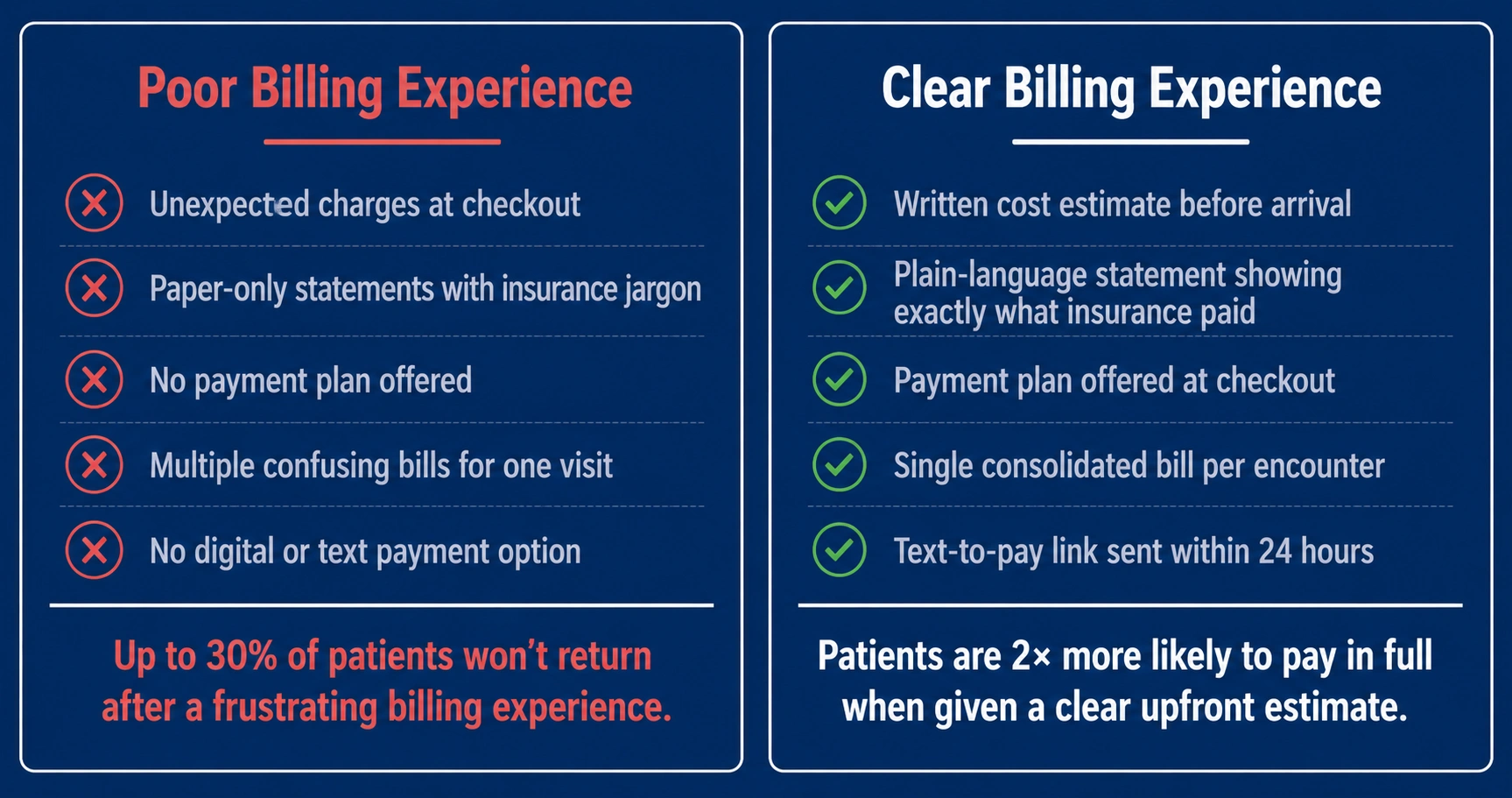
What Erodes Patient Trust During Billing
A surprise bill is one of the most reliable ways to permanently lose a patient. When patients receive charges they did not expect — or statements they cannot decode — the emotional response is frustration and distrust. That distrust does not stay contained to billing. It follows patients into their overall perception of your practice and shapes whether they return, refer others, or leave a negative review.
The patient billing experience is not a soft metric. It directly affects whether patients pay, return, and recommend you to others.
Why Collection Approach Affects Patient Retention
According to HFMA research, billing experience is among the top drivers of patient attrition. Aggressive tactics — repeated calls, vague threat language, rapid escalation to external collections — may recover a single balance while permanently eliminating the future lifetime revenue that patient would have generated.
A patient who returns three times per year at $150 net revenue per visit is worth $450 annually in ongoing revenue. Losing them over a disputed $90 statement is a poor trade by any measure.
Communication and Workflow Adjustments Practices Need to Make
Upfront Cost Estimates and Eligibility Verification
Eligibility verification should happen before the appointment — not at check-in. When your team confirms coverage and calculates estimated patient responsibility the day prior, front-desk staff can have an informed financial conversation the moment a patient walks in. This single workflow change reduces post-visit balance surprises and meaningfully improves point-of-service collections across every specialty.
Patient cost estimate tools — integrated into your EHR, clearinghouse, or billing platform — make this scalable across high-volume practices without increasing staff workload.
Point-of-Service Collection Scripts and Staff Training
Your front-desk team is not just scheduling appointments. They are your first line of collection. Training staff on how to present cost estimates clearly, request payment without hesitation, and handle common patient objections professionally is essential — and often the most overlooked investment in practice revenue.
Scripts do not make these conversations robotic. They make them consistent, respectful, and effective.
Clear, Plain-Language Patient Statements
Plain-language patient statements reduce disputes, callbacks, and delayed payments in measurable ways. Every statement should show exactly what was billed, what insurance paid, and what the patient owes — in plain English, with a single clear call to action. Adding a QR code or text-to-pay link removes the final barrier between a patient’s intent to pay and an actual payment.
Strategies Every Practice Should Implement Right Now
Verify Eligibility and Estimate Costs Before the Visit
Run eligibility checks 24–48 hours before every scheduled appointment. Use patient cost estimate tools to calculate what the patient will owe based on their active deductible and copay structure. Send that estimate by text or portal message so there is no surprise at check-in.
Collect Copays and Deductibles at the Time of Service
Point-of-service collections should be the standard — not the exception. Train staff to collect copays, estimated deductibles, and coinsurance at check-in as a normal, expected step in the intake process rather than an awkward, last-minute request.
Offer Digital Payment Options and Text-to-Pay
Text-to-pay and digital payment adoption are reshaping what patient collections looks like in practice. Patients who ignore paper statements frequently pay within minutes of receiving a text with a payment link. Patient portal payment adoption is rising sharply — integrate a simple, mobile-friendly payment option into every patient touchpoint, from appointment reminders to post-visit follow-ups.
Set Up Structured Patient Payment Plans
Not every patient can pay in full at the time of service — and that should not prevent you from recovering the balance. Understanding how to set up a patient payment plan for a medical practice is a core operational skill: offer structured plans for balances over $200, with clear terms, auto-pay enrollment, and written agreements. Use Medical Billing Services that can automate plan tracking and escalate missed payments on a defined schedule.
Train Front Desk and Billing Staff on Financial Conversations
Knowing how to collect patient payments without damaging patient relationships starts with staff confidence and consistent scripting. Invest in role-played training that covers estimate delivery, plan offers, and objection handling. Staff who are comfortable with these conversations collect more — with significantly fewer patient complaints.
Outsource Patient Collections to a Revenue Cycle Partner
If your team is stretched thin or lacks the infrastructure for consistent patient follow-up, outsourcing patient collections to a specialized AR Recovery Services partner removes the burden while maintaining professional, patient-friendly communication standards. This is especially valuable for practices managing high volumes of self-pay patient collections alongside complex payer mixes.
How Outsourced Billing Protects Patient Collections Revenue
Proactive Patient Balance Monitoring
An outsourced RCM partner monitors your patient AR in real time — flagging aging balances before they become uncollectible, segmenting accounts by balance size and payer type, and triggering appropriate follow-up sequences automatically. Billing Reporting and Analytics give you full visibility into exactly where your revenue is leaking and how your collection rates compare to specialty benchmarks.
Faster Adaptation to Patient Payment Trends
Patient payment preferences are shifting quickly. Text-to-pay, digital wallets, and buy-now-pay-later healthcare options are gaining adoption across all age groups. An experienced billing partner implements these tools in your workflow faster than most in-house teams can — without requiring capital investment or lengthy IT projects.
Specialty-Specific Patient Collections Reporting
Not all practices collect the same way. A dermatology practice and a family medicine clinic face different patient financial profiles, average balance sizes, and payment timing patterns. Specialty-specific performance reporting — delivered through Virtual Medical Assistance Services — ensures your team benchmarks and optimizes against the right peer data rather than industry-wide averages that may not reflect your patient population.
How TMS Billings Helps Practices Improve Patient Collections in 2026

At TMS Billings, we work with physician practices across specialties to build patient collections workflows that improve recovery rates without compromising patient relationships.
Our approach combines pre-visit eligibility verification, point-of-service collections support, digital payment integration, payment plan management, and specialty-benchmarked reporting — all managed by a team that understands the specific pressure points your practice faces.
Whether you are a high-volume primary care group or a deductible-exposed specialty practice, we build the process around your patient population so you collect more of what you have earned, faster, and with fewer write-offs.
The Financial Impact of Patient Collections in Healthcare [Statistics Section]
Healthcare financial leaders rely on data from HFMA, KFF, and MGMA to benchmark patient collections performance. Here is what the current research tells us.
1. Patient financial responsibility as a share of total revenue is rising. According to HFMA revenue cycle benchmarking reports, patient responsibility as a percentage of total revenue at physician practices has grown steadily, with many practices now attributing 30–35% of total collections to patient payments — up from under 20% a decade ago. In deductible-exposed specialties, that figure can exceed 40%.
2. The gap between what patients owe and what practices collect remains wide. MGMA data indicates that the median patient collection rate for physician practices falls between 55–65% — meaning practices are routinely leaving 35–45 cents of every patient-owed dollar uncollected. For a practice with $800,000 in annual patient billings, that gap represents $280,000–$360,000 in uncollected revenue per year.
3. Patient billing comprehension drives dispute rates and delayed payment. KFF survey data consistently shows that a significant share of insured adults — often 40% or more — report receiving a medical bill they did not understand or believed was incorrect. Billing confusion is a direct driver of delayed and unpaid balances, making plain-language statements and upfront cost estimates essential operational tools.
4. Billing experience is a top driver of patient retention. HFMA research indicates that up to 30% of patients have either switched providers or decided against returning specifically due to a negative billing experience. This makes patient collections in healthcare a patient retention issue — not just a revenue cycle issue.
5. Revenue recovery potential from a 20-point improvement in collection rate. For a four-physician practice billing $200,000 per provider in patient responsibility annually, improving the collection rate from 60% to 80% generates $160,000 in additional annual revenue — with no new patients, no new services, and no payer contract renegotiations.
| Metric | Industry Benchmark | Best-in-Class Target |
|---|---|---|
| Patient collection rate | 55–65% | 80%+ |
| Days to collect patient balance | 45–60 days | Under 30 days |
| Bad debt as % of net patient revenue | 3–8% | Under 3% |
| Point-of-service collection rate | 40–55% | 70%+ |
| Patient payment plan utilization | 15–25% | 30%+ |
| Patient portal payment adoption | 25–35% | 50%+ |
Sources: HFMA, MGMA, KFF — 2024–2025 benchmarking data. Verify at time of publication for most current figures.
Key Takeaways
- Patient collections in healthcare now represents 30–40% of total practice revenue for many specialties — and that share is growing year over year.
- The high-deductible health plan (HDHP) impact on collections is the primary structural driver of rising patient financial responsibility across every specialty.
- Practices that collect at the point of service consistently outperform those relying on post-visit paper statements — often by 15–25 percentage points in collection rate.
- Plain-language patient statements, text-to-pay and digital payment adoption, and structured patient payment plans are the highest-impact tools available to most practices today.
- Bad debt in medical billing above 5% of net patient revenue is a workflow signal — not simply a patient affordability problem.
- Knowing how to reduce patient bad debt in a medical practice begins with upfront communication and point-of-service collections, not downstream collection agency tactics.
- Value-based care and patient cost-sharing trends will continue to shift financial risk toward patients — making patient collections strategy a permanent operational priority for every practice.
Final Thoughts
Patient collections in healthcare is not getting simpler. Patients are paying more, understanding their bills less, and making provider-loyalty decisions based directly on their billing experience. Practices that treat collections as a post-visit afterthought are leaving tens of thousands of dollars on the table — and losing patients they do not even know they have lost.
The good news: the highest-impact improvements do not require new technology or significant staff overhauls. They require clear processes, well-trained staff, and the right billing partner supporting your team.
TMS Billings helps practices across specialties build patient collections workflows that recover more revenue, reduce write-offs, and protect the patient relationships your practice depends on.