
Outsource Medical Billing New York: How to Choose the Right Company for Your Practice
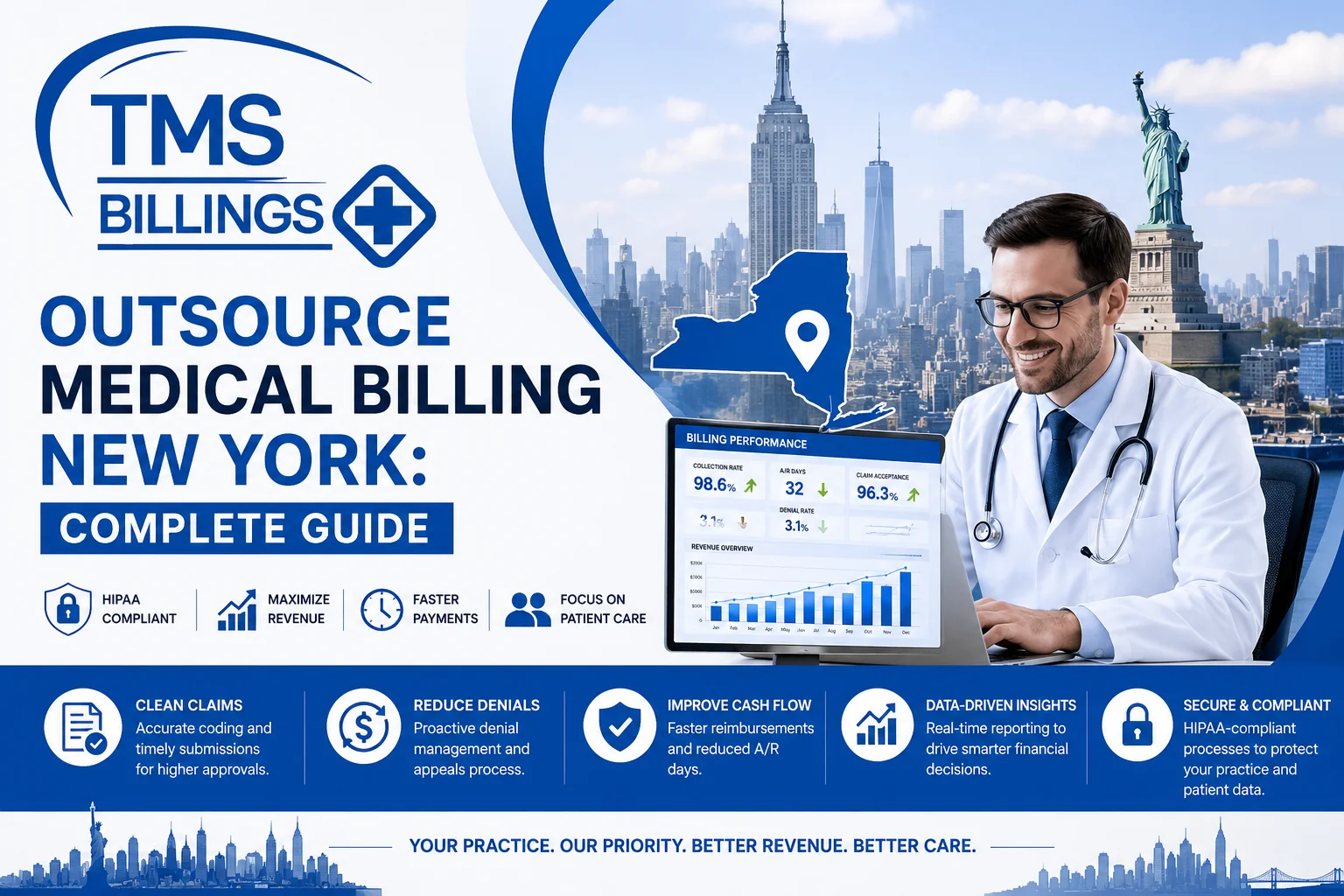
If you are running a medical practice in New York, your revenue cycle is not something you can afford to manage carelessly. Whether you operate a solo family medicine clinic in the Bronx or a growing multi-provider group in Long Island, the decision to outsource medical billing in New York may be the most important financial move your practice makes this year.
New York’s payer landscape is among the most complex in the country. Managing reimbursements from Empire BlueCross, Aetna, United Healthcare, Healthfirst, and multiple New York Medicaid managed care organizations demands precision, payer-specific expertise, and consistent follow-through. One miscoded claim, a missed prior authorization, or an expired credential can cost your practice thousands — and in many cases, that revenue is never recovered once timely filing windows close.
At TMS Billings, we work alongside practices across New York every day. This guide walks you through exactly what to look for in a medical billing company New York, the right questions to ask before signing anything, the warning signs of a wrong-fit billing partner, and how to determine whether your practice is ready to make the switch. For a deeper look at what professional support looks like, explore our Medical Billing Services in New York.
What Does It Mean to Outsource Medical Billing in New York?
Outsourcing medical billing means transferring your claims submission, denial management, payment posting, accounts receivable follow-up, and full revenue cycle oversight to a specialized third-party billing company. In New York, a qualified outsourced billing partner handles everything from insurance verification services and prior authorization management to HIPAA-compliant billing and credentialing services — so your clinical team can stay focused entirely on patient care.
Why New York Practices Are Choosing to Outsource Medical Billing
The administrative and financial pressure on New York providers has never been greater. Reimbursement rates continue to tighten while regulatory complexity increases year over year. Staffing a capable in-house billing department in a high-cost market like New York City is expensive, and high turnover in billing roles creates dangerous gaps in revenue cycle management New York practices simply cannot afford.
New York Medicaid billing alone involves multiple managed care organizations — each operating under distinct prior authorization rules, timely filing limits, and documentation requirements. Staying current with all of them demands dedicated training, ongoing education, and experience that most in-house teams do not have the bandwidth to maintain while also keeping up with daily claim volume.
Medical billing outsourcing New York has expanded significantly in recent years because providers have recognized that a specialized billing partner offers something an in-house team rarely can: consistent performance, payer-specific expertise, and real-time visibility into your full revenue cycle.
The True Cost of In-House Billing in New York
Running billing in-house feels like control. In practice, it is often one of the most expensive decisions a New York practice makes without fully realizing it. The average annual salary for an experienced medical billing and coding New York professional ranges from $55,000 to $75,000. Add benefits, billing software subscriptions, ongoing training, and the time your front desk or administrative staff spend on billing calls and claim rework — and the true cost climbs well beyond what most practice owners expect.
Now factor in the cost of billing errors. According to industry benchmarks, the average cost to rework a single denied claim ranges from $25 to $118, depending on claim complexity and the appeals process required. If your practice submits 400 claims per month and 8% are denied, you are spending thousands of dollars monthly just to recover revenue you should have captured on the first submission.
Understanding the common medical billing errors New York practices make — from diagnosis code mismatches and missing modifiers to expired authorizations and credentialing gaps — is the first step toward understanding what your practice may be losing right now.
What Outsourcing Medical Billing in New York Actually Looks Like
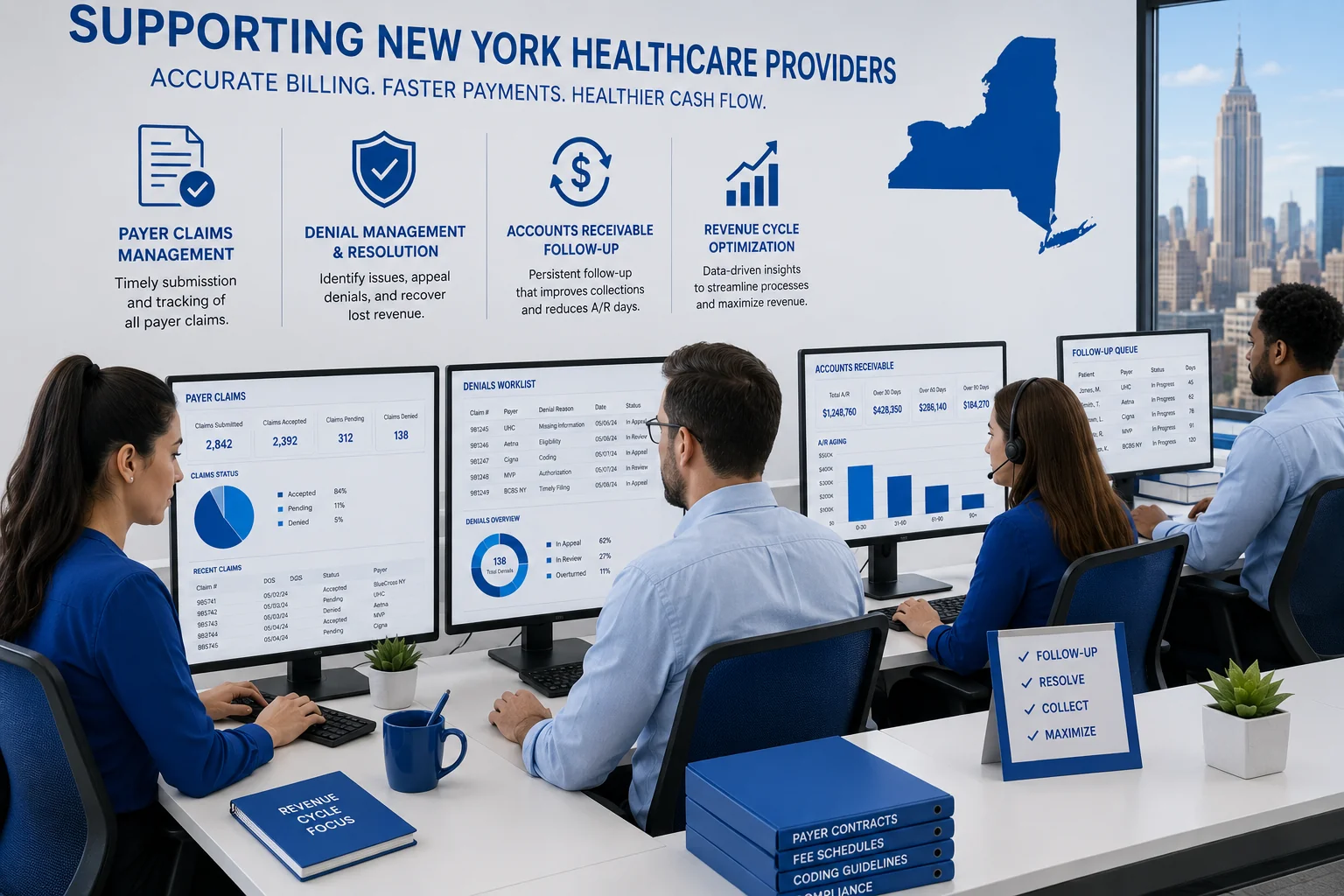
Outsourcing is not about handing your billing over and hoping for the best. A professional medical billing company New York delivers a structured, documented process — from claim scrubbing and clean submission to denial tracking, accounts receivable management, and detailed performance reporting.
Your practice retains full visibility at every stage. You receive regular reports showing clean claim rates, denial rates, AR aging buckets, and collection performance broken down by payer and provider. The difference is that an experienced billing team is managing the details behind those numbers — not your front desk coordinator between patient appointments, and not a biller who leaves for a competing clinic next month.
What to Look for When You Outsource Medical Billing in New York
Not every billing company is equipped for New York’s environment. Knowing what to look for before you sign a contract is how you avoid a costly mistake.
New York Medicaid and Payer-Specific Experience
New York’s Medicaid managed care system is layered and demanding. Healthfirst, MetroPlus, Fidelis Care, WellCare, and VNS Health each operate under different managed care contracts with their own billing requirements. New York Medicaid billing outsourcing services that work in other states often struggle with New York’s MCO-specific rules and documentation standards.
Ask directly whether the company has active experience billing Empire BlueCross, Aetna, United Healthcare, and New York’s top Medicaid MCOs. Ask how they handle payer-specific prior authorization management and whether they actively track each MCO’s timely filing windows. Vague answers to these specific questions are a clear warning sign.
Clean Claim Rate and Denial Management Track Record
A clean claim rate of 95% or higher is the industry standard for professional billing teams. According to MGMA’s revenue cycle benchmarking data, top-performing practices consistently maintain clean claim rates above 96%, while average in-house billing teams often fall below 90%.
Ask for documented clean claim rates from current clients in New York. Then ask how they handle claim denial management — specifically how quickly denial patterns are identified, how appeals are structured, and what their resolution rate is. A credible billing company can show you these numbers. One that deflects or generalizes is not a company you should trust with your revenue.
Credentialing and Prior Authorization Support
Credentialing services New York is one of the most time-consuming but critical functions in any billing operation. If a provider is not properly credentialed with a payer, every claim that provider submits will be rejected — and the practice will not find out until the rejections start arriving. This scenario is especially common when practices add new providers without formally verifying credentialing status across all active payers.
Prior authorization management carries equal weight. Missed or expired authorizations are among the top drivers of claim denials in New York, particularly in specialties like behavioral health, physical therapy, and orthopedics. Clarify whether the billing company handles insurance verification services and prior authorization tracking or whether those responsibilities remain entirely with your staff.
Reporting Transparency and Practice Visibility
Billing transparency and reporting is a non-negotiable baseline — not a premium add-on. You should never have to call your billing company to find out what your own denial rate is. Look for a company that provides:
- Real-time or weekly dashboards showing AR aging and collection rates
- Monthly performance reports broken down by payer, provider, and CPT code
- Denial trend reports that identify root causes — not just denial totals
- Timely filing tracking across every active payer in your mix
- Clear escalation protocols when claims age past thresholds
EHR-integrated billing is a strong operational advantage. It reduces duplicate entry errors, eliminates transcription mistakes, and gives both your team and the billing company a single source of truth for all patient and claim data.
7 Questions to Ask Any Medical Billing Company in New York Before You Sign
Before signing a contract, ask every candidate these questions and listen carefully to how they answer:
- What is your current average clean claim rate across your active New York clients?
- How do you manage New York Medicaid billing — including MCO-specific rules, prior auth requirements, and timely filing windows by plan?
- Can you provide references from practices with a similar size, specialty, and payer mix in New York?
- Walk me through your denial management workflow — from identification through appeal through resolution.
- Do you provide credentialing services New York, and how do you manage prior authorization for our specialty?
- What does your reporting look like — what metrics, how often, and in what format?
- Is there a performance-based component to your pricing, or is it purely flat-fee regardless of collection results?
These questions to ask a medical billing company New York cut through marketing language and surface what actually matters: process discipline, New York-specific expertise, and accountability. Any hesitation or evasiveness in the answers tells you everything you need to know.
Red Flags: Warning Signs a Billing Company Is the Wrong Fit for Your New York Practice
Knowing what to avoid is just as important as knowing what to look for when you choose a medical billing service New York.
No New York-Specific Payer Knowledge
If a billing company cannot speak fluently about Empire BlueCross billing rules, Healthfirst MCO requirements, New York Medicaid compliance standards, or MCO-specific prior authorization workflows — they do not have the expertise your practice requires. Generic billing processes built for national volume do not translate to New York’s payer environment, and the cost of that knowledge gap lands entirely on your revenue.
Vague or Delayed Reporting
If a billing company cannot tell you within 48 hours what your current AR days are, your denial rate by payer, or your collection performance for the prior 30 days, you do not have a billing partner. You have a black box that invoices you monthly. Billing transparency and reporting is a minimum standard, not something you should have to negotiate for.
No Structured Denial Management Workflow
Effective claim denial management is never reactive. A professional billing company runs continuous denial analysis, identifies root causes at the claim level, corrects upstream workflow errors, and tracks appeal outcomes to closure. If a company cannot describe their denial management process in specific, documentable terms, they are likely allowing denied claims to age out — and costing your practice revenue that will never be recovered.
Flat-Fee Pricing With No Performance Alignment
Pricing structures matter. A flat monthly fee that remains constant regardless of what your practice actually collects creates a fundamental misalignment of incentives. Look for percentage-based pricing models where the billing company earns more only when you collect more. This ensures your billing partner is invested in improving your healthcare revenue recovery — not just processing claims and sending you an invoice.
In-House vs. Outsource Medical Billing New York: Which Is Right for Your Practice?
This is the question many New York practice owners wrestle with seriously. The honest answer depends on your practice size, specialty, payer complexity, current billing performance, and the true all-in cost of your existing setup.
Cost Comparison for New York Practices
| Factor | In-House Billing | Outsourced Billing |
|---|---|---|
| Annual Staffing Cost | $55,000 – $120,000+ | Percentage of collections (typically 4%–9%) |
| Billing Software | $5,000 – $30,000/year | Included |
| Training and Compliance | Ongoing cost | Included |
| Scalability | Requires additional hiring | Scales automatically with volume |
| Denial Follow-Up | Often inconsistent | Structured and documented |
| Payer-Specific Expertise | Limited by staff bandwidth | Specialized by payer and specialty |
| Coverage During Staff Absence | Revenue at risk | Continuous |
For a practice collecting $1.2 million annually, outsourcing at 7% costs $84,000 — comparable to a single experienced biller’s total compensation in New York, but with a full team, integrated software, compliance oversight, and measurable accountability built in.
When In-House Billing Still Makes Sense
In-house billing may remain the right choice if your practice is a high-volume single-specialty group with a narrow, stable payer mix; your billing team is experienced, tenured, and actively trained on your specific payer requirements; your clean claim rate consistently exceeds 95%; and you have a documented denial management workflow producing measurable results well above industry benchmarks.
When Outsourcing Is the Smarter Move
Medical billing outsourcing New York is the stronger option when your denial rate is climbing without a clear recovery plan, AR is aging past 90 days, your in-house biller represents a single point of failure, you are expanding your provider roster, or your billing performance is consuming management attention that should be on growing your practice. For the majority of small and mid-size New York practices, outsourcing delivers better results at a comparable or lower true cost — particularly when credentialing, prior auth, and denial management are included.
The Financial Impact of Choosing the Wrong Billing Company
The Real Cost of Getting Medical Billing Wrong in New York
The numbers behind billing inefficiency are significant — and backed by data from authoritative sources your practice should know.
According to MGMA benchmarking data, the average medical practice loses between 5% and 11% of net revenue annually due to billing inefficiencies, including undercoded claims, untimely filing, and unworked denials. For a practice collecting $800,000 per year, that represents up to $88,000 in lost annual revenue — most of which is permanently unrecoverable once timely filing deadlines pass.
Per CMS claim submission and compliance guidelines, clean claim processing requires accurate ICD-10 diagnosis codes, valid NPI numbers, correct modifier application, and documentation that supports the billed level of service. Practices that do not maintain consistent compliance with these requirements face payment delays, increased audit exposure, and systematically lower collection rates.
New York State Department of Health Medicaid managed care billing requirements impose additional complexity. Prior authorization documentation errors and MCO-specific coding requirements generate denial rates in New York that consistently exceed national averages — particularly in behavioral health, physical therapy, and high-volume primary care settings.
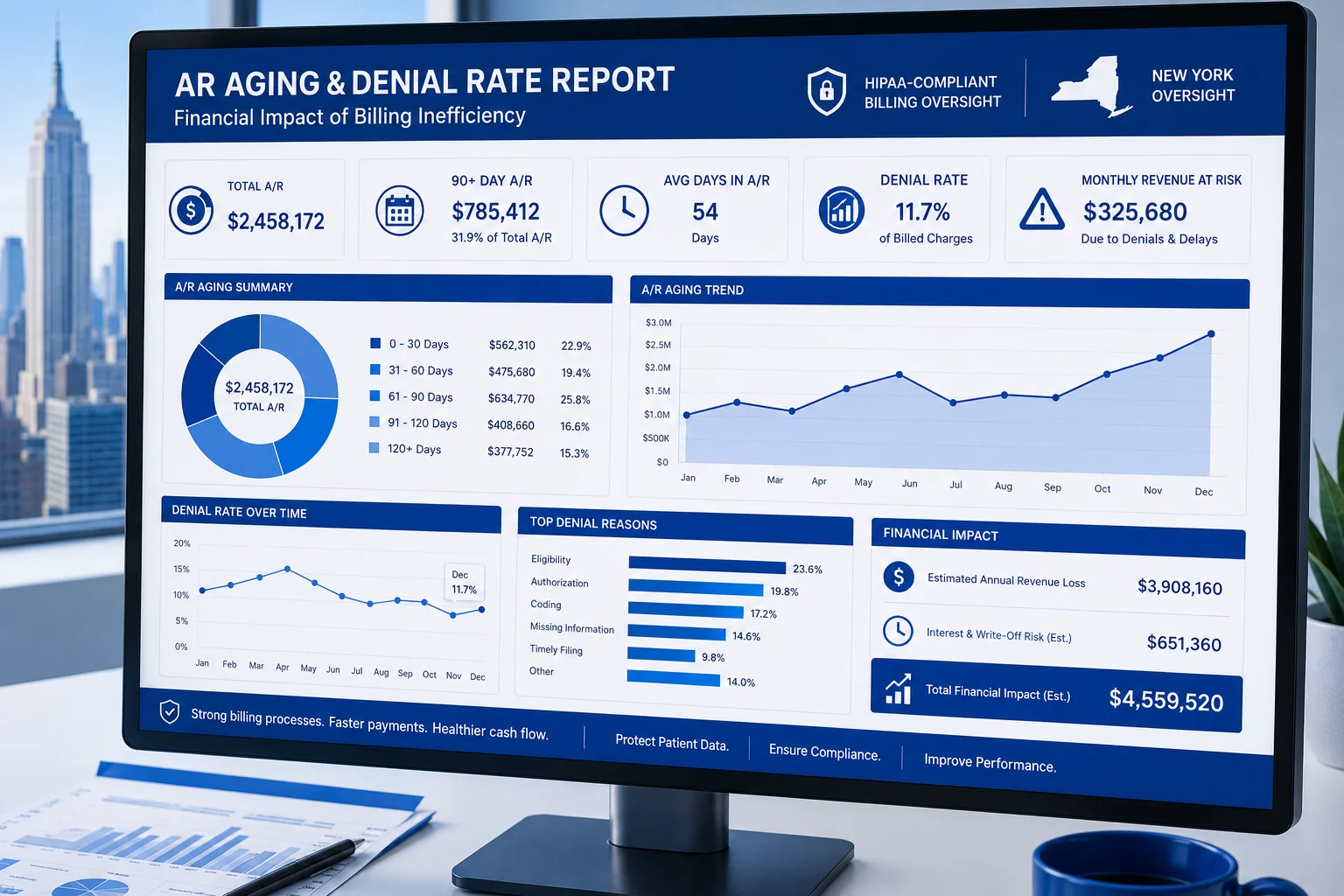
Additional benchmarks from industry data show:
- The average denial rate for in-house billing teams runs 12%–15%, compared to 4%–6% for professional outsourced billing teams
- The cost to rework a single denied claim ranges from $25 to $118 depending on specialty and appeal complexity
- Practices with AR over 90 days exceeding 20% of total AR are leaving significant revenue in uncollectable risk
- Clean claim rates above 96% correlate directly with shorter AR cycles, lower write-off rates, and higher net collection percentages
- EHR-integrated billing reduces duplicate entry and transcription errors by up to 40% compared to manual claim-entry workflows
- New York Medicaid billing outsourcing services demonstrate denial resolution rates 60%–70% higher than average in-house teams managing the same MCO payer mix
These numbers are not hypothetical. They represent what is happening in practices across Brooklyn, Queens, Manhattan, the Bronx, and Long Island every day — including yours, whether you can see it clearly in your current reporting or not.
Example 1 — A Brooklyn Practice That Lost $50K After a Bad Billing Switch
A family medicine practice in Brooklyn switched to a national billing company that advertised low fees and fast turnaround times. Within six months, their denial rate climbed from 6% to 18%. The billing company had no working experience with Healthfirst or Fidelis Care — two of the practice’s highest-volume payers. Claims were submitted without the payer-specific modifiers these MCOs require, and prior authorizations were not tracked between submission and adjudication. By the time the practice identified the problem and transitioned to a new billing company, they had lost over $50,000 in uncollected revenue. More than $80,000 sat in AR beyond 120 days — the majority of it past timely filing windows and permanently unrecoverable.
Example 2 — A Queens Practice That Recovered $30K Within 90 Days of Outsourcing
A physical therapy group in Queens had been managing billing in-house with two part-time billing staff members. Their clean claim rate was 81% — nearly 15 points below the professional standard. After transitioning to a HIPAA-compliant billing New York team with documented physical therapy billing experience, their clean claim rate improved to 94% within 45 days. The billing audit for their practice identified $30,000 in unpaid and unworked claims from the prior six months — claims that had been submitted but never followed up after initial denial. That revenue was fully recovered within 90 days of onboarding.
Example 3 — A Manhattan Group That Cut AR Days by 18 After Switching Billing Companies
A multi-provider internal medicine group in Manhattan was running 68 average AR days — more than 20 days above the specialty benchmark of 40–45 days. After selecting a choose medical billing service New York with documented internal medicine experience and strong New York payer contract knowledge, the group implemented a structured accounts receivable management workflow with weekly AR aging reviews and payer-specific escalation protocols. Within three months, AR days dropped to 50. Within six months, the practice was operating at 42 days — within benchmark range — with a significantly reduced write-off rate and improved month-over-month collections.
What Good Onboarding Looks Like When You Outsource Medical Billing in New York
Switching billing companies can feel risky. A structured, transparent onboarding process is what protects your revenue through the transition — and the quality of that process is one of the clearest signals of how a billing company actually operates.
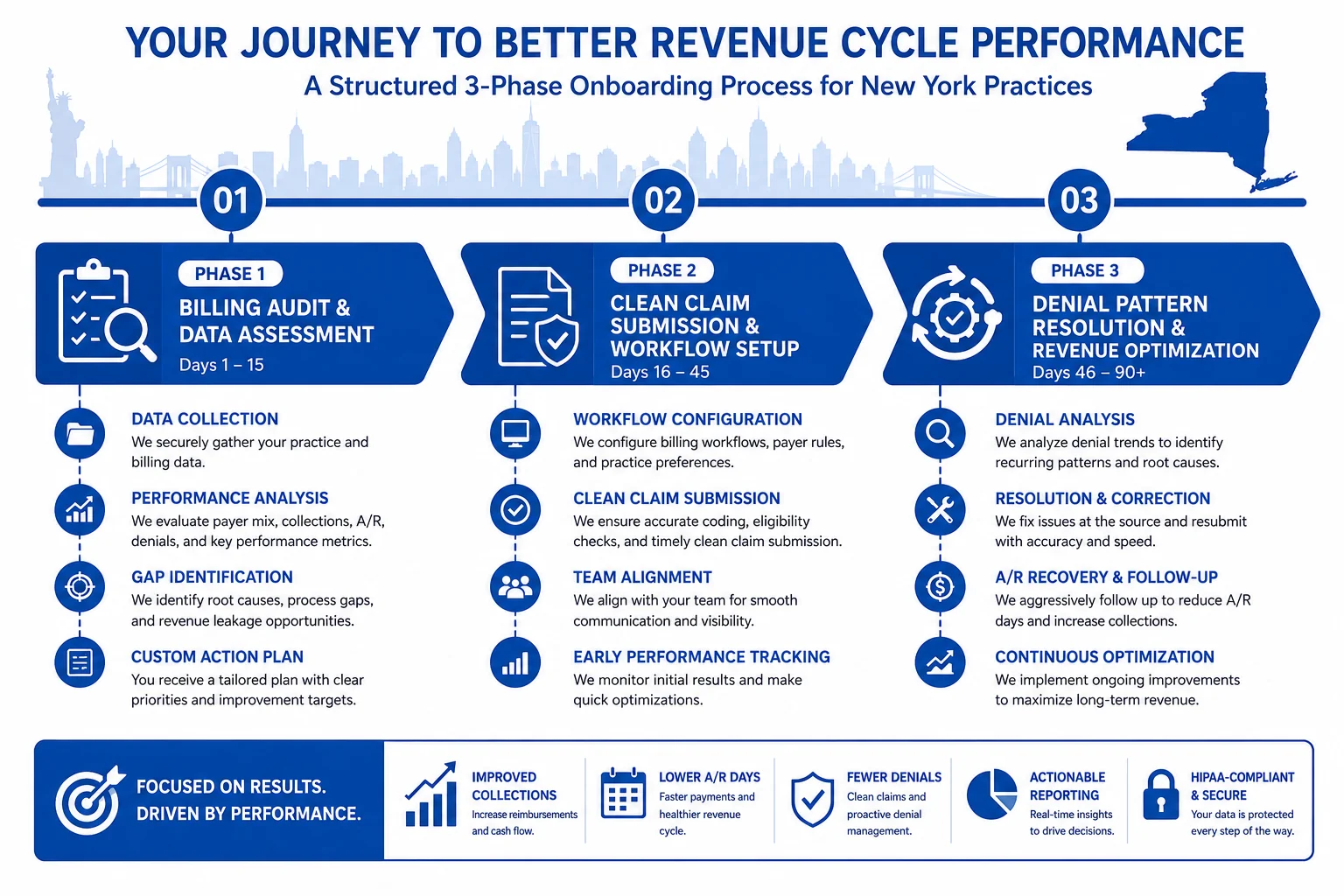
Weeks 1–2: Billing Audit and Process Review
Every TMS Billings engagement begins with a thorough billing audit for the medical practice. We review your existing AR in full — identifying denied, aging, and unworked claims. We audit your credentialing status across all active payers. We map your current billing workflow against your actual payer mix, prior authorization requirements, and claim volume. Before a single new claim is submitted under our management, we have a complete, documented picture of where your revenue cycle stands today.
Weeks 3–4: Clean Claim Submission Begins
With your payer environment fully mapped and your billing history reviewed, we begin submitting clean claims under your established provider credentials. We verify insurance coverage for all active patients before appointment, confirm prior authorizations are in place, and integrate directly with your EHR system to ensure EHR-integrated billing is fully operational. No manual re-entry. No dual data sources.
Months 2–3: Denial Patterns Identified and Resolved
By month two, we have sufficient data to identify your practice’s specific denial patterns at the CPT and payer level. We address root causes directly — whether that is a documentation gap, a missing modifier, a credentialing discrepancy, or an MCO-specific billing rule your previous process was not following — and implement upstream workflow changes that prevent those denials from recurring. This is where clean claim rate improvement and AR reduction become measurable and consistent.
Is Your Practice Ready to Outsource Medical Billing? A Readiness Checklist
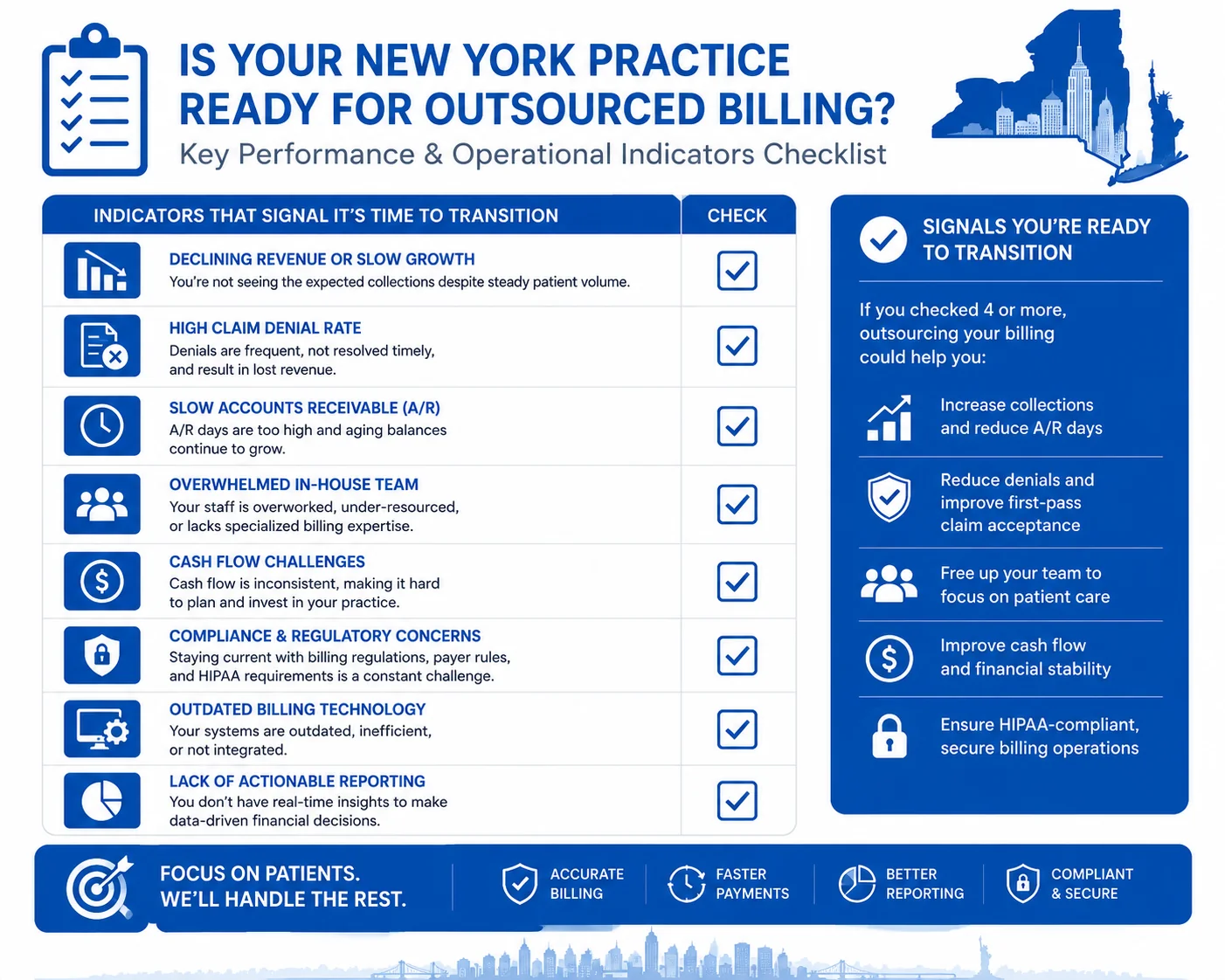
Review each of these indicators honestly. If five or more apply to your practice, outsourcing is likely the right move — and the sooner, the better.
- Your denial rate is consistently above 5% with no clear workflow to address root causes
- AR is aging beyond 90 days with no structured recovery plan or payer escalation process
- Your billing team spends more time on rework and appeals than on clean initial submissions
- You have added new providers without formally confirming credentialing across all active payers
- You have no documented denial management workflow — denials are worked reactively, when time allows
- You are missing timely filing deadlines with one or more payers on a recurring basis
- Your in-house biller is a single point of failure — if they leave, billing continuity is immediately at risk
- You have little to no visibility into your collection performance by payer or provider
- Your clean claim rate is below 90%
- Your billing staff has not received formal training on New York Medicaid MCO-specific billing rules in the past 12 months
- You do not know your current AR days or denial rate without running a manual report
- Your practice has grown in provider count or service volume but your billing infrastructure has not scaled with it
- You are receiving recurring payer audits or claim inquiries that your billing team cannot resolve confidently
- You are experiencing consistent cash flow issues that do not reflect your actual patient volume
- Your billing costs — including salary, software, and administrative time — exceed 12%–15% of gross revenue
If more than five of these describe your practice right now, it is time to have a serious conversation about medical billing outsourcing New York before another month of revenue cycles through unresolved.
How Outsourced Medical Billing Improves Revenue Cycle Performance in New York
When medical billing outsourcing New York is executed by the right partner, the impact on your revenue cycle is measurable and consistent across multiple performance areas.
Clean Claim Rate Improvements
A billing team focused exclusively on your revenue cycle — with payer-specific expertise, documented workflows, and daily claim scrubbing — will improve your clean claim rate. For most practices we onboard, improvements of 8 to 15 percentage points are visible within the first 60 days. Every percentage point increase in your clean claim rate translates directly into faster adjudication, fewer follow-up calls, and higher net collections.
Denial Rate Reduction
Structured claim denial management, combined with payer-specific coding knowledge, proactive prior authorization tracking, and insurance verification services, reduces denial rates substantially. Practices that transition from in-house to outsourced billing with TMS Billings commonly see denial rates drop from 12%–15% to 4%–6% within the first full quarter — a result that compresses directly into improved monthly revenue and reduced administrative burden.
Accounts Receivable Days Improvement
Accounts receivable management is where outsourced billing frequently delivers its most visible financial impact. When a dedicated billing team actively follows up on unpaid claims, identifies aging patterns by payer, escalates appropriately, and works AR with structured daily protocols, AR days fall. That means more of your earned revenue arrives in a shorter window — improving cash flow, reducing write-offs, and giving your practice a more predictable financial baseline to operate from.
How TMS Billings Helps New York Practices Outsource Medical Billing the Right Way
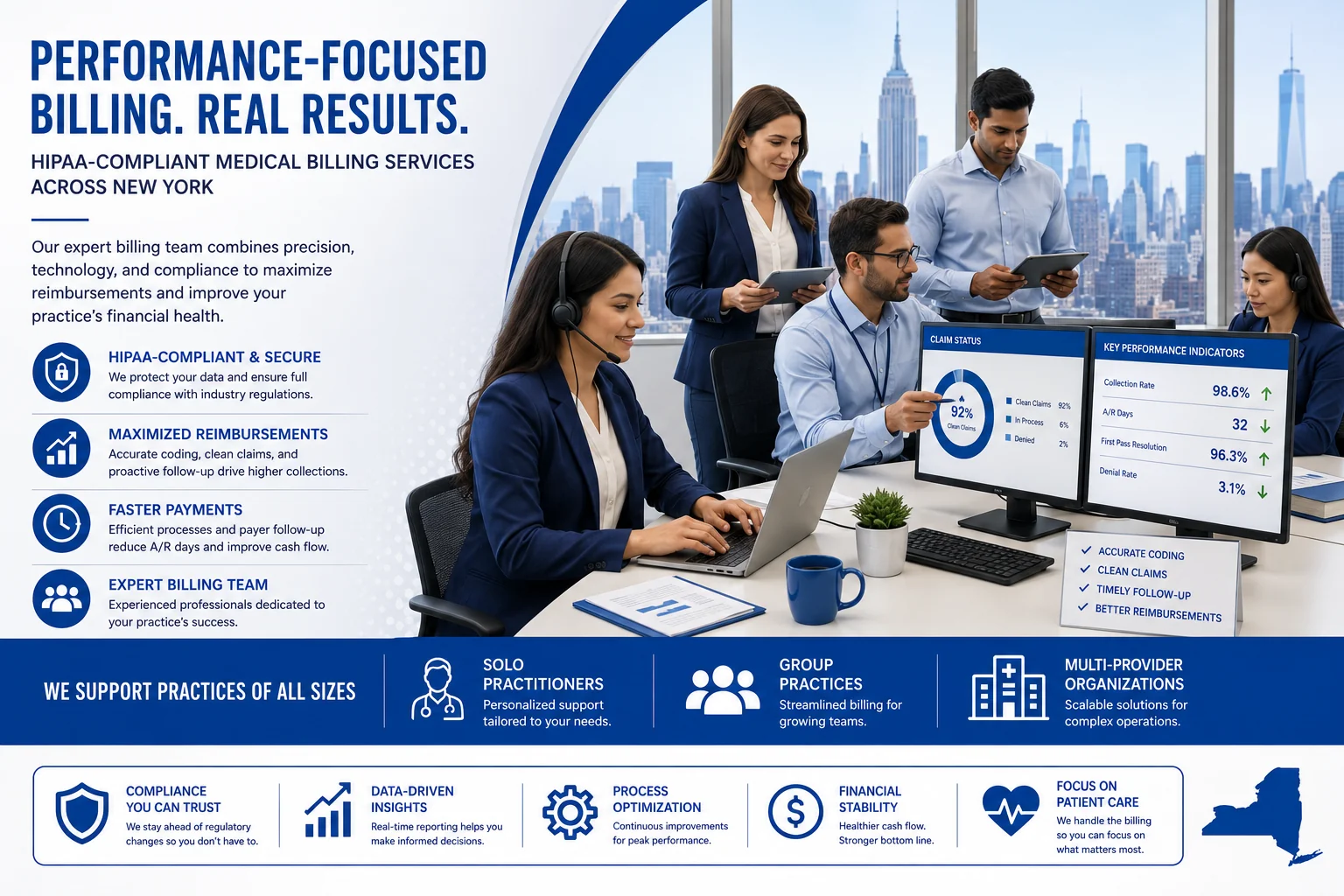
TMS Billings is a HIPAA-compliant billing New York partner with deep, documented experience across New York’s most demanding payer environments. We work with solo practitioners, small group practices, and growing multi-provider organizations across the five boroughs, Westchester, and Long Island.
Our team brings active, working experience with Empire BlueCross, Aetna, United Healthcare, Healthfirst, MetroPlus, Fidelis Care, and the full landscape of New York Medicaid managed care billing requirements. We provide credentialing services New York, prior authorization management, insurance verification services, structured denial management, and full accounts receivable oversight — not as premium add-ons, but as core components of every client engagement.
We are not a national clearinghouse or a generic billing call center. We are a billing partner built specifically for the New York market, and we can demonstrate performance results in writing — not just in a sales conversation.
If you are ready to outsource your billing to a New York specialist, we would be glad to show you what your practice’s numbers look like today and what they could look like within 90 days. That conversation starts with a free billing review — and it starts with us.
Key Takeaways
- New York’s payer landscape demands a billing company with documented, payer-specific experience — not a generalist billing operation
- Clean claim rate, denial management track record, and reporting transparency are your three non-negotiable evaluation criteria when you choose a medical billing service New York
- The true cost of the wrong billing company is not just the monthly fee — it is lost revenue, aging AR, missed timely filing windows, and write-offs that cannot be recovered
- A structured onboarding process protects your revenue during the transition and reveals exactly where your current billing process is underperforming
- Most New York practices that transition to professional outsourced billing see measurable improvement in clean claim rates, denial rates, and AR days within 90 days
- Choosing a HIPAA-compliant billing New York partner with built-in credentialing, prior auth, and denial management eliminates the gaps that cost practices the most
- Medical billing compliance New York is an ongoing operational requirement — your billing partner must stay current, or your practice bears the risk
- New York billing services for practices that include proactive accounts receivable management and denial resolution consistently outperform reactive, in-house billing teams on every revenue cycle metric
Final Thoughts
The decision to outsource medical billing in New York is one of the most consequential choices your practice will make. Done right, it improves revenue, reduces administrative burden, and gives you clear, consistent visibility into your financial performance. Done wrong, it costs you far more than you realize — often before you know anything is broken.
Do not choose a billing company based on the lowest fee or the most polished sales pitch. Choose based on documented performance in New York, payer-specific expertise you can verify, and a transparent process that keeps you informed at every stage.
If you are ready to move forward — or if you simply want to understand what your current billing situation is actually costing your practice — TMS Billings is ready to help. The conversation costs you nothing. The delay may cost you more than you know.