
Medical Billing Errors New York Practices Can’t Afford to Ignore
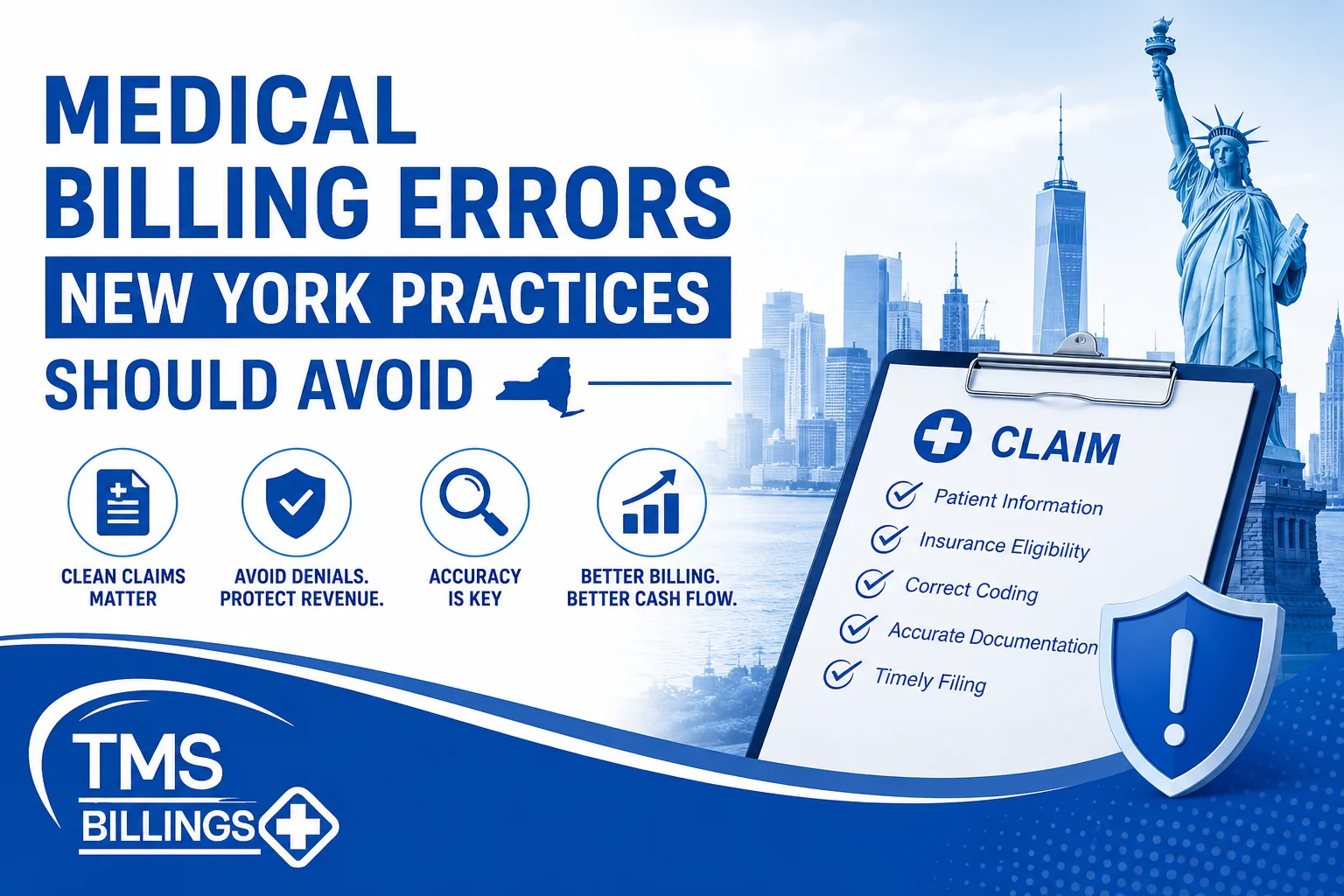
Every month, New York medical practices submit thousands of claims — and a troubling percentage of those claims never get paid. Not because the care was not delivered, not because the documentation was not there, but because of medical billing errors New York providers make with frustrating regularity. Coding mistakes, missed prior authorizations, eligibility failures, and credentialing gaps are silently draining revenue from practices across Brooklyn, Queens, Manhattan, the Bronx, and Long Island.
If your denial rate is rising, your accounts receivable is aging, or your billing team spends more time correcting claims than submitting them, this guide is written for you. Our team provides medical billing services in New York and has audited enough practices to know exactly where the money goes — and how to get it back.
Quick Answer: What Are the Most Common Medical Billing Errors Costing New York Practices Money?
The most common medical billing errors include incorrect CPT and ICD-10 codes, missing prior authorizations, insurance eligibility verification failures, late claim submissions, and credentialing gaps for new providers. Together, these errors drive the majority of claim denials and underpayments that cost New York practices tens of thousands of dollars in lost revenue each year.
What Are Medical Billing Errors and Why Do They Cost New York Practices So Much?
A medical billing error is any mistake in the claim submission process that results in a denial, underpayment, delay, or rejection by an insurance payer. These errors occur at every stage of the revenue cycle — from the moment a patient schedules an appointment to the moment a remittance is posted.
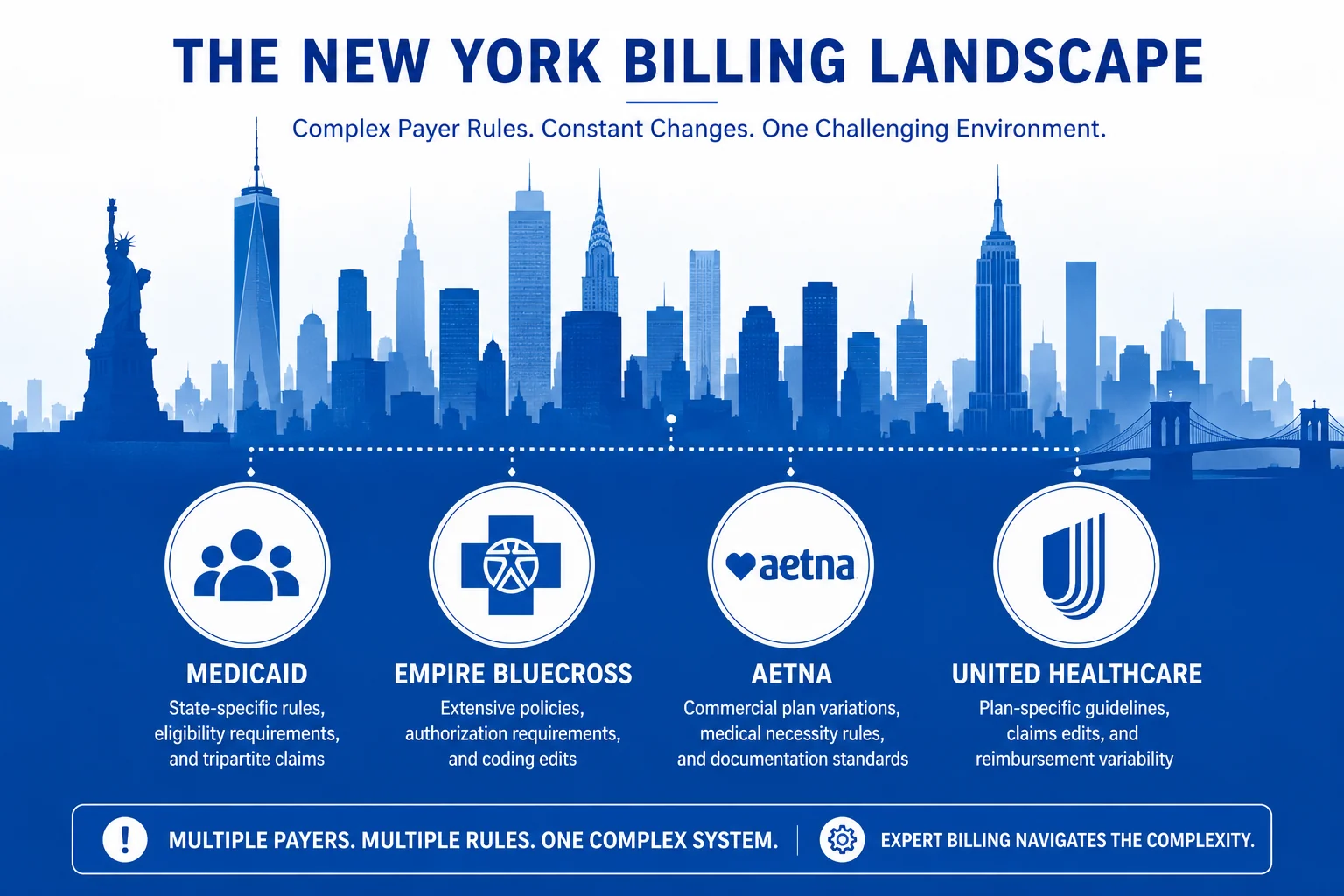
What makes medical billing errors in New York especially damaging is the complexity of the state’s payer environment. Your practice is navigating New York Medicaid, managed care organizations (MCOs), and commercial payers like Empire BlueCross, Aetna, United Healthcare, Healthfirst, and Oscar — each operating under different billing rules, prior authorization requirements, timely filing deadlines, and appeals processes.
A single ICD-10 coding error on a high-value procedure claim can result in a denial worth hundreds of dollars. If your team does not catch it, correct it, and resubmit within the payer’s appeal window, that money is permanently gone. The frustrating reality is that most billing errors are preventable — they stem from undertrained staff, outdated workflows, or a billing process that simply cannot keep up with your practice’s volume.
The Most Common Medical Billing Errors in New York Practices
Coding Errors: The Medical Billing Mistakes in New York That Trigger the Most Denials
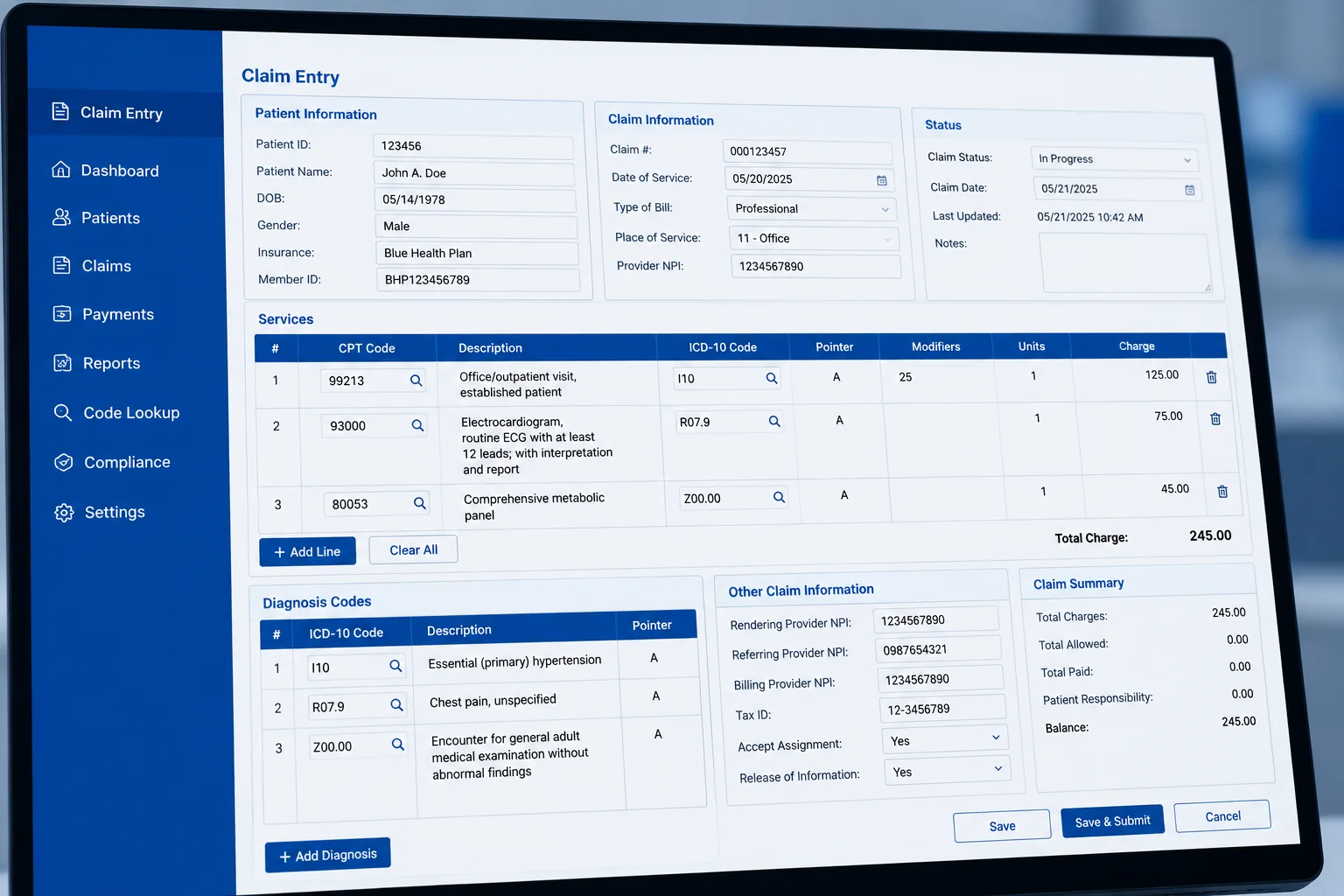
Incorrect CPT codes and ICD-10 coding errors are the single most common cause of claim denials in New York. A psychiatry group in the Bronx billing a 90837 (60-minute therapy session) when they rendered a 90834 (45-minute session) is not just sloppy billing — it is a compliance risk that can trigger a payer audit. An orthopedic practice using a non-specific ICD-10 diagnosis code when Aetna requires a more precise laterality code will see that claim auto-denied.
Medical coding errors happen when coders are not current on annual ICD-10 updates, when physician documentation does not support the billed code level, or when outdated fee schedules are still being used. These mistakes directly suppress your clean claim rate and flag your practice for pattern-based audits.
Missing or Invalid Prior Authorizations
Prior authorization requirements in New York are among the most burdensome in the country. New York Medicaid and commercial payers require authorizations for imaging, specialty referrals, certain surgical procedures, and most behavioral health services.
If your front desk submits a claim for an MRI that required prior authorization and did not receive one, that claim will be denied — full stop. Reversing that denial requires peer-to-peer review, documentation-heavy appeals, and hours of staff time your billing team does not have. Many practices simply do not fight it. The claim gets written off, and the cycle continues.
Insurance Eligibility Verification Failures
Your front desk verifies insurance at check-in. But are they verifying eligibility for the specific service being rendered that day? There is a meaningful difference — and it costs practices money every week.
A patient may carry active coverage with Healthfirst, but if their plan excludes a particular service, has reached its benefit limit, or requires a referral that was never obtained, your claim will be denied. The insurance verification process must be service-specific, not just a confirmation that the card is active.
Claim Submission Timing Errors
Every payer has a timely filing window — a maximum number of days after the date of service during which a claim must be submitted. Miss that window, and the denial is final. No appeal, no exception.
Medicare allows 12 months. New York Medicaid timelines vary by MCO and service type. Empire BlueCross may allow as few as 90 days. If your billing team is backed up or understaffed, claims sitting in a queue past their deadline represent revenue that is simply evaporating.
Credentialing Gaps and Provider Enrollment Issues
Your practice hired a new nurse practitioner. She started seeing patients on day one. But was her credentialing complete with every payer your practice participates in?
Credentialing gaps are particularly damaging for New York group practices that expand quickly, bring on locum tenens staff, or add new service lines. The enrollment process with major payers can take 90 to 180 days — meaning months of claims can stack up denied or paid at out-of-network rates before anyone realizes the problem.
The Real Cost of Medical Billing Errors for New York Practices
The financial damage billing errors cause is not abstract. Here is what the data shows.
- The American Medical Association estimates that approximately 25% of all medical claims contain errors that cause payment delays or denials.
- The Centers for Medicare & Medicaid Services (CMS) reports that claim denial rates have risen sharply in recent years, with certain payers rejecting initial submissions at rates exceeding 15–20%.
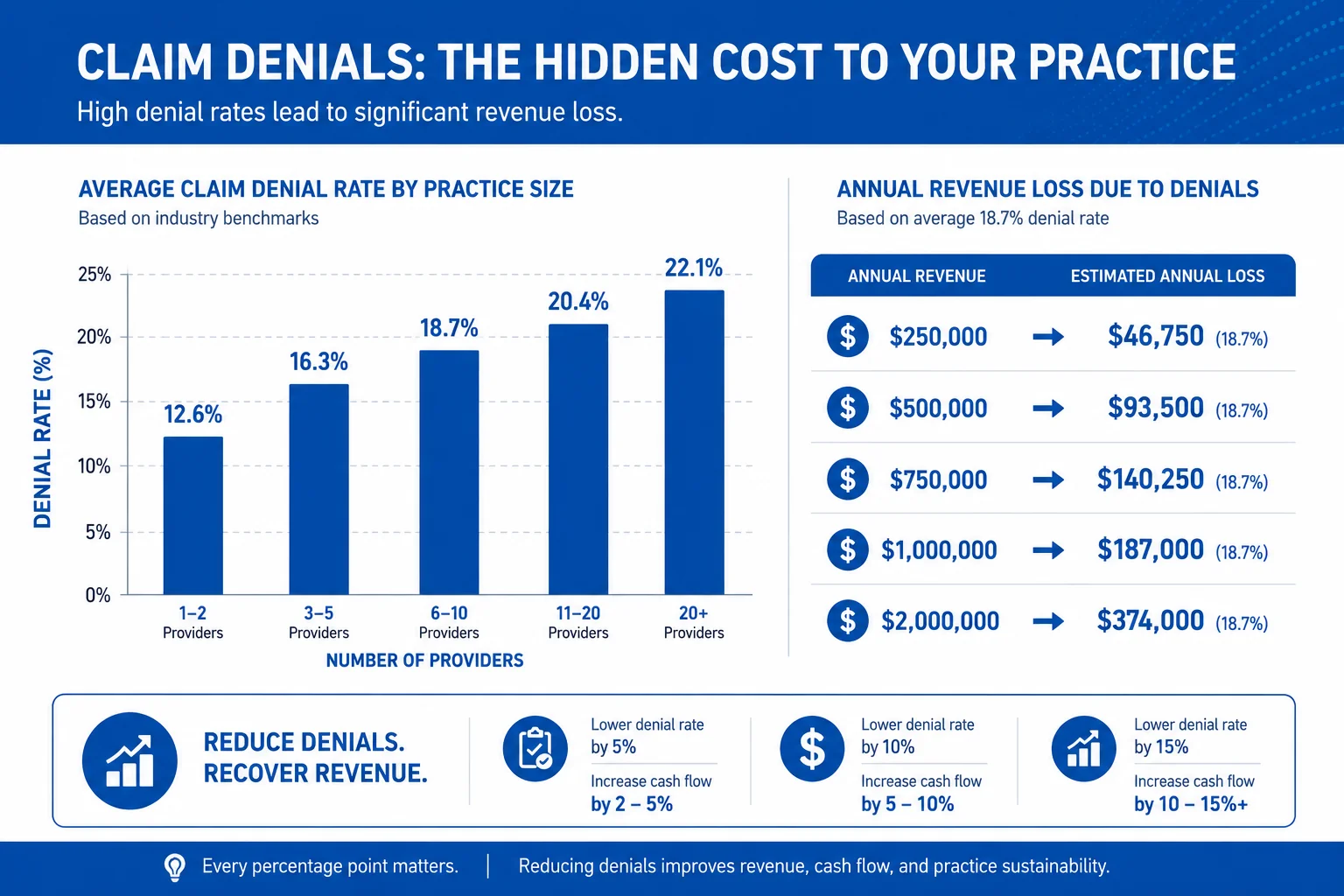
- According to MGMA benchmarks, the average practice loses 1–3% of net revenue annually to billing errors and uncollected claims. On a $1 million billing practice, that is up to $30,000 walking out the door every year.
- Research from the Healthcare Financial Management Association (HFMA) found that 65% of denied claims are never reworked or appealed — they are simply written off as uncollectable, even when recovery was entirely possible.
- The administrative cost to rework a single denied claim ranges from $25 to $118, depending on complexity. Multiply that by several hundred denials per month and the overhead cost alone becomes staggering.
- New York Medicaid denial and underpayment rates exceed the national average, in part because of the state’s managed care structure and its high prior authorization requirements — issues documented in provider guidance from the New York State Department of Health.
- Practices using professional outsourced billing services consistently achieve clean claim rates of 95–99%, compared to the national in-house average of approximately 75–85%.
Every percentage point of improvement in your clean claim rate is real, recoverable revenue. The question is whether your current process is capturing it.
Stop Leaving Revenue on the Table
Your practice is earning money it is not collecting. Our New York billing specialists will review your billing performance at no cost — and show you exactly what it will take to recover it. No obligation. No sales pitch. Just answers.
Why New York Makes Medical Billing Harder Than Most States
New York Medicaid Complexity
New York Medicaid is one of the largest and most complex Medicaid programs in the country. Most Medicaid-enrolled patients are covered through a Managed Care Organization rather than fee-for-service Medicaid — and each MCO operates under its own billing policies, prior authorization requirements, and claims portals.
What applies to Fidelis Care does not necessarily apply to MetroPlus or WellCare. Your billing team cannot treat Medicaid patients as a monolithic group, and staying current on policy updates is a full-time job by itself.
Commercial Payer Rules Vary Wildly Across New York Insurers
Empire BlueCross, Aetna, United Healthcare, Oscar Health, Cigna — each of these payers operates its own fee schedule, modifier requirements, timely filing windows, and claim submission protocols. A modifier that Empire BlueCross requires may be flat-out rejected by United Healthcare.
Revenue cycle management in New York requires payer-specific knowledge that general billing staff simply do not maintain. When your team treats every payer the same, errors are not just possible — they are guaranteed.
Regulatory Compliance Pressure in New York
Medical billing compliance in New York requires navigating federal HIPAA billing compliance standards alongside state-level requirements from the New York State Department of Financial Services and the Department of Health. Medicaid audit activity in New York is among the highest in the nation, and overpayment recoupment demands are real, disruptive, and expensive.
A practice that is not running regular internal audits is not just losing revenue — it is also exposed to compliance risk that can result in payer exclusion.
Warning Signs Your New York Practice Has a Billing Problem
Your Denial Rate Is Above 5%
The industry benchmark for a healthy medical practice is a denial rate below 5%. If your denial rate sits at 10%, 12%, or higher — which is true for many of the practices we audit — you are losing a significant share of earned revenue every single month.
A chronic denial problem is a systemic signal, not just a billing inconvenience. It points to upstream failures in documentation, eligibility verification, coding, or prior authorization management.
Accounts Receivable Is Aging Past 90 Days
Accounts receivable days — the average time between rendering a service and receiving payment — should sit under 40 days for most specialties. Large amounts of AR aging beyond 90 days put that revenue at serious risk.
Claims beyond 90 days are often past appeal deadlines with certain payers and are increasingly difficult to collect. In New York practices, aging AR is almost always a symptom of unworked denials, credentialing delays, or a billing team stretched too thin to follow up consistently.
Your Staff Spends More Time on Rework Than New Claims
If your billing team is spending the bulk of their day correcting denied claims, appealing rejections, and chasing prior authorizations after the fact — rather than submitting clean claims the first time — your entire workflow is backward.
Rework costs more than prevention, produces worse results, and demoralizes the team doing it. If this is your reality, it is time to fix the root causes, not just manage the chaos.
How Medical Billing Errors Snowball Into Bigger Revenue Problems
Example 1 — A Brooklyn Clinic That Lost $40K in Uncorrected Coding Errors
A Brooklyn family medicine clinic had used the same evaluation and management CPT coding approach for three years — without updating to comply with the 2021 AMA coding guideline changes. When a major payer flagged the discrepancy during a routine audit, the clinic was required to repay $40,000 in overpayments and faced a compliance review. No internal billing audit had ever been conducted. The errors had been accumulating silently for years.
Example 2 — A Queens Practice Denied for Missing Prior Auth With No Appeal Process
A Queens internal medicine group had no formal prior authorization workflow. When patients with United Healthcare plans were referred for specialist visits and advanced imaging, claims went out without verified authorizations. Denials accumulated. With no denial management workflow and no one tracking the aging report, the team moved on to new patients rather than appeal outstanding claims — writing off more than $60,000 over two years that was entirely recoverable.
Example 3 — A Manhattan Group Practice With Credentialing Gaps Delaying Payments 6 Months
A Manhattan multi-specialty group hired three providers during a rapid growth phase. All three began seeing patients immediately. Credentialing with three major payers was not complete. Six months later, the practice discovered that hundreds of claims had been denied or processed at out-of-network rates — with several already past timely filing deadlines. Total exposure: over $85,000 in delayed or lost revenue.
How to Fix Medical Billing Errors in Your New York Practice
Run a Billing Audit to Expose Medical Billing Errors Costing Your New York Practice
A monthly billing audit should review your denial rate by payer, your AR aging breakdown, your clean claim rate by provider, and your top denial reason codes. Look for patterns — the same CPT code denied by the same payer repeatedly is not coincidence, it is a fixable upstream problem.
If you have never run a formal billing audit, start with the last 90 days of remittance data and identify your top five denial reasons. Those are your first priorities.
Train Front Desk Staff on Eligibility Verification
Your front desk is the first line of defense against preventable billing errors. Training them to verify not just active coverage, but service-specific eligibility, referral requirements, and prior authorization needs — 24 to 48 hours before every appointment — eliminates a significant share of avoidable denials.
A structured pre-visit checklist is the simplest, highest-impact process improvement most practices can implement immediately.
Work With Certified Medical Coders
If your billing is handled by staff who are not credentialed coders — CPC, CCS, or equivalent — your coding accuracy is at risk. Medical coding errors are the top trigger for claim denials, and getting them consistently right requires ongoing education as ICD-10 updates roll out annually and payer-specific rules evolve.
Build a Denial Management Workflow
Every denied claim should enter a defined workflow: identify the denial reason code, determine if it is correctable, correct and resubmit within the payer’s window, or escalate to a formal appeal. No denial should sit unworked or age out silently.
Track your denial reasons consistently. When patterns emerge — same payer, same code, same denial reason — address the root cause upstream rather than continuing to fight the same battles downstream.
Why Outsourcing Medical Billing Services in New York Is the Smarter Move
What Outsourced Billing Companies Actually Do
A professional medical billing company in New York handles the full revenue cycle: eligibility verification, prior authorization management, clean claim submission with claim scrubbing software, payment posting, denial management, underpayment recovery, and monthly reporting.
They also carry the burden of staying current on payer rule changes, ICD-10 updates, and medical billing compliance in New York — so your internal team does not have to.
How Outsourcing Improves Your Clean Claim Rate
The gap between in-house billing and professional medical billing services New York companies provide comes down to specialization and process. Outsourced billing teams use purpose-built claim scrubbing software with payer-specific editing rules that catch errors before submission — not after denial.
The result is consistently higher clean claim rates, lower denial rates, faster accounts receivable days, and more revenue collected on every dollar billed.
The ROI of Outsourcing vs. In-House Billing Staff
The true cost of an in-house billing team includes salary, benefits, training, billing software, and the ongoing cost of errors and missed appeals. A single experienced medical biller in New York City earns $55,000–$75,000 per year in base salary alone. Add overhead, and you are often spending more than the cost of outsourcing — while accepting more billing risk.
Outsourcing medical billing in New York is typically priced as a percentage of collections, directly aligning the billing company’s incentive with your revenue growth. When they perform better, you collect more.

Is Your New York Practice Making These 12 Medical Billing Mistakes? A Self-Audit Checklist
Work through this list. Every item you cannot confirm represents a potential revenue leak.
- Insurance eligibility is NOT verified for the specific services being rendered before each appointment
- Prior authorizations are chased reactively after denial — not confirmed before the patient is seen
- CPT and ICD-10 codes have not been audited against current payer requirements in the past 6 months
- Your fee schedule has not been reviewed or updated in the last 12 months
- Claims are not being submitted within 24–72 hours of the date of service, consistently
- Modifiers are missing, inconsistently applied, or not reviewed for payer-specific requirements
- Denied claims are not being appealed — or are not appealed within the payer’s filing deadline
- No accounts receivable aging report is reviewed on a regular monthly basis
- New or rotating providers are seeing patients before confirming credentialing with all relevant payers
- Duplicate claim submissions are occurring due to a lack of claim tracking systems
- Patient demographic and insurance data is not reverified at every visit — only at initial registration
- No formal internal billing audit has been conducted in the past 6 months
- Your team has no denial rate benchmark to measure against (target: under 5%)
- There is no written denial management workflow your billing staff follows consistently
- Billing staff has not received any coding or compliance training in the past year
If you confirmed more than three of these gaps, your practice is actively losing revenue it has already earned.
How Our Medical Billing Services Help New York Practices Stop the Revenue Bleeding
At TMS Billings, we work exclusively with practices navigating the complex New York billing environment. Our team manages end-to-end revenue cycle management in New York — from eligibility verification and prior authorization management to clean claim submission, denial management, underpayment recovery, and payer contract negotiation in New York.
We understand Empire BlueCross, Aetna, United Healthcare, Healthfirst, Oscar, and the full landscape of New York Medicaid managed care. We know the timely filing windows, the payer-specific modifier requirements, and the credentialing timelines — because this is the work we do every day.
Our clients consistently see denial rates drop, AR days improve, and clean claim rates rise into the 95–99% range within the first 90 days of working with us. Explore what that could mean for your practice through our medical billing services in New York.
Key Takeaways
- Medical billing errors New York practices experience most often involve coding mistakes, missing prior authorizations, eligibility failures, and credentialing gaps — all of which are preventable.
- The average practice loses 1–3% of net revenue annually to billing errors, and 65% of denied claims are never reworked or recovered.
- New York’s payer complexity — Medicaid managed care, multiple commercial insurers, strict compliance requirements — makes in-house billing especially difficult to execute at a high level.
- A denial rate above 5% and AR aging beyond 90 days are clear, urgent warning signs that require immediate action.
- Outsourcing medical billing in New York consistently delivers higher clean claim rates, lower denial rates, and better overall revenue cycle performance — at a cost that is comparable to or lower than in-house billing.
- The first step to stopping revenue loss is a billing audit — identify the patterns, fix the root causes, and stop fighting the same denials month after month.
Final Thoughts — And What to Do Right Now
Medical billing errors are costing New York practices real, recoverable money every single day. The good news is that these are not random, unpredictable problems. They are patterns — and patterns can be identified, corrected, and prevented.
Your practice delivers exceptional care. Your revenue should reflect that.
Whether you are a solo provider in Queens, a behavioral health group in Brooklyn, or a growing multi-specialty clinic in Manhattan, the billing problems you are experiencing are solvable. You do not have to solve them alone.
Speak with a New York medical billing specialist today and take the first step toward a billing process that works as hard as you do.