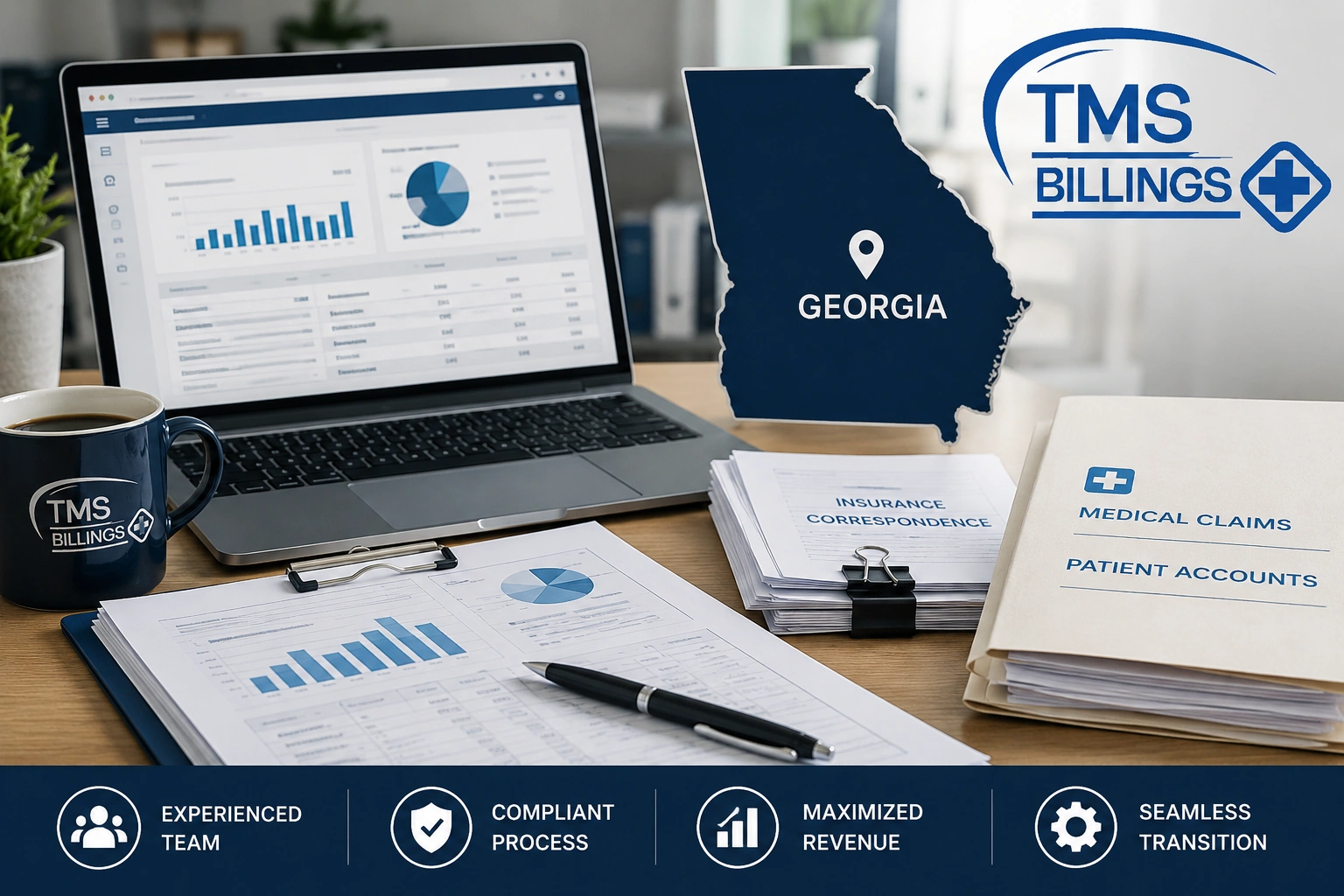

Georgia’s Medicaid managed-care landscape is in the middle of a significant transition. Amerigroup and Peach State Health Plan’s long-standing Care Management Organization contracts were not renewed, while CareSource continues its participation and Humana and Molina Healthcare of Georgia join UnitedHealthcare of Georgia as new plan partners. For practices relying on Medical Billing Services built around the old payer roster, a claim that cleared smoothly last year may now hit an unfamiliar edit simply because a different CMO holds that patient’s contract.
This shift is pushing many practice owners and billing managers to reconsider whether to outsource medical billing georgia operations to a partner who already tracks these changes. This guide from the TMS Billings Coding & Compliance Team walks through what outsourcing actually costs, the real trade-offs against keeping billing in-house, Georgia-specific payer and Medicare rules your practice needs to follow, how to vet a vendor, and how to switch without disrupting your revenue cycle. Whether your team already outsources and is reevaluating its vendor, or is exploring this decision for the first time, the payer landscape described below applies directly to your claims.
In-House vs. Outsourced Medical Billing at a Glance
| Factor | In-House Billing | Outsourced Billing |
|---|---|---|
| Staffing | Requires hiring, training, and retaining billing staff | Handled by the vendor’s existing coding and billing team |
| Georgia payer updates | Your team tracks CMO and MAC changes directly | Vendor monitors payer changes as part of the service |
| Upfront cost | Salaries, benefits, and software licensing | Percentage-of-collections, flat-fee, or per-claim pricing |
| Day-to-day control | Direct, immediate oversight | Managed through vendor reporting and communication |
| Scalability | Limited by current staff capacity | Scales with claim volume without new hires |
What Does It Mean to Outsource Medical Billing in Georgia?
Quick Answer: To outsource medical billing georgia practices hand charge entry, coding, claims submission, claim denial management, and accounts receivable follow-up to a third-party billing partner instead of running these tasks with in-house staff, freeing internal resources to focus on patient care rather than payer administration.
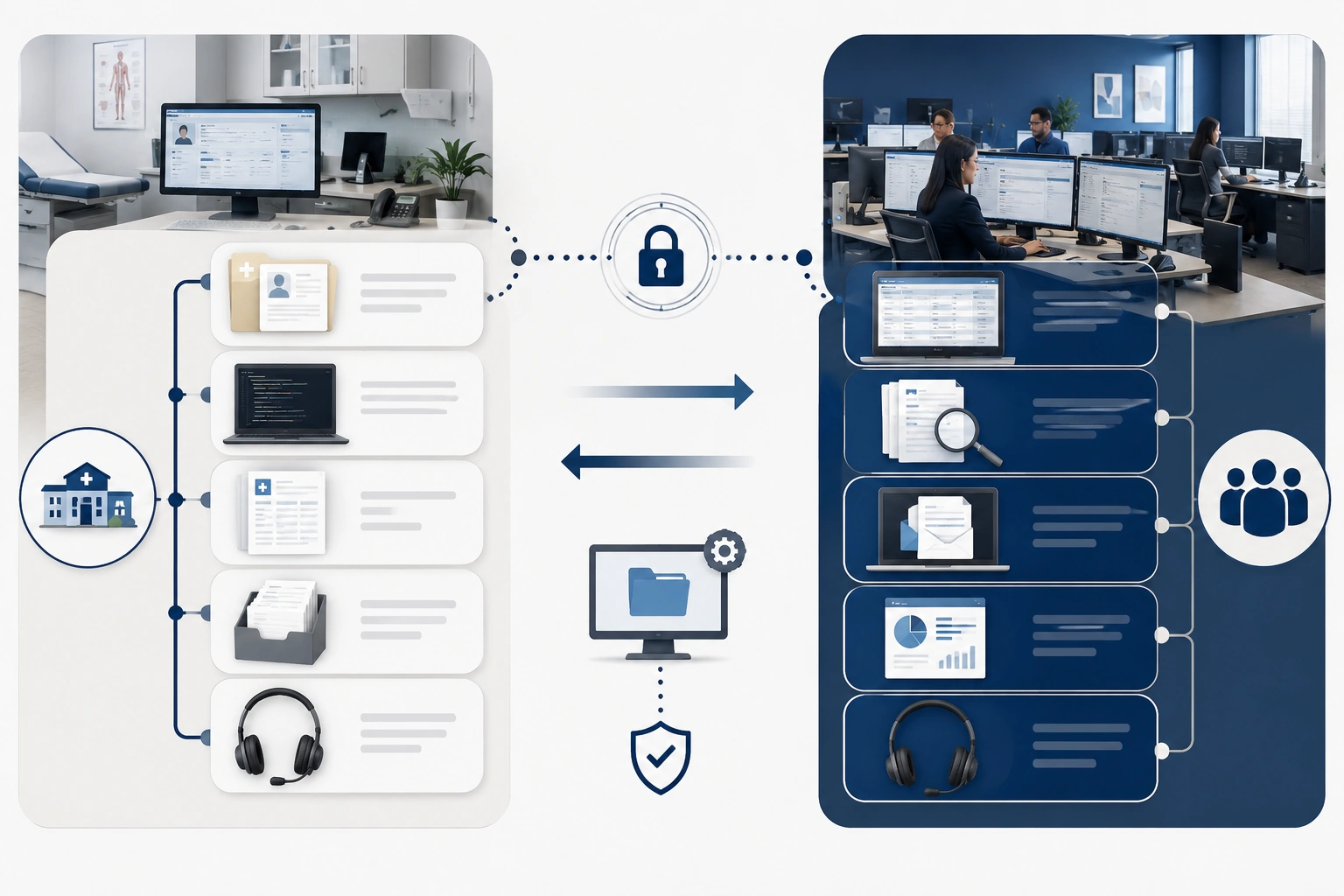
Most outsourced medical billing services manage more than claims submission alone. A billing partner typically handles charge entry, ICD-10 and CPT coding, claims scrubbing, and accounts receivable recovery, often working through direct EHR integration with the practice’s existing practice-management platform. Many billing companies employ AAPC-certified coders, and confirming that a prospective vendor’s coders hold active Certified Professional Coder credentials is a reasonable first check, since CPC certification verifies a coder’s working knowledge of current coding guidelines and payer-specific rules.
What outsourcing includes can also vary by specialty. A primary care practice, a behavioral health group, and a physical therapy clinic each generate different documentation patterns and coding requirements, so it is worth confirming that a prospective partner has direct experience across relevant medical billing specialties before signing an agreement.
Why More Georgia Practices Are Outsourcing Medical Billing in 2026
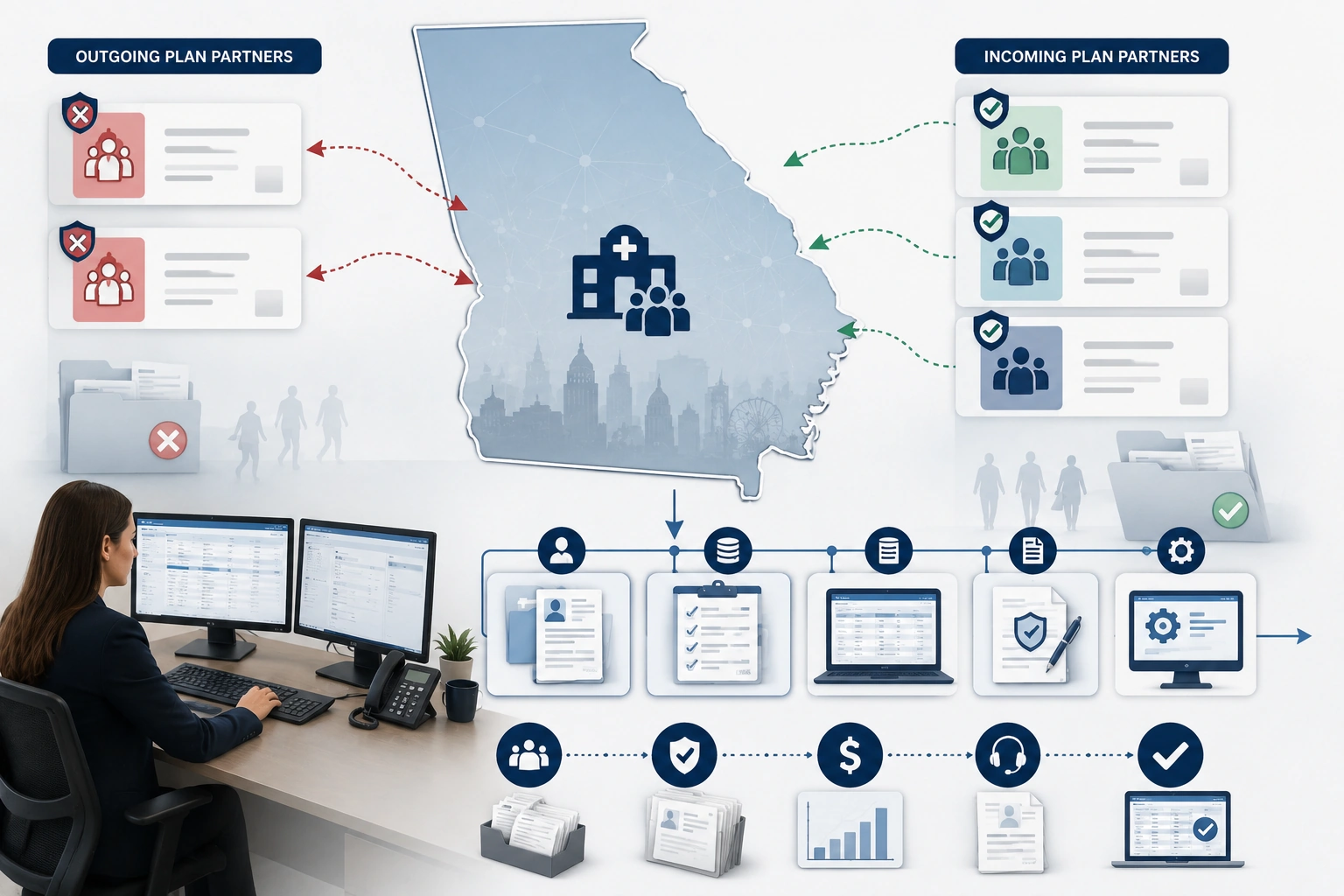
Practices across the state are asking why outsource medical billing in Georgia has become a more urgent question in 2026 than in prior years. The answer starts with Georgia Families managed care, the state’s Medicaid managed-care program, which is undergoing significant plan changes this year. Amerigroup and Peach State Health Plan’s Care Management Organization contracts were not renewed, CareSource continues as a participating plan, and Humana and Molina Healthcare of Georgia join UnitedHealthcare of Georgia as incoming partners. For practices serving Medicaid patients, including those enrolled through PeachCare for Kids, this reshuffling means re-credentialing with new plans and adjusting Georgia Medicaid billing workflows to different prior authorization requirements almost simultaneously.
This Georgia-specific disruption is layered on top of a broader, national pattern. According to MGMA, medical groups have reported increasing efforts to automate and outsource revenue cycle management functions to build stronger financial partnerships as billing-staff turnover and hiring difficulty continue to strain in-house teams. For a Georgia practice managing both the CMO transition and everyday commercial payer work with plans such as Cigna, Anthem Blue Cross Blue Shield of Georgia, and Aetna, that combination of pressures is prompting a fresh look at outsourcing.
The CMO transition timeline referenced above reflects payer communications available as of publication and remains subject to change. Practices should confirm current CMO status directly on the Georgia Department of Community Health website before making credentialing decisions.
Outsource Medical Billing Georgia — What Practices Need to Know
This section is the practical core of this guide: real cost structures, the honest trade-offs against in-house billing, Georgia-specific payer and Medicare rules, and what to ask before signing with a billing partner.
What Outsourcing Actually Costs in Georgia
Most outsourced medical billing services in Georgia are priced one of three ways: a percentage of monthly collections, a flat monthly fee regardless of volume, or a per-claim rate. None of these structures is universally cheaper than the others; the right fit depends on your practice’s claim volume, specialty mix, and how predictable your monthly revenue already is. Practices weighing how much does it cost to outsource medical billing should request a sample Pricing breakdown tied to their own claim volume rather than a single quoted rate, since a structure that works well for a high-volume primary care group may not suit a smaller behavioral health practice.
Real Practice Example: A multi-provider primary care practice in metro Atlanta modeled percentage-of-collections pricing against a flat monthly fee before switching vendors. The practice chose the percentage-of-collections structure because it kept the vendor’s incentives aligned with the practice’s own collections as patient volume grew through the year.
In-House vs. Outsourced: Weighing the Trade-Offs
The medical billing outsourcing company decision usually comes down to a trade-off rather than a clear right answer. Running billing in-house means direct, day-to-day control over your claims, but it also means absorbing the cost of hiring, training, and replacing billing staff, a cycle that has grown more expensive as turnover in billing roles has increased nationally. Among the benefits of outsourcing medical billing for small practices is the ability to access an established coding and billing team without carrying that hiring burden internally, though it comes with less direct, moment-to-moment oversight than an in-house team provides. Weighing in-house vs. outsourced medical billing honestly, rather than assuming one option is always better, is the right starting point for this decision.
Credentialing and Payer Enrollment During Georgia’s Medicaid CMO Transition
When a state Medicaid managed-care contract changes hands, credentialing and payer enrollment has to happen again with each new plan. Practices serving patients now covered by Humana, Molina Healthcare of Georgia, or UnitedHealthcare of Georgia need to confirm enrollment status, update EHR payer tables, and learn each plan’s claim-edit and prior authorization rules individually, since these often differ meaningfully from CMO to CMO. A billing partner’s Credentialing Services can track these deadlines across multiple plans at once, reducing the risk of a reimbursement gap during the transition. The Care Management Organizations page on the Georgia Department of Community Health website is the authoritative source for current CMO status.
Georgia’s Medicare Billing Rules: Working With Palmetto GBA
Georgia’s Medicare Administrative Contractor is Palmetto GBA, which administers Medicare Part A and Part B claims for Jurisdiction J, a region it shares with Alabama and Tennessee, as confirmed by Palmetto GBA’s announcement of its MAC contract award. This matters for your practice because Palmetto GBA sets local coverage determinations and documentation-request timelines specific to this jurisdiction, separate from national Medicare policy. A partner familiar with Palmetto GBA’s requirements, alongside broader Georgia medical billing services experience, can flag documentation gaps before a claim is submitted rather than after it is denied.
Data Security and HIPAA Compliance When You Outsource
Sharing patient billing data with a third-party vendor requires a signed Business Associate Agreement before any protected health information moves between systems, as outlined in HHS guidance on BAA provisions. Beyond the agreement itself, HIPAA-compliant medical billing depends on the vendor’s actual safeguards: encrypted data transmission, restricted staff access to PHI, and a documented breach-notification process. Confirming revenue cycle management data-handling practices, not just the signed BAA, is worth doing before any patient data changes hands. Your practice’s compliance counsel should review the final agreement, since specific HIPAA compliance obligations vary by practice and data-sharing arrangement.
Georgia’s Surprise Billing Rules and Balance-Billing Compliance
Georgia’s Surprise Billing Consumer Protection Act restricts balance billing for out-of-network emergency care and certain non-emergency services at in-network facilities, and it sets an arbitration process for resolving out-of-network payment disputes, according to the Georgia Office of Commissioner of Insurance. This state law applies alongside the federal No Surprises Act, and a billing partner tracking both layers helps keep Georgia Medicaid billing and commercial claims compliant with each. Strong AR Recovery Services depend on this dual compliance, since a claim flagged under either law can otherwise stall in accounts receivable indefinitely.
Vetting a Medical Billing Outsourcing Company: What to Ask Before You Sign

Before signing with any vendor, confirm the specifics that determine day-to-day performance rather than relying on general reputation. A genuine credentialed medical billing company should be able to document its coders’ AAPC certifications, show compatibility with your EHR or practice-management platform, and provide transparent reporting on metrics like first-pass clean claims rate and net collections rate rather than collections totals alone. Practices working through how to choose a medical billing company in Georgia should also review contract terms closely, including termination clauses and how patient data is returned if the relationship ends.
How to Switch to Outsourced Medical Billing Without Disrupting Revenue
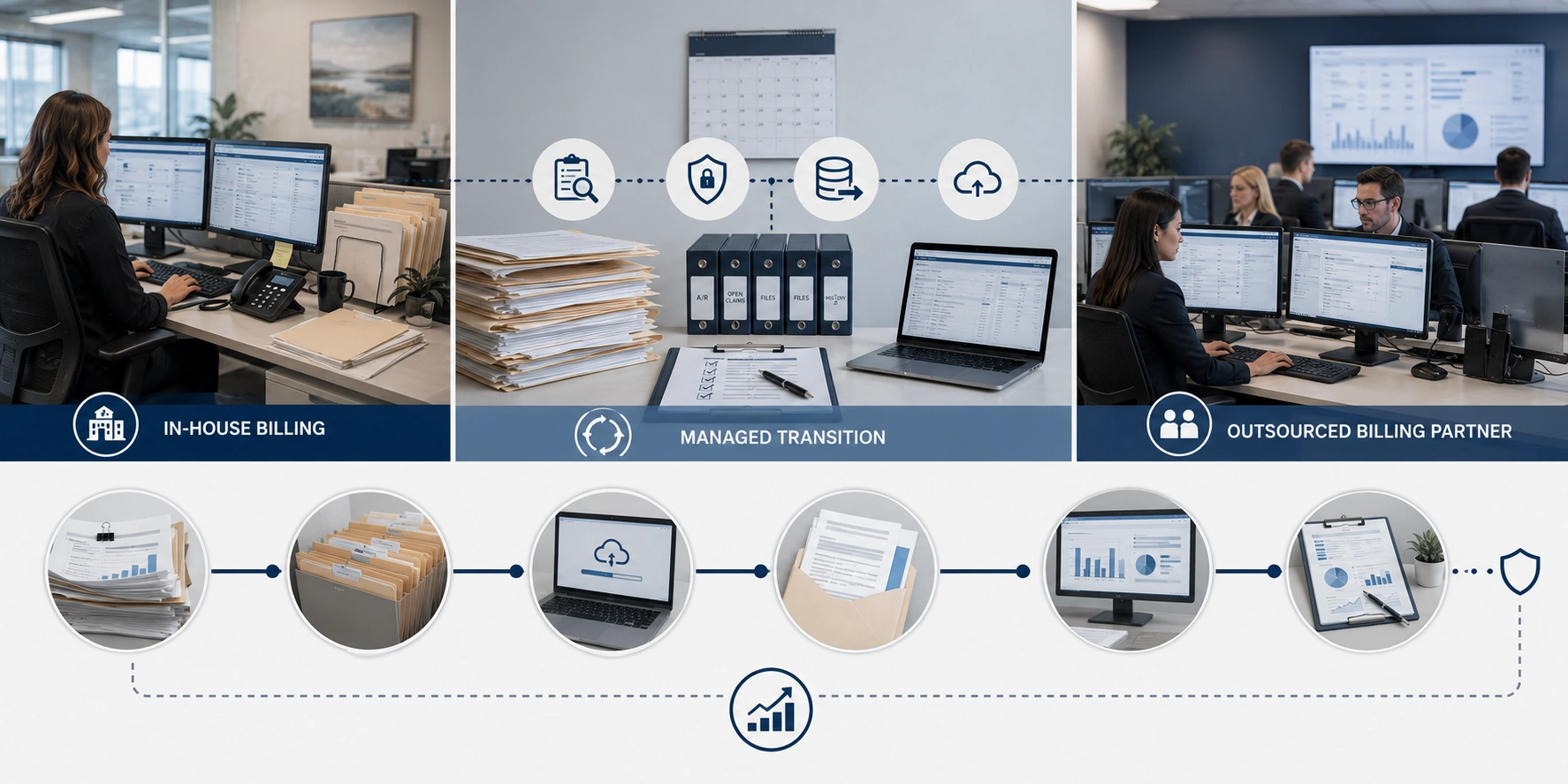
Recognizing the signs your practice should outsource medical billing is easier than executing the switch itself, which is where most disruption risk lives. Start by auditing your current accounts receivable before any transition begins, so both your team and the incoming vendor share a clear baseline of what is outstanding and by payer. Set a clean cutover date rather than switching mid-billing-cycle, since a mid-cycle handoff makes it harder to track which claims belong to which system.
Confirm data migration and claims clearinghouse setup with the new vendor well in advance, including how historical claims data and open AR will transfer. Once live, track denial patterns by payer through the first 90 days rather than assuming a smooth handoff; a temporary uptick in denials from a specific CMO or commercial plan often points to a payer-table setup issue that can be corrected quickly once identified. This same discipline supports effective revenue cycle management Georgia practices need through any transition, whether it involves Medicaid, Medicare, or commercial claims, and reflects the same principle behind TMS Billings’ broader Revenue Cycle Management support.
How TMS Billings Supports Georgia Practices
TMS Billings works with Georgia practices navigating exactly the challenges described above. That includes coding accuracy across specialties from primary care to behavioral health, credentialing support through Medicaid and Medicare payer transitions, and working knowledge of Georgia-specific payer and MAC rules rather than a generic national playbook. TMS Billings also provides outsourced medical billing services built around Georgia’s specific payer landscape. Transparent reporting is part of that support, giving your team visibility into claims status and collections through Billing Reporting & Analytics built for exactly this kind of oversight.
Real Practice Example: A multi-specialty Georgia practice avoided a lapse in Medicaid reimbursement during the 2026 CMO transition by tracking re-credentialing deadlines across the incoming managed-care plans ahead of the cutover date, rather than reacting once claims had already begun denying.
Key Takeaways
- Georgia’s 2026 Medicaid CMO transition is a primary driver behind practices choosing to outsource medical billing georgia operations this year.
- Outsourcing pricing typically follows a percentage-of-collections, flat-fee, or per-claim model, and no single structure is universally the cheapest option.
- In-house billing offers direct control; outsourcing trades some of that control for access to an established coding and billing team without the hiring burden.
- A signed Business Associate Agreement and documented safeguards are non-negotiable before any patient billing data moves to a third-party vendor.
- Vetting a vendor should include AAPC coder credentials, EHR compatibility, and transparent reporting, not just a quoted price.
- A clean cutover date and a 90-day denial-tracking plan reduce the revenue disruption risk of switching vendors.
Final Thoughts
Deciding whether to outsource medical billing georgia operations is not a decision to make on pricing alone. It depends on your practice’s current staffing, how exposed your claims are to Georgia’s shifting Medicaid CMO landscape, and how much day-to-day control your team is willing to trade for specialized support. The practices navigating this transition most smoothly are treating it as an operational decision, not a reaction to a single denied claim or a single frustrating month.
If your practice is weighing this decision, TMS Billings’ Coding & Compliance Team can walk through your current claim volume, payer mix, and credentialing status to help you see what outsourcing would realistically look like for your revenue cycle. Book a Free Consultation to start that conversation.