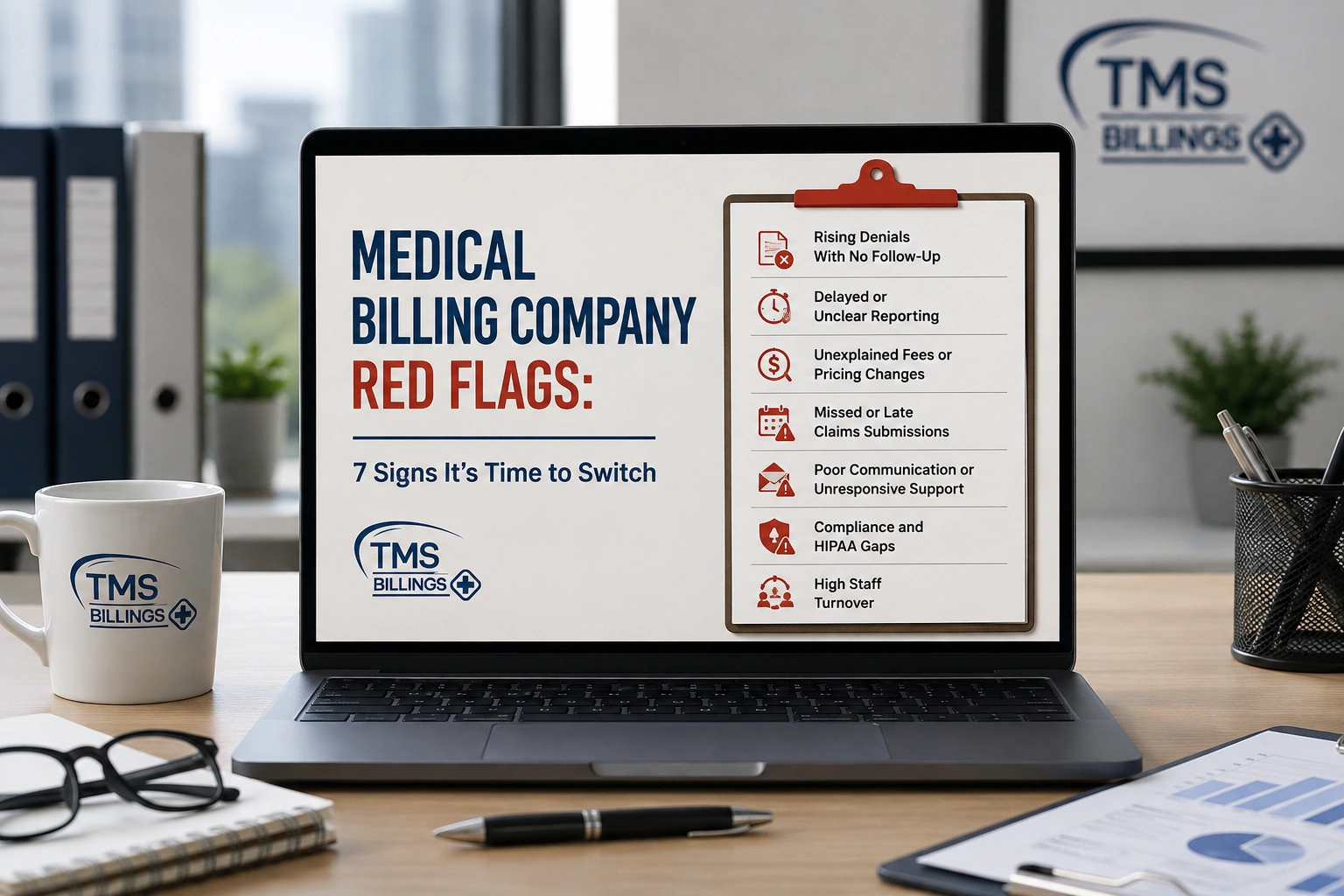

Medical Billing Company Red Flags: 7 Signs It’s Time to Switch
A late report here. An unreturned call there. A small, unexplained fee nobody questioned. Six months into a vendor relationship, one practice found a stack of denied claims that had never been reworked — tens of thousands of dollars in recoverable revenue sitting untouched. None of the warning signs looked serious alone. Together, they were classic medical billing company red flags.
If that sounds familiar, you’re not catching a failing billing partner through one dramatic failure — you’re catching it through a pattern of small ones. This guide breaks down the 7 clearest medical billing company red flags, what each one actually costs, and how to switch medical billing companies without losing revenue if you decide it’s time. Whether you’re troubleshooting a current vendor or comparing medical billing services for the first time, the cost of staying with a bad medical billing company is rarely the fee on the invoice — it’s the revenue quietly written off, denied, or never billed at all.
Medical billing company red flags are warning signs — like rising unworked denials, vague reporting, or unresponsive support — that signal a billing partner is costing your practice revenue. Recognizing them early helps you decide when it’s time to switch.
What Are Medical Billing Company Red Flags?
Medical billing company red flags are recurring signals — not one-off mistakes — that show a vendor is no longer protecting your revenue cycle management. One late report isn’t a red flag; a pattern across months is.
These signs cluster around four areas: money (rising denials, unexplained fees), operations (missed deadlines, coding accuracy), communication (unresponsive support, vague reporting), and risk (HIPAA compliance gaps, staff turnover). Published vendor evaluation and RCM benchmarking data backs this up: practices that track denial and collection metrics against industry norms catch underperforming vendors far earlier than those who don’t. Medical billing company warning signs rarely appear all at once — that’s exactly why practices tend to normalize them instead of acting.
7 Medical Billing Company Red Flags to Watch For
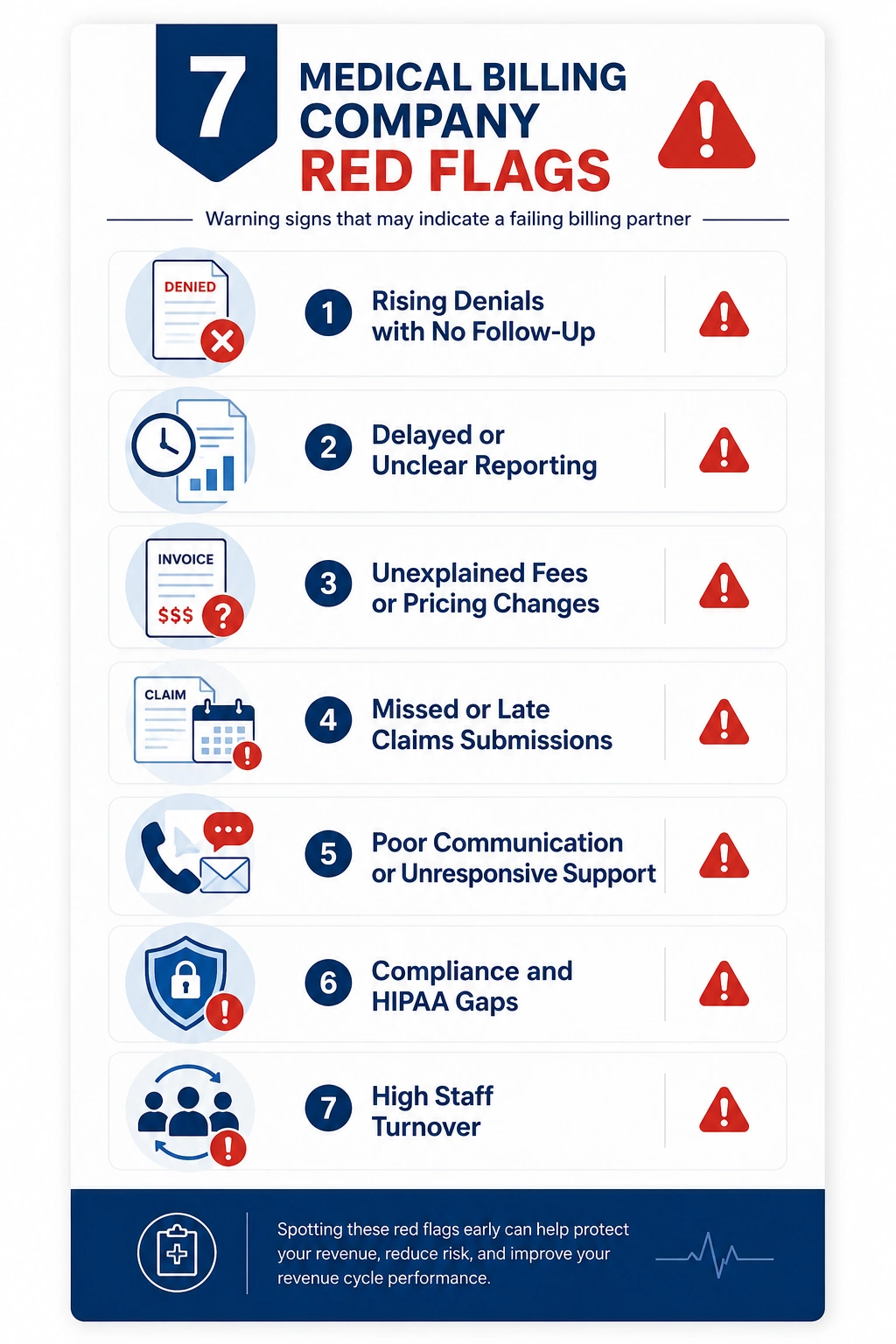
Each of these signs your medical billing company is failing you can look minor in isolation, but every one has a measurable cost. Here are the 7 medical billing company red flags that matter most.
1. Rising Denials With No Follow-Up
Rising denials with no follow-up is one of the clearest medical billing company red flags, because unworked claims don’t disappear — they age past the point of collectability. A healthy claims denial rate sits in the low single digits; anything climbing past 8–10% with no corrective plan is a problem.
The real damage is what happens after: does your vendor have a documented appeals process, or do denials sit in a queue for weeks while your days in accounts receivable (A/R) climbs? Ask for your collection rate and denial trend over the last two quarters — our denial code guide breaks down what the most common codes actually mean. If your vendor can’t produce that trend on request, you’re looking at unresolved denials draining revenue every month.
2. Delayed or Unclear Reporting
Delayed or unclear reporting means you’re making financial decisions on information that’s weeks old, or missing entirely. A reliable partner delivers consistent reporting on claims, denials, and collections without you asking twice.
If your monthly report is one summary number instead of a breakdown by payer or denial reason, you can’t see where revenue is stuck. Billing transparency isn’t a nice-to-have — it’s how you catch problems early. Request gross charges versus net collections for the last several months. If your vendor can’t produce it quickly, that reporting gap is itself one of the more telling medical billing company warning signs.
3. Unexplained Fees or Pricing Changes
Unexplained fees or pricing changes show up as invoices that don’t match what you signed up for — new line items, rate increases with no notice, or charges you can’t map back to your contract terms. A trustworthy partner explains pricing changes before they hit your invoice, not after.
This matters because billing fees are usually tied to collections, so a vendor with declining performance sometimes makes up the difference through fees instead of better results. Compare your contract terms against your last three invoices. If the math doesn’t reconcile, that’s one more reason practices start researching signs to switch medical billing companies in the first place.
4. Missed or Late Claims Submissions
Missed or late claims submissions push revenue out with every timely-filing deadline that passes. Most payers allow 90–180 days to submit a clean claim; once that window closes, the claim is often unrecoverable.
A pattern of late submissions usually points to a capacity problem — not enough staff, outdated systems, or too many practices sharing too few billers. Ask how many claims are typically submitted within 48 hours of the encounter closing. If your vendor can’t answer confidently, or claims have been written off for filing too late, that’s a structural issue and one of the most expensive medical billing company red flags to ignore.
5. Poor Communication or Unresponsive Support
Poor communication or unresponsive support means waiting days for a callback on a question that should take five minutes. Account manager responsiveness is one of the fastest ways to tell whether a billing company treats your practice as a priority.
Watch for account managers who change without notice, emails unanswered for days, or every question routed through a general inbox. Response time on billing issues correlates directly with how much revenue sits unresolved while you wait. If you’ve stopped reaching out because you already expect silence, that’s not a communication style — that’s a service failure.
6. Compliance and HIPAA Gaps
Compliance and HIPAA gaps put your practice at legal and financial risk beyond any single denied claim. A billing partner handling protected health information should clearly explain how they secure data, train staff on HIPAA compliance, and limit data breach risk.

Vague answers — “we’re compliant,” with no specifics — are themselves a warning sign. Ask about their breach notification process and audit procedures; certified coders who follow AAPC auditing standards and prioritize coding accuracy reduce this risk significantly. Compliance gaps rarely surface as one dramatic event — they show up during a payer audit or breach investigation, when the cost is no longer hypothetical.
7. High Staff Turnover at the Billing Company
High staff turnover at the billing company shows up as a revolving door of contacts, each needing to be re-briefed on your specialty and payer mix. Every handoff is a chance for something to get missed.
Institutional knowledge about your practice — which payers are slow, which codes get flagged — lives with people, not just systems. Ask how long your assigned team has worked with your account. A stable team is one of the simplest, most overlooked medical billing company warning signs to check before signing — and one of the clearest signs to switch medical billing companies once you’re already in one.
Red Flag or Reliable Partner? A Quick Comparison
Not sure if what you’re seeing is a genuine problem or just an off week? This table lines up a red flag against a reliable billing partner across the areas that matter most for revenue. Knowing when to switch medical billing companies often comes down to how many rows on the left sound familiar — if your current vendor matches more than one or two, it’s a signal to start evaluating whether to outsource medical billing to a partner who can close those gaps.
| Factor | Red Flag Billing Company | Reliable Billing Partner |
|---|---|---|
| Denial follow-up | Denials pile up unworked | Proactive appeals within days |
| Reporting | Vague, delayed, or inconsistent | Real-time, detailed reporting |
| Communication | Slow or unresponsive | Dedicated account rep, fast turnaround |
| Pricing | Hidden fees, unclear invoices | Transparent, flat-rate or % pricing |
| Compliance | HIPAA gaps, audit exposure | Certified coders, regular audits |
| Staffing | High turnover, inconsistent contacts | Stable team, low turnover |

How to Switch Medical Billing Companies Without Losing Revenue
How to switch medical billing companies without losing revenue comes down to timing and a clean handoff, not disruption. If the signs to switch medical billing companies above sound familiar, the transition itself is usually far less risky than practices expect.
A well-run switch typically follows a simple sequence:
- Weeks 1–2 — Parallel setup: Your new partner gains EHR access, verifies credentialing, and learns your payer mix while your current vendor keeps working active claims.
- Weeks 2–4 — New claims transition: New claims start routing to your incoming partner; your outgoing vendor keeps working existing accounts receivable.
- Weeks 4–6 — AR handoff and cleanup: All open claims, including aged AR, are documented and transferred with a clear record of what’s been worked. This is the step practices skip when switching on their own.
- Ongoing — Benchmark check-ins: Your new partner should commit to measurable targets — collection rate, days in A/R, denial rate — within 90 days, and report against them.
A few questions to raise before you sign: What happens to claims already in progress? Will you need to change EHR systems? How is PHI handled during the transfer, to keep HIPAA compliance intact throughout? A partner who answers clearly, before you sign anything, is already showing you what real medical billing services look like.
How TMS Billings Helps Practices Switch With Confidence
How TMS Billings helps practices switch with confidence starts with a free billing audit — a clear look at your denial rate, days in A/R, and collection rate before you commit to anything.
Once you’re ready to move, TMS Billings handles the transition using the structured handoff outlined above: parallel claims processing, a documented AR transfer, and benchmark reporting from day one. You’ll always know your dedicated account manager, what your numbers look like, and why. For practices that outsource medical billing to TMS Billings, the difference shows up in what you stop worrying about — unresolved denials, vague invoices, and silence when you have a question.
Ignoring medical billing company red flags doesn’t make them disappear — it just means more unworked denials, more unexplained fees, and more revenue quietly slipping away. TMS Billings gives practices transparent pricing, proactive denial management, and a dedicated team, so switching never puts your cash flow at risk. Get a free billing audit.