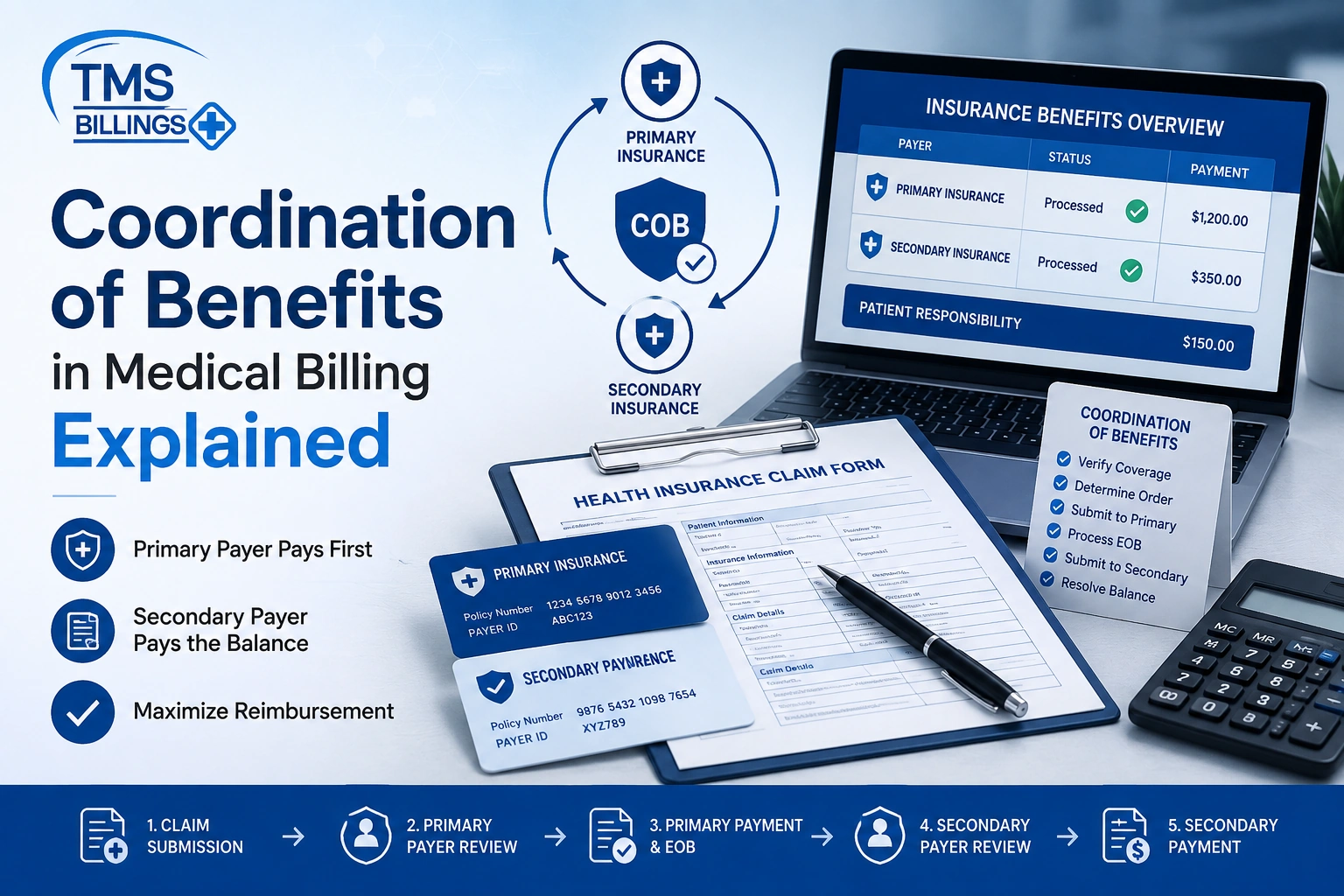

Coordination of Benefits in Medical Billing Explained
Two claims. Same patient. Same visit. One gets paid in ten days because the biller confirmed which of the patient’s two insurance plans was primary — the process known as coordination of benefits in medical billing — before submitting. The other sits in denial for six weeks under code CO-22, because nobody checked. This guide explains how coordination of benefits works in medical billing, how primary and secondary payers are determined, and how to fix — and prevent — the denials it causes. Getting this right is a routine part of running clean medical billing services.
Coordination of benefits in medical billing is the process of determining which of a patient’s two or more insurance plans pays first (primary) and which pays second (secondary), so claims aren’t denied or overpaid.
What Is Coordination of Benefits in Medical Billing?
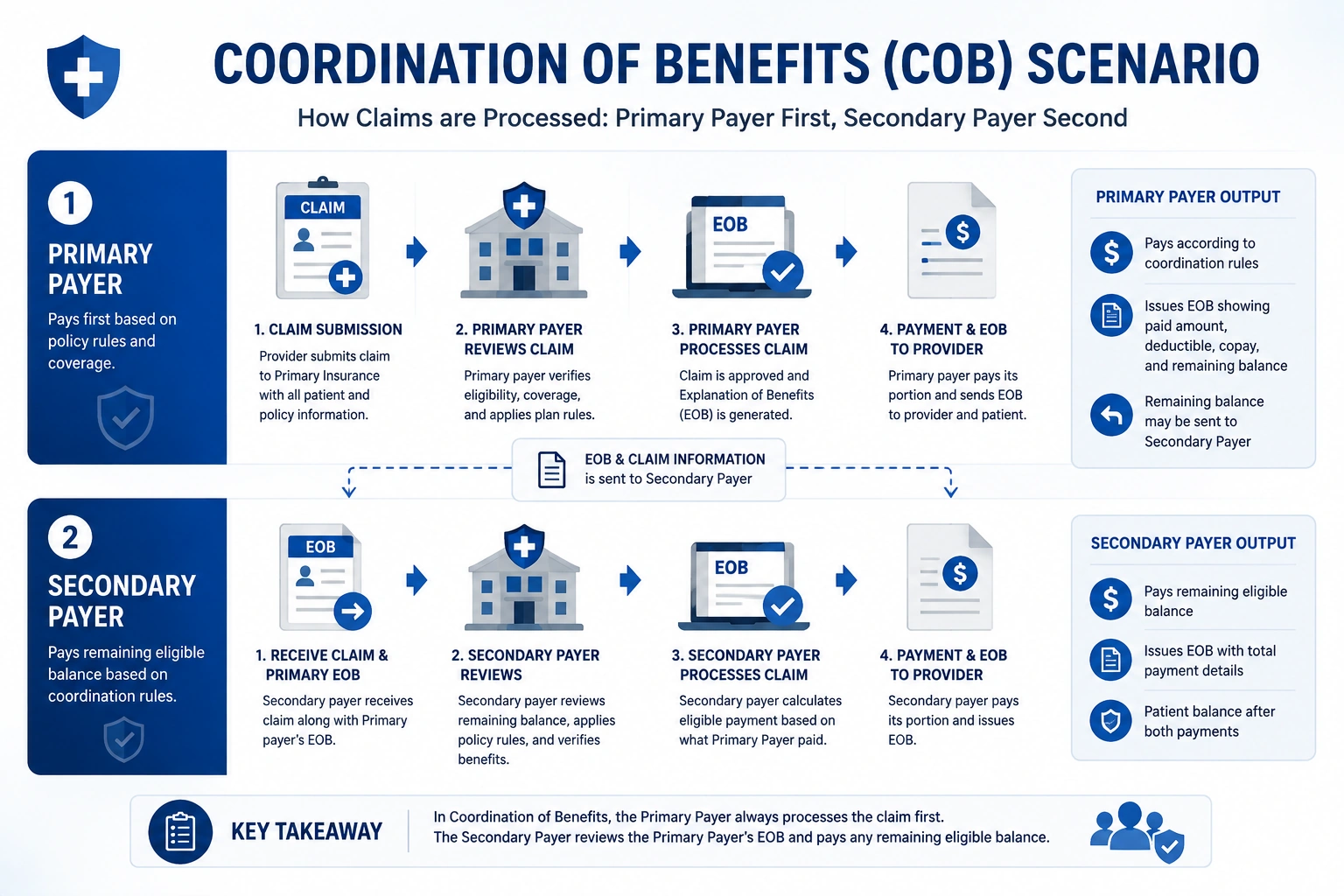
Coordination of benefits in medical billing is the set of rules payers use whenever a patient carries more than one active health plan. Instead of both insurers paying in full, one is designated primary and pays first; the other is secondary and covers what’s left, up to its own plan limits.
This prevents dual insurance coverage claims from generating duplicate payments — exactly what a payer is checking for when it asks a biller to confirm COB status. It comes up constantly: a working spouse with employer coverage plus dependent coverage under a partner’s plan, a Medicare beneficiary who’s still employed, or a child listed on both parents’ policies. Each scenario has a standard order-of-benefit rule, and confirming that order before the claim goes out is what separates a clean payment from a rebill.
Most group health plans coordinate benefits using one of two methods. Under the traditional (carve-out) method, the secondary payer calculates what it would have paid as primary, subtracts whatever the primary payer already paid, and pays the difference. Under the non-duplication method — more common in self-funded and some regional plans — the secondary payer pays nothing if the primary payer’s payment already meets or exceeds what the secondary plan would have paid on its own. That distinction matters for billers: it’s why a secondary claim sometimes comes back with a zero-dollar payment even though the secondary coverage is active and real. It isn’t a denial in the usual sense — it’s the coordination method working as written into the plan document.
Payers also renew this check periodically rather than once. Most group plans require members to complete a COB or “other coverage” update at open enrollment, and Medicare relies on its own periodic outreach for the same purpose. A COB record that was accurate last year can go stale the moment a patient changes jobs, a spouse switches employers, or a dependent ages onto a different plan — which is why front-desk verification at each visit, not just at initial intake, is what actually keeps the primary/secondary designation current.
How Is the Primary vs. Secondary Payer Determined?
Primary vs secondary insurance status is decided using a short list of standard rules, applied in order until one plan is clearly first. To determine primary and secondary insurance, billers typically check: which plan covers the patient as the policyholder rather than as a dependent, which plan has covered the person longer, and whether a special rule — the birthday rule, or Medicare Secondary Payer guidelines — applies to the situation.
Most commercial payers base these rules on the NAIC Coordination of Benefits Model Regulation, which most states use as the template for their own insurance codes. For Medicare patients specifically, order is governed by Medicare Secondary Payer rules, detailed on CMS’s Medicare Secondary Payer page: an employer plan from a company with 20 or more employees pays primary while Medicare pays secondary; for smaller employers, Medicare usually pays first.
A few additional rules from the same NAIC model come up often enough to be worth knowing:
- Active employee vs. retiree or COBRA coverage — a plan covering someone as an active employee is primary over a plan covering that same person as a retiree or under COBRA continuation, regardless of which plan started first.
- Group plan vs. individual plan — an employer-sponsored group plan is typically primary over an individually purchased plan.
- Divorced or separated parents, no court decree — order of benefits for the dependent child generally runs: the custodial parent’s plan, then the custodial step-parent’s plan (if remarried), then the non-custodial parent’s plan, then the non-custodial step-parent’s plan.
- Divorced or separated parents, with a court decree — a court order naming which parent must provide coverage overrides the birthday rule and the sequence above.
- True tie — if none of the rules break the tie, the plan that has covered the patient longer is primary.
In practice, billers confirm this order through payer eligibility responses (the EDI 271 transaction returned by a clearinghouse or payer portal), which usually flag other known coverage, or — for Medicare patients — through CMS’s Coordination of Benefits & Recovery resources, including the COB Secure Web Portal.
Coordination of benefits applies to overlapping group and individual health plans; it’s a different framework from third-party liability. When an injury follows a car accident or workplace incident, auto no-fault coverage or workers’ compensation typically pays before health insurance is billed at all, under state liability law rather than NAIC order-of-benefit rules. Billers sometimes conflate the two, but confirming there’s no accident-related liability payer involved is a separate step from confirming which health plan is primary — and skipping it creates a separate set of denials.
The Birthday Rule Explained
The birthday rule insurance carriers use applies when a dependent child is covered under both parents’ plans: whichever parent’s birthday — month and day, not year — falls earlier in the calendar year has the primary plan. That’s the birthday rule for coordinating child coverage used across most states, though a handful apply gender-based or court-order rules instead for divorced or separated parents, so it’s worth confirming state variations on the edge cases.
For example, if one parent’s birthday is March 5 and the other’s is July 20, the March 5 parent’s plan is primary for the child — even if that parent is younger or enrolled in their plan more recently. If both parents happen to share the exact same birthday, the standard tiebreaker is length of coverage: whichever parent’s plan has covered the child longer becomes primary. And because the birthday rule only applies to married or continuously cohabiting parents, any divorce, separation, or court custody order takes precedence over it, which is why confirming marital and custody status is part of a thorough COB check rather than an assumption.
| Scenario | Primary Payer | Secondary Payer |
|---|---|---|
| Patient has employer coverage + spouse’s employer coverage | Patient’s own employer plan | Spouse’s employer plan |
| Dependent child covered by both parents | Parent whose birthday falls earlier in the calendar year (Birthday Rule) | Other parent’s plan |
| Patient has Medicare + active employer coverage (employer with 20+ employees) | Employer plan | Medicare |
| Patient has Medicare + retiree coverage | Medicare | Retiree plan |
| Patient has Medicaid + any other coverage | Other coverage (Medicaid is payer of last resort) | Medicaid |
| Dependent child, divorced parents with a court decree | Parent named in the court order | Other parent’s plan |
What Causes a COB-Related Claim Denial?
A COB denial in medical billing almost always traces back to one thing: the claim went to a payer that isn’t actually first in line. What causes a COB denial most often is outdated insurance information on file — a patient’s coverage changed and the payer’s system doesn’t reflect it — or a claim sent to the secondary insurer before the primary has adjudicated it.
When that happens, the payer returns the CO-22 denial code, which reads: this care may be covered by another payer per coordination of benefits. It’s a contractual-obligation adjustment, so the balance can’t be shifted to the patient — the practice has to correct the payer order and resubmit. For a related adjustment code, see our denial code guide.
CO-22 usually shows up in one of two ways, and the fix differs slightly for each. A front-end rejection happens when the clearinghouse or payer catches the mismatch before adjudication — the fastest to resolve, since no payment has been issued yet. A post-adjudication CO-22, on the other hand, means the payer processed and paid the claim, then flagged the COB mismatch afterward, which can trigger a recoupment request on top of the original denial if the practice already posted that payment. That’s the scenario billers most want to avoid, since it turns one COB error into two financial corrections.
Because resolving a COB denial takes time — updating the record, waiting on the true primary payer’s EOB, then resubmitting to the secondary — practices also need to watch timely filing deadlines on both sides of the claim. A COB correction that’s technically right but submitted after a payer’s filing window closes can turn into a second, unrelated denial that’s much harder to appeal.
How to Fix and Prevent a COB Denial
To fix a coordination of benefits denial, start by verifying the patient’s current coverage directly — insurance verification and eligibility checks at every visit catch changes before they turn into denials. Confirm the correct payer order, correct the record in your billing system, and resubmit to the true primary payer first; once that claim is adjudicated, forward the secondary payer the EOB so payer-to-payer claim crossover happens cleanly.
For Medicare patients, this usually means completing or updating a Medicare Secondary Payer Questionnaire (MSPQ) at check-in, since Medicare relies on that COB update or attestation to know whether an employer plan is primary. Building dependent coverage coordination and MSPQ checks into intake — rather than only reacting at the denial stage — is what stops the CO-22 cycle from repeating on the next visit.
A few habits reduce how often a COB denial shows up at all:
- Ask, don’t assume, at every visit. “Has your insurance changed since your last visit, and do you have any other coverage?” catches most changes before they become a claim problem — patients often don’t think to report a new job’s insurance or a spouse’s plan change unprompted.
- Run real-time eligibility, not just a one-time check. Eligibility responses that return COB data directly from the payer are more current than whatever’s stored in the practice management system from a prior visit.
- Keep an internal COB tracking log. A short running list of patients with known dual coverage — and which plan is primary — lets front-desk and billing staff cross-check new claims against a known-correct order instead of relying on memory.
- Appeal, don’t just resubmit, when the payer’s own record is wrong. If a payer’s file still shows an old employer or an outdated primary, submit the COB update through that payer’s COB portal (or the Coordination of Benefits & Recovery process for Medicare) and request reprocessing, rather than repeatedly resubmitting the same claim into the same mismatch.
How TMS Billings Helps Practices Manage COB Verification
TMS Billings builds coordination of benefits (COB) in medical billing checks into eligibility verification itself, not just denial cleanup — confirming primary and secondary payer order before a claim ever goes out. Our team keeps MSPQ and dependent-coverage records current, tracks coverage changes proactively, and reworks CO-22 denials the same week they land instead of letting them age in a queue. That combination is what keeps clean-claim rates up and days-in-A/R down for the practice’s we support.
Stop Losing Revenue to COB Denials
A missed COB update is one of the quietest revenue leaks in a practice — claims sit denied, get rebilled, and slow down the entire cycle. TMS Billings verifies primary and secondary coverage before claims go out, so COB denials stop happening in the first place.
Getting coordination of benefits in medical billing right the first time is what keeps claims moving instead of sitting in a CO-22 queue.