

How to Negotiate Insurance Reimbursement Rates With Payers: A Guide for Medical Practices (2026)
Two primary care practices. Same payer. Same specialty. Same zip code. One practice sits on a fee schedule that hasn’t moved in four years — buried in an evergreen contract that auto-renewed every January without anyone reading it. The other renegotiated eighteen months ago and now collects meaningfully more on its highest-volume codes, with a faster claims turnaround clause attached. The difference isn’t leverage they were born with. It’s claims data, a benchmark against Medicare, and a negotiation request that was specific instead of vague.
Learning how to negotiate insurance reimbursement rates is one of the highest-ROI activities a medical practice can undertake — and one most practices never attempt. This guide covers how to prepare, what to ask for, and the mistakes that get a negotiation request ignored. It also covers where a medical billing services partner can shorten the process.
What Does It Mean to Negotiate Insurance Reimbursement Rates?
To negotiate insurance reimbursement rates means formally requesting that a payer increase the allowed amounts in your practice’s fee schedule, typically by presenting claims data, quality metrics, and a benchmark comparison against Medicare. It is a payer contract negotiation — a discussion with a health plan’s network relations or contracting department, not a dispute over a single denied claim.
Quick answer: To negotiate insurance reimbursement rates, a medical practice presents claims data, a Medicare benchmark comparison, and a specific rate or contract-term request to a payer’s network relations team. Practices that prepare data-backed proposals — and negotiate contract terms, not just the base rate — tend to see stronger outcomes.
Practices often assume the fee schedule they signed at credentialing is fixed. It isn’t. Payer contract negotiation strategies exist precisely because CPT-level allowed amounts, escalator clauses, and renewal terms are all negotiable line items, not fixed law.
When Should a Medical Practice Renegotiate a Payer Contract?
The best time to renegotiate a payer contract is 90–120 days before your contract’s renewal or evergreen date, since most payer agreements auto-renew annually unless terminated within that window. Missing the notice period commonly locks a practice into another full cycle at the existing rate.
Beyond the calendar trigger, three events should prompt a review regardless of renewal date: a meaningful increase in patient volume or a new location, a low claims denial rate sustained over 12+ months (a quality signal payers respond to), and any update to the Medicare Physician Fee Schedule that widens the gap between your commercial rate and the new Medicare benchmark. When to renegotiate your payer contract is as much about timing the notice window as it is about having a strong case.
How to Prepare for a Reimbursement Rate Negotiation — What Payers Actually Respond To
How to prepare for a payer contract negotiation starts with data, not a phone call. Payers respond to specific, quantified requests backed by claims history — not general appeals about rising costs.
The #1 Leverage Point: Claims and Quality Data
What data to bring to a reimbursement rate negotiation starts with 12 months of claims by CPT code: volume, current allowed amount, and first-pass denial rate. A practice with a low denial rate and high patient volume on a payer’s top-billed codes has real reimbursement rate benchmarking leverage — it is cheaper for the payer to keep a low-friction, high-volume provider in network than to lose them.
Only a small share of medical groups currently pull negotiated-rate data from payers’ own machine-readable files, which were made a legal requirement under the federal Transparency in Coverage rule in 2022 — meaning most practices are negotiating without seeing what the payer already pays comparable providers in the same market.
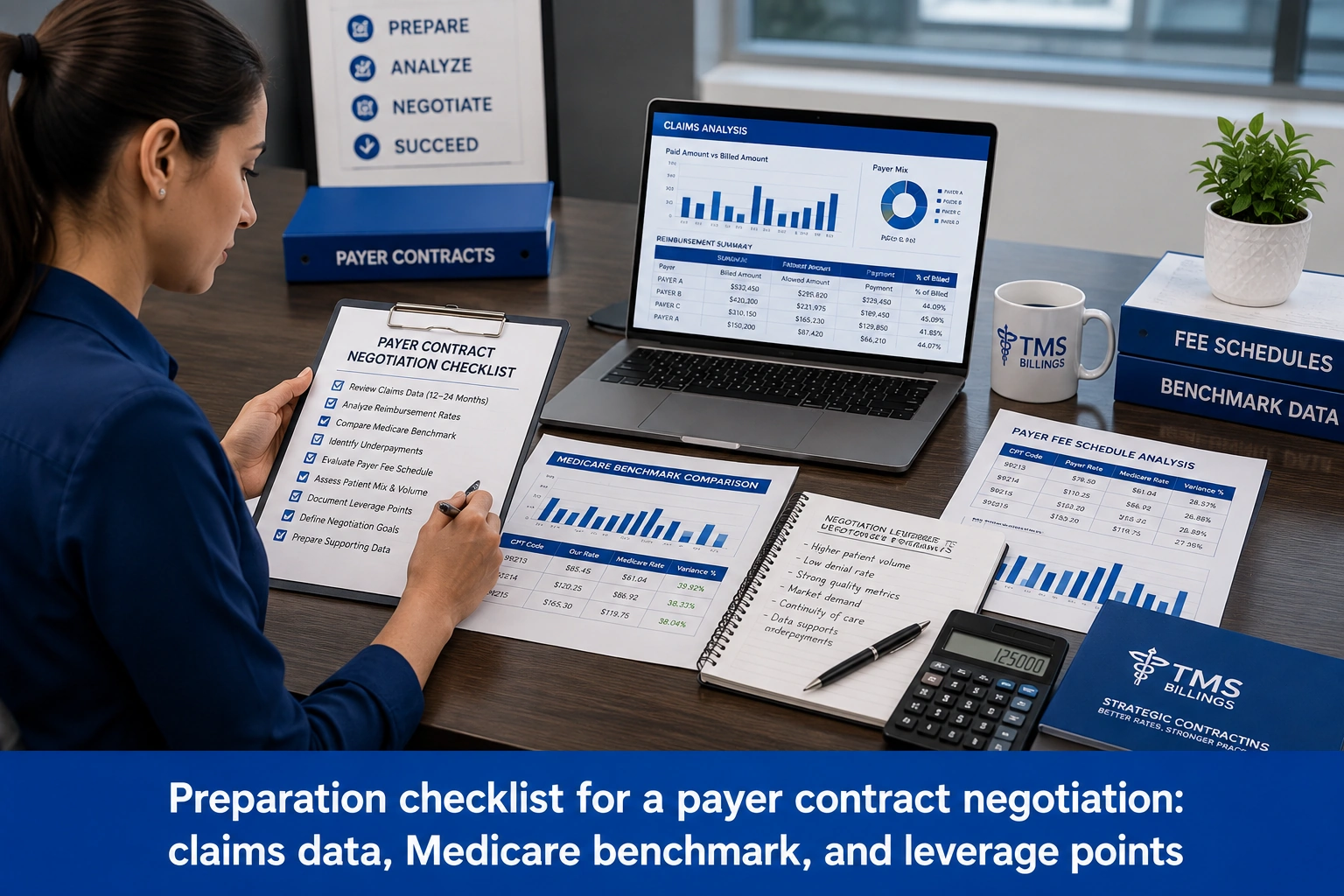
Building Your Negotiation Packet
A complete packet includes: your top 15–20 CPT codes by revenue, your allowed amount per code as a percentage of the current Medicare benchmark, your denial and appeal rate, any quality or patient-satisfaction metrics you track, and a one-page summary of your specific ask (a percentage increase, a flat rate, or specific contract-term changes). Revenue cycle management services can assemble this packet directly from your billing system’s claims history.
In-Network vs Out-of-Network Reimbursement — How It Affects Your Negotiating Position
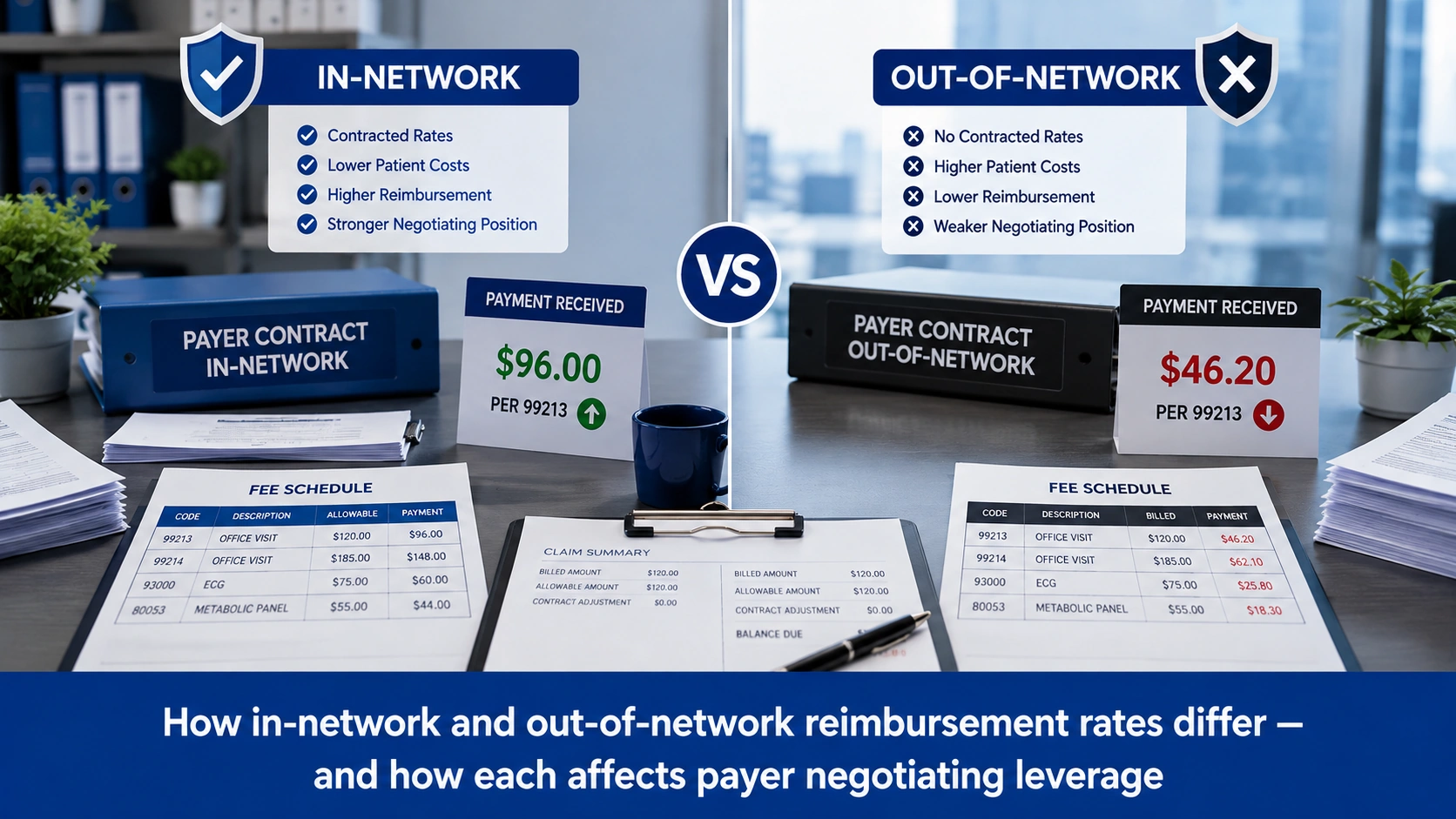
In-network vs out-of-network reimbursement rate comparison matters in negotiation because in-network rates are contractually fixed and pre-negotiated, while out-of-network reimbursement is typically based on a percentage of billed charges or a “usual and customary” benchmark set unilaterally by the payer.
This difference is itself a leverage point. A practice credibly willing to go out-of-network for a specific payer — because its patient volume, specialty scarcity, or geographic coverage gives it standing to do so — has a stronger negotiating position than one that has no alternative to staying in-network at any rate offered. Conversely, a practice with thin margins and heavy dependence on one payer’s in-network volume has less room to threaten termination and should lead with data and contract-term asks instead.
Contract Terms That Matter Beyond the Base Rate
Contract terms besides the base rate that practices should negotiate include a multi-year rate escalator clause, timely filing limits, claims turnaround-time guarantees, and a termination-without-cause clause with a clearly defined notice period.
A multi-year rate escalator — a fixed percentage increase applied automatically each renewal year — is one of the most underused levers in primary care contracting. It avoids re-negotiating from scratch annually and protects the practice against inflation in the interim. Termination-without-cause clauses matter because payer contracts without one can trap a practice in an unfavorable agreement indefinitely; a defined notice window (commonly 90–120 days) gives the practice a real exit option, which itself becomes negotiating leverage. See our payer credentialing and contracting guide for how these terms interact with your credentialing cycle.
Insurance Reimbursement Rate Benchmarks — Medicare and Commercial Payer Data (2026)
Insurance reimbursement rate benchmarking for 2026 starts with the CMS Physician Fee Schedule conversion factor, since nearly every commercial payer negotiation is ultimately framed as a percentage of the current Medicare rate.
Medicare as the universal benchmark. For calendar year 2026, CMS finalized two separate conversion factors for the first time: $33.5675 for clinicians in a qualifying Alternative Payment Model, and $33.4009 for all other clinicians — increases of 3.77% and 3.26% respectively over the 2025 conversion factor, driven partly by a temporary 2.5% statutory increase under the One Big Beautiful Bill Act. Practices without a current Medicare benchmark comparison have no negotiating reference point, because commercial fee schedules are almost always expressed as a multiple of this figure rather than as a standalone dollar amount.
Commercial payer reimbursement as a percentage of Medicare. Independent benchmarking data (Milliman’s 2025 Commercial Reimbursement Benchmarking report) puts national average commercial reimbursement for professional services at roughly 148% of Medicare fee-for-service rates — with wide regional variation, from around 143% of Medicare in lower-reimbursement states up to nearly 300% of Medicare in the highest-cost markets. That spread is the single clearest evidence that “the standard fee schedule” is not a fixed number — it is a starting offer that varies enormously by market and negotiating history.
Negotiated-rate transparency is underused. Despite the 2022 federal requirement that commercial payers publish machine-readable files of their negotiated in-network rates, industry data indicates only a small minority of medical groups currently use that transparency data in contract negotiations — leaving most practices negotiating blind against a payer that already knows exactly what it pays comparable providers nearby.
Evergreen and auto-renewal contract traps. Most payer contracts auto-renew annually under an evergreen clause unless terminated within a defined notice window — commonly 90 to 120 days before the renewal date. Missing that window is the single most common reason a practice ends up locked into another full contract cycle at an outdated rate.
Common Mistakes That Sink Payer Contract Negotiations — and How to Fix Each One
Common mistakes when negotiating payer contracts include accepting the standard fee schedule without ever asking, negotiating the base rate while ignoring contract terms, and missing the renewal notice window entirely.
- Accepting the initial offer. Fix: treat every credentialing or renewal fee schedule as a starting point, not a final offer, and always request the current signed contract in writing before responding.
- Negotiating rate only. Fix: bundle a rate request with contract-term asks — escalators, timely filing, termination clauses — in the same proposal, since payers often have more flexibility on terms than on the headline rate.
- Vague requests. Fix: ask for a specific percentage or dollar figure per code, backed by claims data, instead of asking a payer to “review our rates.”
- Missing the notice window. Fix: calendar a review 90–120 days before every contract’s evergreen or renewal date — before the termination-without-cause window closes.
- Under-using claims and denial data. Fix: a sustained low denial rate is a quality signal; bring it to the table explicitly rather than assuming the payer already knows it. Our claims denial management guide covers how to build this record.
How to Negotiate Insurance Reimbursement Rates — Step-by-Step
- Pull your claims and utilization data. Export the last 12 months of claims data showing your top CPT codes by volume, current allowed amounts, and denial rate; this becomes the evidentiary base of your negotiation ask.
- Benchmark your current rates against Medicare. Calculate your rates as a percentage of the current CMS Physician Fee Schedule for your top codes; commercial payers are compared against Medicare because it is the industry’s universal benchmark.
- Identify your negotiating leverage. Determine whether you have geographic exclusivity, high patient volume, a low denial/appeal rate, strong quality metrics, or a credible willingness to reduce network participation.
- Request the contract and fee schedule in writing. Formally request your current signed contract and full fee schedule from the payer’s network relations department; verbal quotes are not binding.
- Submit a structured rate increase proposal. Present your ask as a percentage increase or specific dollar target per code, backed by claims data and the Medicare benchmark — not a vague request to “review rates.”
- Negotiate non-rate contract terms alongside the base rate. Push for a multi-year rate escalator, faster claims turnaround, reduced timely filing restrictions, and a termination-without-cause clause.
- Set a renewal and review timeline. Calendar a review 90–120 days before the renewal or evergreen date to preserve leverage before the notice window closes.
- Document the final agreement and update your billing system. Update your practice management system with the new fee schedule and confirm effective dates in writing to prevent underpayment during the transition.
Negotiating Leverage by Practice Size
| Factor | Solo Practice | Small Group (2–10) | Large Group (11–50) | Health System / IDN |
|---|---|---|---|---|
| Typical negotiating leverage | Low — individual volume | Moderate — pooled volume | High — significant patient volume | Very high — market-level leverage |
| Primary leverage source | Quality metrics, patient satisfaction | Claims volume, specialty scarcity | Network adequacy, multi-specialty reach | Geographic market share |
| Realistic rate-increase ask | Modest, code-specific | Moderate, category-wide | Broad fee-schedule increase | Full contract restructuring |
| Best negotiating approach | Data-backed, single-code requests | Bundled request across top codes | Formal RFP-style renegotiation | Legal/contracting team-led |
| Common mistake | Accepting the fee schedule without asking | Negotiating rate only, ignoring terms | Missing the renewal notice window | Under-using system-wide claims data |
Can a small practice negotiate insurance reimbursement rates? Yes — solo and small-group practices routinely succeed with narrower, single-code or category-specific requests backed by strong quality data, even without the volume leverage of a large system.

How TMS Billings Helps Practices Negotiate and Manage Payer Contracts
TMS Billings supports practices through the full payer contracting lifecycle — pulling claims data, benchmarking against Medicare and commercial market data, identifying contract-term gaps, and preparing the negotiation packet a payer’s network relations team will actually respond to.
Most medical practices are sitting on a payer contract that hasn’t been touched since it was signed — auto-renewing every year on the same fee schedule while claims volume, quality metrics, and Medicare benchmarks all move in the practice’s favor. That gap compounds across every claim submitted under the contract. TMS Billings offers a free payer contract rate review for medical practices: we’ll pull your claims data, benchmark your current rates against Medicare and industry standards, and show you exactly where you have leverage — by payer, by code, by contract term. No commitment. No generic report. Just specifics.