
Self-pay volume, high-deductible health plans, and growing out-of-network utilization in behavioral health and therapy practices mean more practices are issuing superbills in 2026 than at any point in the past decade — frequently without a standardized process behind them. Our Medical Billing Services team works with outpatient practices every week, and a superbill in medical billing is one of the most consistently mishandled documents we encounter, largely because it looks simple on the surface. This article explains what a superbill is, its required components, who relies on one, the costly mistakes that delay or derail reimbursement, and how your practice can build a compliant, repeatable superbill process instead of leaving it to staff discretion.
What Is a Superbill in Medical Billing?
In short: A superbill in medical billing is an itemized document a provider generates after a visit, listing services rendered, diagnosis and procedure codes, and provider and patient details. Patients or their billing staff submit it to an insurer to request reimbursement — it is not itself a claim form or a payment receipt.
To answer what is a superbill in medical billing more fully: it functions as the source document behind a reimbursement request. A provider or their staff completes it at the point of care, capturing the clinical and administrative details a payer needs to evaluate the visit. This distinguishes it from two documents it is commonly confused with. An insurance claim form — most often the CMS-1500 claim form — is submitted directly to a payer through a claims clearinghouse and follows a standardized electronic or paper format.

A receipt, by contrast, only confirms that payment was made; it carries none of the coding detail a payer requires. A superbill sits between the two: clinically detailed like a claim, but handed to the patient rather than transmitted directly to the insurer.
Key Components of a Superbill
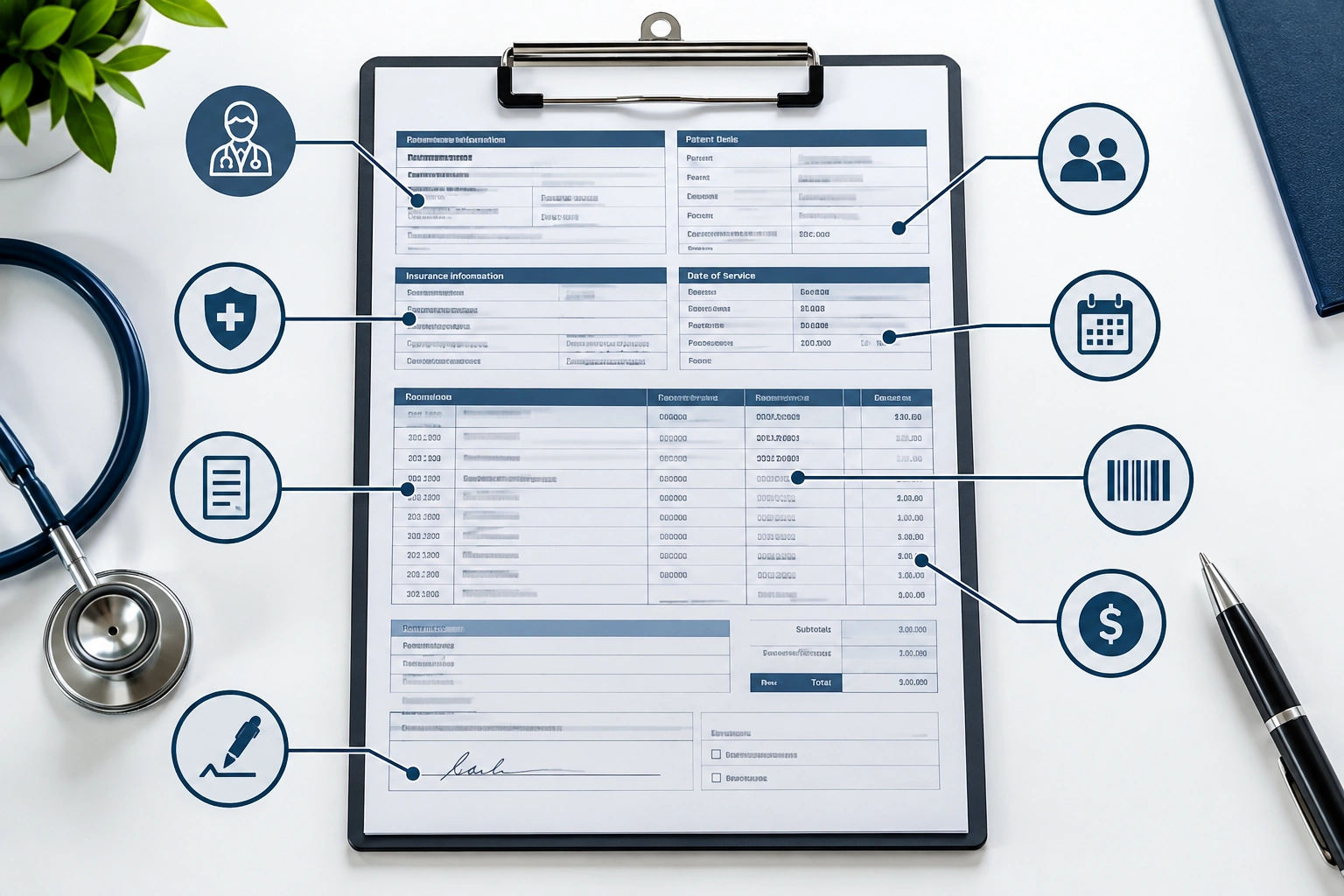
A complete superbill in medical billing generally includes the following:
- Provider information — practice name, address, the treating provider’s National Provider Identifier (NPI), and signature or credential line
- Patient and insurance information — name, date of birth, policy and subscriber details
- Date(s) of service — each visit or encounter listed separately
- CPT/HCPCS and ICD-10 codes — procedure codes paired with the diagnosis codes that justify them
- Fee per service line — the charge associated with each listed procedure
These superbill components are not optional extras; a payer reviewing a self-pay or out-of-network reimbursement request needs every field to evaluate medical necessity and process the claim. Our Medical Coding Services team frequently finds that missing or inconsistent fields — not the overall format — are what trigger the delays practices assume are unavoidable.
Who Relies on a Superbill — and Why It Matters in 2026
Superbills are most common among self-pay and cash-pay patients, and among practices seeing out-of-network patients who plan to file for out-of-network reimbursement themselves. Behavioral health, therapy (physical, occupational, and speech), chiropractic, and concierge-style primary care practices issue them regularly, since these specialties see a disproportionate share of self-pay and out-of-network visits. Related but separate federal protections apply here too: patients billed as self-pay or uninsured are also covered under the CMS Medical Bill Rights framework for cost estimates, distinct from the superbill itself. Because a superbill carries protected health information (PHI), your front-desk team must also handle it in line with HIPAA compliance standards for transmission and storage.
| Document | Who Submits It | Contains Coding Detail |
|---|---|---|
| Superbill | Patient (self-submits to insurer) | Yes |
| Insurance Claim Form (CMS-1500) | Provider/practice (via clearinghouse) | Yes |
| Receipt | N/A (payment confirmation only) | No |
Superbill in Medical Billing — 6 Costly Mistakes to Avoid
Most superbill mistakes are avoidable, but they are also common — and each one below can stall reimbursement, trigger medical claim denials, or create compliance exposure your practice did not anticipate. Understanding where the superbill process breaks down is the first step to fixing it.
1. Missing or Incorrect NPI and Provider Information
Claims are rejected outright when the treating provider’s National Provider Identifier is missing, mistyped, or belongs to the wrong rendering provider. In multi-provider practices, this happens more often than expected when staff default to a single “practice” NPI instead of confirming the individual who actually rendered the service. Payers use this field to verify provider credentialing before considering the rest of the claim, so an NPI error stops the review before it starts.
2. Mismatched CPT and ICD-10 Codes
A diagnosis code that fails to support medical necessity for the listed procedure code is one of the fastest paths to a denial. This is a frequent contributor to common medical coding mistakes practices see across specialties, not just superbills. The CMS overview of the CPT/HCPCS coding system outlines how procedure codes must align with supporting diagnoses, and CPT codes themselves remain maintained and copyrighted by the American Medical Association and licensed for use.

3. Incomplete Patient or Insurance Information
Missing policy numbers, subscriber name mismatches, and outdated demographic data stall reimbursement long before a claim ever reaches substantive review. Front-desk verification at check-in — rather than relying on whatever information is already on file — closes most of this gap before the visit ends.
4. Missing Provider Signature or Required Credentials
Many payers require a signature, physical or electronic, along with a credential designation on every superbill issued. Its absence is one of the easiest, most avoidable denial reasons a practice can eliminate simply by building the field into the workflow rather than treating it as optional paperwork.
5. Using a Superbill in Place of a Compliant Insurance Claim
A superbill is not a substitute for a properly formatted claim, such as the CMS-1500, when a practice is filing directly with a payer rather than handing documentation to the patient. Conflating the two is a structural error, not a clerical one, and it is a common driver of claim denials in medical billing when staff use one template for both purposes.
6. No Documentation Trail Behind the Superbill
A superbill unsupported by the clinical note behind it creates audit exposure even when the claim itself is ultimately paid. Reviewers and auditors expect the codes on a superbill to trace back to documented, medically necessary care — a gap here can surface long after the reimbursement has already been issued.
How to Create an Accurate, Compliant Superbill
Knowing how to create a superbill that holds up under payer review starts with standardizing one template across every provider in the practice, rather than allowing individual staff discretion to shape the format. Verify NPI and CPT/ICD-10 pairings before the visit concludes, and confirm patient and insurance details at check-in rather than waiting until billing. Require a signature or credential line on every superbill issued, with no exceptions for “quick” visits. Because superbills contain PHI, transmission and storage should also follow the HHS.gov overview of the HIPAA Privacy Rule. None of these steps require new software — most practices need only a documented checklist and a consistent review step before a superbill leaves the office.

How TMS Billings Helps Practices Get Superbills Right
Our approach centers on accurate CPT/ICD-10 pairing behind every line item, a documented audit trail your practice can point to during a denial or appeal, and a standardized superbill template built directly into your intake and coding workflow — not a generic services recap, but a direct response to the mistakes outlined above. This work sits alongside our broader Revenue Cycle Management support, since superbill accuracy is one component of a larger reimbursement cycle.
Consider a solo behavioral health practice issuing inconsistent, staff-drafted superbills for its out-of-network clients: a wave of denials tied to missing NPI fields followed, and the pattern resolved only after the practice adopted one standardized, coding-reviewed template used by every staff member.
Key Takeaways
- A superbill in medical billing is an itemized, provider-generated document — not a claim form and not a receipt.
- Required components include NPI, patient and insurance details, dates of service, CPT/ICD-10 codes, and per-line fees.
- Self-pay, out-of-network, and certain outpatient specialties rely on superbills most heavily.
- Missing NPIs, mismatched codes, and missing signatures are among the most common, avoidable superbill mistakes.
- A standardized template and a consistent review step reduce denials tied to superbill documentation.
Final Thoughts
Getting the superbill process right is not about paperwork for its own sake — it is about protecting your practice’s reimbursement timeline and your patients’ ability to recover what their plan actually covers. A superbill in medical billing cannot guarantee reimbursement, since that depends on each patient’s plan and out-of-network benefits, but a standardized, coding-reviewed template removes the avoidable errors that delay it. If your practice is still relying on ad hoc templates or inconsistent staff habits, our coding and compliance team can help you build a process that holds up. Book a Free Consultation to review your current superbill workflow.