It’s a fact that one can really thrive in medical billing, and if you are looking for a career in this field, you must be aware of some fundamental concepts. Medical billing is the process that makes sure your practice gets paid for your services. In medical billing, you’ll be filing and submitting claims to insurance companies. Sounds tricky, right? But hey, with this blog guide, I am aiming to make everything easier for you. So, let’s cover the basics of what is medical billing in detail, and by the end of this blog, you’ll be much more knowledgeable. Let’s get started.
What is Medical Billing?

Credit: neolytix.com
Never heard of this term? Simply put, medical billing is the process of submitting and following up on claims with health insurance companies to receive payment for services provided by healthcare providers. In simpler terms, it’s all about turning the care a patient receives into a financial transaction that ensures the provider gets paid.
Here’s how it works:
- After a patient’s visit, medical professionals submit claims to medical insurance and billing companies.
- The insurance reviews the claim and decides how much they will reimburse.
- The remaining balance may be billed to the patient.
In simplest terms, medical billing ensures that all parties involved—patients, healthcare providers, and insurance companies, are on the same page. It helps healthcare providers stay in business and ensures patients don’t get overcharged or left with unexpected bills.
Types of Medical Billing
Now that we know what is medical billing; let’s talk about types. Each provider and healthcare service demands a different type. There are several types of medical billing, each designed to handle different parts of the healthcare system. Let’s break them down:
Institutional Billing
The first common type, institutional billing, typically refers to hospital billing. Moreover, it includes services provided in a hospital or other large healthcare institution.
- Used for inpatient and outpatient services
- Bills for a variety of treatments and tests
- Includes charges for room, board, medications, and surgeries
Professional Billing
Professional billing is usually handled by individual healthcare providers, such as doctors, specialists, or dentists.
- Covers individual services like office visits or consultations
- Includes diagnostics and procedures provided by a healthcare professional
- Often managed using CPT codes for procedures
Dental Billing
The last type, and you might have heard about it as well. Dental billing focuses on the billing procedures related to dental care.
- Includes both preventive and surgical dental services
- Managed through specific dental codes (e.g., CDT codes)
- Often involves submitting claims to dental insurance companies
Medical Billing Process

Credit: tnpti.com
Wondering how it works? So, I must tell you, the medical billing process is quite detailed, with several key steps that ensure accurate billing and reimbursement. Understanding how it works helps ensure everything is processed correctly and on time.
Step 1: Patient Registration
Before any treatment occurs, the patient provides personal details, including insurance information. This is the first step in creating a record for billing.
- Collect personal and insurance info
- Verify eligibility with insurance companies
- Create a billing account for the patient
Step 2: Medical Coding
In the next step, after the service is provided, the medical billing company assigns the appropriate codes to the treatment or procedure. However, this is essential for processing insurance claims.
- Codes match treatments, diagnoses, and services
- Use ICD-10, CPT®, and HCPCS codes
- Helps to standardize the medical billing cycle
Step 3: Claim Submission
Once the coding is done, the medical billing team submits the claim to the insurance company. The insurance will review the claim and determine how much to pay.
- Submit claim through electronic systems or paper forms
- Ensure accuracy to avoid rejections
- Claims are tracked and followed up on
Step 4: Payment Posting
Once payment is received, the medical biller posts the payment to the patient’s account. This keeps the provider informed of what has been paid and what is still due.
- Apply payments to patient accounts
- Update outstanding balances
- Send patient bills for the remaining balance
Step 5: Account Follow-Up
And in the last step, if the insurance doesn’t pay or the claim is denied, a follow-up is needed. This may involve calling the insurance company to resolve issues or correcting mistakes in the claim.
- Review unpaid claims
- Contact insurance companies for updates
- Address coding or eligibility issues
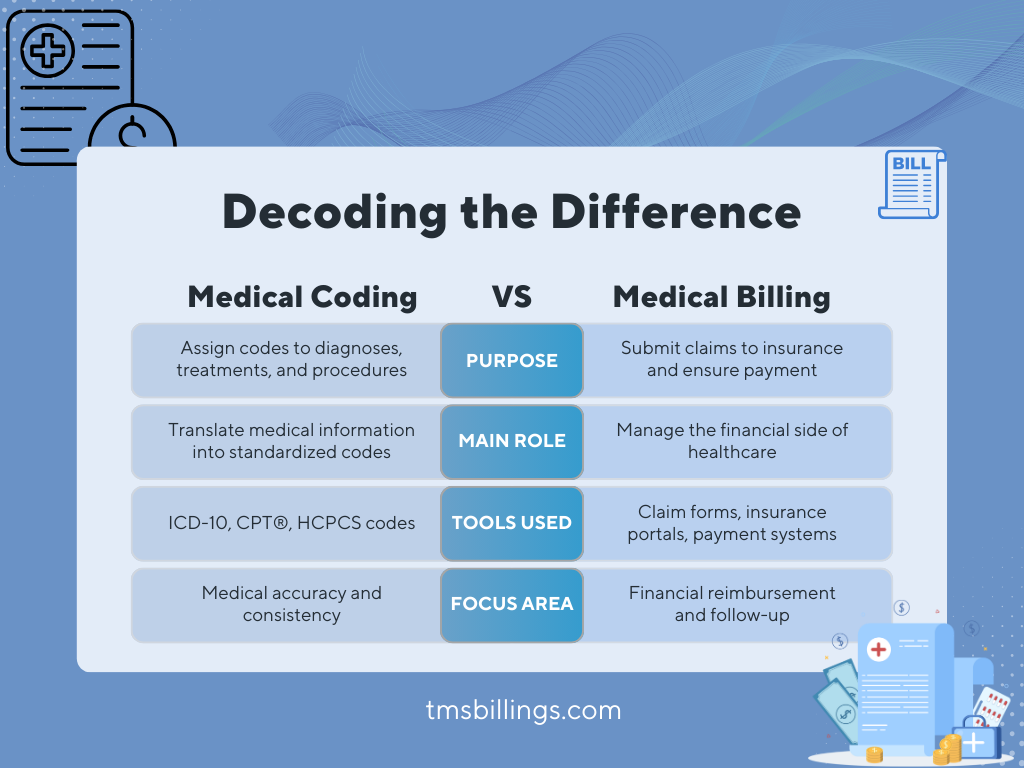
Coding vs. Billing
Here’s a quick comparison to clarify the difference between medical coding and medical billing:
Front-End vs. Back-End Billing
When it comes to medical billing, there are two main approaches: front-end and back-end billing. Each has its role in ensuring that the billing process is smooth.
Front-End Billing
Front-end billing focuses on the beginning of the medical billing cycle. It deals with the initial interactions with the patient.
- Verifying insurance details
- Collecting co-pays and deductibles
- Pre-authorization for certain treatments
Back-End Billing
Back-end billing occurs after the services have been provided and focuses on the claims process.
- Submitting claims to insurance companies
- Following up on unpaid or denied claims
- Posting payments to patient accounts
Benefits of Medical Billing
So, medical billing offers several benefits for healthcare providers and patients alike. Here are some of the top advantages:
- Efficient Reimbursement: Helps healthcare providers get paid faster. Moreover, it reduces the risk of errors in payments.
- Improved Cash Flow: With correct coding and timely billing, providers maintain steady cash flow.
- Compliance: Medical billing services ensure providers meet insurance and regulatory standards, reducing the risk of fines or audits.
- Cost-Effective: Outsourcing medical billing solutions can save providers money, as they don’t need to hire a full-time billing department.
- Patient Satisfaction: Streamlined billing processes reduce errors, helping to keep patients happy and avoiding billing disputes.
If you’re looking for reliable medical billing services, partnering with TMS Billing Services can help optimize your billing process, ensuring efficiency, compliance, and faster reimbursements.
Final Remarks
So, it all comes down to the fact that medical billing is a crucial part of the healthcare system. It ensures that healthcare providers are compensated for their services while also protecting patients from unexpected charges. By outsourcing to trusted medical billing companies like TMS Billing Services, you can ensure a smooth and efficient billing solution that minimizes errors and maximizes financial outcomes.
Frequently Asked Questions
Let’s clear up some of the confusion about medical billing.
What is medical billing?
In simple terms, medical billing is the process of submitting claims to insurance companies to ensure that healthcare providers get paid for their services.
What are the types of medical billing?
The main types are institutional, professional, and dental billing, each handling different aspects of healthcare services.
What’s the difference between medical coding and medical billing?
Medical coding involves assigning codes to diagnoses and procedures, while medical billing involves submitting claims for payment and managing reimbursements.
What is the role of medical billing in healthcare?
It ensures that healthcare providers receive payment for services provided while maintaining accurate financial records.
Can I outsource my medical billing?
Yes, many healthcare providers choose to outsource medical billing services to companies that specialize in this process to improve efficiency and accuracy.
Ready to Take the Stress Out of Medical Billing?
Don’t let complex billing processes slow down your practice or delay your payments. At TMS Billings, we specialize in accurate, efficient, and compliant medical billing solutions that help healthcare providers get paid faster and reduce administrative headaches.
👉 Contact TMS Billings today to streamline your billing process, minimize errors, and boost your revenue with our trusted medical billing services.