I know, medical coding and billing are often talked about together, especially when we discuss the ins and outs of a billing practice. But here’s the thing: they’re not the same thing, and understanding the difference is key. I used to work at a medical billing practice, and during my time there, I learned a lot about how these two concepts, while closely related, serve very different purposes. So, if you’ve ever wondered what exactly sets them apart or how they work together, you’re in the right place. Let’s break down the difference between billing and coding in simple terms!
What’s Medical Coding All About?

Credit: preppy.org
We will start with medical coding. If you’ve had a doctor’s visit, the provider writes down the details of your condition and treatment. Medical coders then go through these notes and assign codes based on the diagnosis, treatment, or services you received. These codes are from systems like ICD-10 (for diagnoses) and CPT (for procedures).
So, what does a medical coding specialist do?
- Reviews patient records and treatment notes.
- Assigns the correct ICD-10 and CPT codes.
- Ensures accurate documentation for billing and insurance purposes.
- Converts medical information into standardized codes for easier processing.
Think of it as translating medical info into a “code language” that medical billing agents and insurance companies understand.
The medical coding and medical billing process ensures that each diagnosis or procedure gets assigned the correct code for accurate billing. If you’re curious about the details of medical coding, check out our guide on what medical coding is to dive deeper into the process.
What Does Medical Billing Do?

Credit: demigos.com
Now, let’s talk about medical billing. After medical coders assign the right codes, medical billers take those codes and create a claim that’s sent to the insurance company for payment. This process ensures that healthcare providers get paid for the services they’ve delivered.
Medical billing specialists are responsible for submitting claims to insurance providers and ensuring the payment process goes smoothly. If a claim is denied, the medical billing agent will follow up to resolve any issues.
Essentially, medical billing and coding are all about accurately translating the services provided into claims that get processed for payment. And when we say medical coding analyst or medical coding assistant, we’re referring to roles that specifically handle the coding part, while medical billing specialists focus on payment processing.
How Do Billing and Coding Work Together?
Now that we’ve covered what medical billing and coding are all about, let’s dive into how they work together.
- Medical coders are like translators. They take the doctor’s notes and convert them into the correct medical codes.
- Medical billers then take these codes and submit them to the insurance companies to request payment.
Without the coder’s accurate codes, the medical billing specialist would have nothing to submit to insurance providers. Without the biller’s follow-up and claim submissions, the medical provider wouldn’t get paid. It’s a perfectly synced system!
If you’re looking into the medical billing business, it’s important to note that the efficiency of both billing and coding departments is key to running a successful practice.
Differences Between Medical Billing and Coding
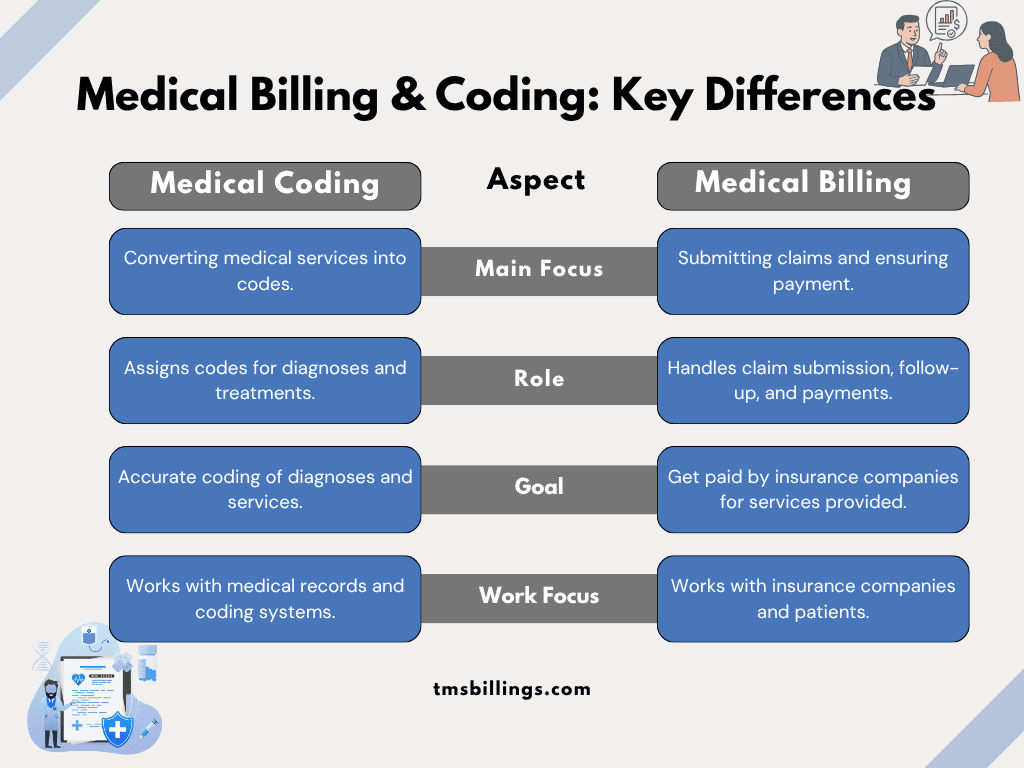
So, what is the difference between medical billing and coding in detail? Let’s break it down a little more clearly:
The Focus
Medical coding is about translating medical diagnoses and treatments into codes. It’s detailed and specific.
However, medical billing is all about processing claims and ensuring healthcare providers get paid for the services they’ve provided.
Where They Work
Medical coders work closely with doctors and medical records to assign codes based on patient treatment.
Medical billers work with insurance companies, patients, and healthcare providers to get claims processed and paid.
Skills Needed
A medical coding assistant needs to have a strong understanding of medical terminology, anatomy, and coding systems.
On the other hand, a medical billing agent needs excellent communication skills and a solid understanding of insurance policies and payment processing.
The Goal
The goal of coding is to ensure the correct services and diagnoses are captured.
And for billing, it is to ensure timely and accurate payment for those services.
Who’s Involved
Medical coding analysts often work with medical records, doctors, and clinical staff to assign proper codes.
Medical billing specialists work more closely with insurance companies, patients, and accounting departments to resolve payment issues.
Why Are Both So Important?
So, why do we need both medical billing and coding? Well, without accurate coding, the medical billing process falls apart. If the codes are wrong, the insurance company won’t know what to pay for, and the claim could be denied.
This is where getting the process right matters, and if you’re finding all this a bit overwhelming, we can help! If you want to make sure everything is handled correctly and efficiently, check out our medical billing services. We’re here to make sure your claims are accurate, timely, and get paid!
Ending Remarks
In a nutshell, learning the difference between medical billing and coding helps you see how each role contributes to the bigger picture in healthcare.
Frequently Asked Questions
What’s the difference between medical billing and coding?
Medical coding translates diagnoses and procedures into codes, while medical billing takes those codes and submits claims for payment.
Do medical coders need a certification?
Yes, certifications (like those from AAPC or AHIMA) are common and often required for medical coders to ensure quality work.
Can I do both medical billing and coding?
Yes! Many people take on both roles, especially in smaller practices, but larger organizations tend to separate the two jobs.
Why are medical coders important?
Medical coders ensure that diagnoses and treatments are accurately recorded and categorized, which prevents billing errors and denials.
What skills are needed for medical billing?
Medical billing agents need good organizational and communication skills, along with knowledge of insurance processes and claims management.